Half Plane Intersections Let H h 1 h

- Slides: 6
Half Plane Intersections • Let H = { h 1, h 2, …, hn} be the set of linear constraints in two variables: – aix + biy ci where ai, bi, and ci are constants such that at least one of ai +bi is non-zero – Geometrically: each constraint is closed half plane bounded by line aix + biy = ci
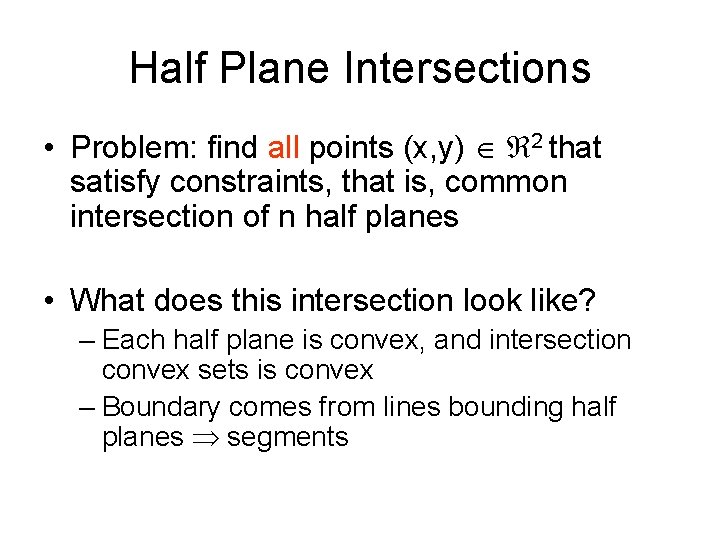
Half Plane Intersections • Problem: find all points (x, y) 2 that satisfy constraints, that is, common intersection of n half planes • What does this intersection look like? – Each half plane is convex, and intersection convex sets is convex – Boundary comes from lines bounding half planes segments
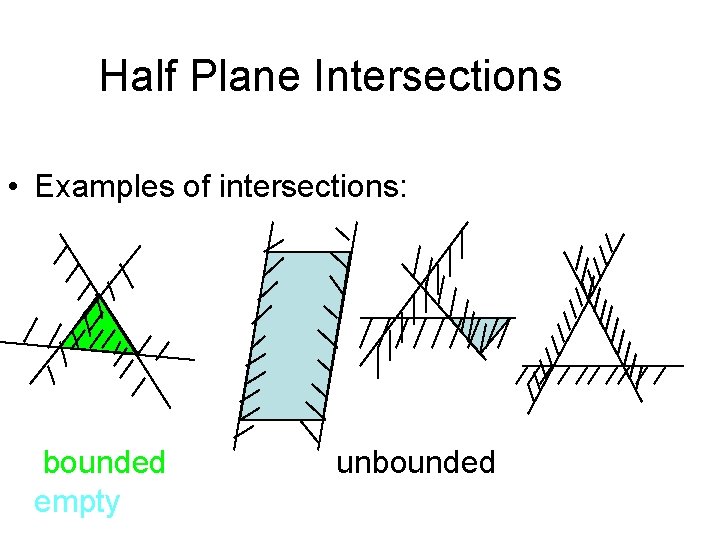
Half Plane Intersections • Examples of intersections: bounded empty unbounded
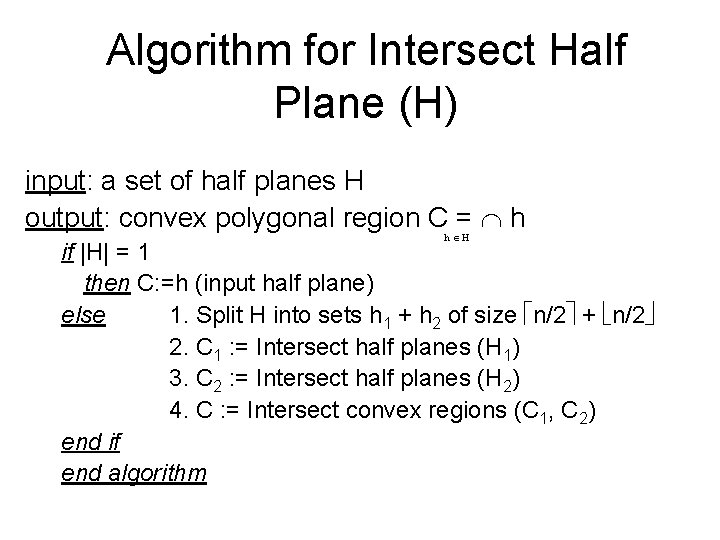
Algorithm for Intersect Half Plane (H) input: a set of half planes H output: convex polygonal region C = h h H if |H| = 1 then C: =h (input half plane) else 1. Split H into sets h 1 + h 2 of size n/2 + n/2 2. C 1 : = Intersect half planes (H 1) 3. C 2 : = Intersect half planes (H 2) 4. C : = Intersect convex regions (C 1, C 2) end if end algorithm
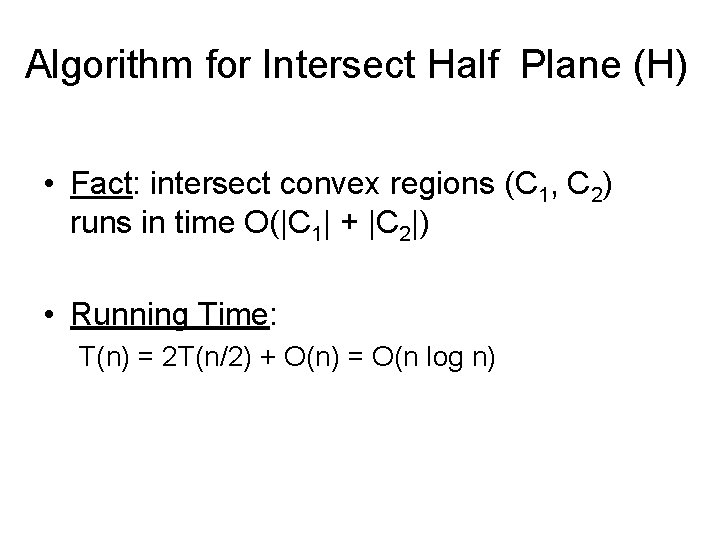
Algorithm for Intersect Half Plane (H) • Fact: intersect convex regions (C 1, C 2) runs in time O(|C 1| + |C 2|) • Running Time: T(n) = 2 T(n/2) + O(n) = O(n log n)
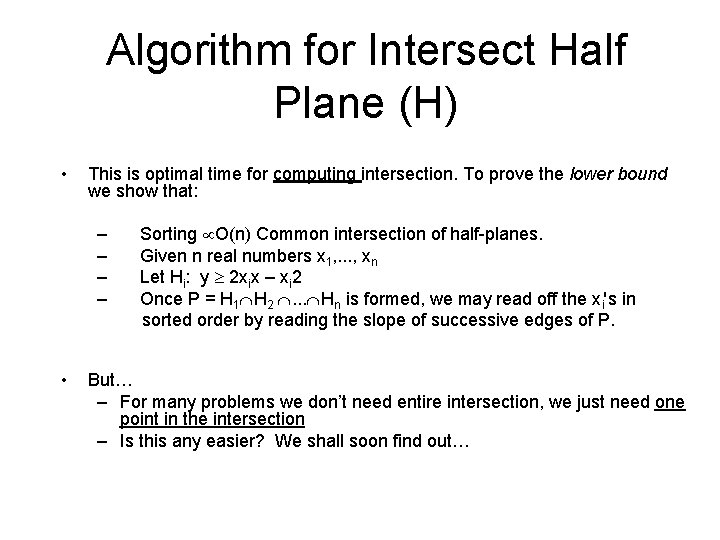
Algorithm for Intersect Half Plane (H) • This is optimal time for computing intersection. To prove the lower bound we show that: – – • Sorting O(n) Common intersection of half-planes. Given n real numbers x 1, . . . , xn Let Hi: y 2 xix – xi 2 Once P = H 1 H 2 . . . Hn is formed, we may read off the xi's in sorted order by reading the slope of successive edges of P. But… – For many problems we don’t need entire intersection, we just need one point in the intersection – Is this any easier? We shall soon find out…