Guide to Computer Forensics and Investigations Fourth Edition

- Slides: 18
Guide to Computer Forensics and Investigations Fourth Edition Chapter 6 Working with Windows and DOS Systems
Objectives • Describe Microsoft file structures • Explain the structure of File Allocation Table (FAT) disks • Explain the structure of New Technology File System (NTFS) disks Guide to Computer Forensics and Investigations 2
Microsoft File Structures • In Microsoft file structures, sectors are grouped to form clusters – Storage allocation units of one or more sectors • Clusters are typically 512, 1024, 2048, 4096, or more bytes each • Combining sectors minimizes the overhead of writing or reading files to a disk Guide to Computer Forensics and Investigations 3
Microsoft File Structures (continued) • Clusters are numbered sequentially starting at 2 – First sector of all disks contains a system area, the boot record, and a file structure database • OS assigns these cluster numbers, called logical addresses • Sector numbers are called physical addresses • Clusters and their addresses are specific to a logical disk drive, which is a disk partition Guide to Computer Forensics and Investigations 4
Examining FAT Disks • File Allocation Table (FAT) – File structure database that Microsoft originally designed for floppy disks – Used before Windows NT and 2000 • FAT database is typically written to a disk’s outermost track and contains: – Filenames, directory names, date and time stamps, the starting cluster number, and file attributes • FAT versions – FAT 12, FAT 16, FAT 32, and VFAT Guide to Computer Forensics and Investigations 5
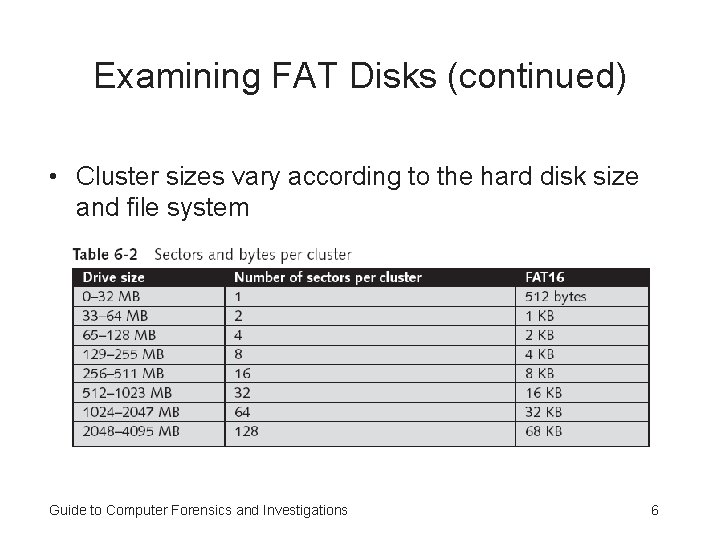
Examining FAT Disks (continued) • Cluster sizes vary according to the hard disk size and file system Guide to Computer Forensics and Investigations 6
Examining FAT Disks (continued) • Microsoft OSs allocate disk space for files by clusters – Results in drive slack • Unused space in a cluster between the end of an active file and the end of the cluster • Drive slack includes: – RAM slack and file slack • An unintentional side effect of FAT 16 having large clusters was that it reduced fragmentation – As cluster size increased Guide to Computer Forensics and Investigations 7
Examining FAT Disks (continued) Guide to Computer Forensics and Investigations 8
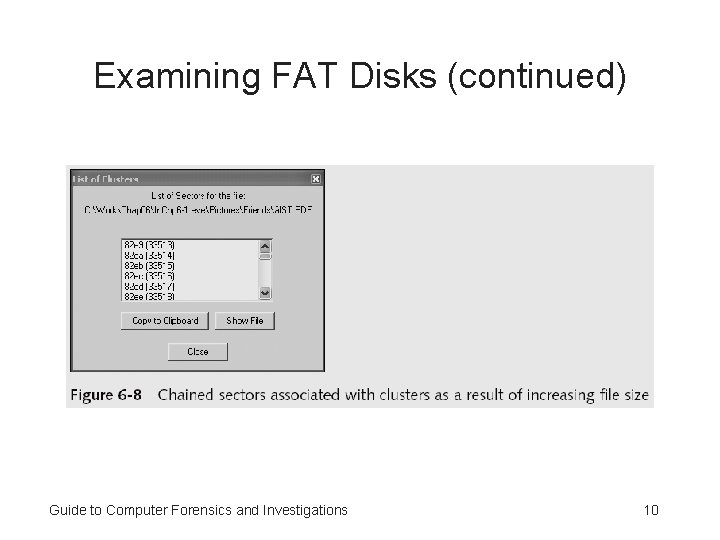
Examining FAT Disks (continued) • When you run out of room for an allocated cluster – OS allocates another cluster for your file, which creates more slack space on the disk • As files grow and require more disk space, assigned clusters are chained together – The chain can be broken or fragmented Guide to Computer Forensics and Investigations 9
Examining FAT Disks (continued) Guide to Computer Forensics and Investigations 10
Examining FAT Disks (continued) • When the OS stores data in a FAT file system, it assigns a starting cluster position to a file – Data for the file is written to the first sector of the first assigned cluster • When this first assigned cluster is filled and runs out of room – FAT assigns the next available cluster to the file • If the next available cluster isn’t contiguous to the current cluster – File becomes fragmented Guide to Computer Forensics and Investigations 11
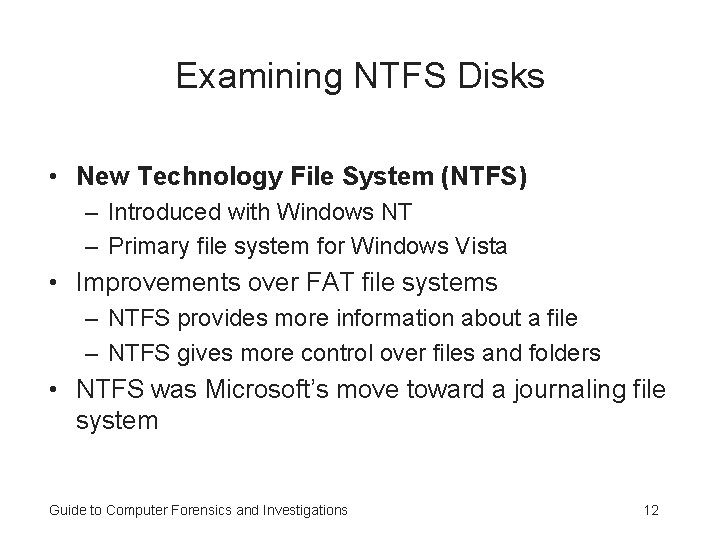
Examining NTFS Disks • New Technology File System (NTFS) – Introduced with Windows NT – Primary file system for Windows Vista • Improvements over FAT file systems – NTFS provides more information about a file – NTFS gives more control over files and folders • NTFS was Microsoft’s move toward a journaling file system Guide to Computer Forensics and Investigations 12
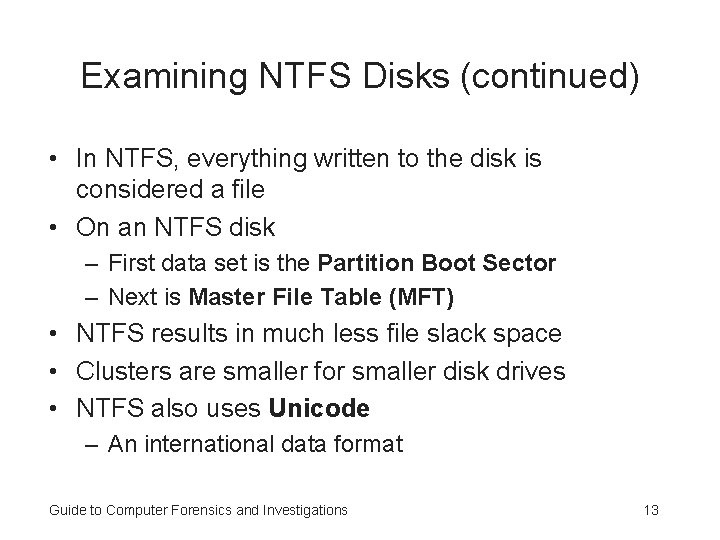
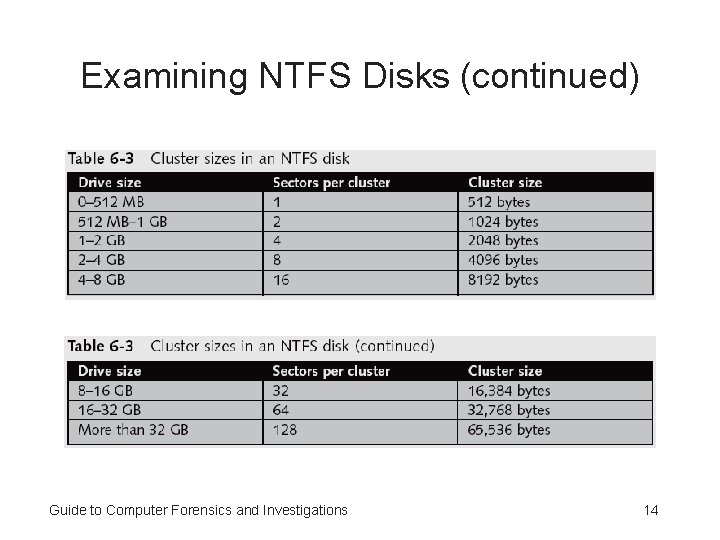
Examining NTFS Disks (continued) • In NTFS, everything written to the disk is considered a file • On an NTFS disk – First data set is the Partition Boot Sector – Next is Master File Table (MFT) • NTFS results in much less file slack space • Clusters are smaller for smaller disk drives • NTFS also uses Unicode – An international data format Guide to Computer Forensics and Investigations 13
Examining NTFS Disks (continued) Guide to Computer Forensics and Investigations 14
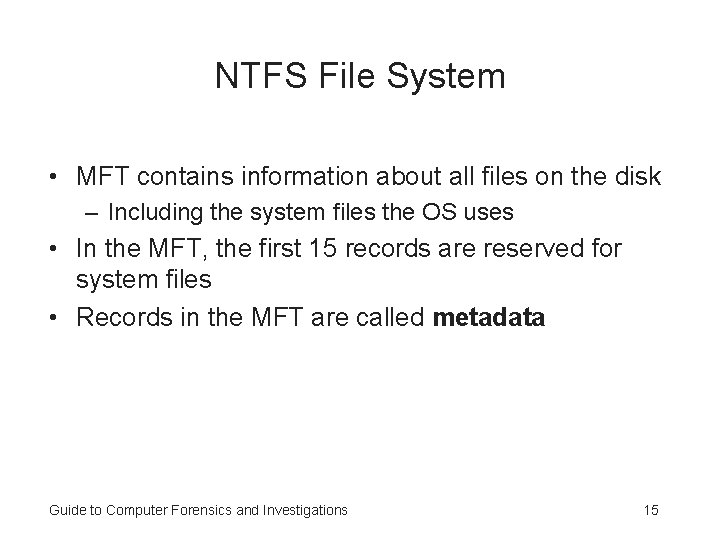
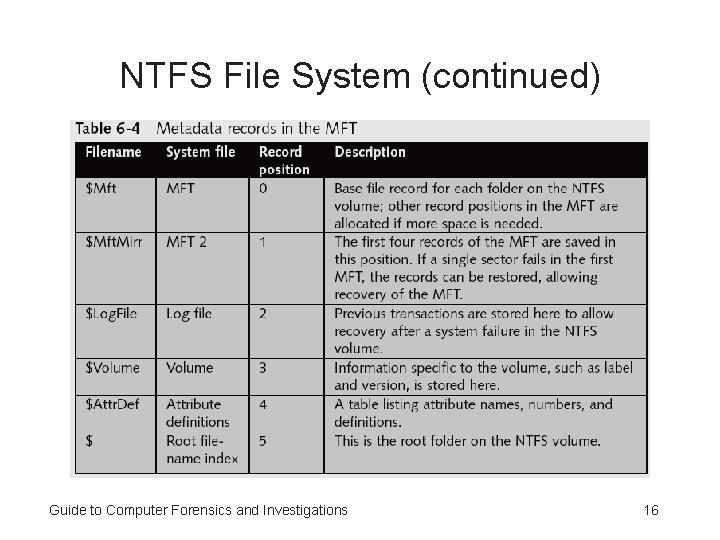
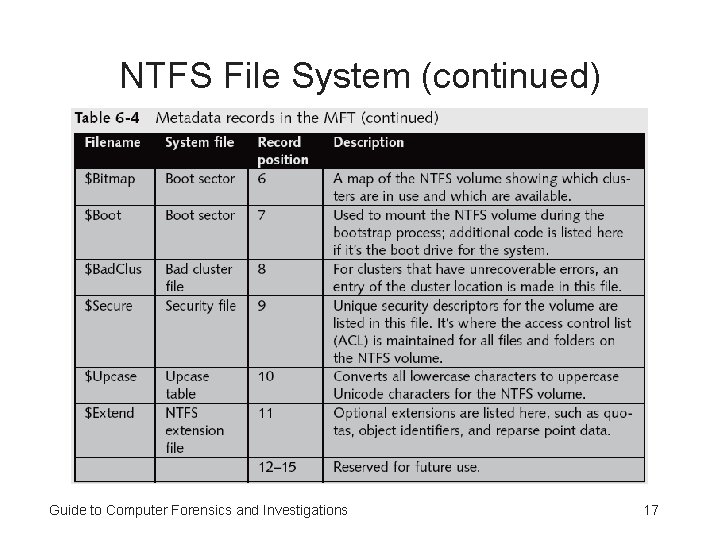
NTFS File System • MFT contains information about all files on the disk – Including the system files the OS uses • In the MFT, the first 15 records are reserved for system files • Records in the MFT are called metadata Guide to Computer Forensics and Investigations 15
NTFS File System (continued) Guide to Computer Forensics and Investigations 16
NTFS File System (continued) Guide to Computer Forensics and Investigations 17
Summary • Microsoft used FAT 12 and FAT 16 on older operating systems • New Technology File System (NTFS) is more versatile because it uses the Master File Table (MFT) to track file information Guide to Computer Forensics and Investigations 18