Go to Market Proposal for Ionic Materials Gian
- Slides: 4
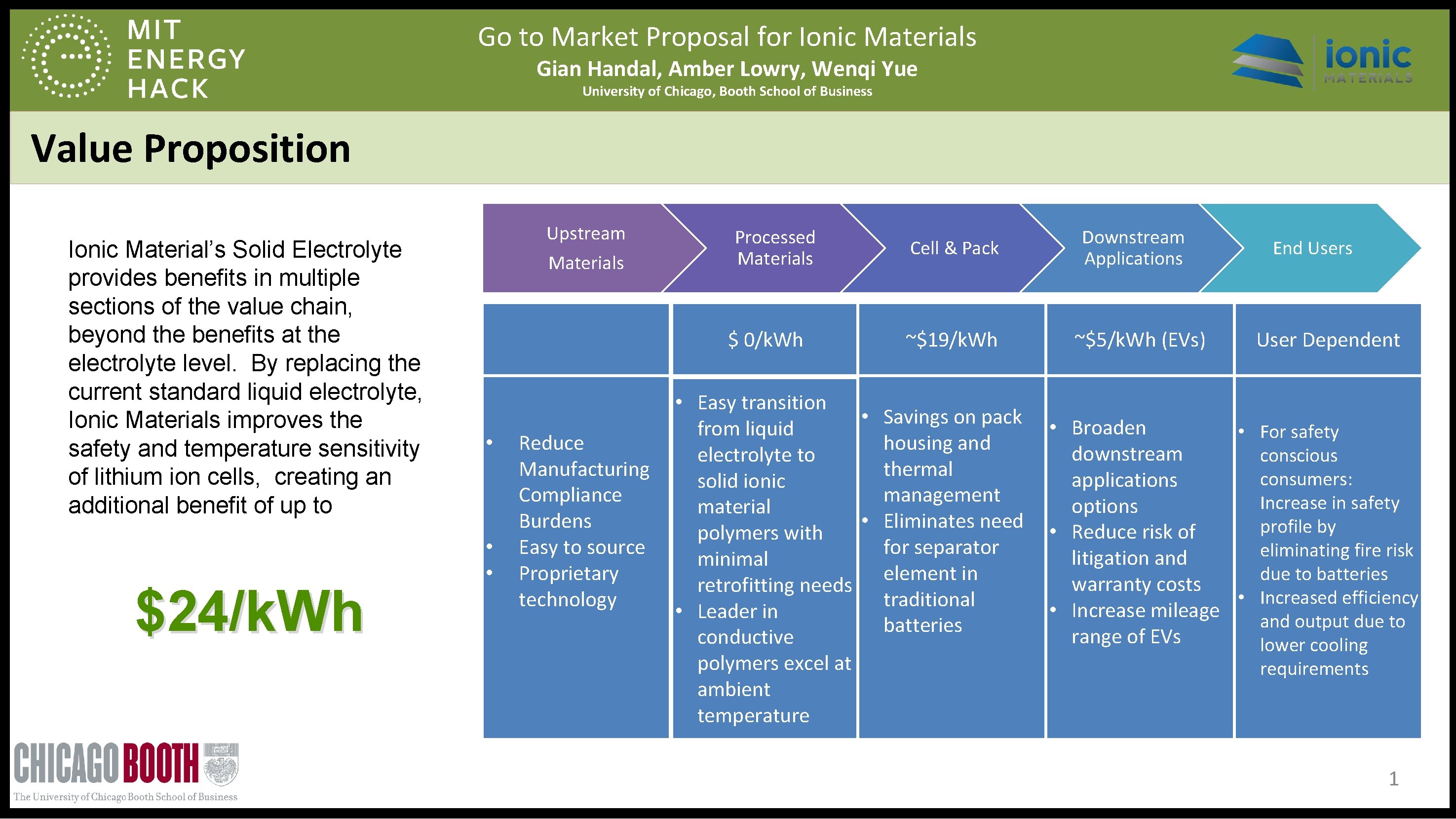
Go to Market Proposal for Ionic Materials Gian Handal, Amber Lowry, Wenqi Yue University of Chicago, Booth School of Business Value Proposition Ionic Material’s Solid Electrolyte provides benefits in multiple sections of the value chain, beyond the benefits at the electrolyte level. By replacing the current standard liquid electrolyte, Ionic Materials improves the safety and temperature sensitivity of lithium ion cells, creating an additional benefit of up to $24/k. Wh Upstream Materials Processed Materials $ 0/k. Wh • • • Reduce Manufacturing Compliance Burdens Easy to source Proprietary technology Cell & Pack ~$19/k. Wh • Easy transition • Savings on pack from liquid housing and electrolyte to thermal solid ionic management material • Eliminates need polymers with for separator minimal element in retrofitting needs traditional • Leader in batteries conductive polymers excel at ambient temperature Downstream Applications ~$5/k. Wh (EVs) End Users User Dependent • Broaden • For safety downstream conscious consumers: applications Increase in safety options profile by • Reduce risk of eliminating fire risk litigation and due to batteries warranty costs • Increased efficiency • Increase mileage and output due to range of EVs lower cooling requirements 1
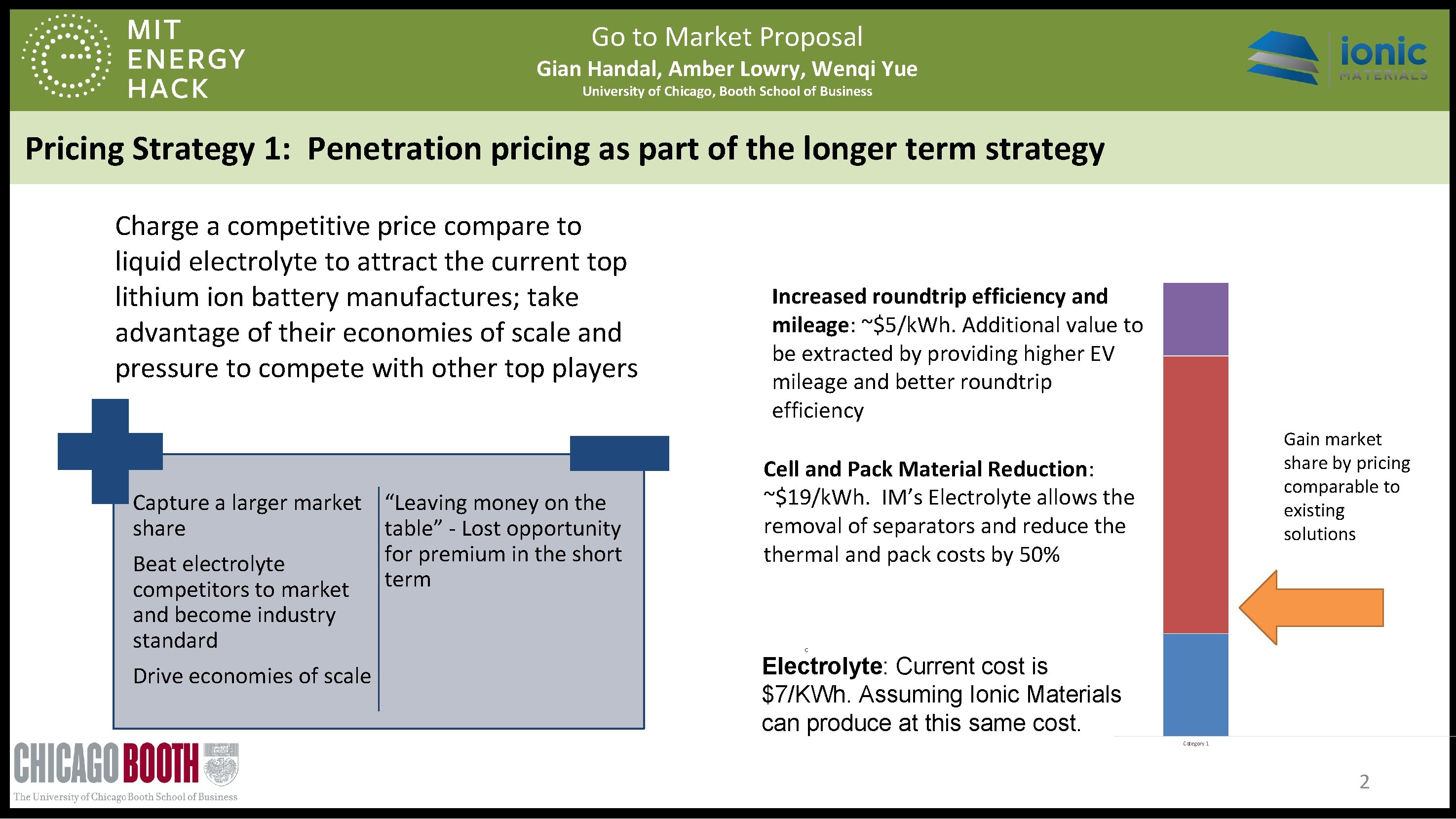
Go to Market Proposal Gian Handal, Amber Lowry, Wenqi Yue University of Chicago, Booth School of Business Pricing Strategy 1: Penetration pricing as part of the longer term strategy Charge a competitive price compare to liquid electrolyte to attract the current top lithium ion battery manufactures; take advantage of their economies of scale and pressure to compete with other top players Capture a larger market “Leaving money on the share table” - Lost opportunity for premium in the short Beat electrolyte term competitors to market and become industry standard Drive economies of scale Increased roundtrip efficiency and mileage: ~$5/k. Wh. Additional value to be extracted by providing higher EV mileage and better roundtrip efficiency Gain market share by pricing comparable to existing solutions Cell and Pack Material Reduction: ~$19/k. Wh. IM’s Electrolyte allows the removal of separators and reduce thermal and pack costs by 50% C Electrolyte: Current cost is $7/KWh. Assuming Ionic Materials can produce at this same cost. Category 1 2
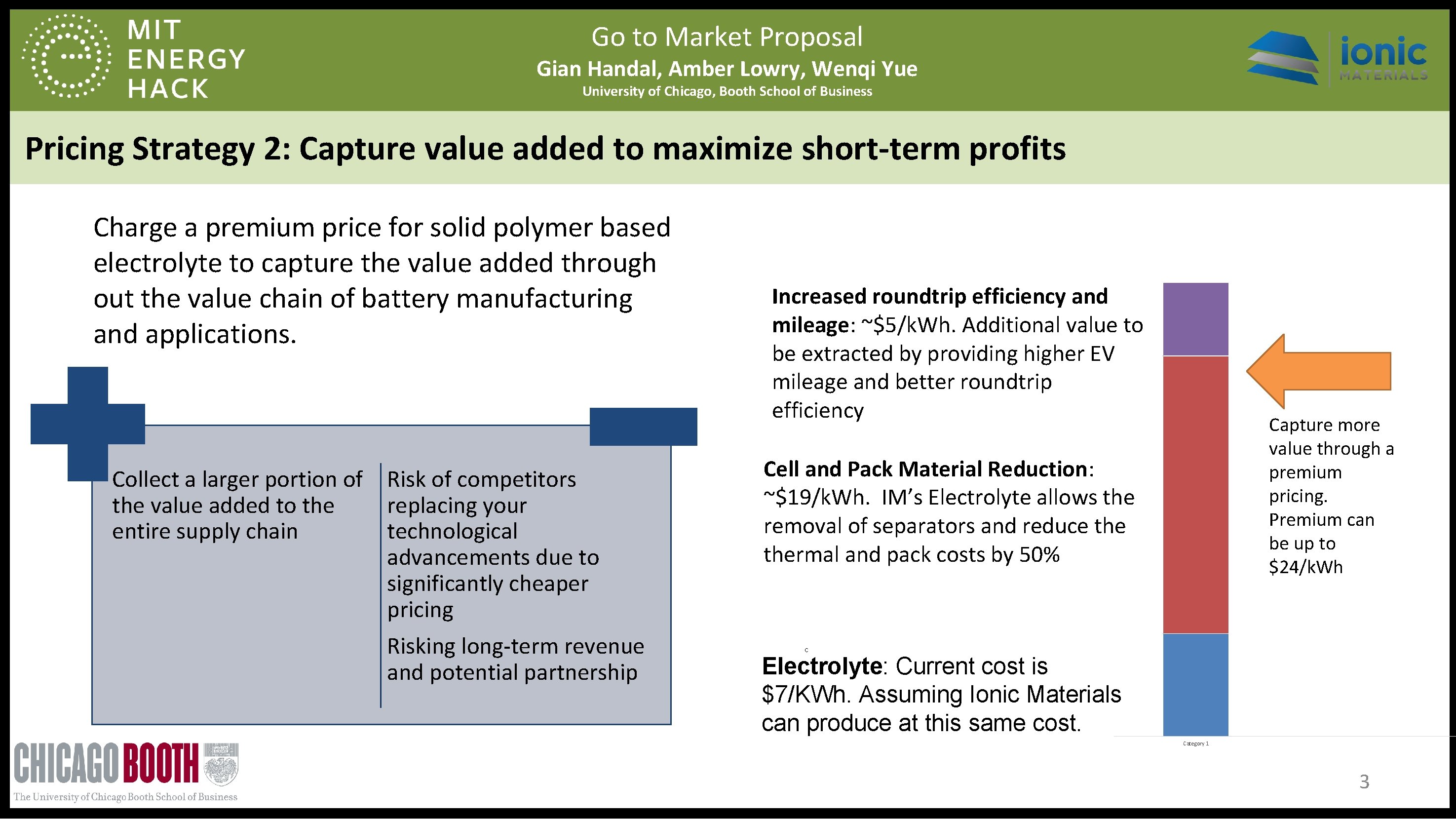
Go to Market Proposal Gian Handal, Amber Lowry, Wenqi Yue University of Chicago, Booth School of Business Pricing Strategy 2: Capture value added to maximize short-term profits Charge a premium price for solid polymer based electrolyte to capture the value added through out the value chain of battery manufacturing and applications. Collect a larger portion of Risk of competitors the value added to the replacing your entire supply chain technological advancements due to significantly cheaper pricing Risking long-term revenue and potential partnership Increased roundtrip efficiency and mileage: ~$5/k. Wh. Additional value to be extracted by providing higher EV mileage and better roundtrip efficiency Capture more value through a premium pricing. Premium can be up to $24/k. Wh Cell and Pack Material Reduction: ~$19/k. Wh. IM’s Electrolyte allows the removal of separators and reduce thermal and pack costs by 50% C Electrolyte: Current cost is $7/KWh. Assuming Ionic Materials can produce at this same cost. Category 1 3
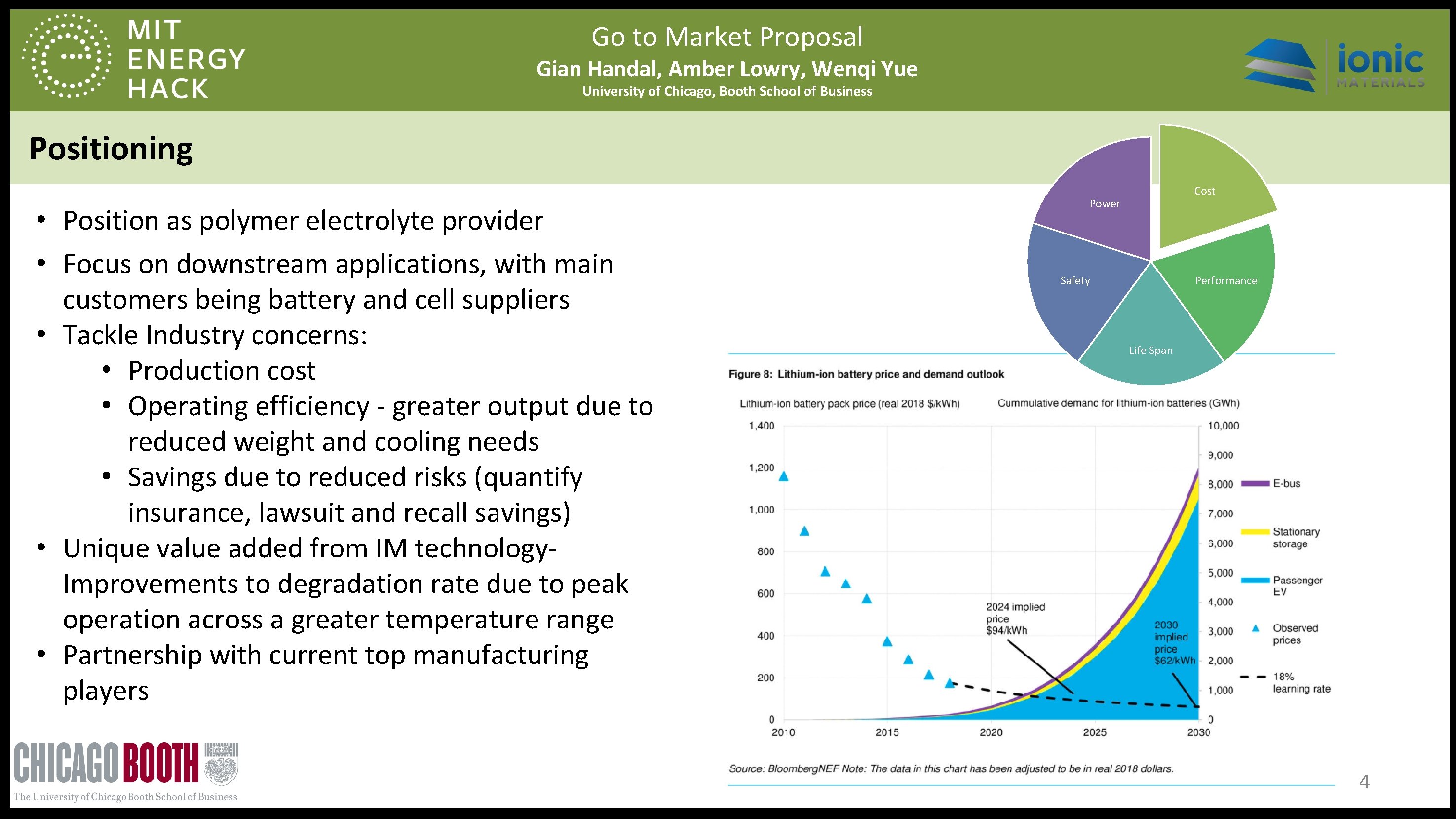
Go to Market Proposal Gian Handal, Amber Lowry, Wenqi Yue University of Chicago, Booth School of Business Positioning • Position as polymer electrolyte provider • Focus on downstream applications, with main customers being battery and cell suppliers • Tackle Industry concerns: • Production cost • Operating efficiency - greater output due to reduced weight and cooling needs • Savings due to reduced risks (quantify insurance, lawsuit and recall savings) • Unique value added from IM technology. Improvements to degradation rate due to peak operation across a greater temperature range • Partnership with current top manufacturing players Cost Power Safety Performance Life Span 4