Flex A fast Lexical Analyzer Generator CSE 470

- Slides: 10
Flex: A fast Lexical Analyzer Generator CSE 470: Spring 2000 Updated by Prasad
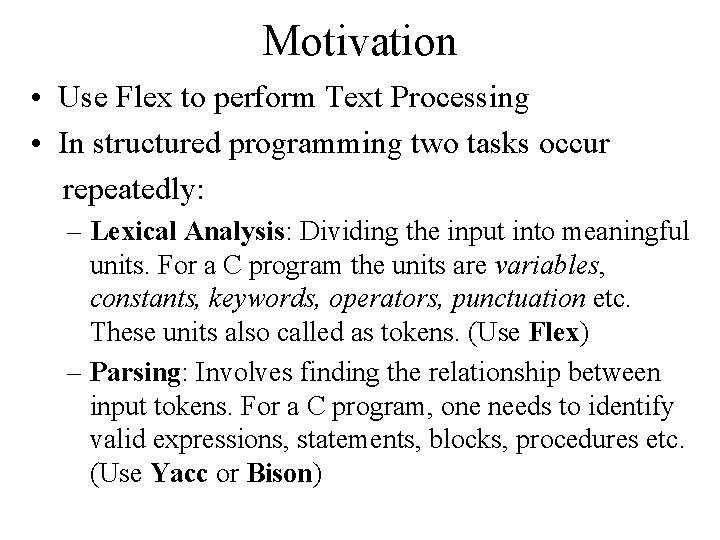
Motivation • Use Flex to perform Text Processing • In structured programming two tasks occur repeatedly: – Lexical Analysis: Dividing the input into meaningful units. For a C program the units are variables, constants, keywords, operators, punctuation etc. These units also called as tokens. (Use Flex) – Parsing: Involves finding the relationship between input tokens. For a C program, one needs to identify valid expressions, statements, blocks, procedures etc. (Use Yacc or Bison)
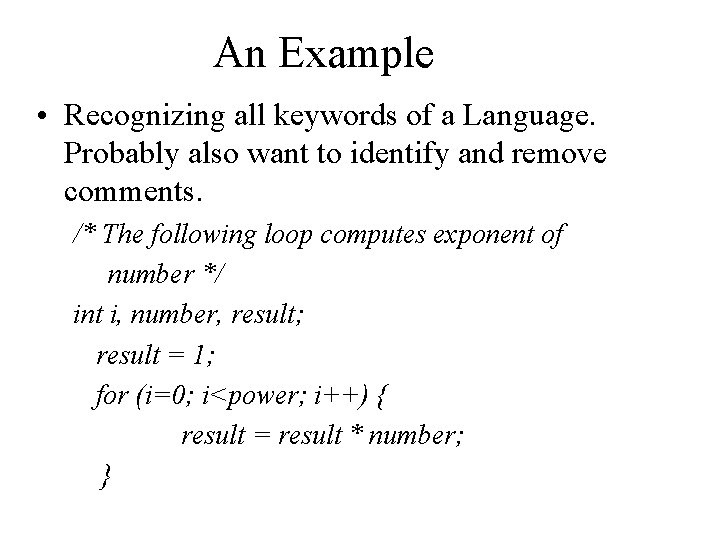
An Example • Recognizing all keywords of a Language. Probably also want to identify and remove comments. /* The following loop computes exponent of number */ int i, number, result; result = 1; for (i=0; i<power; i++) { result = result * number; }
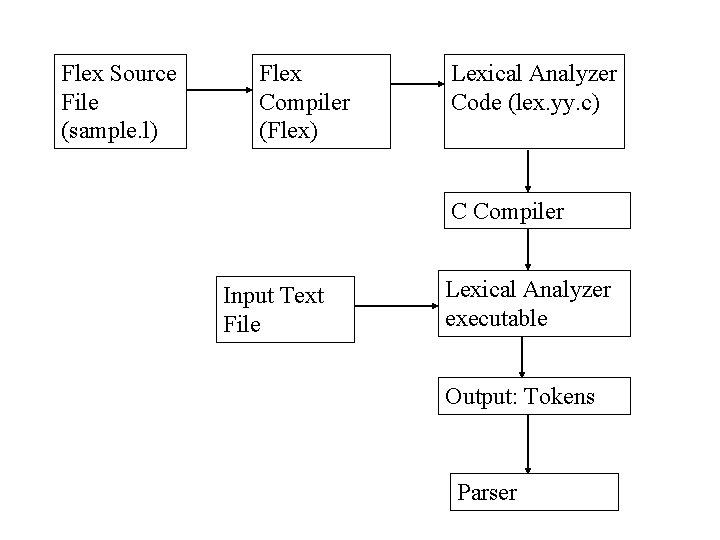
About Flex • Flex: Fast Lexical Analyzer Generator. • Produces Lexical Analyzers in a fast and easy manner. • Given a Flex source file, Flex generates an output C source code file lex. yy. c which defines the scanning routine yylex(). • Flex source file (say sample. l) should contain rules for identifying tokens in the input.
Flex Source File (sample. l) Flex Compiler (Flex) Lexical Analyzer Code (lex. yy. c) C Compiler Input Text File Lexical Analyzer executable Output: Tokens Parser
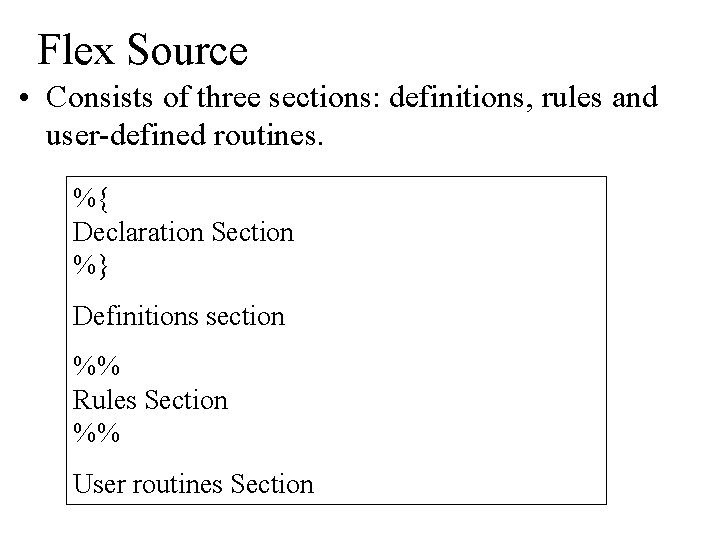
Flex Source • Consists of three sections: definitions, rules and user-defined routines. %{ Declaration Section %} Definitions section %% Rules Section %% User routines Section
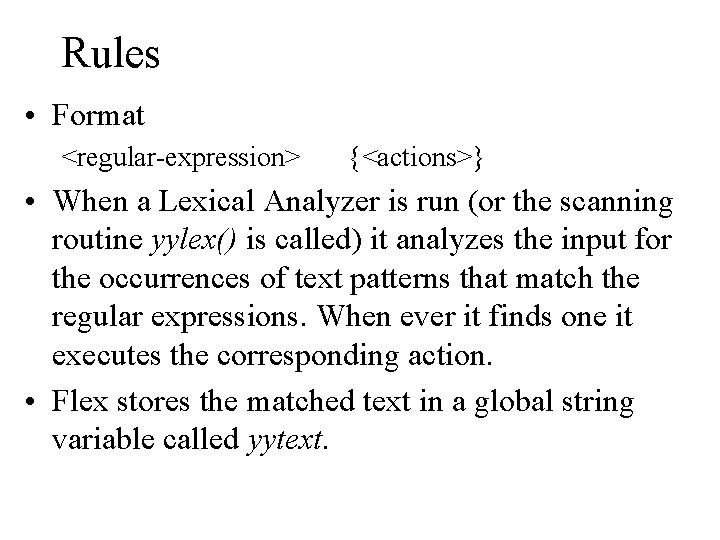
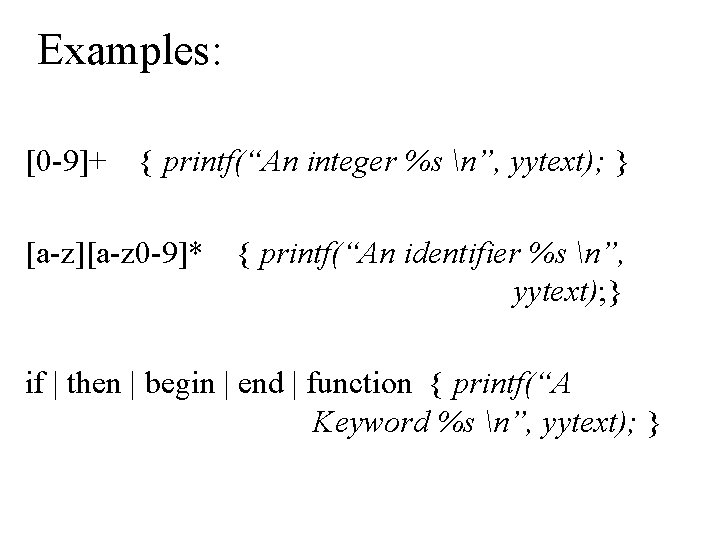
Rules • Format <regular-expression> {<actions>} • When a Lexical Analyzer is run (or the scanning routine yylex() is called) it analyzes the input for the occurrences of text patterns that match the regular expressions. When ever it finds one it executes the corresponding action. • Flex stores the matched text in a global string variable called yytext.
Examples: [0 -9]+ { printf(“An integer %s n”, yytext); } [a-z][a-z 0 -9]* { printf(“An identifier %s n”, yytext); } if | then | begin | end | function { printf(“A Keyword %s n”, yytext); }
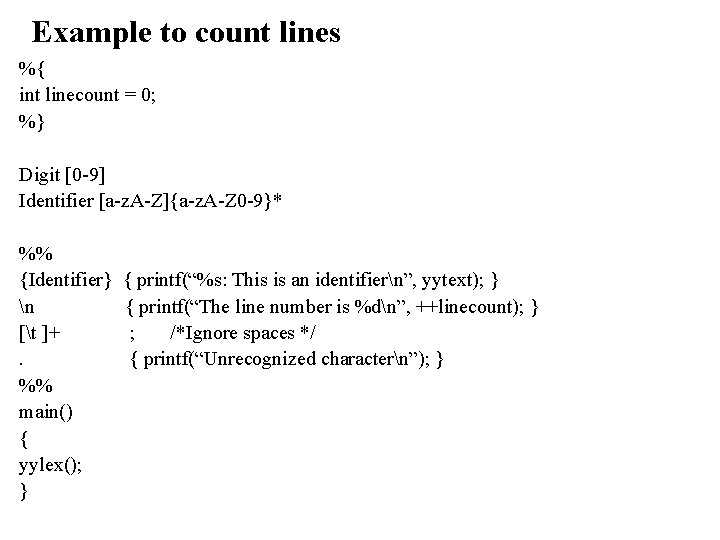
Example to count lines %{ int linecount = 0; %} Digit [0 -9] Identifier [a-z. A-Z]{a-z. A-Z 0 -9}* %% {Identifier} n [t ]+. %% main() { yylex(); } { printf(“%s: This is an identifiern”, yytext); } { printf(“The line number is %dn”, ++linecount); } ; /*Ignore spaces */ { printf(“Unrecognized charactern”); }
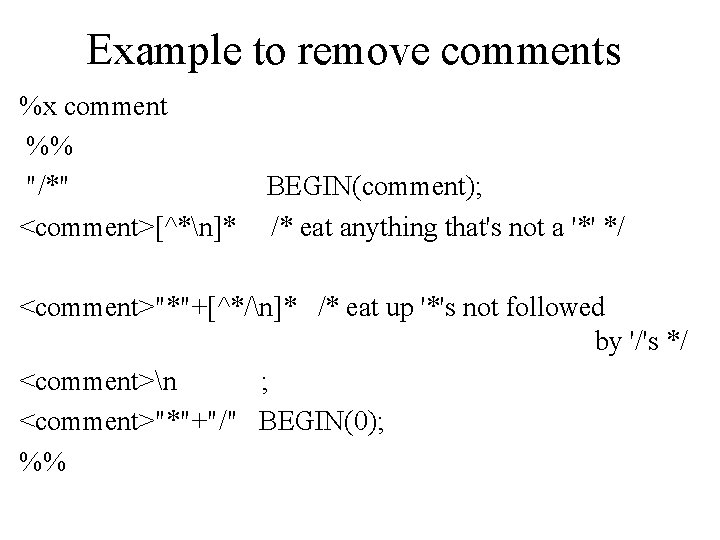
Example to remove comments %x comment %% "/*" <comment>[^*n]* BEGIN(comment); /* eat anything that's not a '*' */ <comment>"*"+[^*/n]* /* eat up '*'s not followed by '/'s */ <comment>n ; <comment>"*"+"/" BEGIN(0); %%