FINANCIAL REPORTING CENTRE CAPITAL MARKETS AUTHORITY SEMINAR ON
- Slides: 24
FINANCIAL REPORTING CENTRE CAPITAL MARKETS AUTHORITY SEMINAR ON REGULATORY COMPLIANCE AND EMERGING FRAUD RISKS IN THE CAPITAL MARKET 4 TH MAY, 2016 REPORTING OF SUSPICIOUS TRANSACTION REPORTS Presented by Patrick T. Mugo HEAD OF ANALYSIS
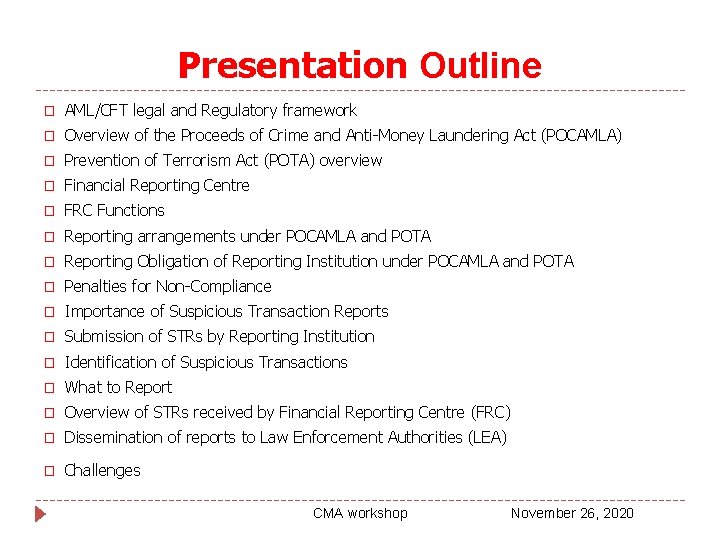
Presentation Outline � AML/CFT legal and Regulatory framework � Overview of the Proceeds of Crime and Anti-Money Laundering Act (POCAMLA) � Prevention of Terrorism Act (POTA) overview � Financial Reporting Centre � FRC Functions � Reporting arrangements under POCAMLA and POTA � Reporting Obligation of Reporting Institution under POCAMLA and POTA � Penalties for Non-Compliance � Importance of Suspicious Transaction Reports � Submission of STRs by Reporting Institution � Identification of Suspicious Transactions � What to Report � Overview of STRs received by Financial Reporting Centre (FRC) � Dissemination of reports to Law Enforcement Authorities (LEA) � Challenges CMA workshop November 26, 2020
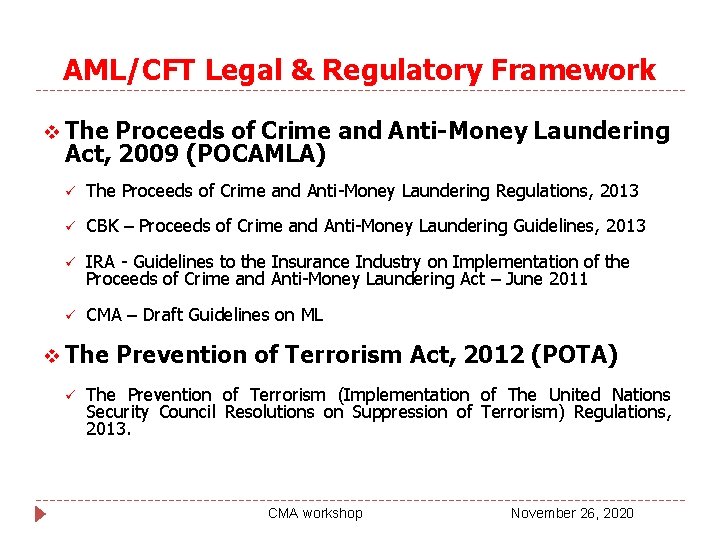
AML/CFT Legal & Regulatory Framework v The Proceeds of Crime and Anti-Money Laundering Act, 2009 (POCAMLA) ü The Proceeds of Crime and Anti-Money Laundering Regulations, 2013 ü CBK – Proceeds of Crime and Anti-Money Laundering Guidelines, 2013 ü IRA - Guidelines to the Insurance Industry on Implementation of the Proceeds of Crime and Anti-Money Laundering Act – June 2011 ü CMA – Draft Guidelines on ML v The ü Prevention of Terrorism Act, 2012 (POTA) The Prevention of Terrorism (Implementation of The United Nations Security Council Resolutions on Suppression of Terrorism) Regulations, 2013. CMA workshop November 26, 2020
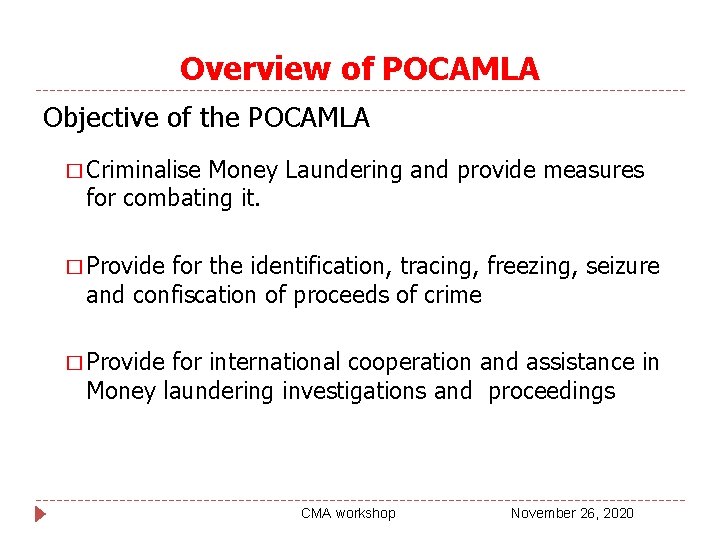
Overview of POCAMLA Objective of the POCAMLA � Criminalise Money Laundering and provide measures for combating it. � Provide for the identification, tracing, freezing, seizure and confiscation of proceeds of crime � Provide for international cooperation and assistance in Money laundering investigations and proceedings CMA workshop November 26, 2020
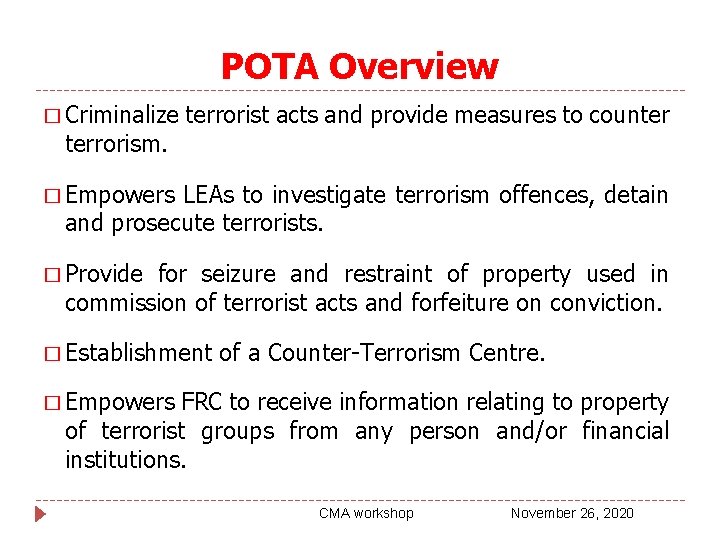
POTA Overview � Criminalize terrorism. terrorist acts and provide measures to counter � Empowers LEAs to investigate terrorism offences, detain and prosecute terrorists. � Provide for seizure and restraint of property used in commission of terrorist acts and forfeiture on conviction. � Establishment of a Counter-Terrorism Centre. � Empowers FRC to receive information relating to property of terrorist groups from any person and/or financial institutions. CMA workshop November 26, 2020
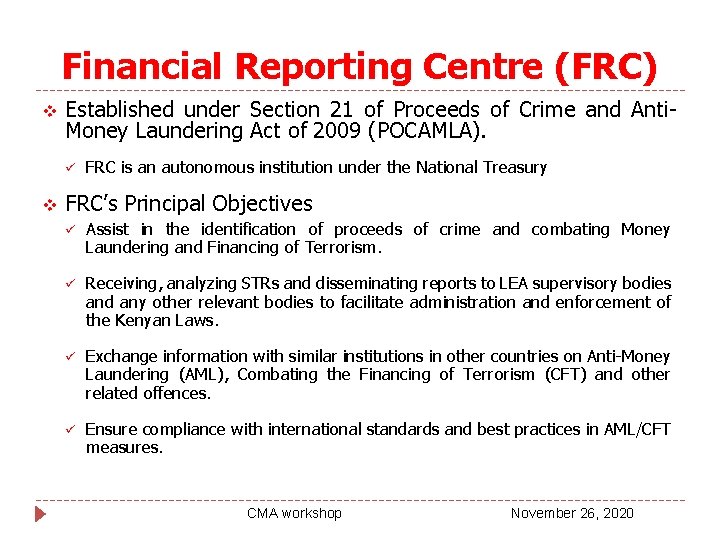
Financial Reporting Centre (FRC) v Established under Section 21 of Proceeds of Crime and Anti. Money Laundering Act of 2009 (POCAMLA). ü v FRC is an autonomous institution under the National Treasury FRC’s Principal Objectives ü Assist in the identification of proceeds of crime and combating Money Laundering and Financing of Terrorism. ü Receiving, analyzing STRs and disseminating reports to LEA supervisory bodies and any other relevant bodies to facilitate administration and enforcement of the Kenyan Laws. ü Exchange information with similar institutions in other countries on Anti-Money Laundering (AML), Combating the Financing of Terrorism (CFT) and other related offences. ü Ensure compliance with international standards and best practices in AML/CFT measures. CMA workshop November 26, 2020
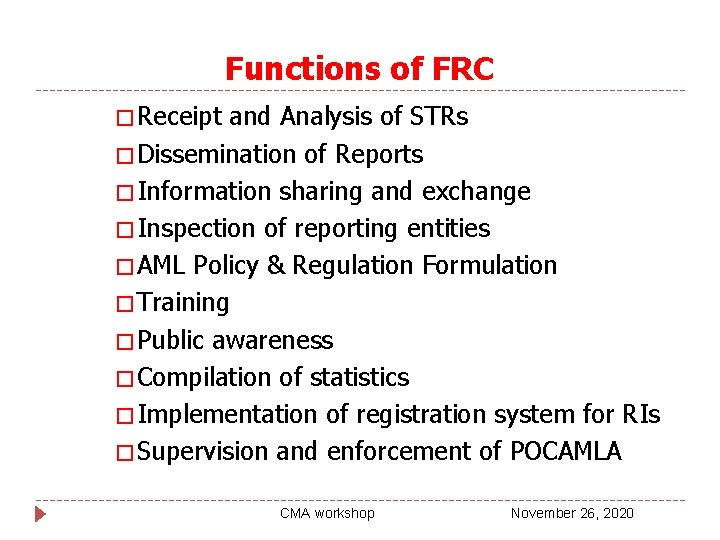
Functions of FRC � Receipt and Analysis of STRs � Dissemination of Reports � Information sharing and exchange � Inspection of reporting entities � AML Policy & Regulation Formulation � Training � Public awareness � Compilation of statistics � Implementation of registration system for RIs � Supervision and enforcement of POCAMLA CMA workshop November 26, 2020
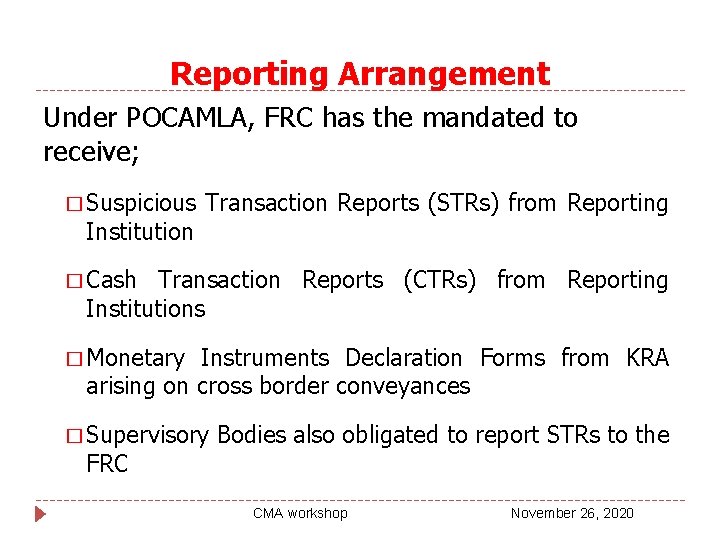
Reporting Arrangement Under POCAMLA, FRC has the mandated to receive; � Suspicious Institution Transaction Reports (STRs) from Reporting � Cash Transaction Reports (CTRs) from Reporting Institutions � Monetary Instruments Declaration Forms from KRA arising on cross border conveyances � Supervisory FRC Bodies also obligated to report STRs to the CMA workshop November 26, 2020
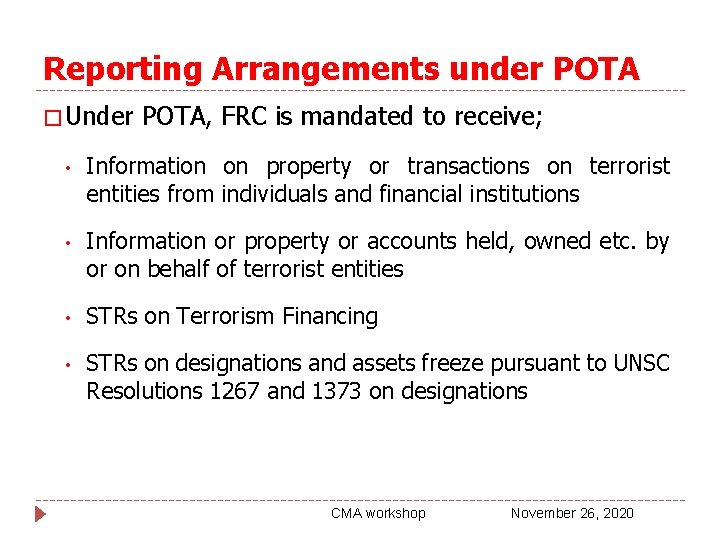
Reporting Arrangements under POTA � Under POTA, FRC is mandated to receive; • Information on property or transactions on terrorist entities from individuals and financial institutions • Information or property or accounts held, owned etc. by or on behalf of terrorist entities • STRs on Terrorism Financing • STRs on designations and assets freeze pursuant to UNSC Resolutions 1267 and 1373 on designations CMA workshop November 26, 2020
Reporting Obligations of Reporting Institutions under POCAMLA To monitor and report suspected ML activity– S. 44 ü ü ü Monitor on an on-going basis-complex, unusual, large transactions whether complete or not Report to the FRC all suspicious transactions including attempted transactions within seven days in the prescribed form. RI to examine background and purpose of transaction and shall record its findings in writing. Findings to be retained by RI for 7 years and availed to the FRC, supervisory body and auditors. File Cash Transaction Reports (CTRs) equivalent to or exceeding USD 10, 000. STRs filed with the FRC to be accompanied by all relevant documentation FRC may call for further particulars or documentation on the STRs submitted by Reporting Institutions. CMA workshop November 26, 2020
Penalties Under POCAMLA � S. 11 ü ü ü - Failure to comply with requirements relating to: Monitor and reporting suspected money laundering activity (S. 44) Verify customer identity (S. 45) Establish and Maintain Customer records (S. 46) ………………. is a criminal offence which on conviction a natural person is liable for imprisonment of 7 years or a fine of Ksh. 2. 5 million or both. For body corporate to a fine not exceeding Ksh. 10 million or the amount of the value of the property involved in the offence whichever is higher. � FRC and other regulatory authorities can in addition take administrative action against a Reporting Institution that has not complied with POCAMLA or its regulations CMA workshop November 26, 2020
Financial Institutions (FI) Obligations under POTA a) Sec. 42(2) requires a Financial Institution that holds any property or an account believed to be owned or controlled by or on behalf of a terrorist group or specified entity to disclose the following to the FRC; The name, address and occupation of property owner ü A description of the property held ü The value of the property ü Such other necessary information ü b) Sec. 42(3) obligates every Financial Institution to submit information to the FRC in relation to a transaction carried out that is suspected to be intended to facilitate the commission of a terrorist act. CMA workshop November 26, 2020
Penalties Under POTA Sec. 42 (5) - Failure by a person to disclose information to the FRC as provided in sec 42 (1, 2, 3) relating to: ü Property possessed or controlled by an individual used for commission of terrorist acts or property owned or controlled by or on behalf of a terrorist group including any information regarding transaction or proposed transaction of such property. ü Property held or account owned or controlled by financial institutions on behalf of a terrorist group. ü STRs on Terrorism Financing ……………. is an offence which is liable on conviction to a fine not exceeding Ksh. 1 million or imprisonment of a term not exceeding 7 years. CMA workshop November 26, 2020
Importance of STRs and Additional Information � STRs are the main source of information available to the FRC to detect suspected cases of money laundering, terrorist financing and predicate crimes. � STRs received by the FRC are analyzed for activities and patterns that may indicate criminal offending. � Additional information provided by RI assists the FRC to establish whether the suspicious activity reported in the STRs merits further investigations by Law Enforcement Authorities. CMA workshop November 26, 2020
Submission of STRs by Reporting Institutions are required to submit STRs when there is reasonable ground to believe that a transaction is linked to money laundering, financing of terrorism or a predicate crime e. g. v Theft v Corruption v Counterfeiting currency v Drug trafficking v Piracy v Human trafficking v Environmental crime v Embezzlement v Robbery v Smuggling v Fraud v Extortion v Commodities trafficking v Forgery v Illegal trade v Kidnapping v Poaching v Wildlife trafficking v Tax evasion v Cattle rustling CMA workshop November 26, 2020
Identification of suspicious Transaction � Screening indicators � Asking customer’s account for suspicious the customer appropriate questions � Review of customer records – what is known about the customer � Evaluate the information transaction suspicious? CMA workshop available – Is the November 26, 2020
What to Report An STR submitted to the FRC must contain mandatory information as required in the regulations, which include; � Particulars of Reporting Institutions submitting the report � Particulars of persons(s) or entity involved in the suspicious activity e. g. name, date of birth, identity card/passport number, profession/employer, address, telephone number � Information about suspicious activity e. g. date, type, account number(s), amount of transaction, source, beneficiary, basis of suspicion (suspicious activity indicators present), suspected predicate offence � Additional information that will support analysis N/B - In order to ensure that all relevant information is included in the STR, a proforma has been designed to assist in the filling of the STR. CMA workshop November 26, 2020
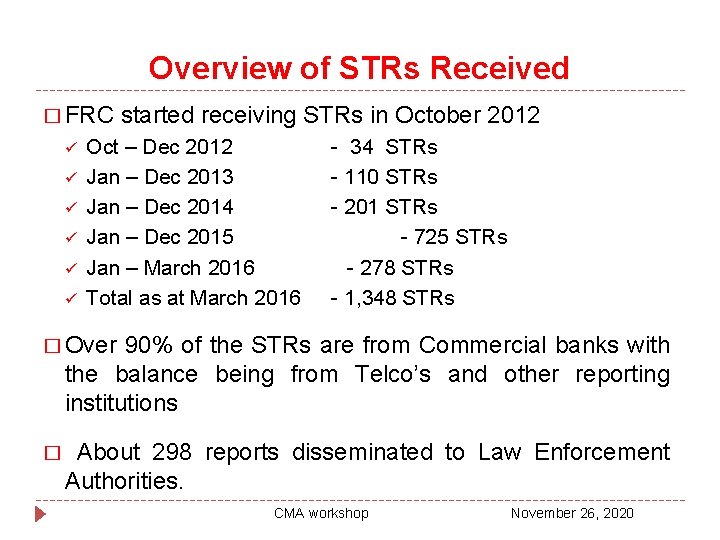
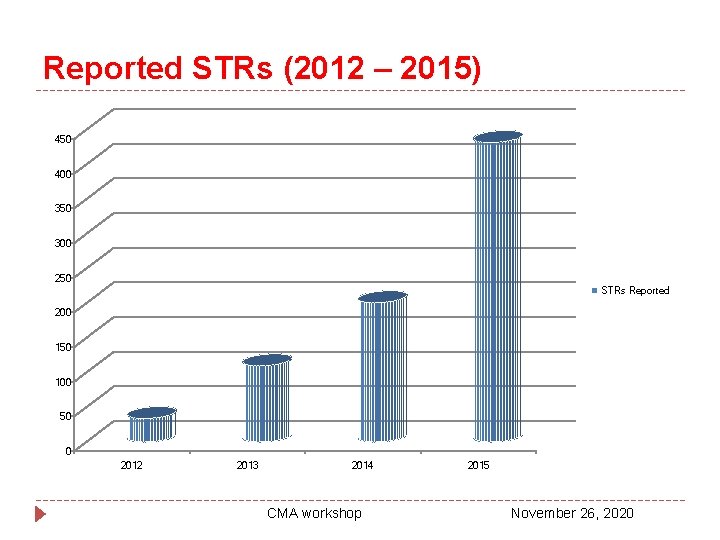
Overview of STRs Received � FRC ü ü ü started receiving STRs in October 2012 Oct – Dec 2012 Jan – Dec 2013 Jan – Dec 2014 Jan – Dec 2015 Jan – March 2016 Total as at March 2016 - 34 STRs - 110 STRs - 201 STRs - 725 STRs - 278 STRs - 1, 348 STRs � Over 90% of the STRs are from Commercial banks with the balance being from Telco’s and other reporting institutions � About 298 reports disseminated to Law Enforcement Authorities. CMA workshop November 26, 2020
Reported STRs (2012 – 2015) 450 400 350 300 250 STRs Reported 200 150 100 50 0 2012 2013 2014 CMA workshop 2015 November 26, 2020
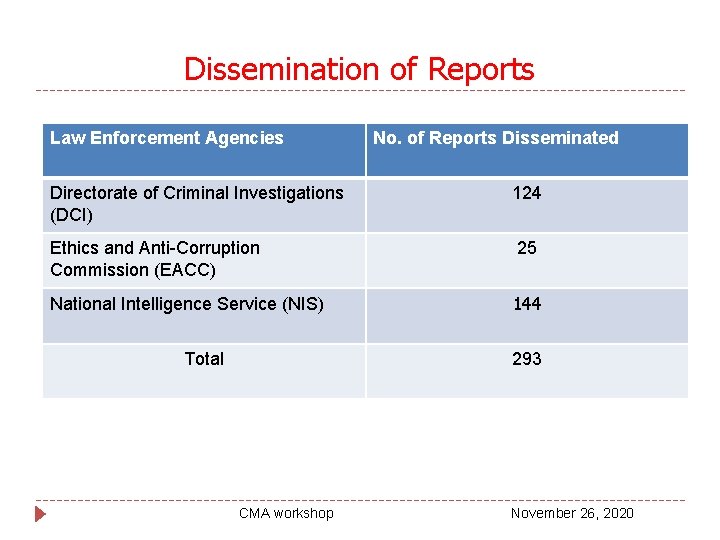
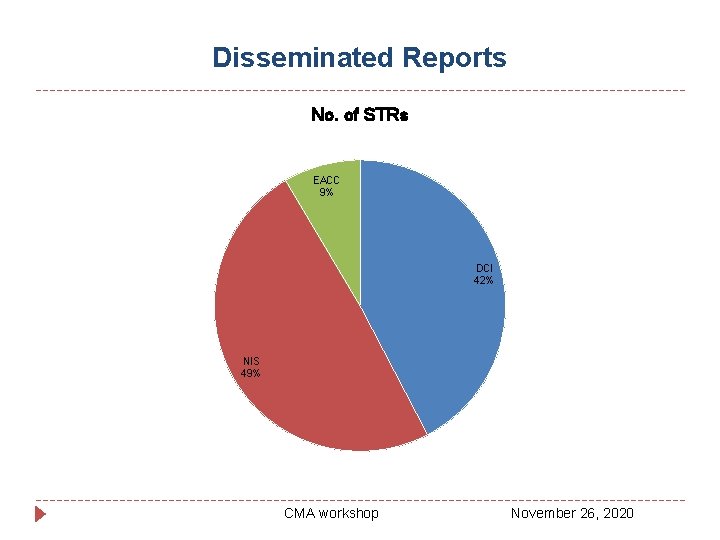
Dissemination of Reports Law Enforcement Agencies No. of Reports Disseminated Directorate of Criminal Investigations (DCI) 124 Ethics and Anti-Corruption Commission (EACC) 25 National Intelligence Service (NIS) 144 Total 293 CMA workshop November 26, 2020
Disseminated Reports No. of STRs EACC 9% DCI 42% NIS 49% CMA workshop November 26, 2020
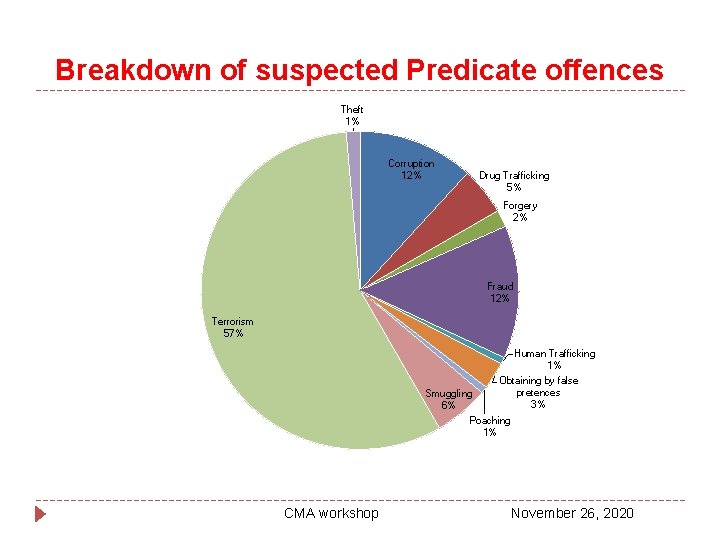
Breakdown of suspected Predicate offences Theft 1% Corruption 12% Drug Trafficking 5% Forgery 2% Fraud 12% Terrorism 57% Human Trafficking 1% Smuggling 6% Obtaining by false pretences 3% Poaching 1% CMA workshop November 26, 2020
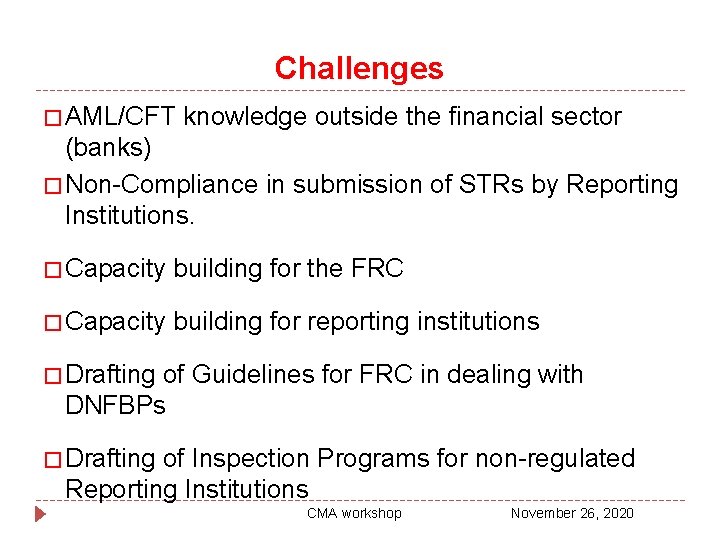
Challenges � AML/CFT knowledge outside the financial sector (banks) � Non-Compliance in submission of STRs by Reporting Institutions. � Capacity building for the FRC � Capacity building for reporting institutions � Drafting of Guidelines for FRC in dealing with DNFBPs � Drafting of Inspection Programs for non-regulated Reporting Institutions CMA workshop November 26, 2020
Thank You ?