Feminist Literary Theory Feminist criticism the ways in




- Slides: 8
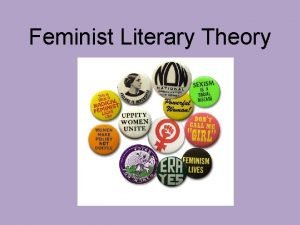
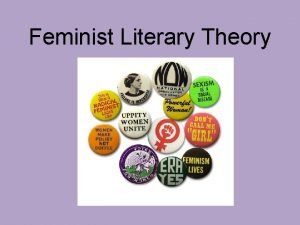
Feminist Literary Theory
Feminist criticism • ". . . the ways in which literature (and other cultural productions) reinforce or undermine the economic, political, social, and psychological oppression of women" (Tyson). • Looks at how aspects of our culture are inherently patriarchal and ". . . this critique strives to expose the explicit and implicit misogyny in male writing about women" (Richter 1346). • Examines how the text presents women’s roles, sensibilities, and identity.
Lisa Tuttle • Feminist theory asks "new questions of old texts. " • Goals of feminist criticism: • to develop and uncover a female tradition of writing, • to interpret symbolism of women's writing so that it will not be lost or ignored by the male point of view • to analyze women writers and their writings from a female perspective • to increase awareness of the sexual politics of language and style.
Elaine Showalter • Three phases of modern women’s literary development: • Feminine phase (1840 -80) • Women writers imitated the dominant male tradition • Feminist phase (1880 -1920) • Women advocated for their rights. • Female phase (four models) (1920 -present) • Biological: the text mirrors the body. Female imagery, metaphors, symbols in text. • Linguistic: women speaking men's language as a foreign tongue. Women must use their own language, for if women continue to speak as men do when they enter discourse, whatever they say will be subdued and alienated. • Psychoanalytic: Analyzes the female psyche and demonstrates how such an analysis affects the writing process, emphasizing the flux and fluidity of female writing as opposed to male writing's rigidity and structure. • Cultural: the female psyche as a construction of cultural forces acknowledges class, racial, national and historical traits.
Questions of Feminist Literary Analysis • How is the relationship between men and women portrayed? • What are the power relationships between men and women (or characters assuming male/female roles)? • How are male and female roles defined? • What constitutes masculinity and femininity? • How do characters embody these traits? • Do characters take on traits from opposite genders? How so? How does this change others’ reactions to them? • What does the work reveal about the operations (economically, politically, socially, or psychologically) of patriarchy? • What does the work imply about the possibilities of sisterhood as a mode of resisting patriarchy? • What does the work say about women's creativity? • What does the history of the work's reception by the public and by the critics tell us about the operation of patriarchy?
Titles of Feminist Articles • “Men, Women, and the Loss of Faith in ‘Young Goodman Brown. ’” • “Women and ‘Sivilization’ in Huckleberry Finn. ”
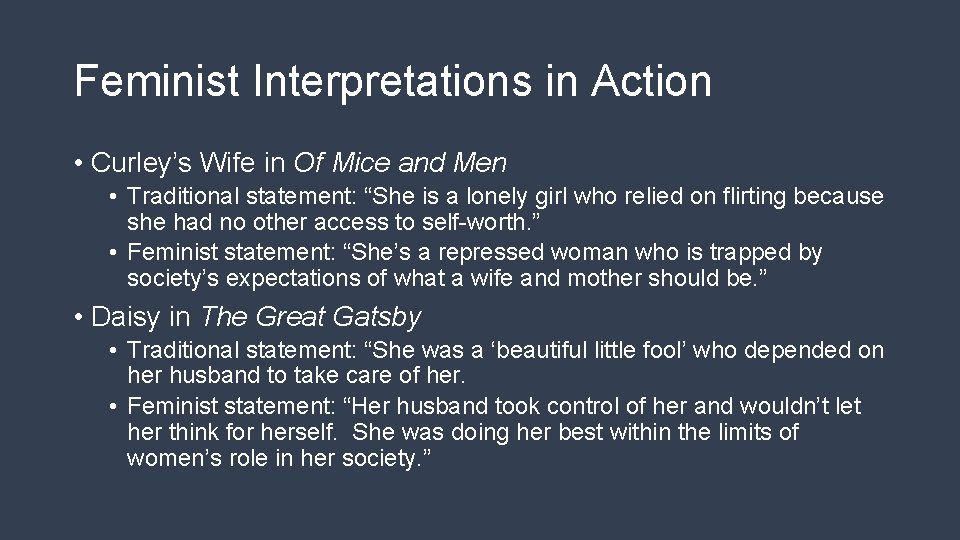
Feminist Interpretations in Action • Curley’s Wife in Of Mice and Men • Traditional statement: “She is a lonely girl who relied on flirting because she had no other access to self-worth. ” • Feminist statement: “She’s a repressed woman who is trapped by society’s expectations of what a wife and mother should be. ” • Daisy in The Great Gatsby • Traditional statement: “She was a ‘beautiful little fool’ who depended on her husband to take care of her. • Feminist statement: “Her husband took control of her and wouldn’t let her think for herself. She was doing her best within the limits of women’s role in her society. ”
Tasks • Look for 1 passage that speaks to some of the feminist questions noted earlier. • Provide close reading ideas examining how the language on the page portrays the characters’ interactions and/or ideas.