Exploring Setting in A Raisin in the Sun
- Slides: 6
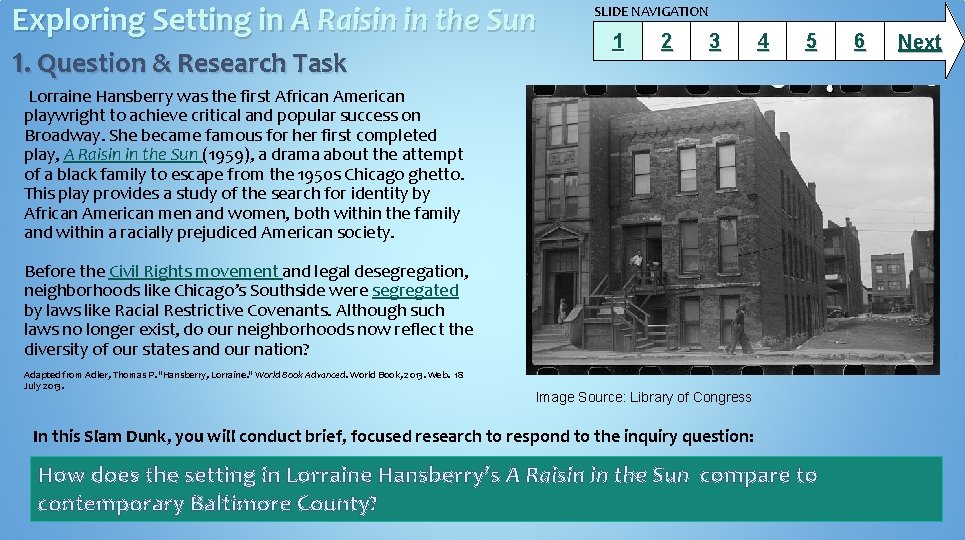
Exploring Setting in A Raisin in the Sun 1. Question & Research Task SLIDE NAVIGATION 1 2 3 4 5 Lorraine Hansberry was the first African American playwright to achieve critical and popular success on Broadway. She became famous for her first completed play, A Raisin in the Sun (1959), a drama about the attempt of a black family to escape from the 1950 s Chicago ghetto. This play provides a study of the search for identity by African American men and women, both within the family and within a racially prejudiced American society. Before the Civil Rights movement and legal desegregation, neighborhoods like Chicago’s Southside were segregated by laws like Racial Restrictive Covenants. Although such laws no longer exist, do our neighborhoods now reflect the diversity of our states and our nation? Adapted from Adler, Thomas P. "Hansberry, Lorraine. " World Book Advanced. World Book, 2013. Web. 18 July 2013. Image Source: Library of Congress In this Slam Dunk, you will conduct brief, focused research to respond to the inquiry question: How does the setting in Lorraine Hansberry’s A Raisin in the Sun compare to contemporary Baltimore County? 6 Next
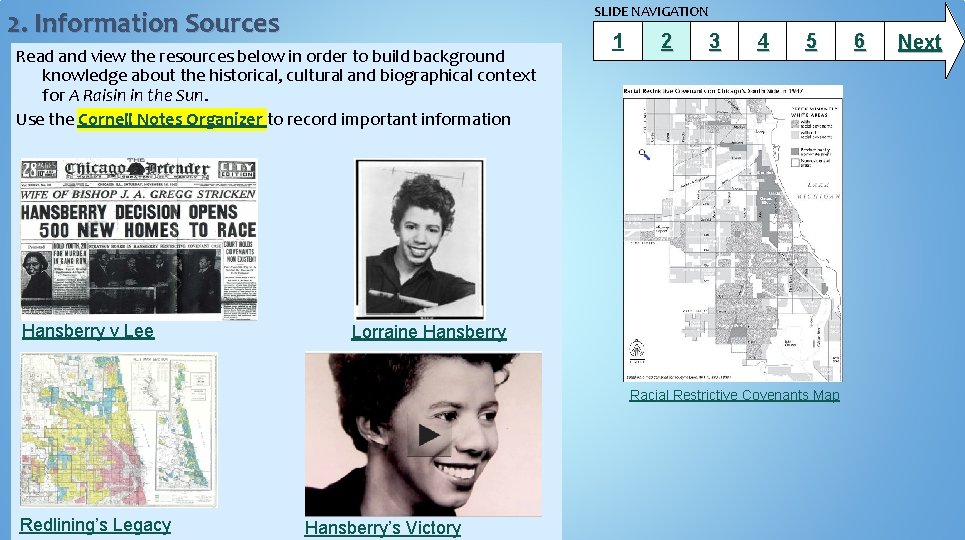
SLIDE NAVIGATION 2. Information Sources Read and view the resources below in order to build background knowledge about the historical, cultural and biographical context for A Raisin in the Sun. Use the Cornell Notes Organizer to record important information Hansberry v Lee 1 2 3 4 5 Lorraine Hansberry Racial Restrictive Covenants Map Redlining’s Legacy Hansberry’s Victory 6 Next
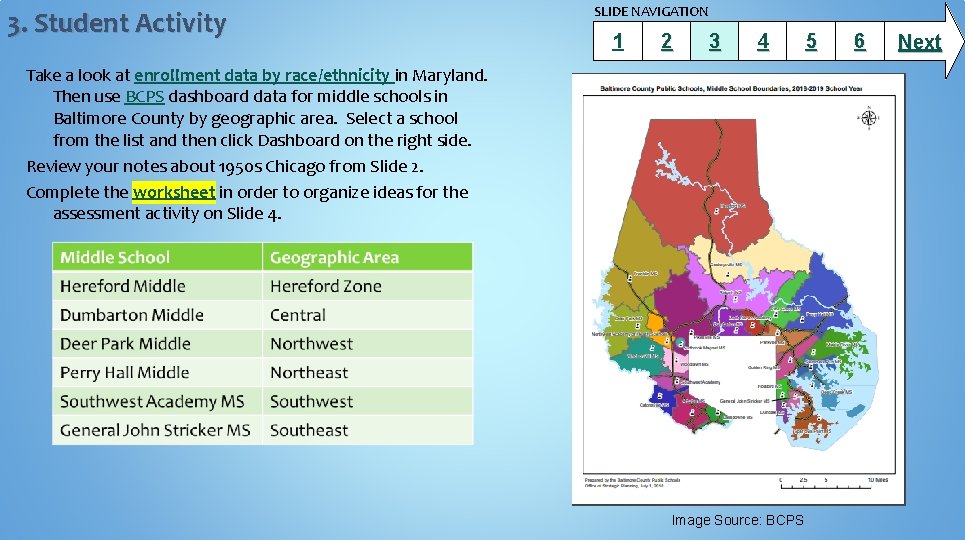
3. Student Activity SLIDE NAVIGATION 1 2 3 4 Take a look at enrollment data by race/ethnicity in Maryland. Then use BCPS dashboard data for middle schools in Baltimore County by geographic area. Select a school from the list and then click Dashboard on the right side. Review your notes about 1950 s Chicago from Slide 2. Complete the worksheet in order to organize ideas for the assessment activity on Slide 4. Image Source: BCPS 5 6 Next
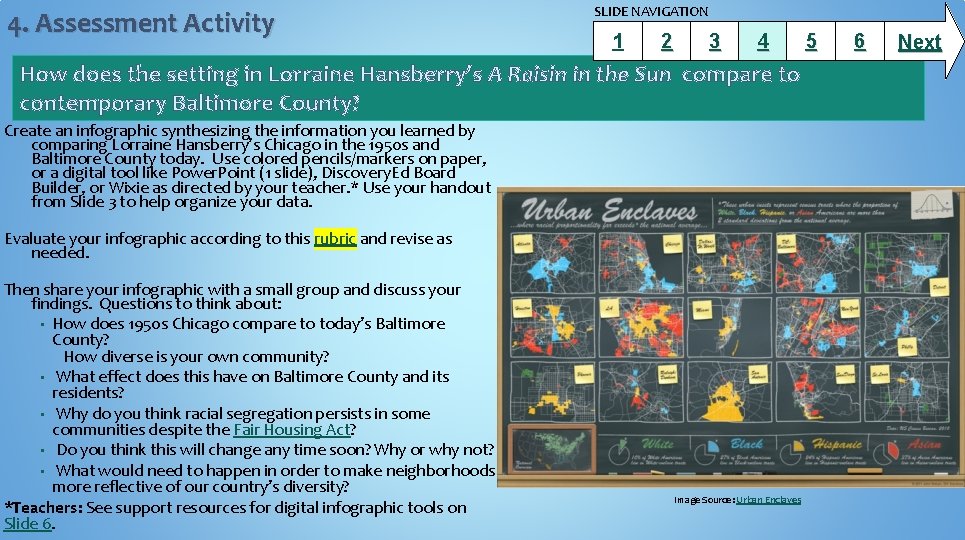
4. Assessment Activity SLIDE NAVIGATION 1 2 3 4 How does the setting in Lorraine Hansberry’s A Raisin in the Sun compare to contemporary Baltimore County? Create an infographic synthesizing the information you learned by comparing Lorraine Hansberry’s Chicago in the 1950 s and Baltimore County today. Use colored pencils/markers on paper, or a digital tool like Power. Point (1 slide), Discovery. Ed Board Builder, or Wixie as directed by your teacher. * Use your handout from Slide 3 to help organize your data. Evaluate your infographic according to this rubric and revise as needed. Then share your infographic with a small group and discuss your findings. Questions to think about: • How does 1950 s Chicago compare to today’s Baltimore County? How diverse is your own community? • What effect does this have on Baltimore County and its residents? • Why do you think racial segregation persists in some communities despite the Fair Housing Act? • Do you think this will change any time soon? Why or why not? • What would need to happen in order to make neighborhoods more reflective of our country’s diversity? *Teachers: See support resources for digital infographic tools on Slide 6. Image Source: Urban Enclaves 5 6 Next
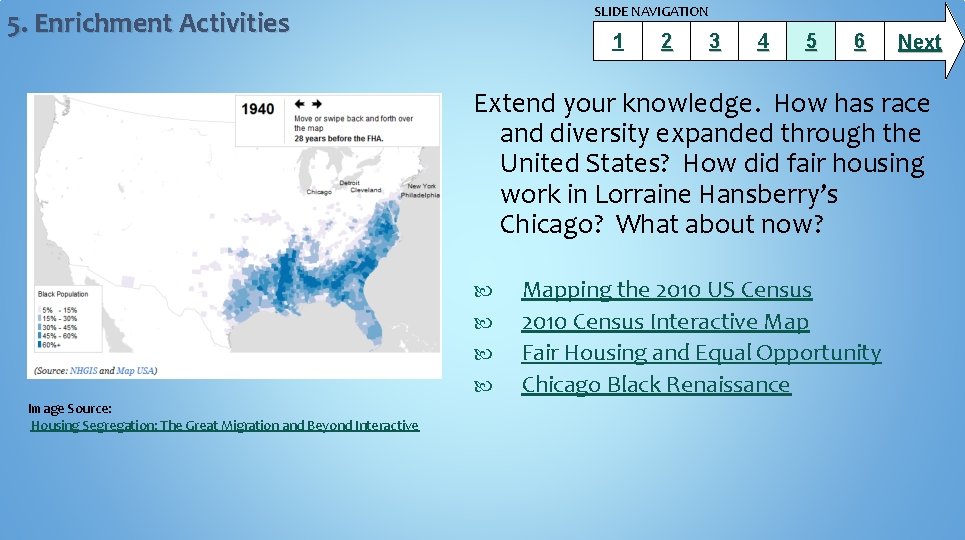
SLIDE NAVIGATION 5. Enrichment Activities 1 2 3 4 5 6 Next Extend your knowledge. How has race and diversity expanded through the United States? How did fair housing work in Lorraine Hansberry’s Chicago? What about now? Image Source: Housing Segregation: The Great Migration and Beyond Interactive Mapping the 2010 US Census 2010 Census Interactive Map Fair Housing and Equal Opportunity Chicago Black Renaissance
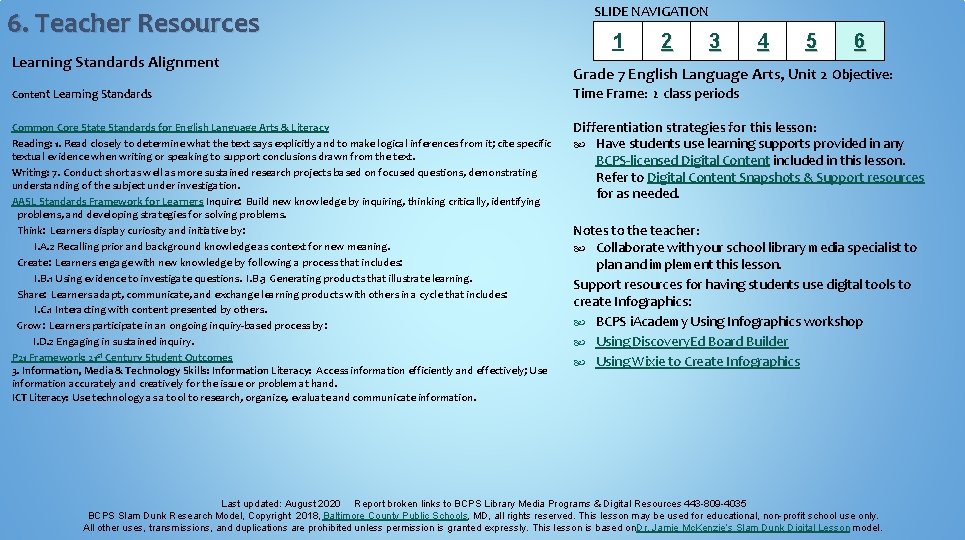
6. Teacher Resources Learning Standards Alignment SLIDE NAVIGATION 1 2 3 4 5 6 Grade 7 English Language Arts, Unit 2 Objective: Content Learning Standards Time Frame: 2 class periods Common Core State Standards for English Language Arts & Literacy Reading: 1. Read closely to determine what the text says explicitly and to make logical inferences from it; cite specific textual evidence when writing or speaking to support conclusions drawn from the text. Writing: 7. Conduct short as well as more sustained research projects based on focused questions, demonstrating understanding of the subject under investigation. AASL Standards Framework for Learners Inquire: Build new knowledge by inquiring, thinking critically, identifying problems, and developing strategies for solving problems. Think: Learners display curiosity and initiative by: I. A. 2 Recalling prior and background knowledge as context for new meaning. Create: Learners engage with new knowledge by following a process that includes: I. B. 1 Using evidence to investigate questions. I. B. 3 Generating products that illustrate learning. Share: Learners adapt, communicate, and exchange learning products with others in a cycle that includes: I. C. 1 Interacting with content presented by others. Grow: Learners participate in an ongoing inquiry-based process by: I. D. 2 Engaging in sustained inquiry. P 21 Framework: 21 st Century Student Outcomes 3. Information, Media & Technology Skills: Information Literacy: Access information efficiently and effectively; Use information accurately and creatively for the issue or problem at hand. ICT Literacy: Use technology as a tool to research, organize, evaluate and communicate information. Differentiation strategies for this lesson: Have students use learning supports provided in any BCPS-licensed Digital Content included in this lesson. Refer to Digital Content Snapshots & Support resources for as needed. Notes to the teacher: Collaborate with your school library media specialist to plan and implement this lesson. Support resources for having students use digital tools to create Infographics: BCPS i. Academy Using Infographics workshop Using Discovery. Ed Board Builder Using Wixie to Create Infographics Last updated: August 2020 Report broken links to BCPS Library Media Programs & Digital Resources 443 -809 -4035 BCPS Slam Dunk Research Model, Copyright 2018, Baltimore County Public Schools, MD, all rights reserved. This lesson may be used for educational, non-profit school use only. All other uses, transmissions, and duplications are prohibited unless permission is granted expressly. This lesson is based on. Dr. Jamie Mc. Kenzie’s Slam Dunk Digital Lesson model.