EVPN a very short introduction SDWAN 1 Acquiring

- Slides: 12
EVPN a very short introduction SD-WAN 1
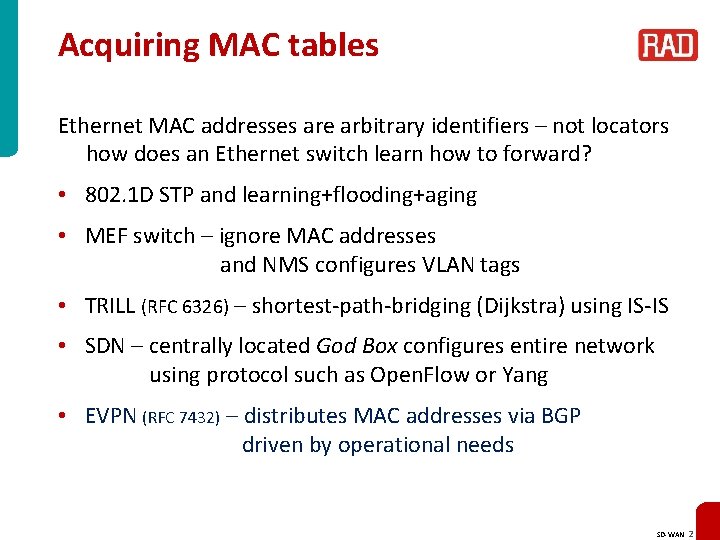
Acquiring MAC tables Ethernet MAC addresses are arbitrary identifiers – not locators how does an Ethernet switch learn how to forward? • 802. 1 D STP and learning+flooding+aging • MEF switch – ignore MAC addresses and NMS configures VLAN tags • TRILL (RFC 6326) – shortest-path-bridging (Dijkstra) using IS-IS • SDN – centrally located God Box configures entire network using protocol such as Open. Flow or Yang • EVPN (RFC 7432) – distributes MAC addresses via BGP driven by operational needs SD-WAN 2
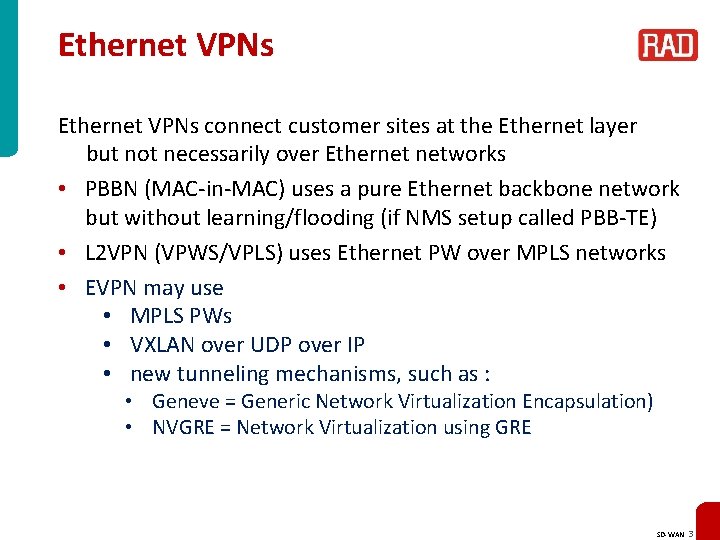
Ethernet VPNs connect customer sites at the Ethernet layer but not necessarily over Ethernet networks • PBBN (MAC-in-MAC) uses a pure Ethernet backbone network but without learning/flooding (if NMS setup called PBB-TE) • L 2 VPN (VPWS/VPLS) uses Ethernet PW over MPLS networks • EVPN may use • MPLS PWs • VXLAN over UDP over IP • new tunneling mechanisms, such as : • Geneve = Generic Network Virtualization Encapsulation) • NVGRE = Network Virtualization using GRE SD-WAN 3
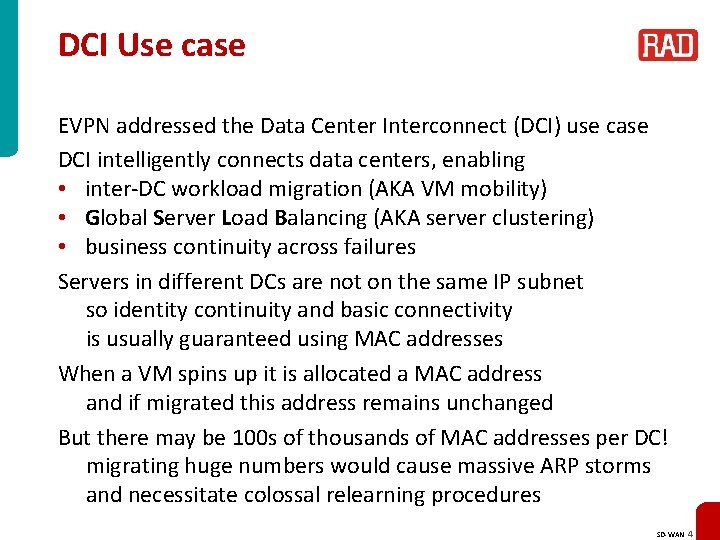
DCI Use case EVPN addressed the Data Center Interconnect (DCI) use case DCI intelligently connects data centers, enabling • inter-DC workload migration (AKA VM mobility) • Global Server Load Balancing (AKA server clustering) • business continuity across failures Servers in different DCs are not on the same IP subnet so identity continuity and basic connectivity is usually guaranteed using MAC addresses When a VM spins up it is allocated a MAC address and if migrated this address remains unchanged But there may be 100 s of thousands of MAC addresses per DC! migrating huge numbers would cause massive ARP storms and necessitate colossal relearning procedures SD-WAN 4
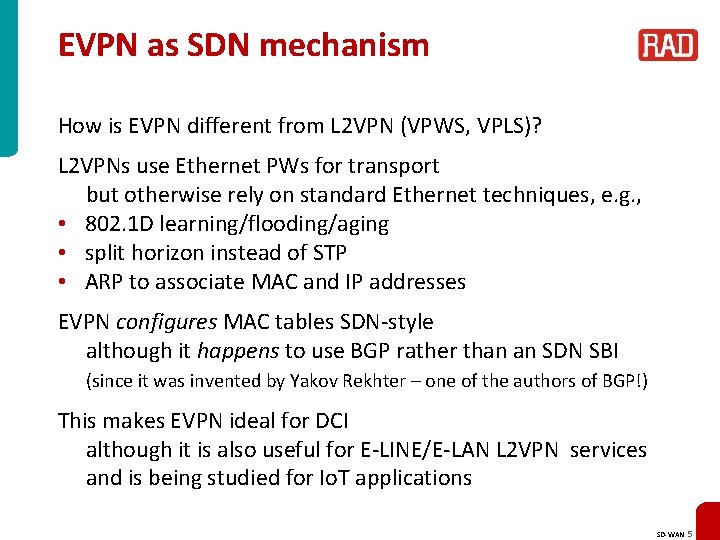
EVPN as SDN mechanism How is EVPN different from L 2 VPN (VPWS, VPLS)? L 2 VPNs use Ethernet PWs for transport but otherwise rely on standard Ethernet techniques, e. g. , • 802. 1 D learning/flooding/aging • split horizon instead of STP • ARP to associate MAC and IP addresses EVPN configures MAC tables SDN-style although it happens to use BGP rather than an SDN SBI (since it was invented by Yakov Rekhter – one of the authors of BGP!) This makes EVPN ideal for DCI although it is also useful for E-LINE/E-LAN L 2 VPN services and is being studied for Io. T applications SD-WAN 5
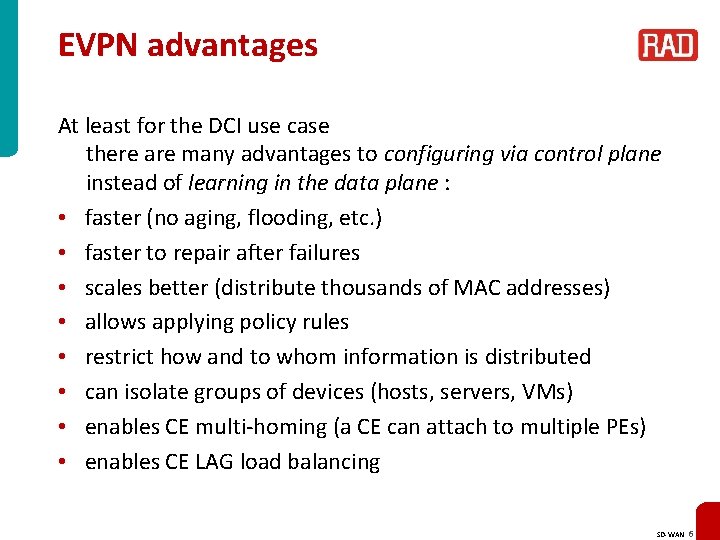
EVPN advantages At least for the DCI use case there are many advantages to configuring via control plane instead of learning in the data plane : • faster (no aging, flooding, etc. ) • faster to repair after failures • scales better (distribute thousands of MAC addresses) • allows applying policy rules • restrict how and to whom information is distributed • can isolate groups of devices (hosts, servers, VMs) • enables CE multi-homing (a CE can attach to multiple PEs) • enables CE LAG load balancing SD-WAN 6
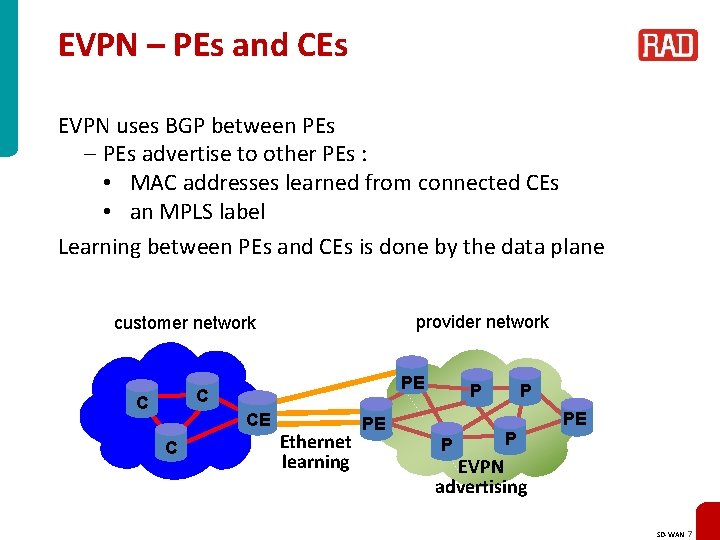
EVPN – PEs and CEs EVPN uses BGP between PEs – PEs advertise to other PEs : • MAC addresses learned from connected CEs • an MPLS label Learning between PEs and CEs is done by the data plane provider network customer network PE C C CE C Ethernet learning P P PE PE P P EVPN advertising SD-WAN 7
BGP distributes routing information in update messages that contain Network Layer Reachability Information along with path attributes for the NLRI Originally NLRI was one or more destination IP prefixes BGP version 4 became multiprotocol (MP-BGP) by extending NLRI to additional address families, e. g. , • unicast IPv 4 • unicast IPv 6 • labelled unicast (i. e. , MPLS labels) • L 3 VPNs • IPv 4 multicast Each of these is defined by an AFI (Address Family Identifier) and SAFI (Subsequent (Next Hop) Address Family Identifier) SD-WAN 8
BGP for EVPN RFC 7432 defines a new address family for EVPN based on the previously defined L 3 VPN address family EVPN enables distribution of MAC addresses or pairs of MAC+IP addresses Thus, EVPN can support • extending Ethernet domain across multiple DCs • VM migration maintaining MAC addresses but reassigning P addresses • VM migration maintaining both MAC and IP addresses without need for triangle routing SD-WAN 9
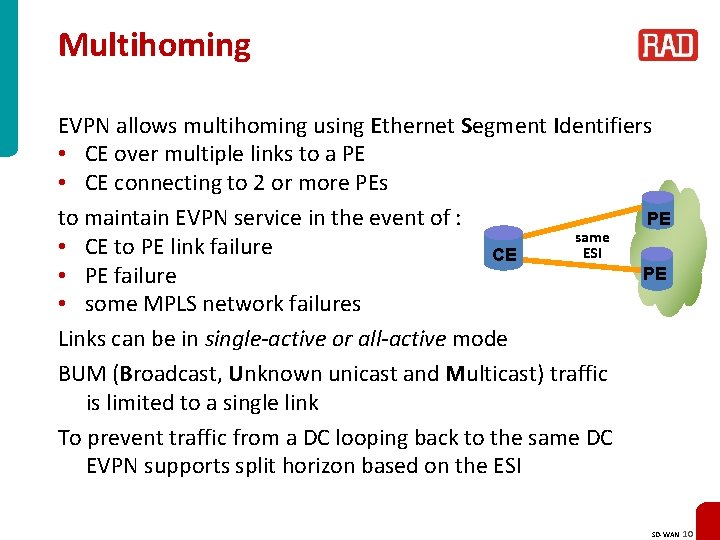
Multihoming EVPN allows multihoming using Ethernet Segment Identifiers • CE over multiple links to a PE • CE connecting to 2 or more PEs PE to maintain EVPN service in the event of : same • CE to PE link failure ESI CE PE • PE failure • some MPLS network failures Links can be in single-active or all-active mode BUM (Broadcast, Unknown unicast and Multicast) traffic is limited to a single link To prevent traffic from a DC looping back to the same DC EVPN supports split horizon based on the ESI SD-WAN 10
Some more EVPN advantages EVPN prevents ARP storms DC edge GWs only pass known traffic DC edge GW proxy-ARPS to all known ARP requests and discards all unknown ARP requests EVPN can prevent MAC flapping after VM migration the new MAC location needs to be learned the old location forgotten the first might happen faster than the second EVPN can support multicast using replication, or P 2 MP or MP 2 MP MPLS LSPs EVPNs can support multiple VLANs while maintaining VLAN isolation SD-WAN 11
Thank You For Your Attention www. rad. com SD-WAN 12