Evaluating Theories of Crime What is a Theory

- Slides: 15
Evaluating Theories of Crime
What is a “Theory? ” n A statement of set of statements about the relationships between 2 or more events n In criminology? n Theories of crime n Theories of how the criminal justice system operates n A theory predicts what will happen, not how the world should be
How do you know a “good theory” when you see one? n Akers’ 6 criteria for evaluating a theory 1. 2. 3. 4. 5. 6. Logical Consistency Scope Parsimony Testability Fit with Empirical Evidence Usefulness of Policy Implications
Logical Consistency n Clearly Defined Concepts Concept = symbol/label that we apply to an abstract image n Examples? n n Concepts must fit in a logical manner n BAD LOGIC: All crime is caused by imprisonment
SCOPE (not the mouthwash) DEPENDENT variable n How “general” is your explanation? n Specific forms of crime/deviance? n All crime, deviance, sin, and recklessness? n n All else being equal, “Wider is Better”
Parsimony n n INDEPENDENT (predictor) variables How complex is your explanation? n n n Parsimony: Low self-control is single cause of crime Not: Crime caused by a combination of poverty, inequality, average daily temperature, intelligence, hair color, weight, daily stress… All else being equal, more parsimony is better!
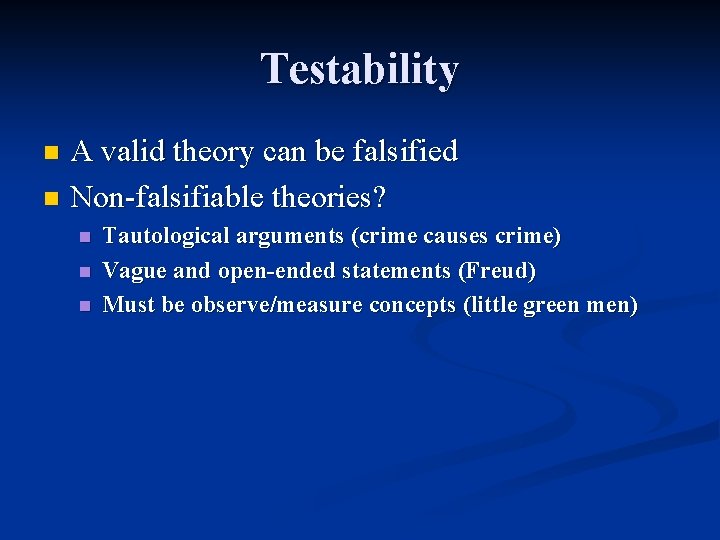
Testability A valid theory can be falsified n Non-falsifiable theories? n n Tautological arguments (crime causes crime) Vague and open-ended statements (Freud) Must be observe/measure concepts (little green men)
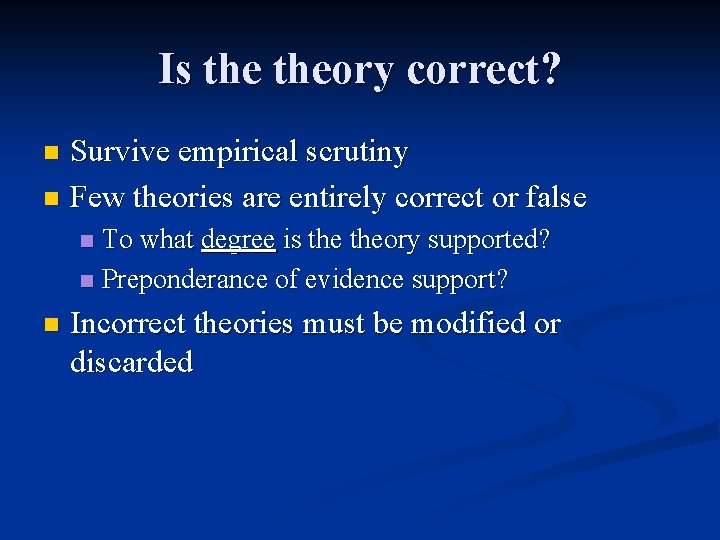
Is theory correct? Survive empirical scrutiny n Few theories are entirely correct or false n To what degree is theory supported? n Preponderance of evidence support? n n Incorrect theories must be modified or discarded
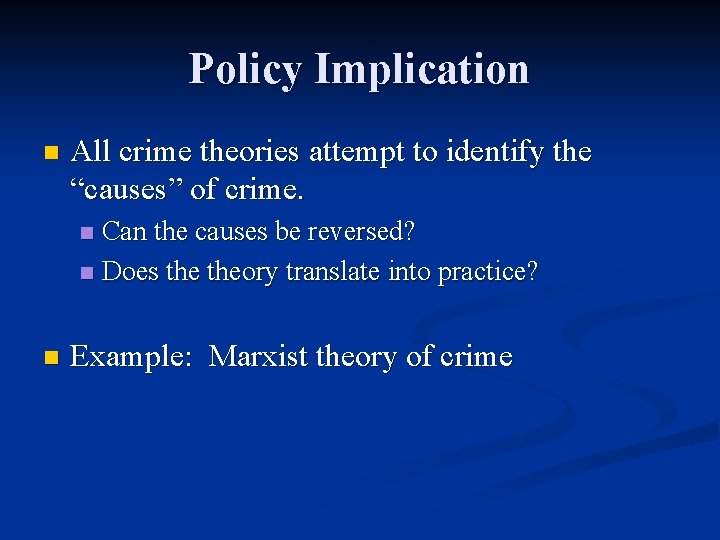
Policy Implication n All crime theories attempt to identify the “causes” of crime. Can the causes be reversed? n Does theory translate into practice? n n Example: Marxist theory of crime
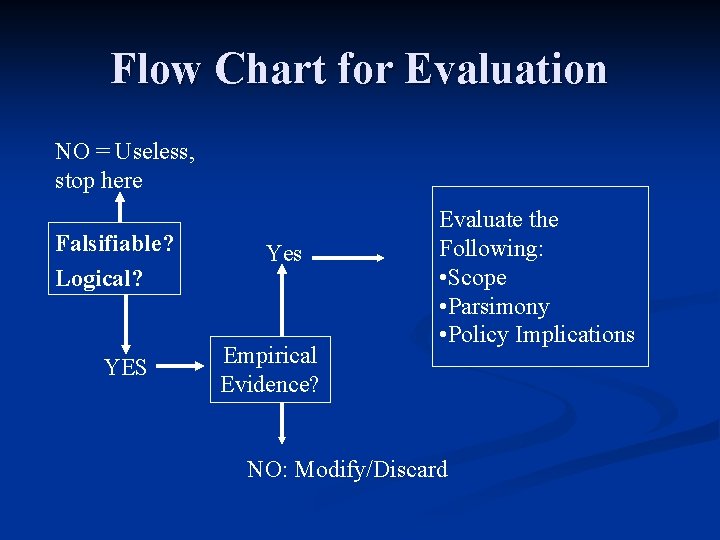
Flow Chart for Evaluation NO = Useless, stop here Falsifiable? Logical? YES Yes Empirical Evidence? Evaluate the Following: • Scope • Parsimony • Policy Implications NO: Modify/Discard
Correlation and Causation n For Social Sciences (“Probabilistic”): X (the “cause”) must precede Y (the “effect”) n X must be related to Y n The correlation cannot be spurious n
Ruling out Spuriousness n Most commonly is the use of “Statistical Control” Observe/measure factors that might render relationship spurious n Include these factors as “control variables” in a statistical model n Problems with this? n
Methods for Studying Crime Experiments n Survey Research n Cross-sectional n Longitudinal n
Experiments Experimental Control is better that statistical control n “True Experiment” n n n Random Assignment In criminology? Typically “quasi” experiments n Rehabilitation based on theory n Manipulate criminal justice system n
Survey Research n Typically cross-sectional n n Usually high school students Recent trend = longitudinal Establish cause-effect ordering n Stability of criminal offending n