
Chapter 7 Social Structure Theories Frank Schmalleger Power


- Slides: 35
Chapter 7 Social Structure Theories Frank Schmalleger Power. Point presentation created by Ellen G. Cohn, Ph. D.
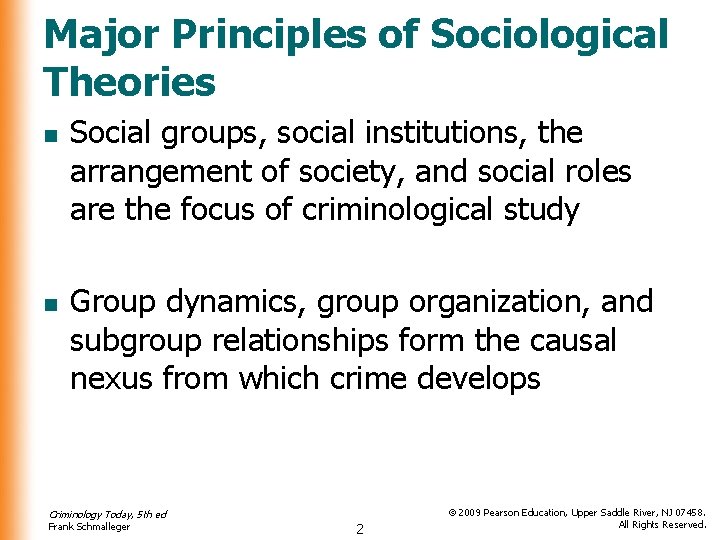
Major Principles of Sociological Theories n n Social groups, social institutions, the arrangement of society, and social roles are the focus of criminological study Group dynamics, group organization, and subgroup relationships form the causal nexus from which crime develops Criminology Today, 5 th ed Frank Schmalleger 2 © 2009 Pearson Education, Upper Saddle River, NJ 07458. All Rights Reserved.
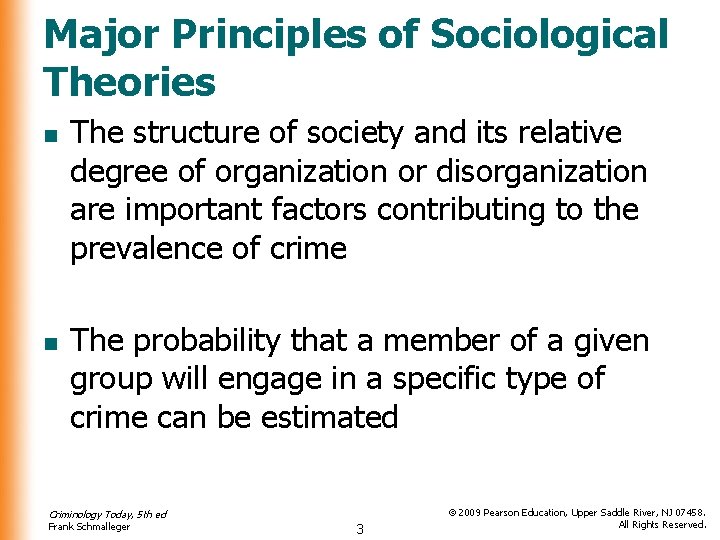
Major Principles of Sociological Theories n n The structure of society and its relative degree of organization or disorganization are important factors contributing to the prevalence of crime The probability that a member of a given group will engage in a specific type of crime can be estimated Criminology Today, 5 th ed Frank Schmalleger 3 © 2009 Pearson Education, Upper Saddle River, NJ 07458. All Rights Reserved.
Major Principles of Sociological Theories Sociological theories: Examine institutional arrangements within society (social structure) and the interaction between and among social institutions, individuals, and groups (social processes) as they affect socialization and have an impact on social behavior (social life) Criminology Today, 5 th ed Frank Schmalleger 4 © 2009 Pearson Education, Upper Saddle River, NJ 07458. All Rights Reserved.
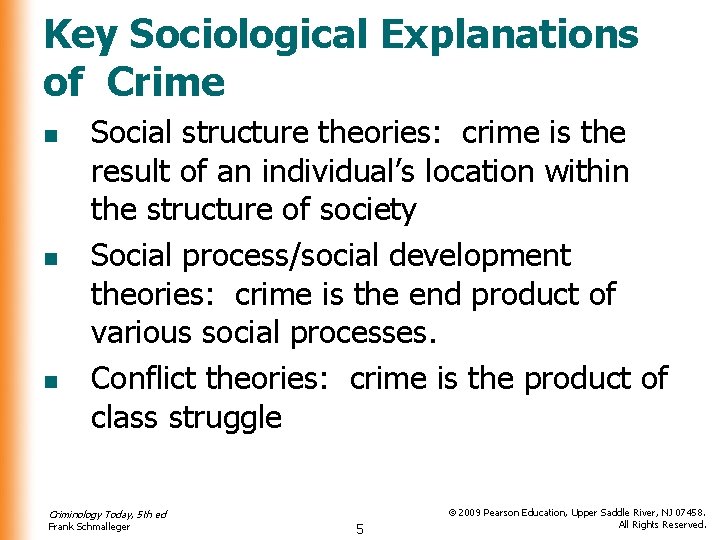
Key Sociological Explanations of Crime n n n Social structure theories: crime is the result of an individual’s location within the structure of society Social process/social development theories: crime is the end product of various social processes. Conflict theories: crime is the product of class struggle Criminology Today, 5 th ed Frank Schmalleger 5 © 2009 Pearson Education, Upper Saddle River, NJ 07458. All Rights Reserved.
Social Structure Theories Defined n Social structure theories n n n Explain crime by reference to economic and social arrangements of society See the various formal and informal arrangements between social groups as the root causes of crime and delinquency Highlight arrangements within society that contribute to low socioeconomic status of identifiable groups as significant causes of crime Criminology Today, 5 th ed Frank Schmalleger 6 © 2009 Pearson Education, Upper Saddle River, NJ 07458. All Rights Reserved.
Types of Social Structure Theories n n n Social disorganization theory (ecological approach Strain theory Culture conflict theory (cultural deviance theory) Criminology Today, 5 th ed Frank Schmalleger 7 © 2009 Pearson Education, Upper Saddle River, NJ 07458. All Rights Reserved.
Theory in Perspective n Social disorganization n n Depicts social change, social conflict, and lack of social consensus as the root causes of crime and deviance Social ecology sees crime and deviance as a disease or social pathology Period: 1920 s – 1930 s Concepts: Social ecology, ecological theories, social pathology, social disorganization, Chicago School, Chicago Area Project, demographics, concentric zones, delinquency areas cultural transmission Criminology Today, 5 th ed Frank Schmalleger 8 © 2009 Pearson Education, Upper Saddle River, NJ 07458. All Rights Reserved.
Park and Burgess n Social ecology movement Focused on how the structure of society adapts to the quality of natural resources and to the existence of other human groups n Social pathology Aspects of society may be somehow pathological, or sick, and may produce deviant behavior among individuals and groups who live under or are exposed to such conditions Criminology Today, 5 th ed Frank Schmalleger 9 © 2009 Pearson Education, Upper Saddle River, NJ 07458. All Rights Reserved.
Shaw and Mc. Kay n n n Applied the concentric zone model to the study of juvenile delinquency Found offending rates remained constant over time within zones of transition Cultural transmission: Traditions of delinquency are transmitted through successive generations of the same zone Criminology Today, 5 th ed Frank Schmalleger 10 © 2009 Pearson Education, Upper Saddle River, NJ 07458. All Rights Reserved.
The Criminology of Place n Environmental criminology n n n Emphasizes the importance of geographic location and architectural features as they are associated with the prevalence of victimization “Hot spots” of crime Broken windows thesis (Wilson and Kelling) n Physical deterioration and unrepaired buildings lead to increased concerns for safety among area residents Criminology Today, 5 th ed Frank Schmalleger 11 © 2009 Pearson Education, Upper Saddle River, NJ 07458. All Rights Reserved.
The Criminology of Place n Defensible space n n A surrogate term for the range of mechanisms that combine to bring an environment under the control of its residents Architectural changes that enhance barriers, define boundaries, and remove criminal opportunity can reduce the risk of crime Criminology Today, 5 th ed Frank Schmalleger 12 © 2009 Pearson Education, Upper Saddle River, NJ 07458. All Rights Reserved.
Theory in Perspective n Strain Theory n n Points to a lack of fit between socially approved success goals and socially approved means to achieve those goals Individuals unable to succeed through legitimate means turn to other avenues Period: 1930 s – present Concepts: anomie, goals, means, innovation, retreatism, ritualism, rebellion, differential opportunity, relative deprivation, distributive justice, general strain theory (GST) Criminology Today, 5 th ed Frank Schmalleger 13 © 2009 Pearson Education, Upper Saddle River, NJ 07458. All Rights Reserved.
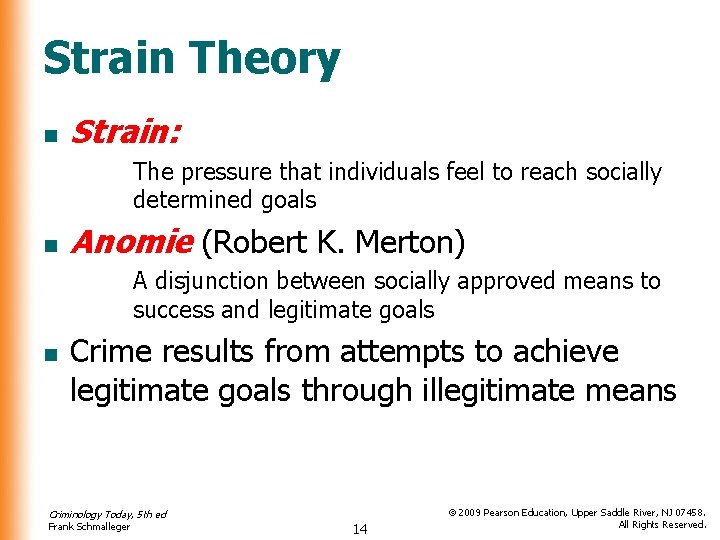
Strain Theory n Strain: The pressure that individuals feel to reach socially determined goals n Anomie (Robert K. Merton) A disjunction between socially approved means to success and legitimate goals n Crime results from attempts to achieve legitimate goals through illegitimate means Criminology Today, 5 th ed Frank Schmalleger 14 © 2009 Pearson Education, Upper Saddle River, NJ 07458. All Rights Reserved.
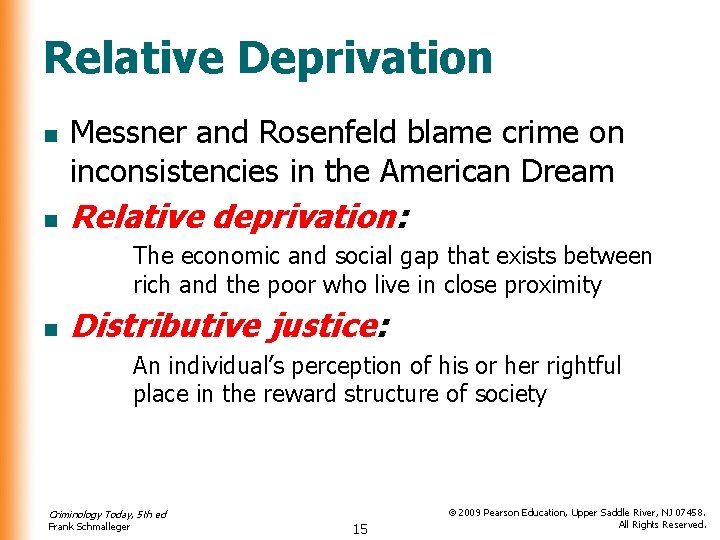
Relative Deprivation n n Messner and Rosenfeld blame crime on inconsistencies in the American Dream Relative deprivation: The economic and social gap that exists between rich and the poor who live in close proximity n Distributive justice: An individual’s perception of his or her rightful place in the reward structure of society Criminology Today, 5 th ed Frank Schmalleger 15 © 2009 Pearson Education, Upper Saddle River, NJ 07458. All Rights Reserved.
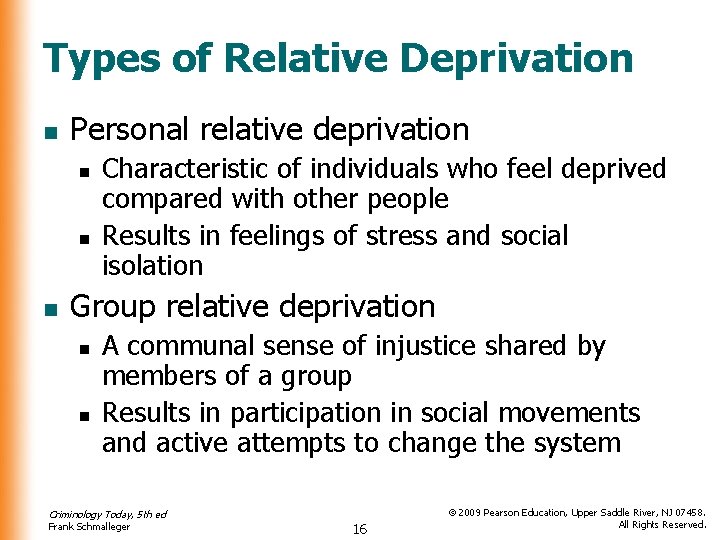
Types of Relative Deprivation n Personal relative deprivation n Characteristic of individuals who feel deprived compared with other people Results in feelings of stress and social isolation Group relative deprivation n n A communal sense of injustice shared by members of a group Results in participation in social movements and active attempts to change the system Criminology Today, 5 th ed Frank Schmalleger 16 © 2009 Pearson Education, Upper Saddle River, NJ 07458. All Rights Reserved.
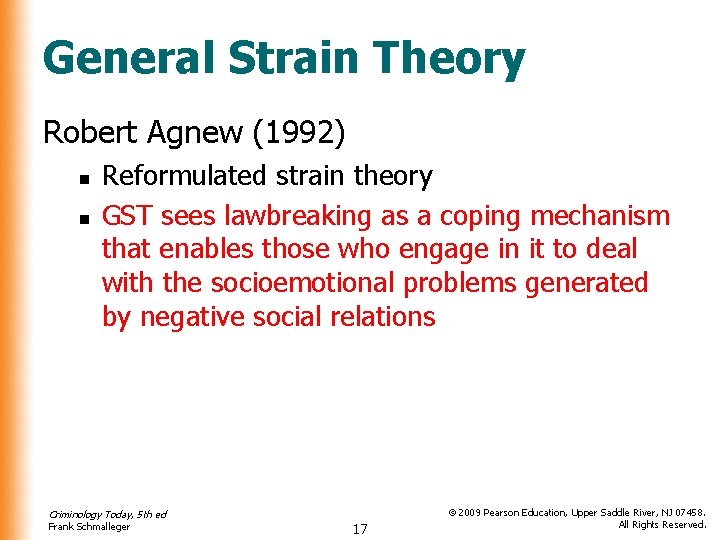
General Strain Theory Robert Agnew (1992) n n Reformulated strain theory GST sees lawbreaking as a coping mechanism that enables those who engage in it to deal with the socioemotional problems generated by negative social relations Criminology Today, 5 th ed Frank Schmalleger 17 © 2009 Pearson Education, Upper Saddle River, NJ 07458. All Rights Reserved.
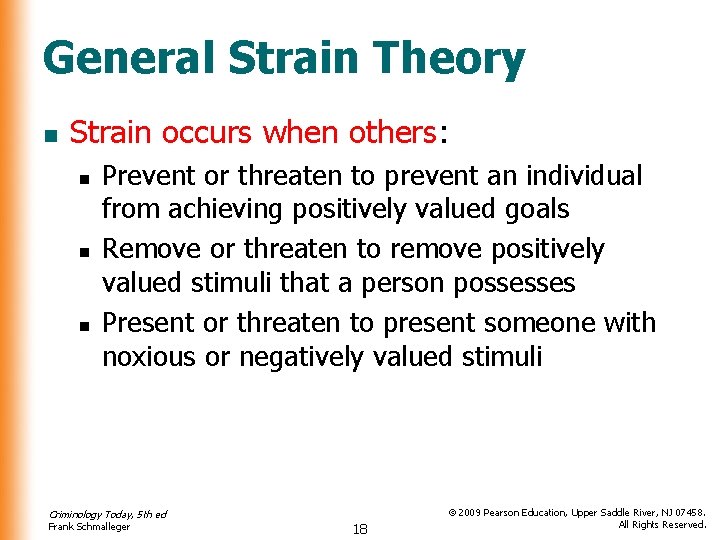
General Strain Theory n Strain occurs when others: n n n Prevent or threaten to prevent an individual from achieving positively valued goals Remove or threaten to remove positively valued stimuli that a person possesses Present or threaten to present someone with noxious or negatively valued stimuli Criminology Today, 5 th ed Frank Schmalleger 18 © 2009 Pearson Education, Upper Saddle River, NJ 07458. All Rights Reserved.
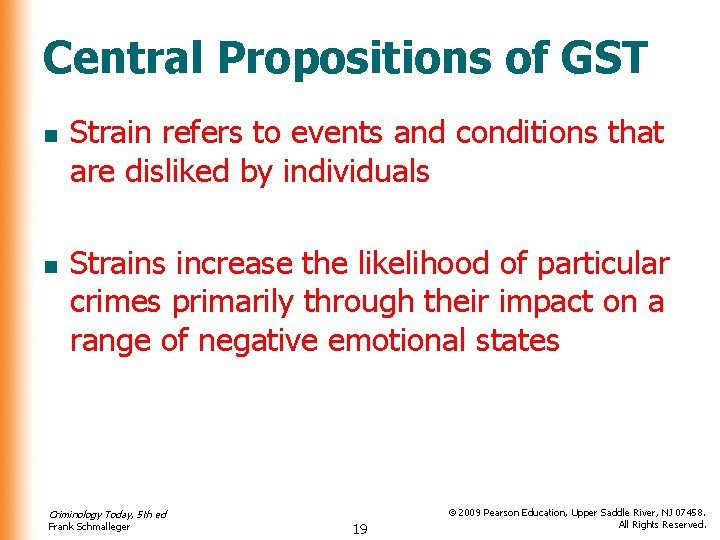
Central Propositions of GST n n Strain refers to events and conditions that are disliked by individuals Strains increase the likelihood of particular crimes primarily through their impact on a range of negative emotional states Criminology Today, 5 th ed Frank Schmalleger 19 © 2009 Pearson Education, Upper Saddle River, NJ 07458. All Rights Reserved.
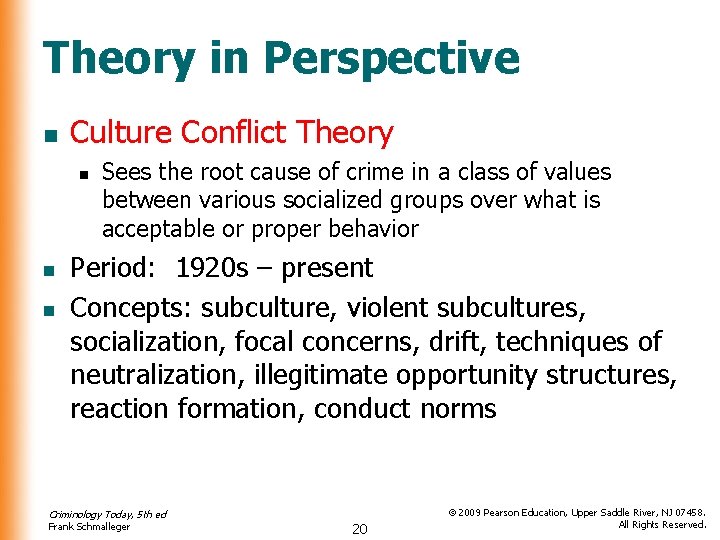
Theory in Perspective n Culture Conflict Theory n n n Sees the root cause of crime in a class of values between various socialized groups over what is acceptable or proper behavior Period: 1920 s – present Concepts: subculture, violent subcultures, socialization, focal concerns, drift, techniques of neutralization, illegitimate opportunity structures, reaction formation, conduct norms Criminology Today, 5 th ed Frank Schmalleger 20 © 2009 Pearson Education, Upper Saddle River, NJ 07458. All Rights Reserved.
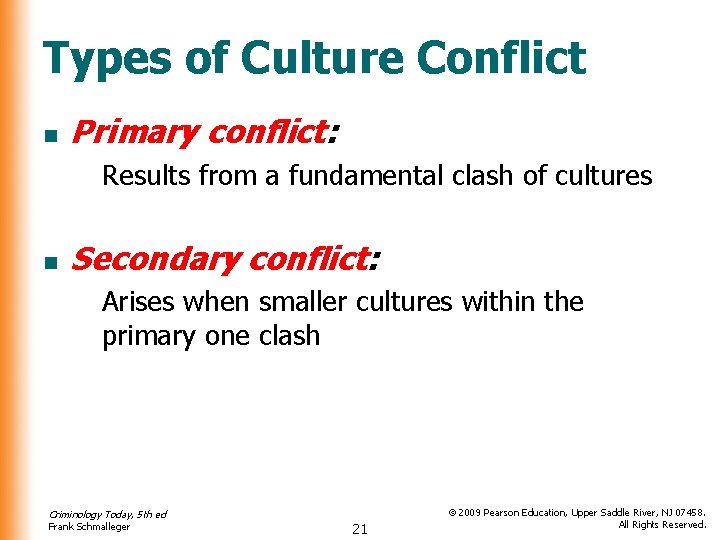
Types of Culture Conflict n Primary conflict: Results from a fundamental clash of cultures n Secondary conflict: Arises when smaller cultures within the primary one clash Criminology Today, 5 th ed Frank Schmalleger 21 © 2009 Pearson Education, Upper Saddle River, NJ 07458. All Rights Reserved.
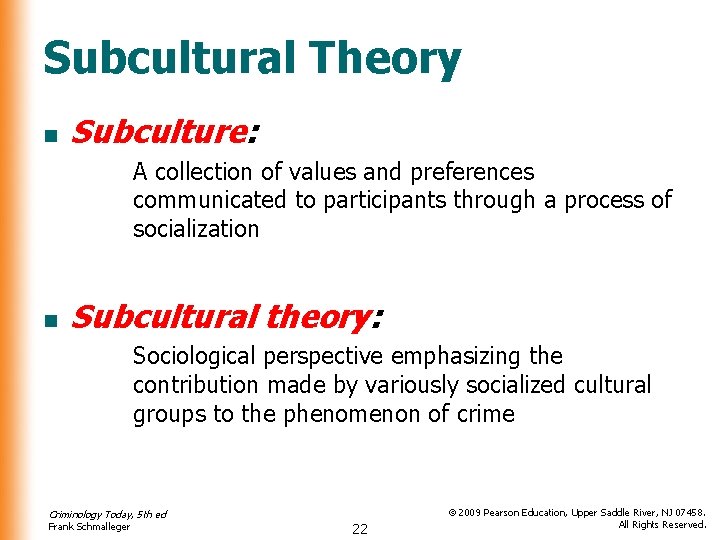
Subcultural Theory n Subculture: A collection of values and preferences communicated to participants through a process of socialization n Subcultural theory: Sociological perspective emphasizing the contribution made by variously socialized cultural groups to the phenomenon of crime Criminology Today, 5 th ed Frank Schmalleger 22 © 2009 Pearson Education, Upper Saddle River, NJ 07458. All Rights Reserved.
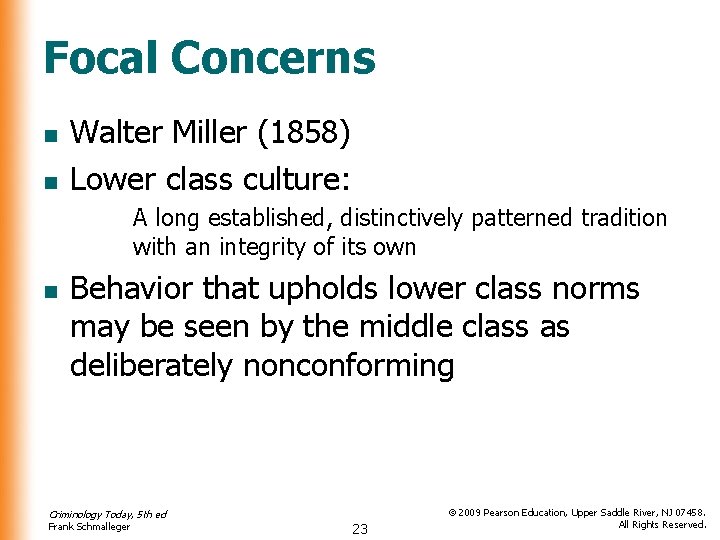
Focal Concerns n n Walter Miller (1858) Lower class culture: A long established, distinctively patterned tradition with an integrity of its own n Behavior that upholds lower class norms may be seen by the middle class as deliberately nonconforming Criminology Today, 5 th ed Frank Schmalleger 23 © 2009 Pearson Education, Upper Saddle River, NJ 07458. All Rights Reserved.
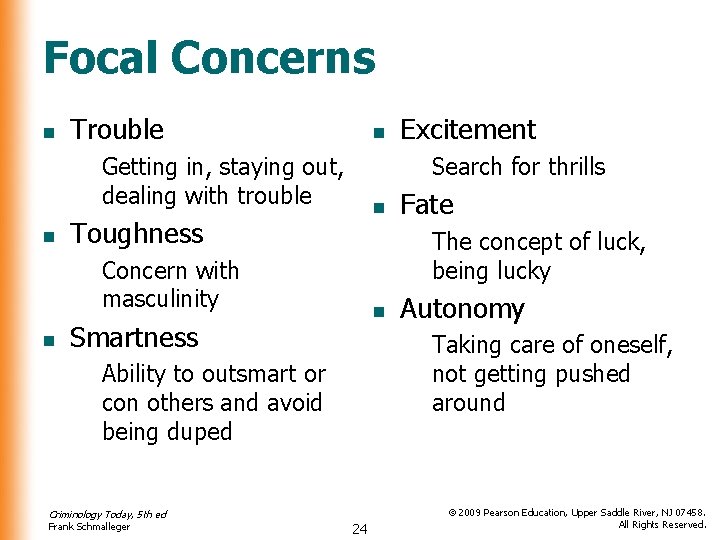
Focal Concerns n Trouble n Getting in, staying out, dealing with trouble n Search for thrills n Toughness n Smartness Frank Schmalleger Autonomy Taking care of oneself, not getting pushed around Ability to outsmart or con others and avoid being duped Criminology Today, 5 th ed Fate The concept of luck, being lucky Concern with masculinity n Excitement 24 © 2009 Pearson Education, Upper Saddle River, NJ 07458. All Rights Reserved.
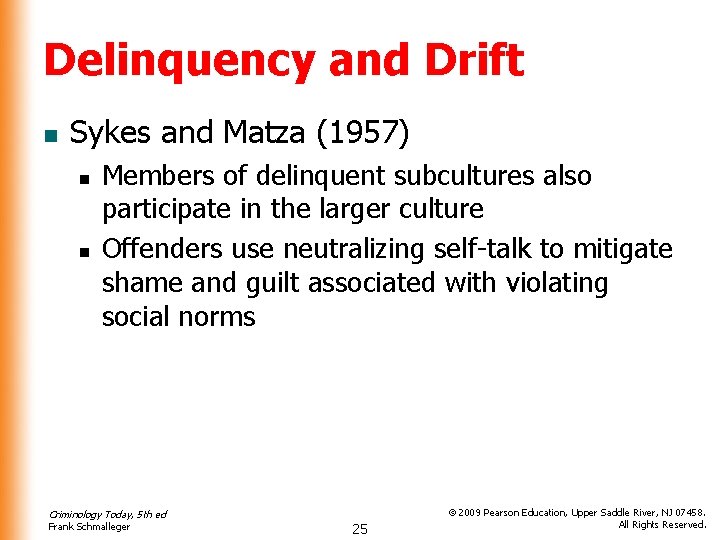
Delinquency and Drift n Sykes and Matza (1957) n n Members of delinquent subcultures also participate in the larger culture Offenders use neutralizing self-talk to mitigate shame and guilt associated with violating social norms Criminology Today, 5 th ed Frank Schmalleger 25 © 2009 Pearson Education, Upper Saddle River, NJ 07458. All Rights Reserved.
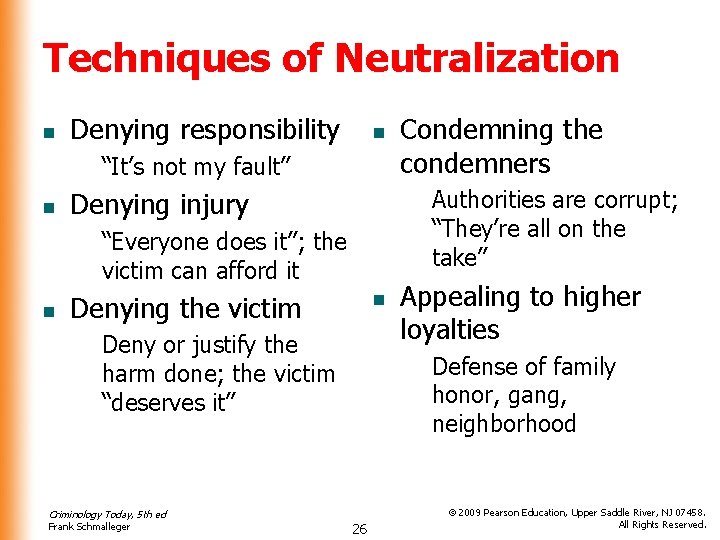
Techniques of Neutralization n Denying responsibility n “It’s not my fault” n Authorities are corrupt; “They’re all on the take” Denying injury “Everyone does it”; the victim can afford it n n Denying the victim Deny or justify the harm done; the victim “deserves it” Criminology Today, 5 th ed Frank Schmalleger Condemning the condemners Appealing to higher loyalties Defense of family honor, gang, neighborhood 26 © 2009 Pearson Education, Upper Saddle River, NJ 07458. All Rights Reserved.
Delinquency and Drift n n Delinquents tend to drift between crime and conventional action – choose the most expedient Use techniques of neutralization to keep from being alienated from larger society Criminology Today, 5 th ed Frank Schmalleger 27 © 2009 Pearson Education, Upper Saddle River, NJ 07458. All Rights Reserved.
Violent Subcultures n Ferracuti and Wolfgang (1967) n n n Violence is a learned form of adaptation to problematic life circumstances Learning to be violent takes place within the context of a subculture emphasizing violence over other forms of adaptation For participants in violent subcultures, violence can be a way of life Criminology Today, 5 th ed Frank Schmalleger 28 © 2009 Pearson Education, Upper Saddle River, NJ 07458. All Rights Reserved.
Violent Subcultures n Southern subculture of violence n n n Southerner, violence and weaponry Certain violent crimes may be more acceptable in the South than other parts of the US Black subculture of violence n n Created by generations of white-on-black violence Seek status through ability to harm, intimidate, dominate others Criminology Today, 5 th ed Frank Schmalleger 29 © 2009 Pearson Education, Upper Saddle River, NJ 07458. All Rights Reserved.
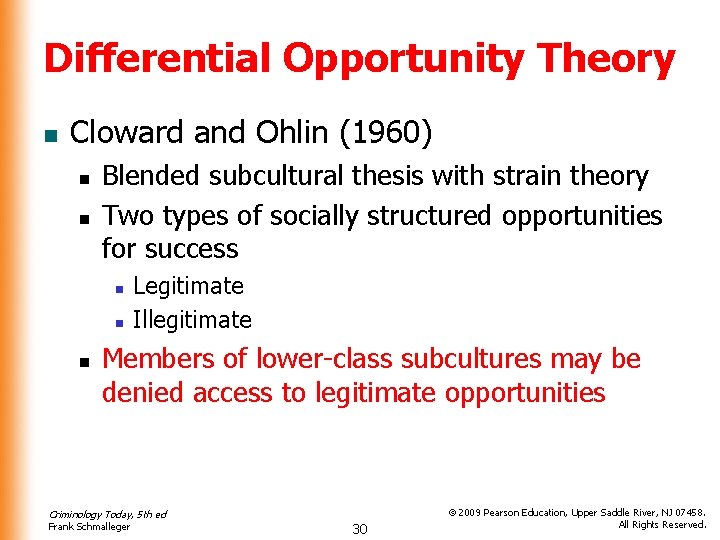
Differential Opportunity Theory n Cloward and Ohlin (1960) n n Blended subcultural thesis with strain theory Two types of socially structured opportunities for success n n n Legitimate Illegitimate Members of lower-class subcultures may be denied access to legitimate opportunities Criminology Today, 5 th ed Frank Schmalleger 30 © 2009 Pearson Education, Upper Saddle River, NJ 07458. All Rights Reserved.
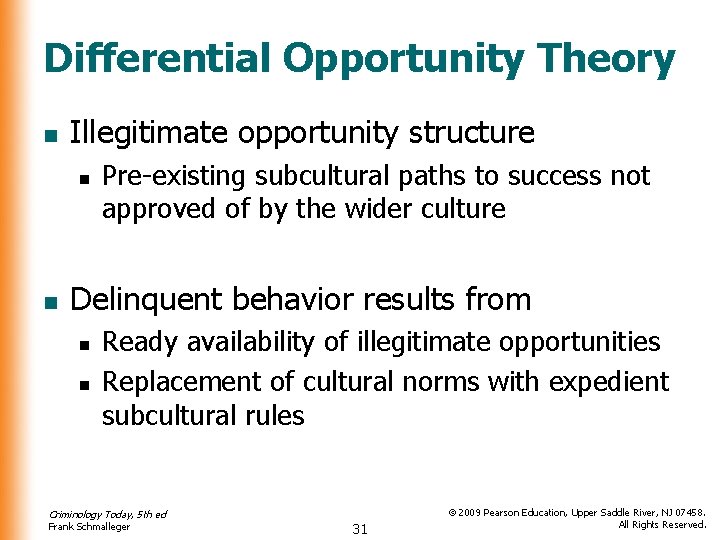
Differential Opportunity Theory n Illegitimate opportunity structure n n Pre-existing subcultural paths to success not approved of by the wider culture Delinquent behavior results from n n Ready availability of illegitimate opportunities Replacement of cultural norms with expedient subcultural rules Criminology Today, 5 th ed Frank Schmalleger 31 © 2009 Pearson Education, Upper Saddle River, NJ 07458. All Rights Reserved.
Delinquent Subcultures n Criminal subcultures: Criminal role models readily available n Conflict subcultures: Status through violence n Retreatist subcultures: Drug use and withdrawal from wider society Criminology Today, 5 th ed Frank Schmalleger 32 © 2009 Pearson Education, Upper Saddle River, NJ 07458. All Rights Reserved.
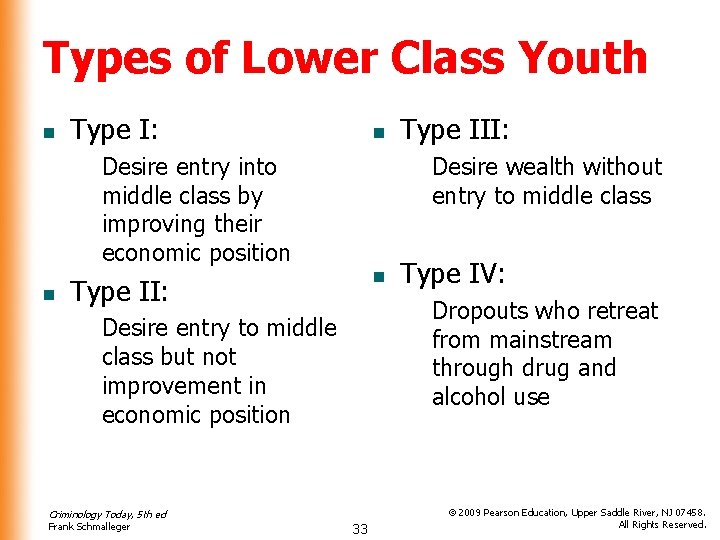
Types of Lower Class Youth n Type I: n Desire entry into middle class by improving their economic position n Desire wealth without entry to middle class n Type II: Frank Schmalleger Type IV: Dropouts who retreat from mainstream through drug and alcohol use Desire entry to middle class but not improvement in economic position Criminology Today, 5 th ed Type III: 33 © 2009 Pearson Education, Upper Saddle River, NJ 07458. All Rights Reserved.
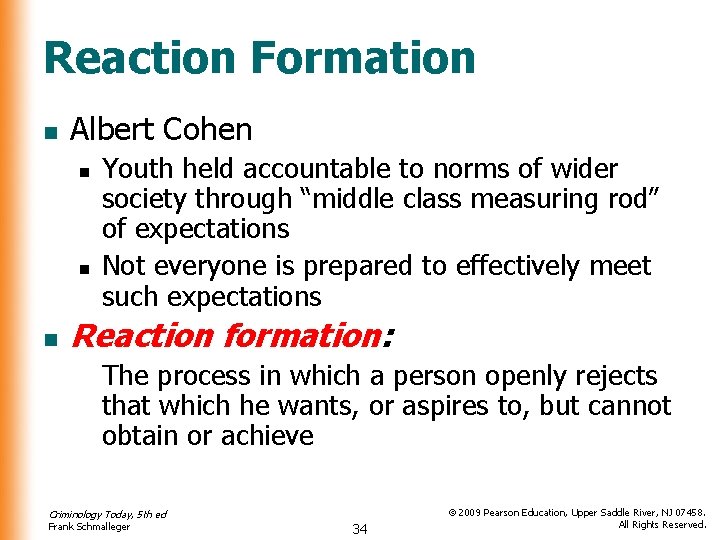
Reaction Formation n Albert Cohen n Youth held accountable to norms of wider society through “middle class measuring rod” of expectations Not everyone is prepared to effectively meet such expectations Reaction formation: The process in which a person openly rejects that which he wants, or aspires to, but cannot obtain or achieve Criminology Today, 5 th ed Frank Schmalleger 34 © 2009 Pearson Education, Upper Saddle River, NJ 07458. All Rights Reserved.
Gangs Today n n Modern gangs are involved in serious and violent crimes Members identify with a name, clothing style, symbols, tattoos, jewelry, haircuts, and hand symbols Gangs are big business Distinctions between gangs and violence Criminology Today, 5 th ed Frank Schmalleger 35 © 2009 Pearson Education, Upper Saddle River, NJ 07458. All Rights Reserved.