Essential Elements of a Shakespearean Tragedy Characteristics of





- Slides: 9
Essential Elements of a Shakespearean Tragedy
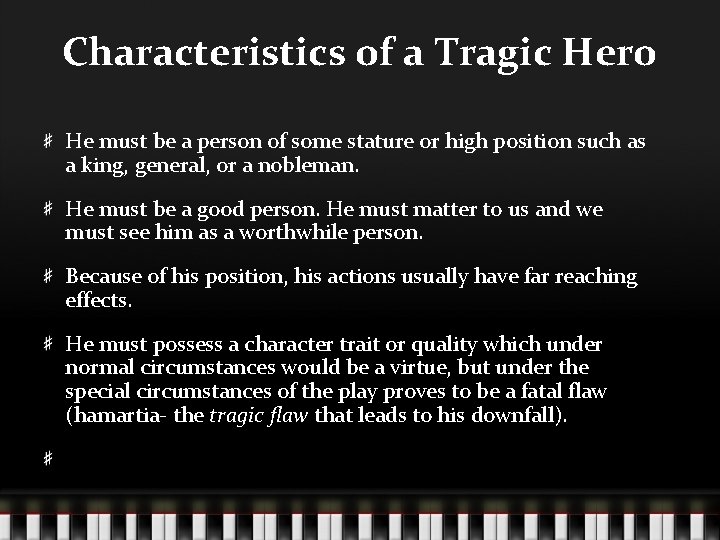
Characteristics of a Tragic Hero He must be a person of some stature or high position such as a king, general, or a nobleman. He must be a good person. He must matter to us and we must see him as a worthwhile person. Because of his position, his actions usually have far reaching effects. He must possess a character trait or quality which under normal circumstances would be a virtue, but under the special circumstances of the play proves to be a fatal flaw (hamartia- the tragic flaw that leads to his downfall).
Characteristics of a Tragic Hero He usually makes further errors in judgment following his misdeed. Often he has a distorted perception of, or is blind to, reality. He suffers both outwardly (isolation, alienation, attacks) and inwardly (tortured conscience). He must elicit both pity and fear from the audience (catharsis). Usually, he recognizes his mistakes in the end. He must die
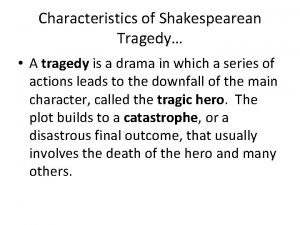
Antagonists One or more opposing forces that work against the tragic hero. The action almost always leads to a catastrophe.
Soliloquy An act of speaking one's thoughts aloud when by oneself or regardless of any hearers, especially by a character in a play.
Aside A dramatic device in which a character speaks to the audience. By convention the audience is to realize that the character's speech is unheard by the other characters on stage. It may be addressed to the audience expressly (in character or out) or represent an unspoken thought.
Foreshadowing Giving hints about impending action without exposing the actual action.
Dramatic Irony A literary technique, originally used in Greek tragedy, by which the full significance of a character's words or actions are clear to the audience or reader although unknown to the character.
Character Foil Characters that exhibits opposite or conflicting traits to one another. The traits often in isolation are not overwhelming, but juxtaposed to their opposite they are glaring.