ENTRY PLAN ASSOCIATE SUPERINTENDENTS OF SCHOOL LEADERSHIP SECONDARY


- Slides: 12
ENTRY PLAN ASSOCIATE SUPERINTENDENTS OF SCHOOL LEADERSHIP – SECONDARY BUFFALO PUBLIC SCHOOLS Sabatino Cimato James Weimer
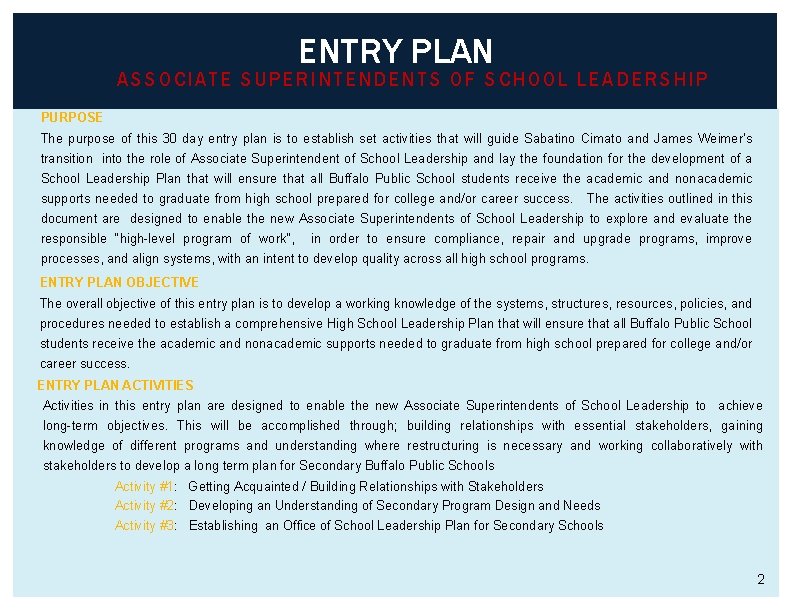
ENTRY PLAN ASSOCIATE SUPERINTENDENTS OF SCHOOL LEADERSHIP PURPOSE The purpose of this 30 day entry plan is to establish set activities that will guide Sabatino Cimato and James Weimer’s transition into the role of Associate Superintendent of School Leadership and lay the foundation for the development of a School Leadership Plan that will ensure that all Buffalo Public School students receive the academic and nonacademic supports needed to graduate from high school prepared for college and/or career success. The activities outlined in this document are designed to enable the new Associate Superintendents of School Leadership to explore and evaluate the responsible “high-level program of work”, in order to ensure compliance, repair and upgrade programs, improve processes, and align systems, with an intent to develop quality across all high school programs. ENTRY PLAN OBJECTIVE The overall objective of this entry plan is to develop a working knowledge of the systems, structures, resources, policies, and procedures needed to establish a comprehensive High School Leadership Plan that will ensure that all Buffalo Public School students receive the academic and nonacademic supports needed to graduate from high school prepared for college and/or career success. ENTRY PLAN ACTIVITIES Activities in this entry plan are designed to enable the new Associate Superintendents of School Leadership to achieve long-term objectives. This will be accomplished through; building relationships with essential stakeholders, gaining knowledge of different programs and understanding where restructuring is necessary and working collaboratively with stakeholders to develop a long term plan for Secondary Buffalo Public Schools Activity #1: Getting Acquainted / Building Relationships with Stakeholders Activity #2: Developing an Understanding of Secondary Program Design and Needs Activity #3: Establishing an Office of School Leadership Plan for Secondary Schools 2
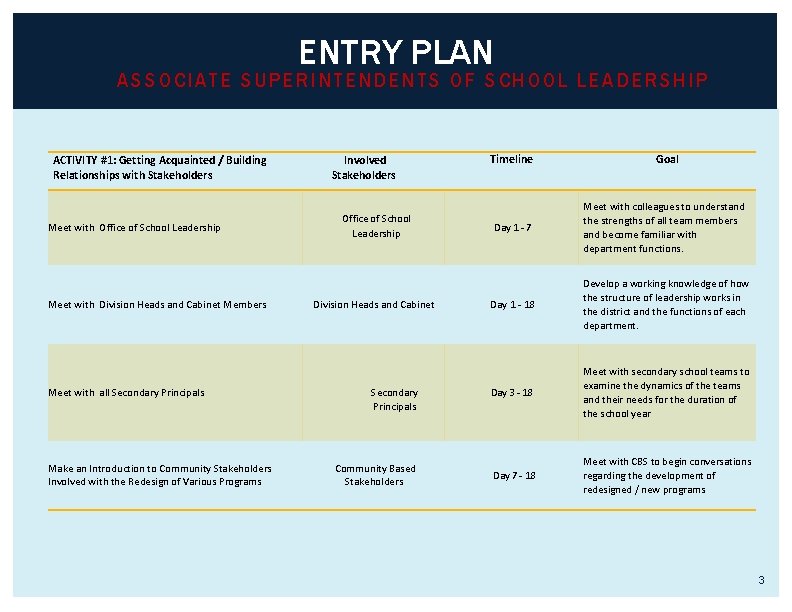
ENTRY PLAN ASSOCIATE SUPERINTENDENTS OF SCHOOL LEADERSHIP ACTIVITY #1: Getting Acquainted / Building Relationships with Stakeholders Meet with Office of School Leadership Meet with Division Heads and Cabinet Members Meet with all Secondary Principals Make an Introduction to Community Stakeholders Involved with the Redesign of Various Programs Involved Stakeholders Office of School Leadership Division Heads and Cabinet Secondary Principals Community Based Stakeholders Timeline Goal Day 1 - 7 Meet with colleagues to understand the strengths of all team members and become familiar with department functions. Day 1 - 18 Develop a working knowledge of how the structure of leadership works in the district and the functions of each department. Day 3 - 18 Meet with secondary school teams to examine the dynamics of the teams and their needs for the duration of the school year Day 7 - 18 Meet with CBS to begin conversations regarding the development of redesigned / new programs 3
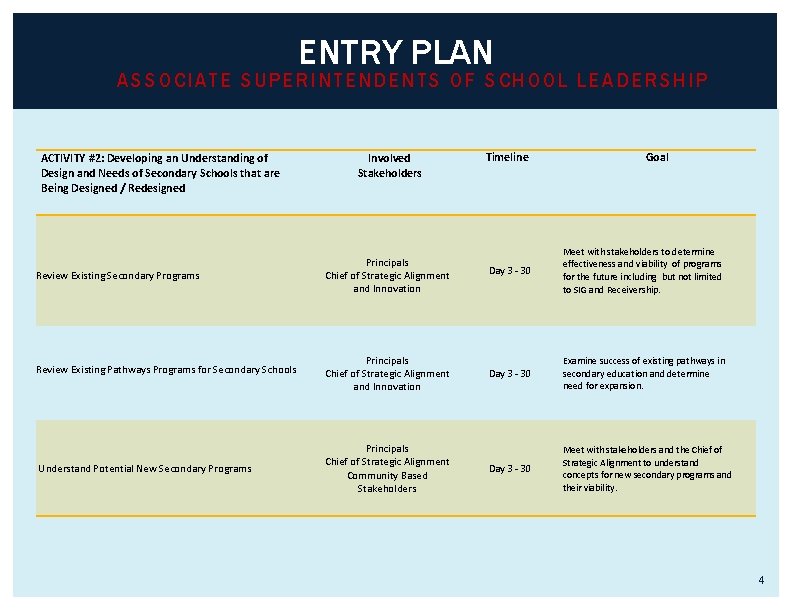
ENTRY PLAN ASSOCIATE SUPERINTENDENTS OF SCHOOL LEADERSHIP ACTIVITY #2: Developing an Understanding of Design and Needs of Secondary Schools that are Being Designed / Redesigned Involved Stakeholders Review Existing Secondary Programs Principals Chief of Strategic Alignment and Innovation Review Existing Pathways Programs for Secondary Schools Principals Chief of Strategic Alignment and Innovation Understand Potential New Secondary Programs Principals Chief of Strategic Alignment Community Based Stakeholders Timeline Goal Day 3 - 30 Meet with stakeholders to determine effectiveness and viability of programs for the future including but not limited to SIG and Receivership. Day 3 - 30 Examine success of existing pathways in secondary education and determine need for expansion. Day 3 - 30 Meet with stakeholders and the Chief of Strategic Alignment to understand concepts for new secondary programs and their viability. 4
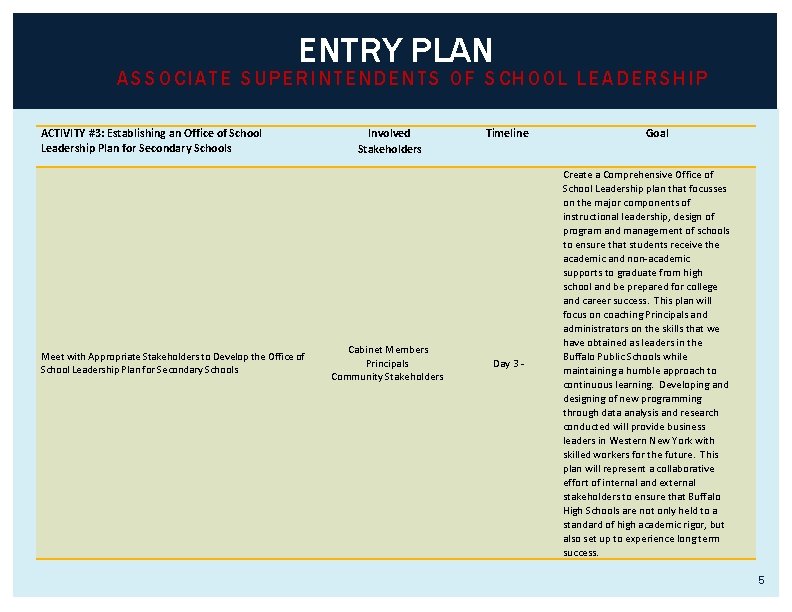
ENTRY PLAN ASSOCIATE SUPERINTENDENTS OF SCHOOL LEADERSHIP ACTIVITY #3: Establishing an Office of School Leadership Plan for Secondary Schools Meet with Appropriate Stakeholders to Develop the Office of School Leadership Plan for Secondary Schools Involved Stakeholders Cabinet Members Principals Community Stakeholders Timeline Day 3 - Goal Create a Comprehensive Office of School Leadership plan that focusses on the major components of instructional leadership, design of program and management of schools to ensure that students receive the academic and non-academic supports to graduate from high school and be prepared for college and career success. This plan will focus on coaching Principals and administrators on the skills that we have obtained as leaders in the Buffalo Public Schools while maintaining a humble approach to continuous learning. Developing and designing of new programming through data analysis and research conducted will provide business leaders in Western New York with skilled workers for the future. This plan will represent a collaborative effort of internal and external stakeholders to ensure that Buffalo High Schools are not only held to a standard of high academic rigor, but also set up to experience long term success. 5
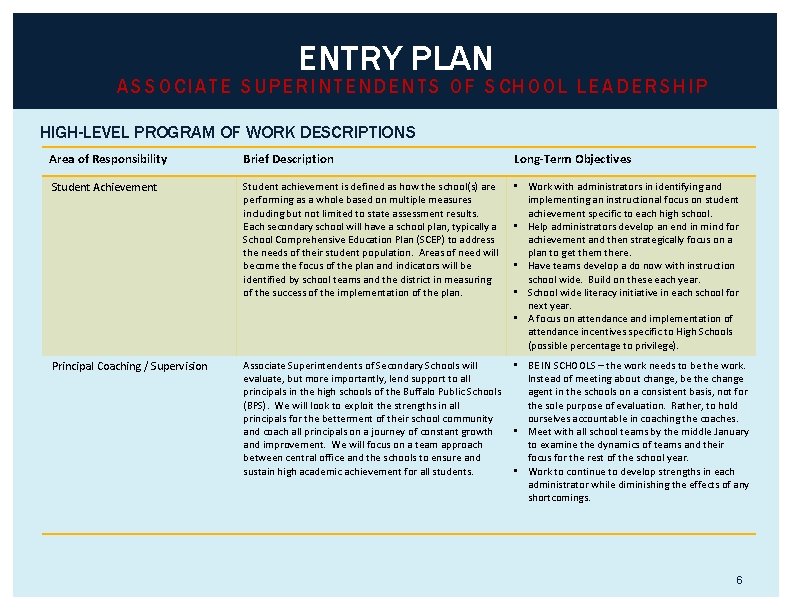
ENTRY PLAN ASSOCIATE SUPERINTENDENTS OF SCHOOL LEADERSHIP HIGH-LEVEL PROGRAM OF WORK DESCRIPTIONS Area of Responsibility Brief Description Long-Term Objectives Student Achievement Student achievement is defined as how the school(s) are performing as a whole based on multiple measures including but not limited to state assessment results. Each secondary school will have a school plan, typically a School Comprehensive Education Plan (SCEP) to address the needs of their student population. Areas of need will become the focus of the plan and indicators will be identified by school teams and the district in measuring of the success of the implementation of the plan. • Work with administrators in identifying and implementing an instructional focus on student achievement specific to each high school. • Help administrators develop an end in mind for achievement and then strategically focus on a plan to get them there. • Have teams develop a do now with instruction school wide. Build on these each year. • School wide literacy initiative in each school for next year. • A focus on attendance and implementation of attendance incentives specific to High Schools (possible percentage to privilege). Principal Coaching / Supervision Associate Superintendents of Secondary Schools will evaluate, but more importantly, lend support to all principals in the high schools of the Buffalo Public Schools (BPS). We will look to exploit the strengths in all principals for the betterment of their school community and coach all principals on a journey of constant growth and improvement. We will focus on a team approach between central office and the schools to ensure and sustain high academic achievement for all students. • BE IN SCHOOLS – the work needs to be the work. Instead of meeting about change, be the change agent in the schools on a consistent basis, not for the sole purpose of evaluation. Rather, to hold ourselves accountable in coaching the coaches. • Meet with all school teams by the middle January to examine the dynamics of teams and their focus for the rest of the school year. • Work to continue to develop strengths in each administrator while diminishing the effects of any shortcomings. 6
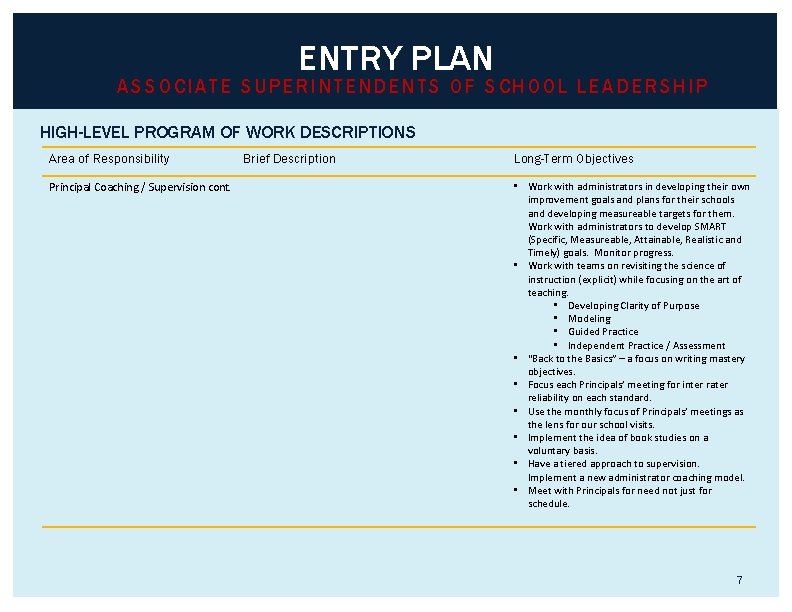
ENTRY PLAN ASSOCIATE SUPERINTENDENTS OF SCHOOL LEADERSHIP HIGH-LEVEL PROGRAM OF WORK DESCRIPTIONS Area of Responsibility Principal Coaching / Supervision cont. Brief Description Long-Term Objectives • Work with administrators in developing their own improvement goals and plans for their schools and developing measureable targets for them. Work with administrators to develop SMART (Specific, Measureable, Attainable, Realistic and Timely) goals. Monitor progress. • Work with teams on revisiting the science of instruction (explicit) while focusing on the art of teaching. • Developing Clarity of Purpose • Modeling • Guided Practice • Independent Practice / Assessment • “Back to the Basics” – a focus on writing mastery objectives. • Focus each Principals’ meeting for inter rater reliability on each standard. • Use the monthly focus of Principals’ meetings as the lens for our school visits. • Implement the idea of book studies on a voluntary basis. • Have a tiered approach to supervision. Implement a new administrator coaching model. • Meet with Principals for need not just for schedule. 7
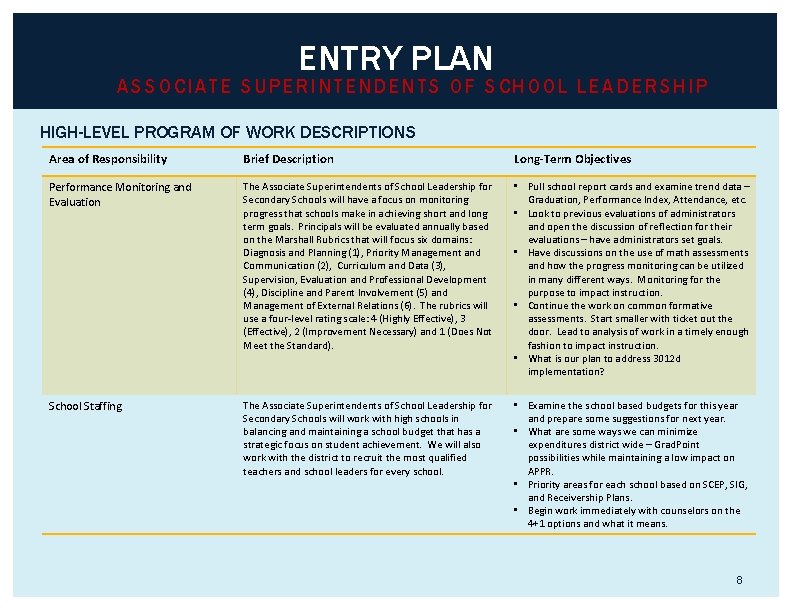
ENTRY PLAN ASSOCIATE SUPERINTENDENTS OF SCHOOL LEADERSHIP HIGH-LEVEL PROGRAM OF WORK DESCRIPTIONS Area of Responsibility Brief Description Long-Term Objectives Performance Monitoring and Evaluation The Associate Superintendents of School Leadership for Secondary Schools will have a focus on monitoring progress that schools make in achieving short and long term goals. Principals will be evaluated annually based on the Marshall Rubrics that will focus six domains: Diagnosis and Planning (1), Priority Management and Communication (2), Curriculum and Data (3), Supervision, Evaluation and Professional Development (4), Discipline and Parent Involvement (5) and Management of External Relations (6). The rubrics will use a four-level rating scale: 4 (Highly Effective), 3 (Effective), 2 (Improvement Necessary) and 1 (Does Not Meet the Standard). • Pull school report cards and examine trend data – Graduation, Performance Index, Attendance, etc. • Look to previous evaluations of administrators and open the discussion of reflection for their evaluations – have administrators set goals. • Have discussions on the use of math assessments and how the progress monitoring can be utilized in many different ways. Monitoring for the purpose to impact instruction. • Continue the work on common formative assessments. Start smaller with ticket out the door. Lead to analysis of work in a timely enough fashion to impact instruction. • What is our plan to address 3012 d implementation? School Staffing The Associate Superintendents of School Leadership for Secondary Schools will work with high schools in balancing and maintaining a school budget that has a strategic focus on student achievement. We will also work with the district to recruit the most qualified teachers and school leaders for every school. • Examine the school based budgets for this year and prepare some suggestions for next year. • What are some ways we can minimize expenditures district wide – Grad. Point possibilities while maintaining a low impact on APPR. • Priority areas for each school based on SCEP, SIG, and Receivership Plans. • Begin work immediately with counselors on the 4+1 options and what it means. 8
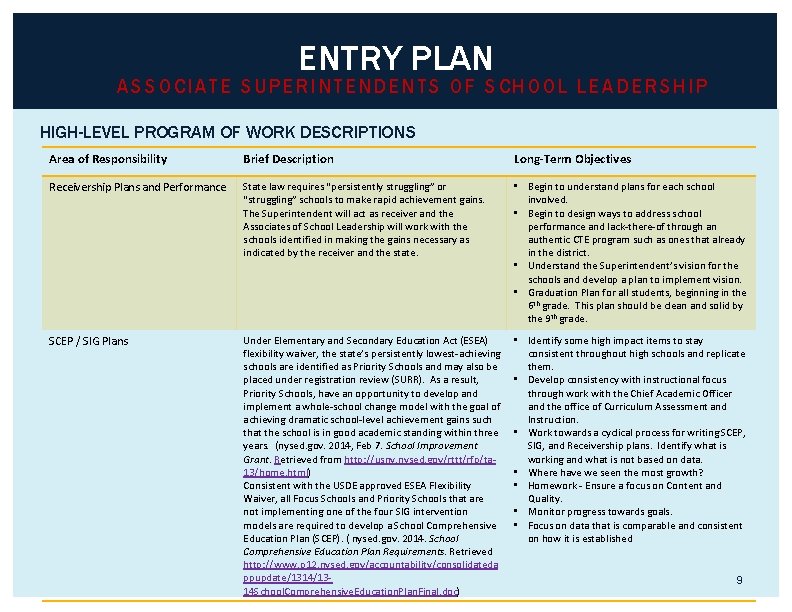
ENTRY PLAN ASSOCIATE SUPERINTENDENTS OF SCHOOL LEADERSHIP HIGH-LEVEL PROGRAM OF WORK DESCRIPTIONS Area of Responsibility Brief Description Long-Term Objectives Receivership Plans and Performance State law requires “persistently struggling” or “struggling” schools to make rapid achievement gains. The Superintendent will act as receiver and the Associates of School Leadership will work with the schools identified in making the gains necessary as indicated by the receiver and the state. • Begin to understand plans for each school involved. • Begin to design ways to address school performance and lack-there-of through an authentic CTE program such as ones that already in the district. • Understand the Superintendent’s vision for the schools and develop a plan to implement vision. • Graduation Plan for all students, beginning in the 6 th grade. This plan should be clean and solid by the 9 th grade. SCEP / SIG Plans Under Elementary and Secondary Education Act (ESEA) flexibility waiver, the state’s persistently lowest-achieving schools are identified as Priority Schools and may also be placed under registration review (SURR). As a result, Priority Schools, have an opportunity to develop and implement a whole-school change model with the goal of achieving dramatic school-level achievement gains such that the school is in good academic standing within three years. (nysed. gov. 2014, Feb 7. School Improvement Grant. Retrieved from http: //usny. nysed. gov/rttt/rfp/ta 13/home. html) Consistent with the USDE approved ESEA Flexibility Waiver, all Focus Schools and Priority Schools that are not implementing one of the four SIG intervention models are required to develop a School Comprehensive Education Plan (SCEP). ( nysed. gov. 2014. School Comprehensive Education Plan Requirements. Retrieved http: //www. p 12. nysed. gov/accountability/consolidateda ppupdate/1314 School. Comprehensive. Education. Plan. Final. doc) • Identify some high impact items to stay consistent throughout high schools and replicate them. • Develop consistency with instructional focus through work with the Chief Academic Officer and the office of Curriculum Assessment and Instruction. • Work towards a cyclical process for writing SCEP, SIG, and Receivership plans. Identify what is working and what is not based on data. • Where have we seen the most growth? • Homework - Ensure a focus on Content and Quality. • Monitor progress towards goals. • Focus on data that is comparable and consistent on how it is established 9
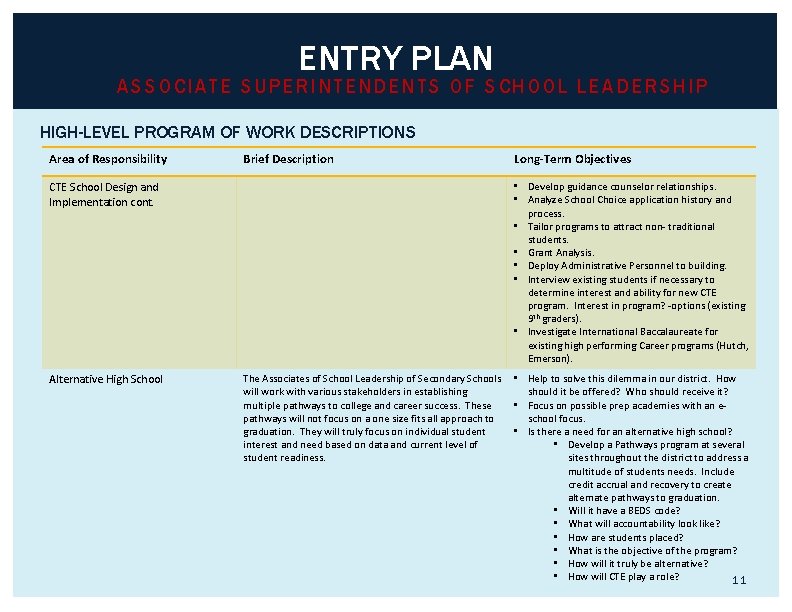
ENTRY PLAN ASSOCIATE SUPERINTENDENTS OF SCHOOL LEADERSHIP HIGH-LEVEL PROGRAM OF WORK DESCRIPTIONS Area of Responsibility Brief Description Long-Term Objectives CTE School Design and Implementation The Associates for School Leadership for Secondary Schools will work closely with the Director of Career and Technical Education (CTE), business partners and community stakeholders to evaluate our current CTE programs. We will explore the expansion of existing programs and the creation of new, sustainable programs throughout the district as a way to not only raise the level of academic achievement throughout the district, but also to offer our students choices and multiple pathways to graduation. • Develop more authentic CTE programs in our schools. • Establish District Wide Career Pathways Advisory Board consisting of local business leaders. Focus on Business needs for the future, targeted areas for programming (Strategic Plan). • Analyze data of existing programs to determine enrollment, effectiveness and viability for future. • Develop a complete plan through interpretation of data for a network of Career Pathways Schools to serve the changing needs of the WNY workforce. • Develop School based advisory boards for two Receivership high schools (South Park, Burgard) to assist in transforming existing CTE program and increase parent involvement. • Begin conversation regarding Math, Science, and Technology School and Bennett High School for future Career Pathways options with a possible focus on technology. • Investigate and develop through data analysis, the connections possible with BPS Adult Education Division and Northland Avenue Training Facility. • Dialogue with Workforce Development and Buffalo Niagara Partnership. • Professionally market and introduce the new Career Pathways programs to parents and families. • Redesign and implement a 7 th and 8 th grade CTE 10 interest survey.
ENTRY PLAN ASSOCIATE SUPERINTENDENTS OF SCHOOL LEADERSHIP HIGH-LEVEL PROGRAM OF WORK DESCRIPTIONS Area of Responsibility Brief Description CTE School Design and Implementation cont. Alternative High School Long-Term Objectives • Develop guidance counselor relationships. • Analyze School Choice application history and process. • Tailor programs to attract non- traditional students. • Grant Analysis. • Deploy Administrative Personnel to building. • Interview existing students if necessary to determine interest and ability for new CTE program. Interest in program? -options (existing 9 th graders). • Investigate International Baccalaureate for existing high performing Career programs (Hutch, Emerson). The Associates of School Leadership of Secondary Schools will work with various stakeholders in establishing multiple pathways to college and career success. These pathways will not focus on a one size fits all approach to graduation. They will truly focus on individual student interest and need based on data and current level of student readiness. • Help to solve this dilemma in our district. How should it be offered? Who should receive it? • Focus on possible prep academies with an eschool focus. • Is there a need for an alternative high school? • Develop a Pathways program at several sites throughout the district to address a multitude of students needs. Include credit accrual and recovery to create alternate pathways to graduation. • Will it have a BEDS code? • What will accountability look like? • How are students placed? • What is the objective of the program? • How will it truly be alternative? • How will CTE play a role? 11
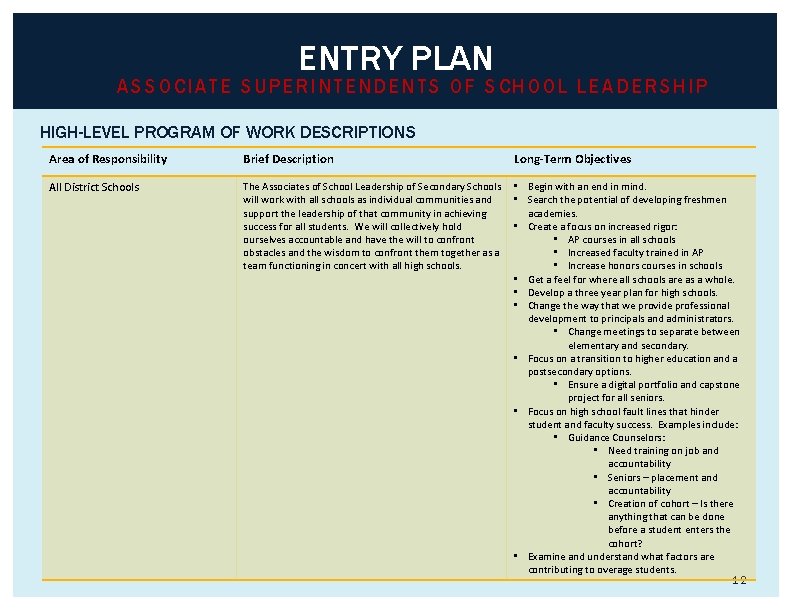
ENTRY PLAN ASSOCIATE SUPERINTENDENTS OF SCHOOL LEADERSHIP HIGH-LEVEL PROGRAM OF WORK DESCRIPTIONS Area of Responsibility Brief Description Long-Term Objectives All District Schools The Associates of School Leadership of Secondary Schools will work with all schools as individual communities and support the leadership of that community in achieving success for all students. We will collectively hold ourselves accountable and have the will to confront obstacles and the wisdom to confront them together as a team functioning in concert with all high schools. • Begin with an end in mind. • Search the potential of developing freshmen academies. • Create a focus on increased rigor: • AP courses in all schools • Increased faculty trained in AP • Increase honors courses in schools • Get a feel for where all schools are as a whole. • Develop a three year plan for high schools. • Change the way that we provide professional development to principals and administrators. • Change meetings to separate between elementary and secondary. • Focus on a transition to higher education and a postsecondary options. • Ensure a digital portfolio and capstone project for all seniors. • Focus on high school fault lines that hinder student and faculty success. Examples include: • Guidance Counselors: • Need training on job and accountability • Seniors – placement and accountability • Creation of cohort – Is there anything that can be done before a student enters the cohort? • Examine and understand what factors are contributing to overage students. 12