English as a Second Language week 2 Laura






- Slides: 15
English as a Second Language week 2 Laura Rupp l. m. rupp@vu. nl office hour: Tue 11 -12
Programme n Topic: English in the Netherlands - Language attitudes – why do we study them? - Attitudes towards English n Course work
Edwards (2014: 11) Attitude Functions in society institutionalisation Linguistic forms codification
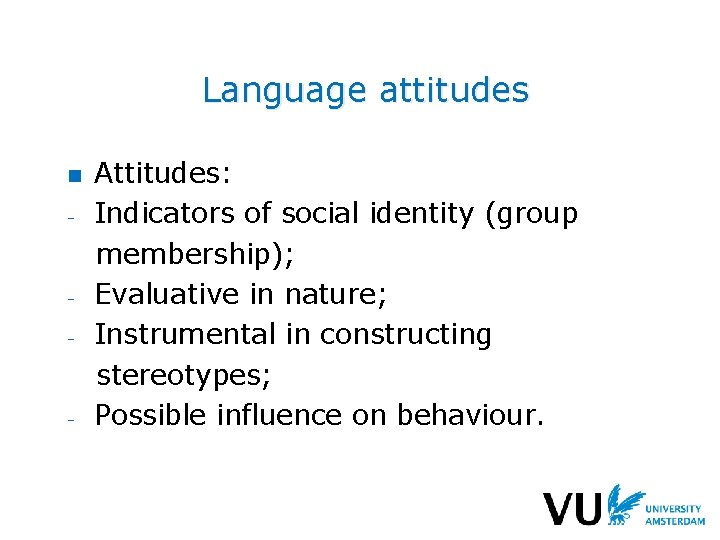
Language attitudes n ₋ ₋ Attitudes: Indicators of social identity (group membership); Evaluative in nature; Instrumental in constructing stereotypes; Possible influence on behaviour.
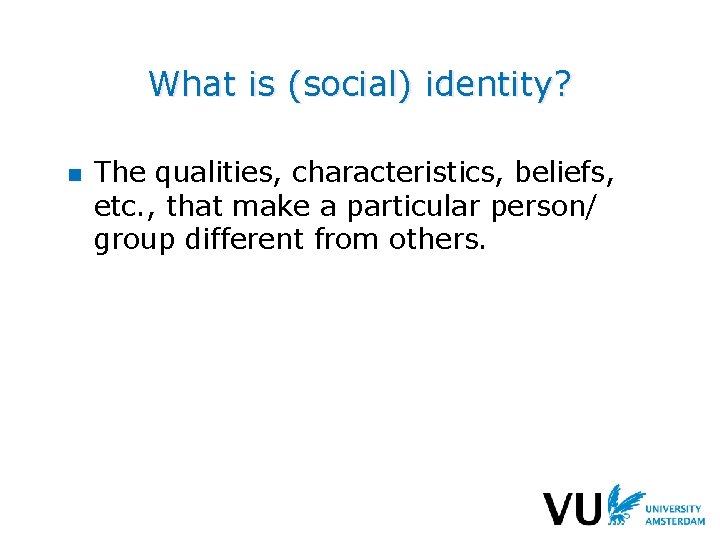
What is (social) identity? n The qualities, characteristics, beliefs, etc. , that make a particular person/ group different from others.
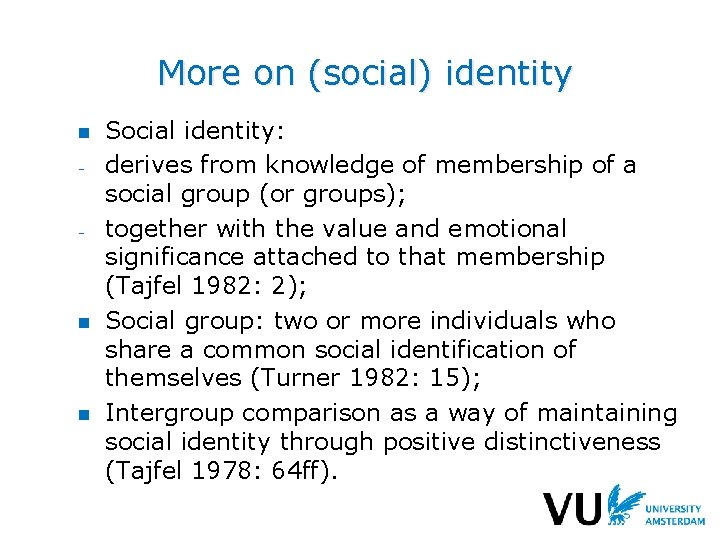
More on (social) identity n ₋ ₋ n n Social identity: derives from knowledge of membership of a social group (or groups); together with the value and emotional significance attached to that membership (Tajfel 1982: 2); Social group: two or more individuals who share a common social identification of themselves (Turner 1982: 15); Intergroup comparison as a way of maintaining social identity through positive distinctiveness (Tajfel 1978: 64 ff).
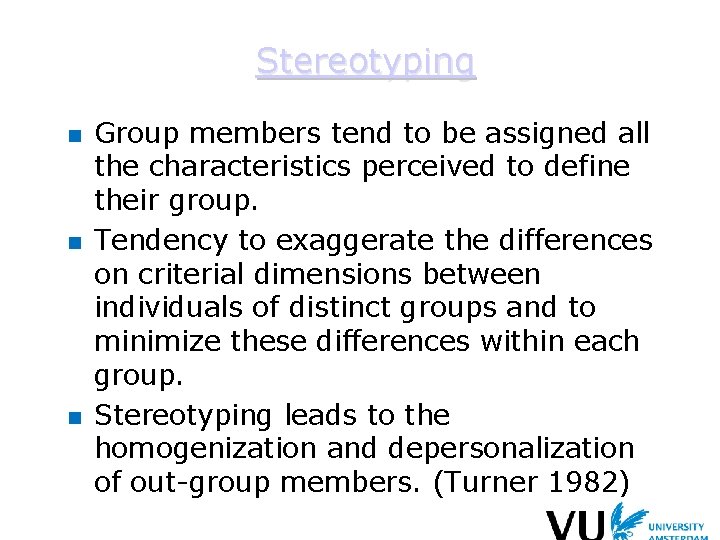
Stereotyping n n n Group members tend to be assigned all the characteristics perceived to define their group. Tendency to exaggerate the differences on criterial dimensions between individuals of distinct groups and to minimize these differences within each group. Stereotyping leads to the homogenization and depersonalization of out-group members. (Turner 1982)
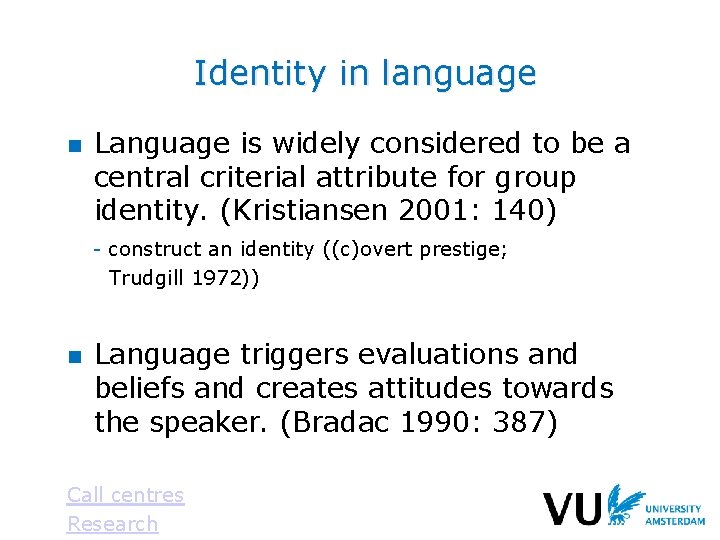
Identity in language n Language is widely considered to be a central criterial attribute for group identity. (Kristiansen 2001: 140) - construct an identity ((c)overt prestige; Trudgill 1972)) n Language triggers evaluations and beliefs and creates attitudes towards the speaker. (Bradac 1990: 387) Call centres Research
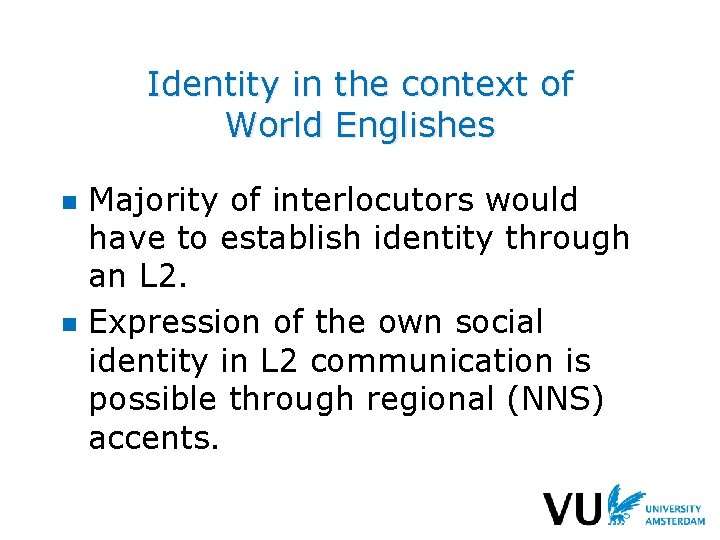
Identity in the context of World Englishes n n Majority of interlocutors would have to establish identity through an L 2. Expression of the own social identity in L 2 communication is possible through regional (NNS) accents.
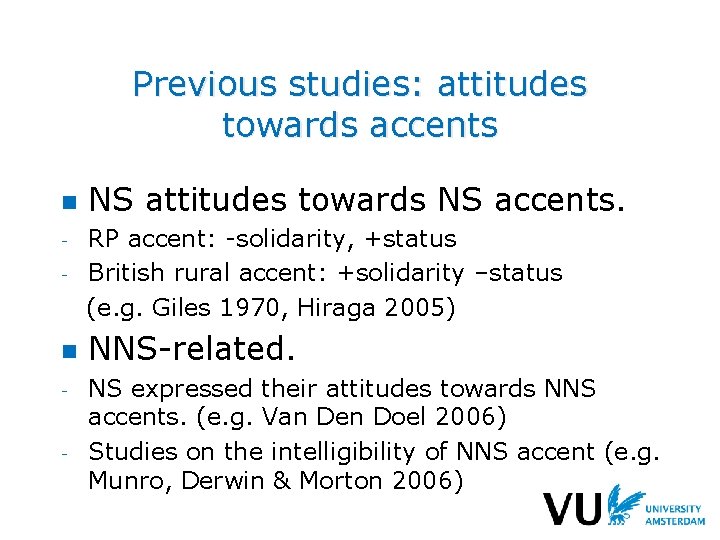
Previous studies: attitudes towards accents n NS attitudes towards NS accents. - RP accent: -solidarity, +status British rural accent: +solidarity –status (e. g. Giles 1970, Hiraga 2005) n NNS-related. - - NS expressed their attitudes towards NNS accents. (e. g. Van Den Doel 2006) Studies on the intelligibility of NNS accent (e. g. Munro, Derwin & Morton 2006)
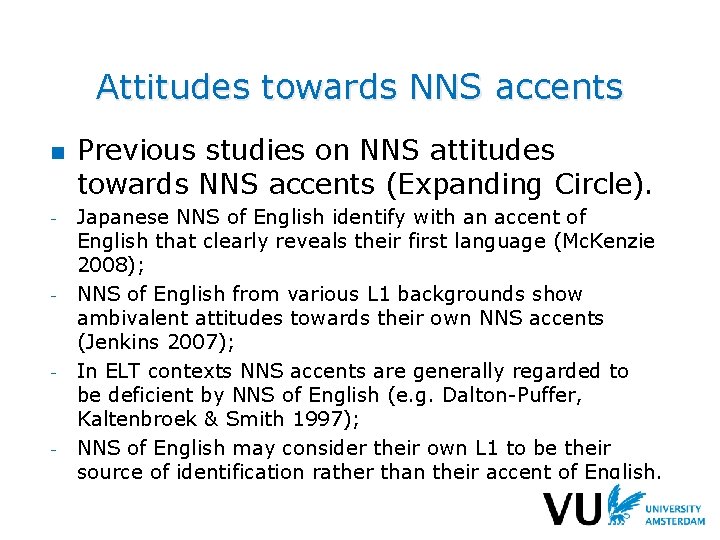
Attitudes towards NNS accents n - - Previous studies on NNS attitudes towards NNS accents (Expanding Circle). Japanese NNS of English identify with an accent of English that clearly reveals their first language (Mc. Kenzie 2008); NNS of English from various L 1 backgrounds show ambivalent attitudes towards their own NNS accents (Jenkins 2007); In ELT contexts NNS accents are generally regarded to be deficient by NNS of English (e. g. Dalton-Puffer, Kaltenbroek & Smith 1997); NNS of English may consider their own L 1 to be their source of identification rather than their accent of English.
Edwards’s attitude survey 1. 2. 3. 4. 5. Learning English Using English Perceived competence Models and varieties of English The status of English and Dutch
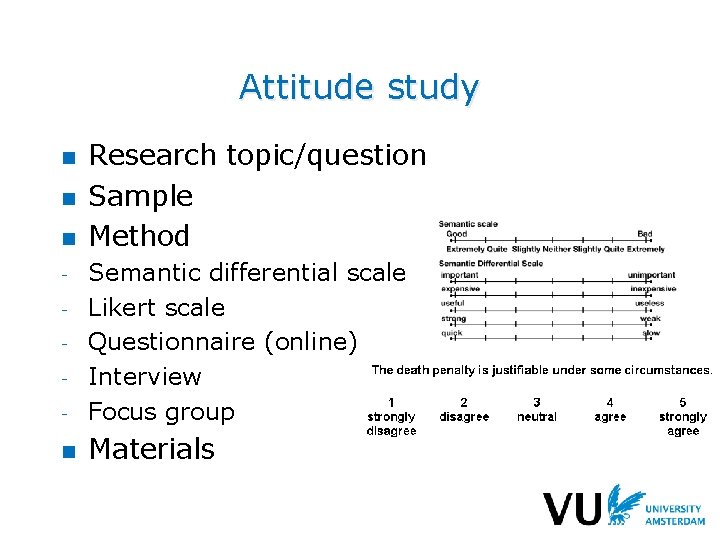
Attitude study n n n Research topic/question Sample Method - Semantic differential scale Likert scale Questionnaire (online) Interview Focus group n Materials -
English in the Netherlands Should the English used in the Netherlands be considered a secondlanguage variety or should it simply be regarded as learner English?
Course work