Engineering Mechanics L 21 Impact Indian Institute of


- Slides: 13
Engineering Mechanics L 21: Impact Indian Institute of Technology Jodhpur 23 -02 -2021 Engineering Mechanics 1
Impact impulse and momentum principles have important use in describing the behavior of colliding bodies. Impact: collision between two bodies and is characterized by the generation of relatively large contact forces over a very short interval of time. It is important to realize that an impact is a very complex event involving material deformation and recovery and the generation of heat and sound. Small changes in the impact conditions may cause large changes in the impact process and thus in the conditions immediately followed We must be careful not to rely heavily on the results of impact calculations. 23 -02 -2021 Engineering Mechanics 2
Direct Central Impact Direct central impact : collision occurs with the contact forces directed along the line of centers. This condition is called direct central impact Conservation of linear momentum (a) Before impact v 1 v 2 m 1 m m 22 (b) Maximum deformation during impact m 1 v 0 m 2 v 1′ (c) After impact 23 -02 -2021 Engineering Mechanics m 1 v 2′ m 2 3
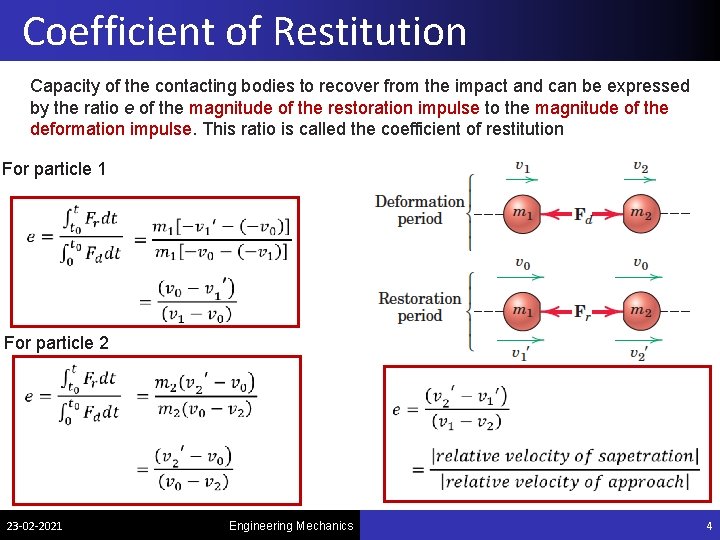
Coefficient of Restitution Capacity of the contacting bodies to recover from the impact and can be expressed by the ratio e of the magnitude of the restoration impulse to the magnitude of the deformation impulse. This ratio is called the coefficient of restitution For particle 1 For particle 2 23 -02 -2021 Engineering Mechanics 4
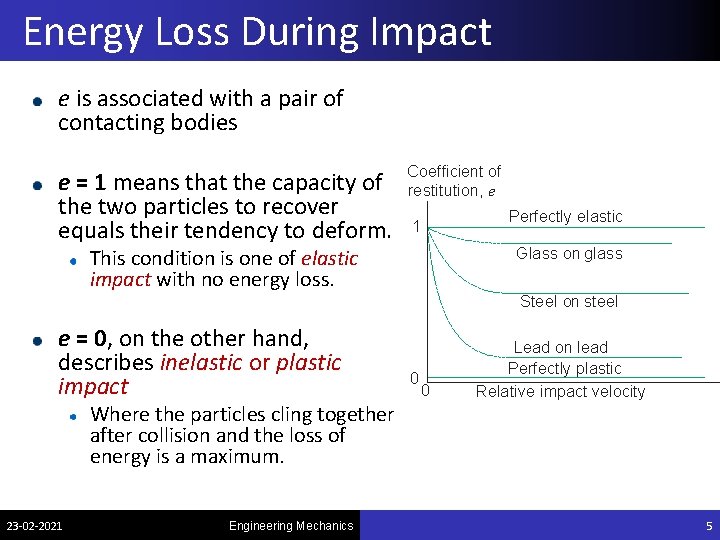
Energy Loss During Impact e is associated with a pair of contacting bodies e = 1 means that the capacity of the two particles to recover equals their tendency to deform. Coefficient of restitution, e Perfectly elastic 1 Glass on glass This condition is one of elastic impact with no energy loss. Steel on steel e = 0, on the other hand, describes inelastic or plastic impact 0 0 Lead on lead Perfectly plastic Relative impact velocity Where the particles cling together after collision and the loss of energy is a maximum. 23 -02 -2021 Engineering Mechanics 5
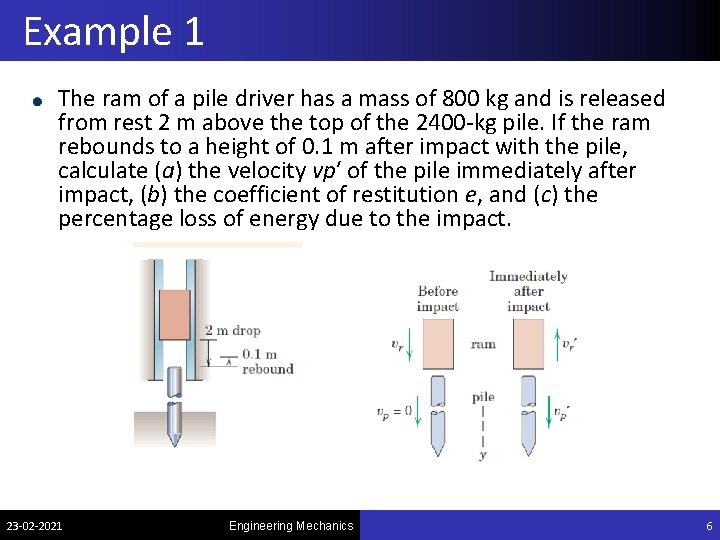
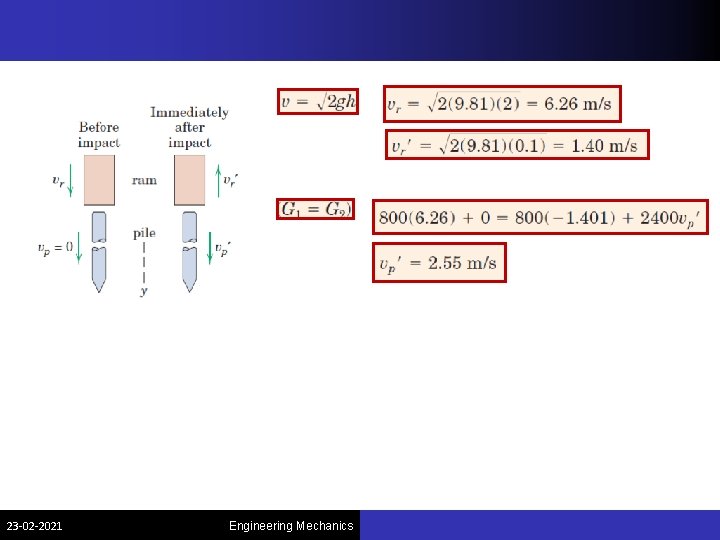
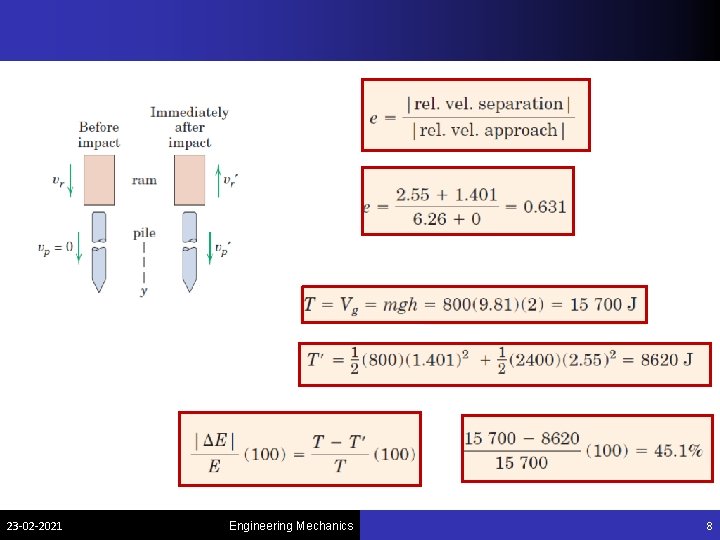
Example 1 The ram of a pile driver has a mass of 800 kg and is released from rest 2 m above the top of the 2400 -kg pile. If the ram rebounds to a height of 0. 1 m after impact with the pile, calculate (a) the velocity vp′ of the pile immediately after impact, (b) the coefficient of restitution e, and (c) the percentage loss of energy due to the impact. 23 -02 -2021 Engineering Mechanics 6
23 -02 -2021 Engineering Mechanics
23 -02 -2021 Engineering Mechanics 8
Oblique Central Impact The directions of the velocity vectors are measured from the direction tangent to the contacting surfaces, n n m 1 v 1 |F| v 1 m 2 (a) 1 1 2 2 m 2 F t – F v 2 (b) (c) 0 0 t Time, t (e) (d) 1. Momentum of the system is conserved in the n-direction 3. The coefficient of restitution 2. momentum for each particle is conserved in the t-direction Four equations are used to solved for velocities post impact 23 -02 -2021 Engineering Mechanics 9
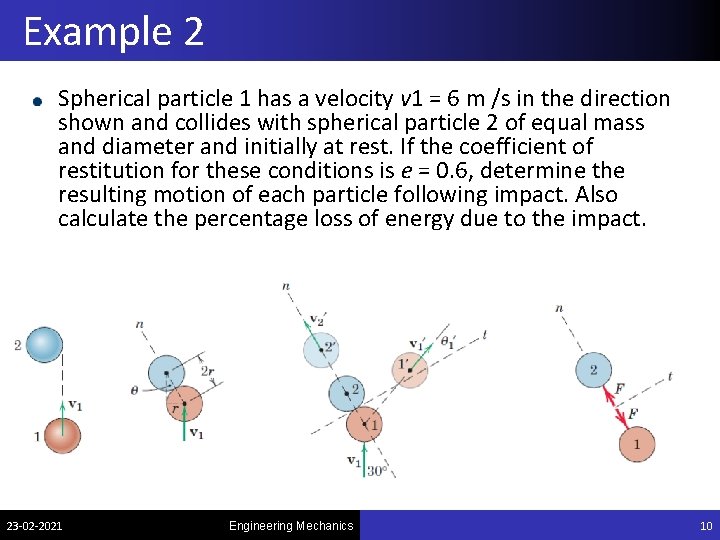
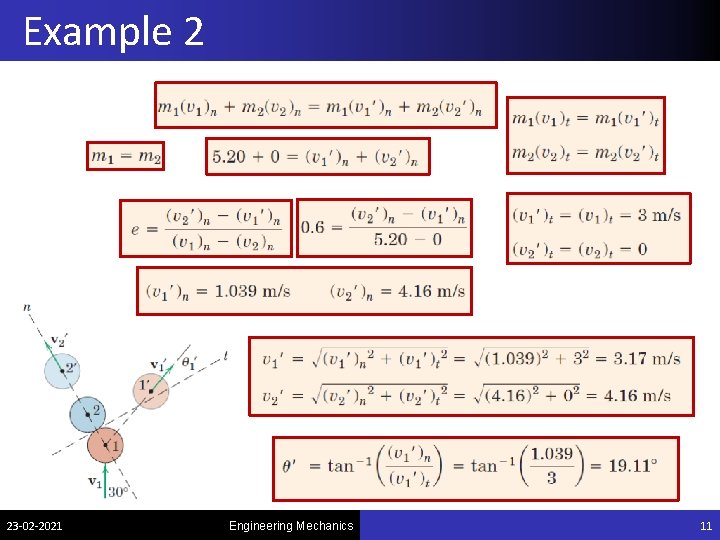
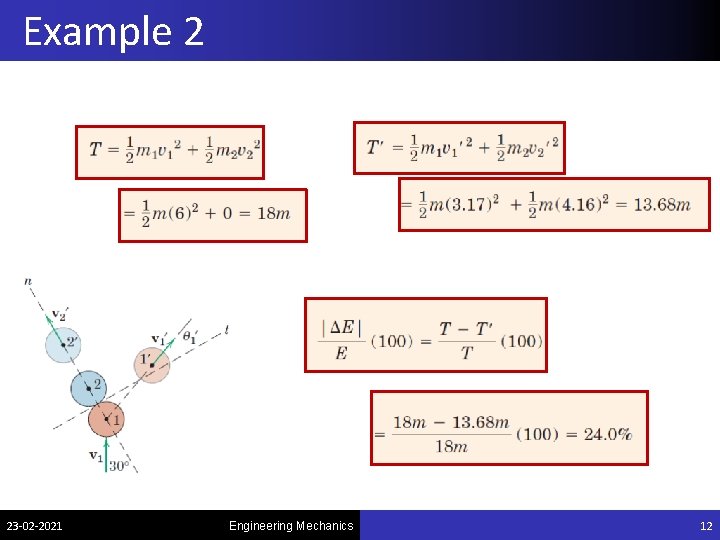
Example 2 Spherical particle 1 has a velocity v 1 = 6 m /s in the direction shown and collides with spherical particle 2 of equal mass and diameter and initially at rest. If the coefficient of restitution for these conditions is e = 0. 6, determine the resulting motion of each particle following impact. Also calculate the percentage loss of energy due to the impact. 23 -02 -2021 Engineering Mechanics 10
Example 2 23 -02 -2021 Engineering Mechanics 11
Example 2 23 -02 -2021 Engineering Mechanics 12
References : Thanking you 23 -02 -2021 13