
Encadre par samai djamal et cocadr par khaled
- Slides: 1
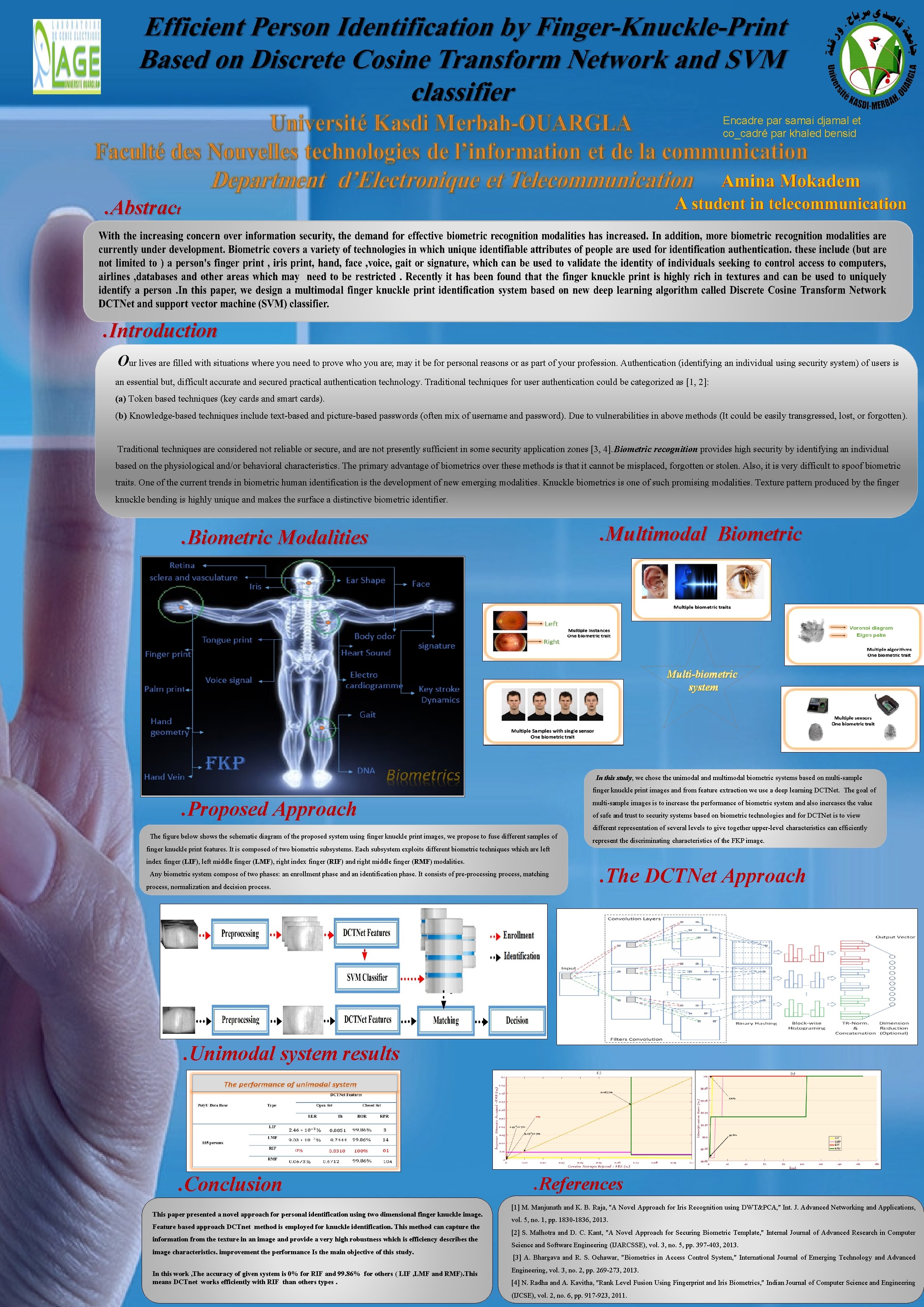
Encadre par samai djamal et co_cadré par khaled bensid . Abstract . Introduction Our lives are filled with situations where you need to prove who you are; may it be for personal reasons or as part of your profession. Authentication (identifying an individual using security system) of users is an essential but, difficult accurate and secured practical authentication technology. Traditional techniques for user authentication could be categorized as [1, 2]: (a) Token based techniques (key cards and smart cards). (b) Knowledge-based techniques include text-based and picture-based passwords (often mix of username and password). Due to vulnerabilities in above methods (It could be easily transgressed, lost, or forgotten). Traditional techniques are considered not reliable or secure, and are not presently sufficient in some security application zones [3, 4]. Biometric recognition provides high security by identifying an individual based on the physiological and/or behavioral characteristics. The primary advantage of biometrics over these methods is that it cannot be misplaced, forgotten or stolen. Also, it is very difficult to spoof biometric traits. One of the current trends in biometric human identification is the development of new emerging modalities. Knuckle biometrics is one of such promising modalities. Texture pattern produced by the finger knuckle bending is highly unique and makes the surface a distinctive biometric identifier. . Multimodal Biometric Modalities Multi-biometric system In this study, we chose the unimodal and multimodal biometric systems based on multi-sample finger knuckle print images and from feature extraction we use a deep learning DCTNet. The goal of . Proposed Approach multi-sample images is to increase the performance of biometric system and also increases the value of safe and trust to security systems based on biometric technologies and for DCTNet is to view different representation of several levels to give together upper-level characteristics can efficiently The figure below shows the schematic diagram of the proposed system using finger knuckle print images, we propose to fuse different samples of represent the discriminating characteristics of the FKP image. finger knuckle print features. It is composed of two biometric subsystems. Each subsystem exploits different biometric techniques which are left index finger (LIF), left middle finger (LMF), right index finger (RIF) and right middle finger (RMF) modalities. Any biometric system compose of two phases: an enrollment phase and an identification phase. It consists of pre-processing process, matching process, normalization and decision process. . The DCTNet Approach . Unimodal system results . Conclusion This paper presented a novel approach for personal identification using two dimensional finger knuckle image. Feature based approach DCTnet method is employed for knuckle identification. This method can capture the information from the texture in an image and provide a very high robustness which is efficiency describes the image characteristics. improvement the performance Is the main objective of this study. In this work , The accuracy of given system is 0% for RIF and 99. 86% for others ( LIF , LMF and RMF). This means DCTnet works efficiently with RIF than others types. . References [1] M. Manjunath and K. B. Raja, "A Novel Approach for Iris Recognition using DWT&PCA, " Int. J. Advanced Networking and Applications, vol. 5, no. 1, pp. 1830 -1836, 2013. [2] S. Malhotra and D. C. Kant, "A Novel Approach for Securing Biometric Template, " Internal Journal of Advanced Research in Computer Science and Software Engineering (IJARCSSE), vol. 3, no. 5, pp. 397 -403, 2013. [3] A. Bhargava and R. S. Ochawar, "Biometrics in Access Control System, " International Journal of Emerging Technology and Advanced Engineering, vol. 3, no. 2, pp. 269 -273, 2013. [4] N. Radha and A. Kavitha, "Rank Level Fusion Using Fingerprint and Iris Biometrics, " Indian Journal of Computer Science and Engineering (IJCSE), vol. 2, no. 6, pp. 917 -923, 2011.

