Emile Gouws The impact of Covid 19 on
- Slides: 9
Emile Gouws The impact of Covid‐ 19 on the autistic community.
• Covid‐ 19 and the consequences of the hard lockdown • The pandemic magnified pre‐existing inequalities • Public travel restrictions • The announcement of the National lockdown had a tremendous impact on Neurodiverse individuals and their families from low to middle income countries • Social distancing and other measures that disrupt routine cause a great sense of anxiety and frustration. • New words and phrases like “social distancing”, “the new normal”, and “lockdown” introduced change in technology and information and other avenues such as education.
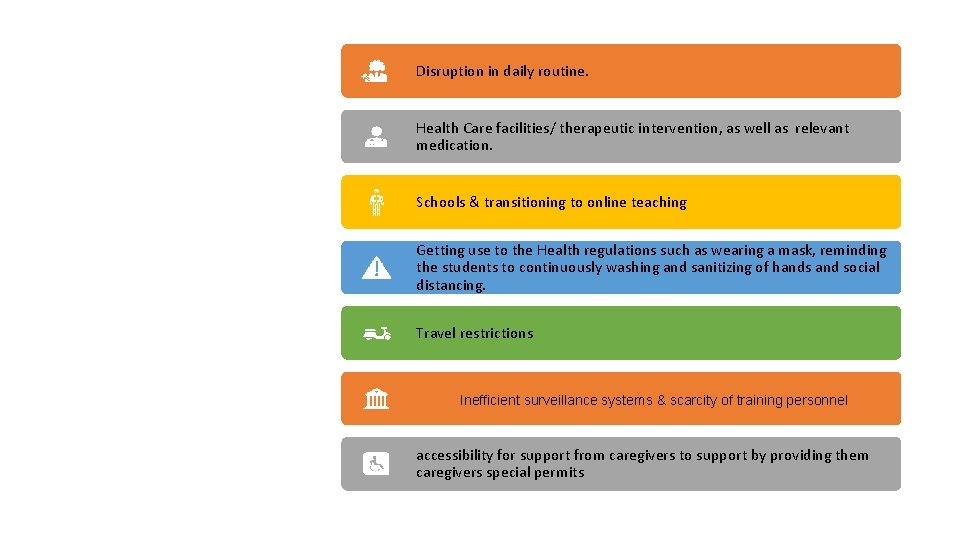
Disruption in daily routine. Health Care facilities/ therapeutic intervention, as well as relevant medication. Schools & transitioning to online teaching Getting use to the Health regulations such as wearing a mask, reminding the students to continuously washing and sanitizing of hands and social distancing. Travel restrictions Inefficient surveillance systems & scarcity of training personnel accessibility for support from caregivers to support by providing them caregivers special permits
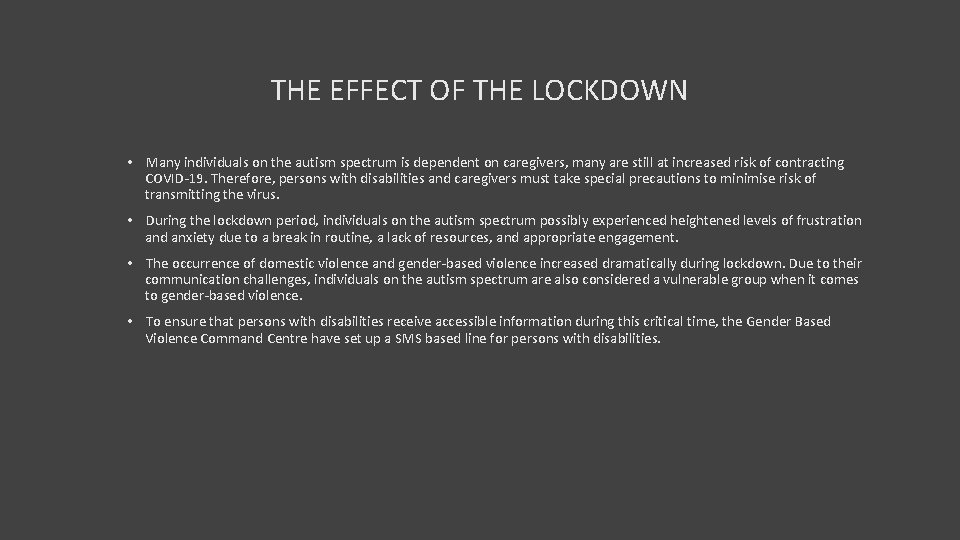
THE EFFECT OF THE LOCKDOWN • Many individuals on the autism spectrum is dependent on caregivers, many are still at increased risk of contracting COVID‐ 19. Therefore, persons with disabilities and caregivers must take special precautions to minimise risk of transmitting the virus. • During the lockdown period, individuals on the autism spectrum possibly experienced heightened levels of frustration and anxiety due to a break in routine, a lack of resources, and appropriate engagement. • The occurrence of domestic violence and gender‐based violence increased dramatically during lockdown. Due to their communication challenges, individuals on the autism spectrum are also considered a vulnerable group when it comes to gender‐based violence. • To ensure that persons with disabilities receive accessible information during this critical time, the Gender Based Violence Command Centre have set up a SMS based line for persons with disabilities.
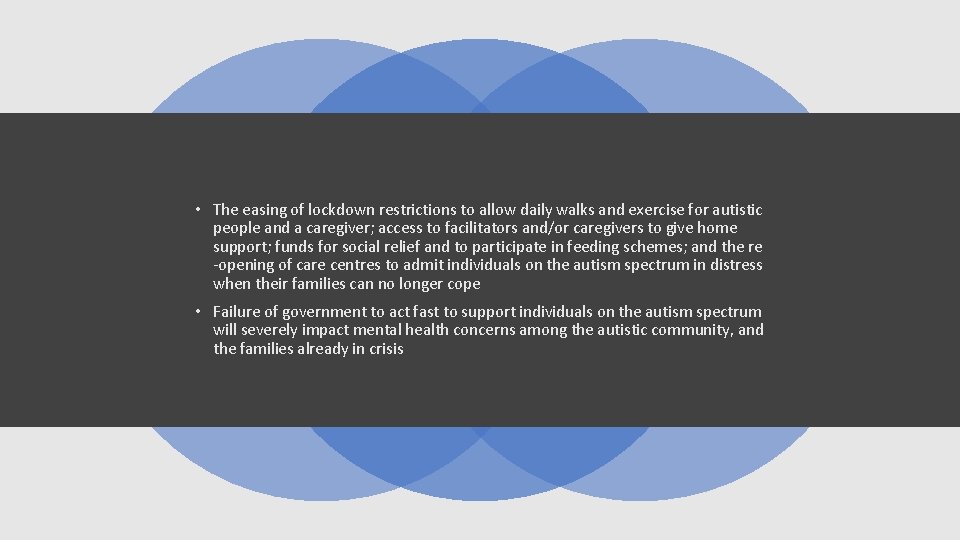
• The easing of lockdown restrictions to allow daily walks and exercise for autistic people and a caregiver; access to facilitators and/or caregivers to give home support; funds for social relief and to participate in feeding schemes; and the re ‐opening of care centres to admit individuals on the autism spectrum in distress when their families can no longer cope • Failure of government to act fast to support individuals on the autism spectrum will severely impact mental health concerns among the autistic community, and the families already in crisis
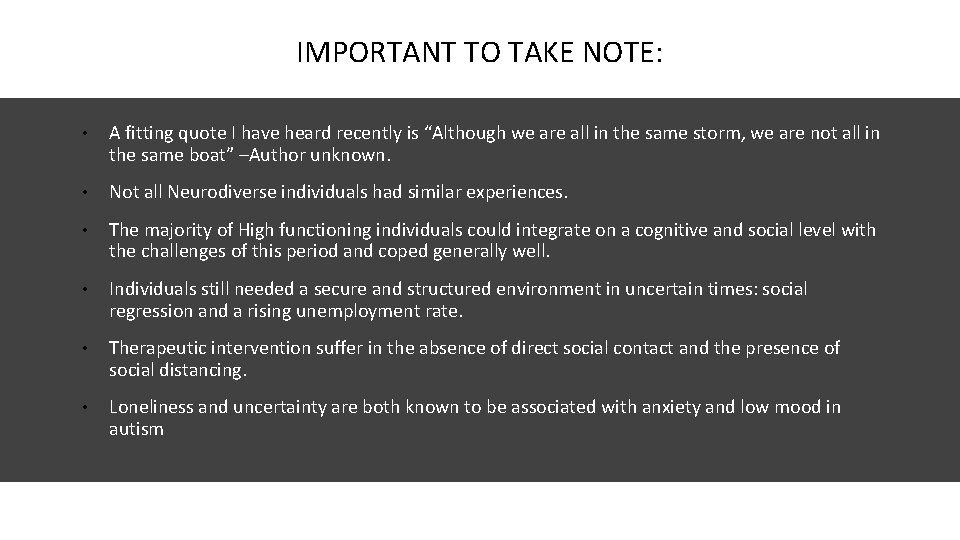
IMPORTANT TO TAKE NOTE: • A fitting quote I have heard recently is “Although we are all in the same storm, we are not all in the same boat” –Author unknown. • Not all Neurodiverse individuals had similar experiences. • The majority of High functioning individuals could integrate on a cognitive and social level with the challenges of this period and coped generally well. • Individuals still needed a secure and structured environment in uncertain times: social regression and a rising unemployment rate. • Therapeutic intervention suffer in the absence of direct social contact and the presence of social distancing. • Loneliness and uncertainty are both known to be associated with anxiety and low mood in autism
Emergency Measures (EMs) • The virtual administration of measures that are only validated as face‐to‐ face instruments, which at a minimum will increase noise in measurement, and render the original power analysis and sample calculations inadequate. In addition, and of relevance to also many non‐regulated, psychosocial studies, the ability to code live social interactions (e. g. child‐parent dyads), is significantly impaired. • The effect of pandemic related stress on pre‐specified outcomes such as anxiety, emotion regulation and repetitive behaviours, rendering baseline assessments problematic. • The effect of EMs on the ability to demonstrate improvement in outcomes that require settings no longer accessible, such as schools, extracurricular spaces, or employment environments. Outcomes related to socialization have been particularly impacted. • The effect of EMs on the ability of investigators to collect biomarker data, such as imaging / EEG. Given the heterogeneity of ASD, a large effort over recent years to include biomarkers that may identify more biologically homogenous subgroups in trials e. g. 1, 2 has come to a halt. • Delays in recruitment, impacting both existing protocols but also decisions about when to start new protocols given potential upcoming waves of COVID‐ 19.
HOW HAS IT AFFECTED ORGANIZATIONS? • Letter from 8 of the Autism Organizations • Rendering of supportive services to autistic persons, their families and/or caregivers. • The packing of Educational Support materials for emotional, social, cognitive and physical development of autistic children • Receive and distribute essential donations such as sanitary towels and diapers • Counselling services available • All training and awareness with groups of people • All face‐to‐face meetings related to the core function of the organisation
• In this letter we urgently asked for the regulations on exercise to be relaxed, as many autistic people (both adults and children) rely on walks or getting out of the house to help them regulate their emotions and anxiety levels.