Emergency Management in Turkey Disasters Experienced Lessons Learned
- Slides: 19
Emergency Management in Turkey: Disasters Experienced, Lessons Learned, and Recommendations for the Future Derin N. Ural, Ph. D. Associate Professor and Founding Director, Center of Excellence for Disaster Management, Istanbul Technical University Turkey
Outline I. Introduction II. Policy Timeline Milestones for National Emergency Management III. SWOT Analysis IV. Challenges 2
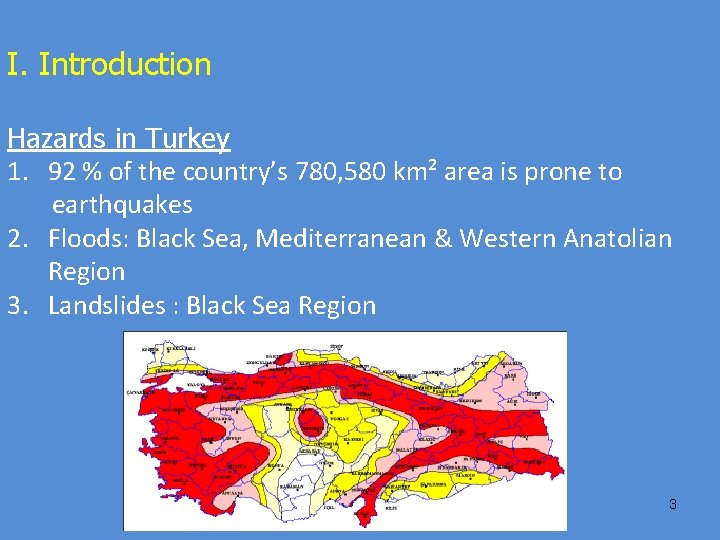
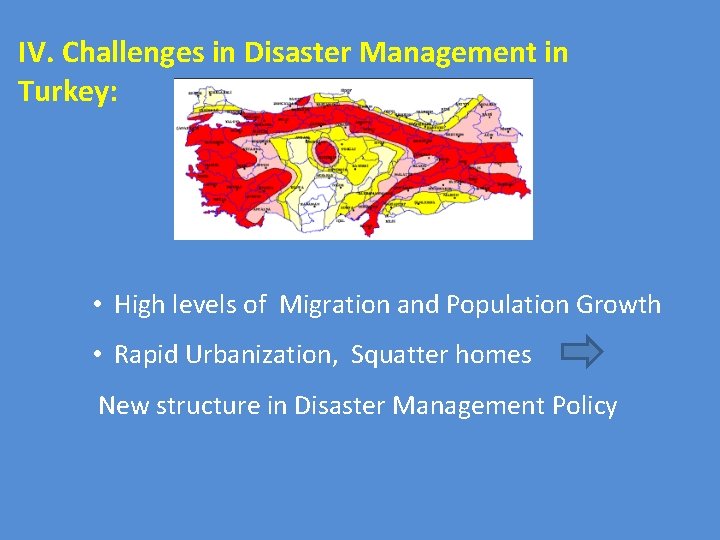
I. Introduction Hazards in Turkey 1. 92 % of the country’s 780, 580 km² area is prone to earthquakes 2. Floods: Black Sea, Mediterranean & Western Anatolian Region 3. Landslides : Black Sea Region 3
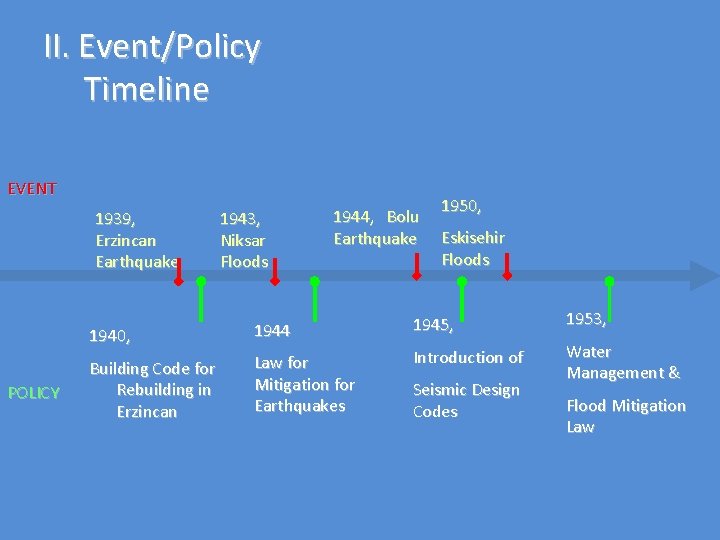
II. Event/Policy Timeline EVENT 1939, Erzincan Earthquake POLICY 1943, Niksar Floods 1944, Bolu Earthquake 1950, Eskisehir Floods 1940, 1944 1945, 1953, Building Code for Rebuilding in Erzincan Law for Mitigation for Earthquakes Introduction of Water Management & Seismic Design Codes Flood Mitigation Law
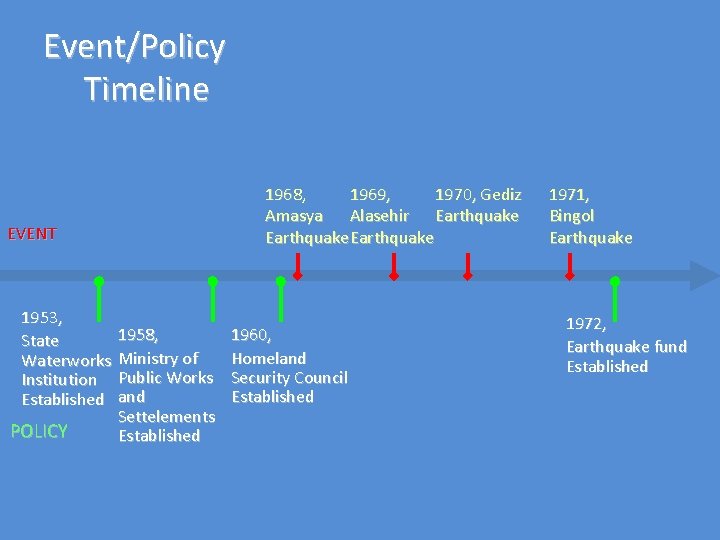
Event/Policy Timeline 1968, 1969, 1970, Gediz Amasya Alasehir Earthquake EVENT 1953, State Waterworks Institution Established POLICY 1958, Ministry of Public Works and Settelements Established 1960, Homeland Security Council Established 1971, Bingol Earthquake 1972, Earthquake fund Established
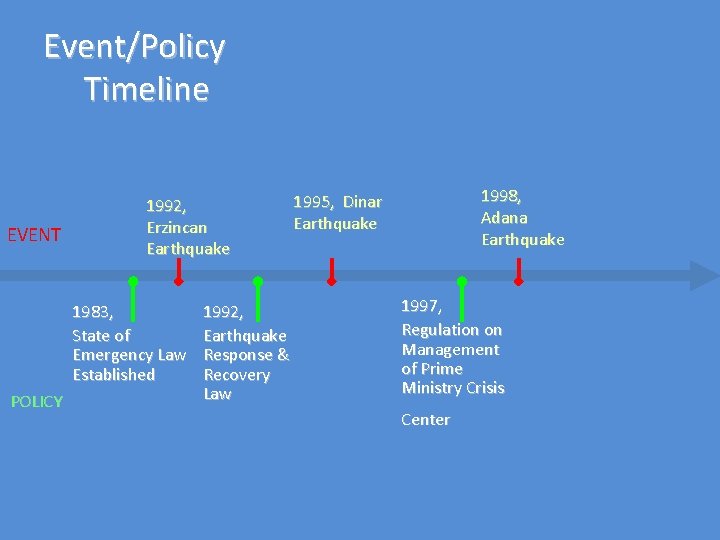
Event/Policy Timeline EVENT 1992, Erzincan Earthquake 1983, State of Emergency Law Established POLICY 1992, Earthquake Response & Recovery Law 1998, Adana Earthquake 1995, Dinar Earthquake 1997, Regulation on Management of Prime Ministry Crisis Center
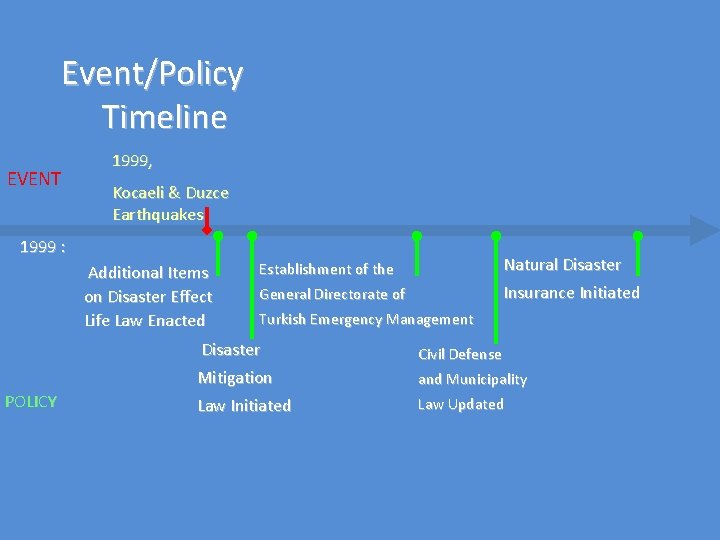
Event/Policy Timeline EVENT 1999, Kocaeli & Duzce Earthquakes 1999 : Additional Items on Disaster Effect Life Law Enacted POLICY Establishment of the Natural Disaster General Directorate of Insurance Initiated Turkish Emergency Management Disaster Civil Defense Mitigation and Municipality Law Initiated Law Updated
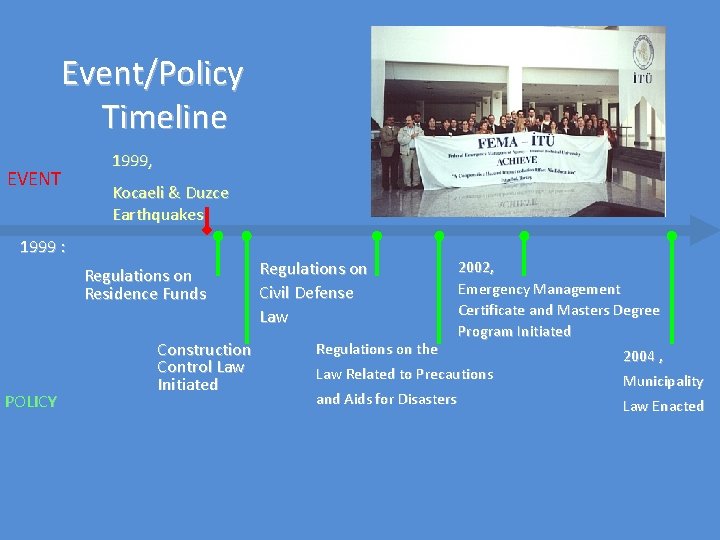
Event/Policy Timeline EVENT 1999, Kocaeli & Duzce Earthquakes 1999 : Regulations on Residence Funds POLICY Construction Control Law Initiated Regulations on Civil Defense Law Regulations on the 2002, Emergency Management Certificate and Masters Degree Program Initiated Law Related to Precautions and Aids for Disasters 2004 , Municipality Law Enacted
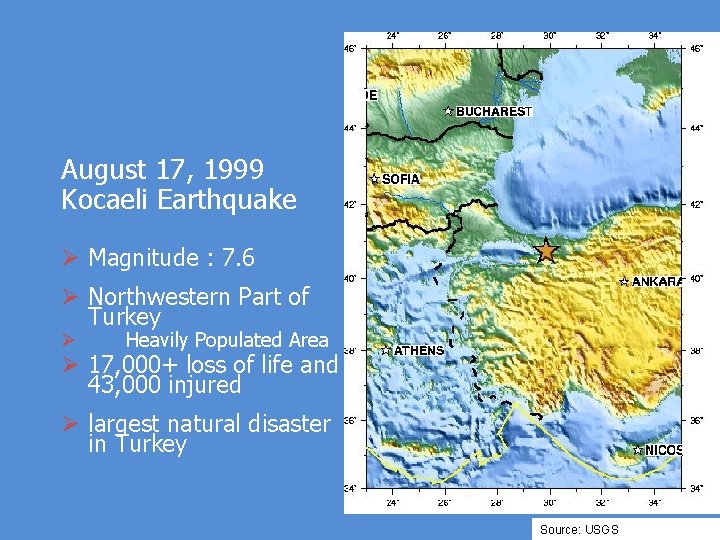
August 17, 1999 Kocaeli Earthquake Ø Magnitude : 7. 6 Ø Northwestern Part of Turkey Ø Heavily Populated Area Ø 17, 000+ loss of life and 43, 000 injured Ø largest natural disaster in Turkey Source: USGS
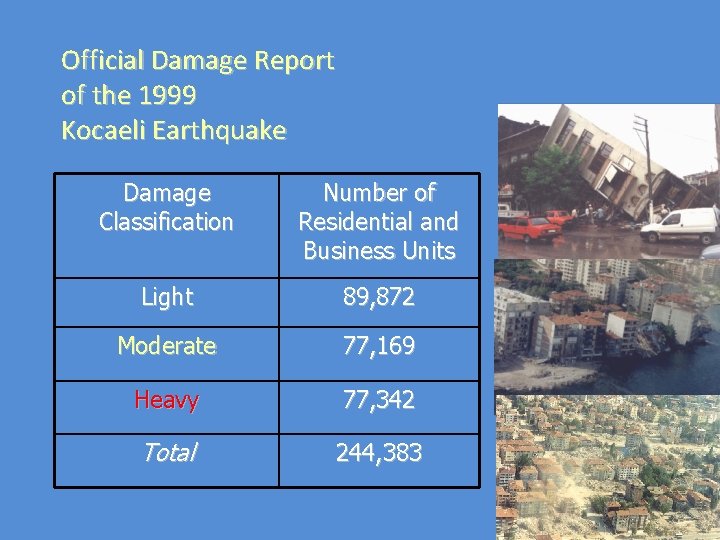
Official Damage Report of the 1999 Kocaeli Earthquake Damage Classification Number of Residential and Business Units Light 89, 872 Moderate 77, 169 Heavy 77, 342 Total 244, 383
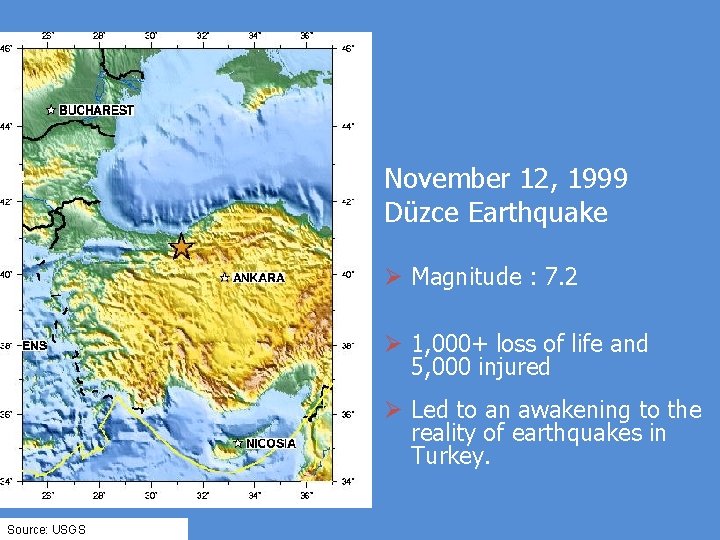
I. Introduction November 12, 1999 Düzce Earthquake Ø Magnitude : 7. 2 Ø 1, 000+ loss of life and 5, 000 injured Ø Led to an awakening to the reality of earthquakes in Turkey. Source: USGS
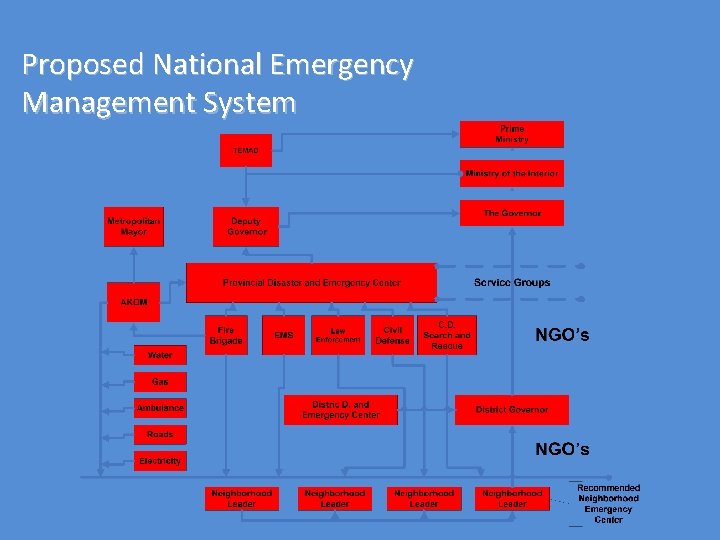
Proposed National Emergency Management System
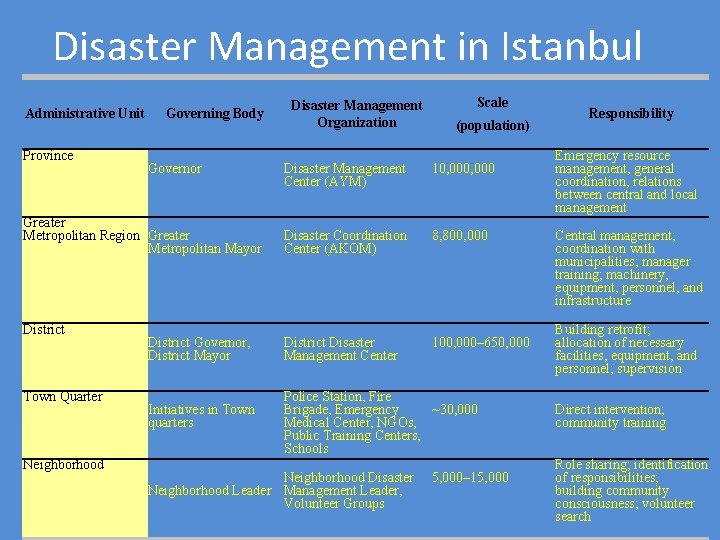
Disaster Management in Istanbul Administrative Unit Province Governing Body Governor Town Quarter Neighborhood Scale (population) Disaster Management Center (AYM) 10, 000 Disaster Coordination Center (AKOM) 8, 800, 000 District Governor, District Mayor District Disaster Management Center 100, 000– 650, 000 Initiatives in Town quarters Police Station, Fire Brigade, Emergency ~30, 000 Medical Center, NGOs, Public Training Centers, Schools Greater Metropolitan Region Greater Metropolitan Mayor District Disaster Management Organization Neighborhood Disaster Neighborhood Leader Management Leader, Volunteer Groups 5, 000– 15, 000 Responsibility Emergency resource management, general coordination, relations between central and local management Central management; coordination with municipalities; manager training; machinery, equipment, personnel, and infrastructure Building retrofit; allocation of necessary facilities, equipment, and personnel; supervision Direct intervention; community training Role sharing; identification of responsibilities; building community consciousness; volunteer search
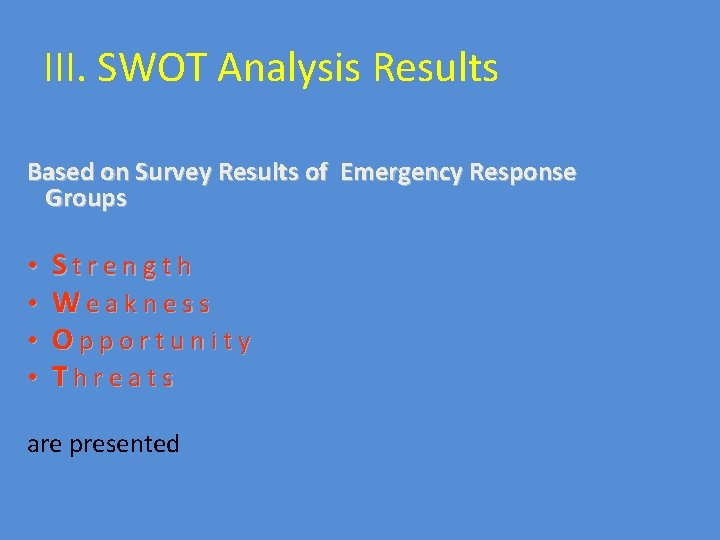
III. SWOT Analysis Results Based on Survey Results of Emergency Response Groups • • Strength Weakness Opportunity Threats are presented
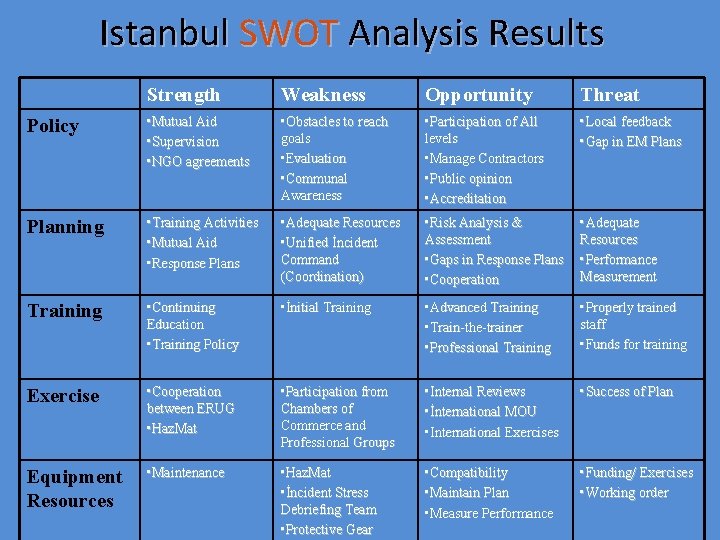
Istanbul SWOT Analysis Results Strength Weakness Opportunity Threat Policy • Mutual Aid • Supervision • NGO agreements • Obstacles to reach goals • Evaluation • Communal Awareness • Participation of All levels • Manage Contractors • Public opinion • Accreditation • Local feedback • Gap in EM Plans Planning • Training Activities • Mutual Aid • Response Plans • Adequate Resources • Unified İncident Command (Coordination) • Risk Analysis & Assessment • Gaps in Response Plans • Cooperation • Adequate Resources • Performance Measurement Training • Continuing Education • Training Policy • İnitial Training • Advanced Training • Train-the-trainer • Professional Training • Properly trained staff • Funds for training Exercise • Cooperation between ERUG • Haz. Mat • Participation from Chambers of Commerce and Professional Groups • Internal Reviews • İnternational MOU • International Exercises • Success of Plan Equipment Resources • Maintenance • Haz. Mat • İncident Stress Debriefing Team • Protective Gear • Compatibility • Maintain Plan • Measure Performance • Funding/ Exercises • Working order
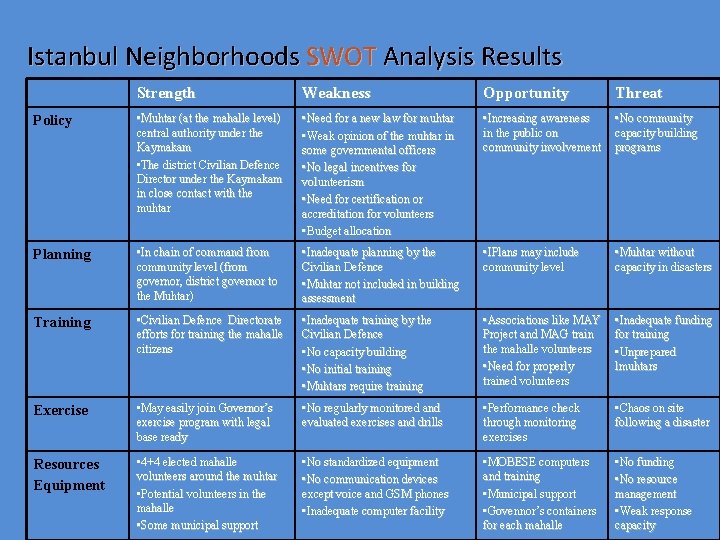
Istanbul Neighborhoods SWOT Analysis Results Strength Weakness Opportunity Threat Policy • Muhtar (at the mahalle level) central authority under the Kaymakam • The district Civilian Defence Director under the Kaymakam in close contact with the muhtar • Need for a new law for muhtar • Weak opinion of the muhtar in some governmental officers • No legal incentives for volunteerism • Need for certification or accreditation for volunteers • Budget allocation • Increasing awareness in the public on community involvement • No community capacity building programs Planning • In chain of command from community level (from governor, district governor to the Muhtar) • Inadequate planning by the Civilian Defence • Muhtar not included in building assessment • IPlans may include community level • Muhtar without capacity in disasters Training • Civilian Defence Directorate efforts for training the mahalle citizens • Inadequate training by the Civilian Defence • No capacity building • No initial training • Muhtars require training • Associations like MAY Project and MAG train the mahalle volunteers • Need for properly trained volunteers • Inadequate funding for training • Unprepared lmuhtars Exercise • May easily join Governor’s exercise program with legal base ready • No regularly monitored and evaluated exercises and drills • Performance check through monitoring exercises • Chaos on site following a disaster Resources Equipment • 4+4 elected mahalle volunteers around the muhtar • Potential volunteers in the mahalle • Some municipal support • No standardized equipment • No communication devices except voice and GSM phones • Inadequate computer facility • MOBESE computers and training • Municipal support • Govennor’s containers for each mahalle • No funding • No resource management • Weak response capacity
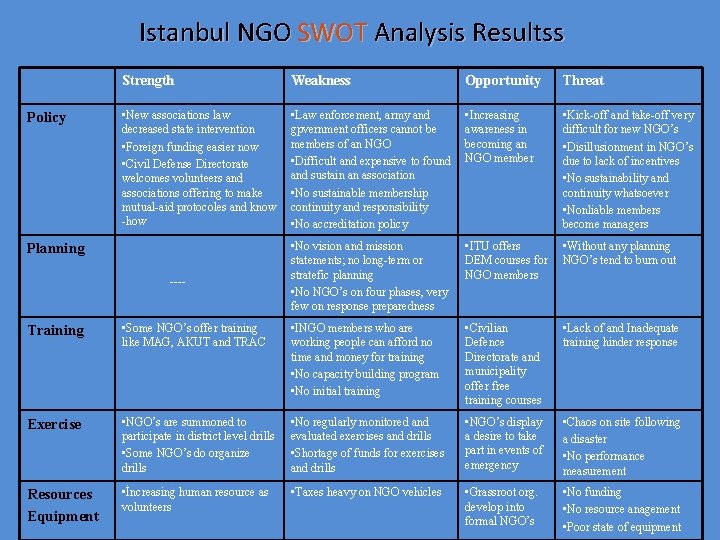
Istanbul NGO SWOT Analysis Resultss Policy Strength Weakness Opportunity Threat • New associations law decreased state intervention • Foreign funding easier now • Civil Defense Directorate welcomes volunteers and associations offering to make mutual-aid protocoles and know -how • Law enforcement, army and gpvernment officers cannot be members of an NGO • Difficult and expensive to found and sustain an association • No sustainable membership continuity and responsibility • No accreditation policy • Increasing awareness in becoming an NGO member • Kick-off and take-off very difficult for new NGO’s • Disillusionment in NGO’s due to lack of incentives • No sustainability and continuity whatsoever • Nonliable members become managers • No vision and mission statements; no long-term or stratefic planning • No NGO’s on four phases, very few on response preparedness • ITU offers DEM courses for NGO members • Without any planning NGO’s tend to burn out Planning ---- Training • Some NGO’s offer training like MAG, AKUT and TRAC • INGO members who are working people can afford no time and money for training • No capacity building program • No initial training • Civilian Defence Directorate and municipality offer free training courses • Lack of and Inadequate training hinder response Exercise • NGO’s are summoned to participate in district level drills • Some NGO’s do organize drills • No regularly monitored and evaluated exercises and drills • Shortage of funds for exercises and drills • NGO’s display a desire to take part in events of emergency • Chaos on site following a disaster • No performance measurement Resources Equipment • İncreasing human resource as volunteers • Taxes heavy on NGO vehicles • Grassroot org. develop into formal NGO’s • No funding • No resource anagement • Poor state of equipment
IV. Challenges in Disaster Management in Turkey: • High levels of Migration and Population Growth • Rapid Urbanization, Squatter homes New structure in Disaster Management Policy
Thank you ITU : Cooperation in International Degree programs derin@itu. edu. tr