Electric Properties Of Colloids n n Particles dispersed








- Slides: 16
Electric Properties Of Colloids n n Particles dispersed in liquid media may become charged mainly in one of two ways : The first involve selective adsorption of a particular ionic species present in solution. Second : charges on particles arises from ionization of groups (such as COOH) that may be situated at the surface of the particles.
Electric Properties Of Colloids n n n The movement of a charged surface with respect to the adjacent liquid phase is the basic principle underlying four electrokinetic phenomena : Electrophoresis Electroosmosis Sedimentation Potential Streaming Potential
Electrophoresis n n Electrophoresis is the most known electrokinetic phenomena. It refers to the motion of charged particles related to the fluid under the influence of an applied electric field. If an electric potential is applied to a colloid, the charged colloidal particles move toward the oppositely charged electrode.
Electro-osmosis n n It is the opposite in principal to that of electrophoresis. If the solid is rendered immobile ( by making particles into a porous plug), the liquid moves relative to the charged surface. When potential is applied
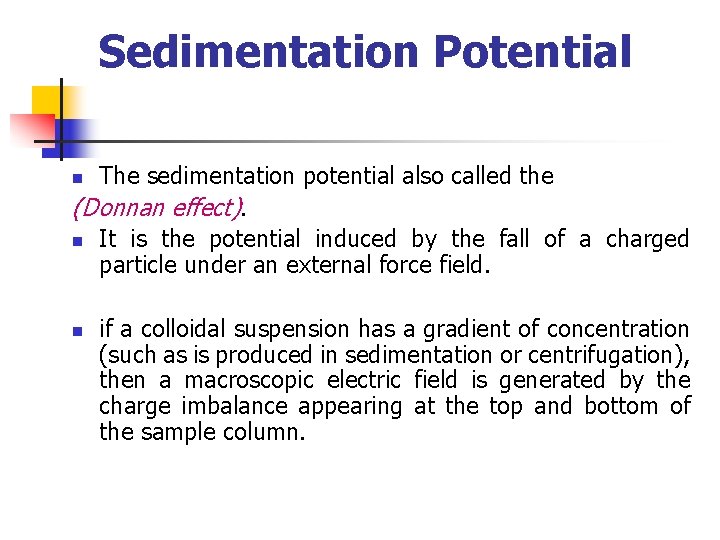
Sedimentation Potential The sedimentation potential also called the (Donnan effect). n It is the potential induced by the fall of a charged particle under an external force field. n n if a colloidal suspension has a gradient of concentration (such as is produced in sedimentation or centrifugation), then a macroscopic electric field is generated by the charge imbalance appearing at the top and bottom of the sample column.
Sedimentation Potential
Streaming Potential n Differs from electro-osmosis in that the potential is created by forcing a liquid to flow through a bed or plug of particles.
Stability of colloids
Stability of colloids n Stabilization aggregation. serves to prevent colloids from The presence and magnitude, or absence of a charge on a colloidal particle is an important factor in the stability of colloids. n Two main mechanisms for colloid stabilization: 1 -Steric stabilization i. e. surrounding each particle with a protective solvent sheath which prevent adherence due to Brownian movement 2 -electrostatic stabilization i. e. providing the particles with n electric charge
Stability of colloids A- Lyophobic sols: - - - Unstable. The particles stabilized only by the presence of electrical charges on their surfaces through the addition of small amount of electrolytes. The like charges produce repulsion which prevent coagulation of the particles and subsequent settling. Addition of electrolytes beyond necessary for maximum stability results in accumulation of opposite ions and decrease zeta potential coagulation precipitation of colloids.
Stability of colloids
Stability of colloids - Coagulation also result from mixing of oppositely charged colloids. B- Lyophilic sols and association colloids: - - Stable Addition of moderate amounts of electrolytes not cause coagulation. If sufficent salt is added , agglomeration and precipitation of lyophilic colloids (salting out)
Stability of colloids This is obtained by: 1 - Addition of large amounts of electrolytes - Anions arranged in a decreasing order of precipitating power: citrate > tartrate > sulfate > acetate > chloride> nitrate > bromide > iodide - The precipitation power is directly related to the hydration of the ion and its ability to separate water molecules from colloidal particles n 2 - addition of less polar solvent - e. g. alcohol, acetone
Stability of colloids - The addition of less polar solvent renders the solvent mixture unfavourable for the colloids solubility ** Coacervation: Definition: the process of mixing negatively and positively charged hydrophilic colloids, and hence the particles separate from the dispersion to form a layer rich in the colloidal aggregates (coacervate)
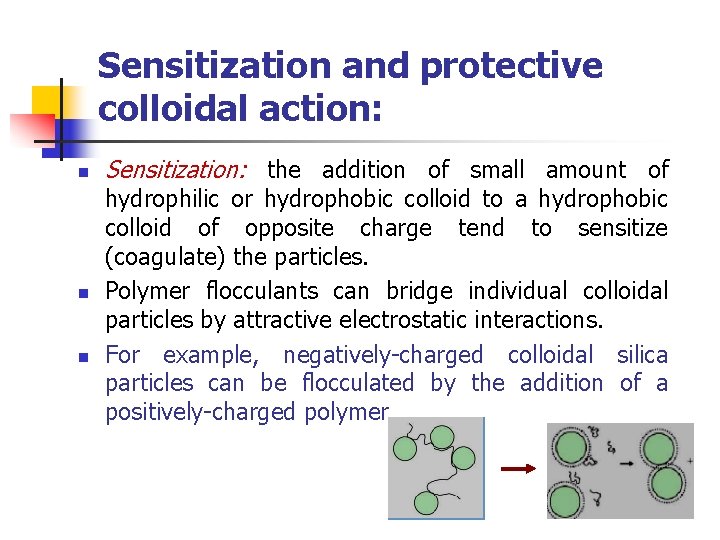
Sensitization and protective colloidal action: n n n Sensitization: the addition of small amount of hydrophilic or hydrophobic colloid to a hydrophobic colloid of opposite charge tend to sensitize (coagulate) the particles. Polymer flocculants can bridge individual colloidal particles by attractive electrostatic interactions. For example, negatively-charged colloidal silica particles can be flocculated by the addition of a positively-charged polymer.
Sensitization and protective colloidal action: n Protection: the addition of large amount of hydrophilic colloid (protective colloid) to a hydrophobic colloid tend to stabilize the system. n This may be due to: The hydrophile is adsorbed as a monomolecular layer on the hydrophobic particles.