EE DNS FORUM UADOM Domain name dispute resolution


- Slides: 12
EE DNS FORUM / UADOM Domain name dispute resolution: challenges and alternatives Kateryna Oliinyk Head of Arzinger IP practice, Patent and Trademark Attorney of Ukraine Panelist of the National Arbitration Forum (MI) Kyiv | 2016
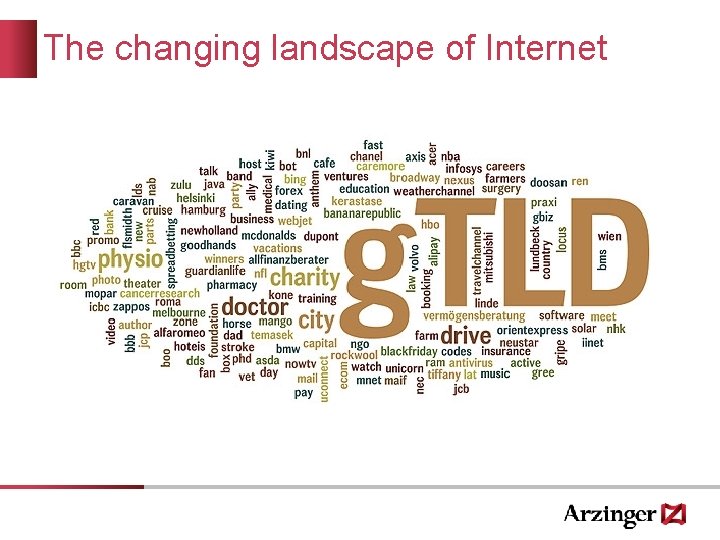
The changing landscape of Internet
1. Identification
Council of Europe. Human rights guidelines for Internet service providers q Do not to reveal the identity of users, their traffic data or the content of data accessed by them to a third party, unless under a legal duty to do so or following specific orders or instructions from the competent public authority made in accordance with the law. Requests in this respect brought to you from abroad should be handled through the competent authorities in your country. q Inform your customers in which circumstances you are under a legal duty to reveal their identification, connection or traffic data by request from law enforcement agencies etc. Such information could particularly be provided by associations of ISPs to whom you might want to link. If you receive a request to disclose such data, make sure to check the authenticity of the request and that it is made by a competent authority in accordance with the law. q Do not collect, process or store data about users, unless this is necessary for explicit, specified and legitimate purposes in accordance with data protection laws. Do not store data for longer than required by law or than is necessary to achieve the purpose of processing of the data.
Breyer v. Federal Republic of Germany , the European Court of Justice (ECJ), decision dated 19 October 2016, case number C-582/14 • a dynamic IP address registered by an online media services provider when a person accesses a website that the provider makes accessible to the public constitutes personal data within the meaning of that provision, in relation to that provider, where the latter has the legal means which enable it to identify the data subject with additional data which the internet service provider has about that person.
Breyer v. Federal Republic of Germany , the European Court of Justice (ECJ), decision dated 19 October 2016, case number C 582/14 A dynamic IP address does not only constitute personal data with respect to the internet service provider (which has the means to link the IP address to the individual behind the address in any case), but also with respect to the operator of a website, if this website operator has legal means to identify the visitor with the help of additional information from the visitor’s internet service provider.
2. WHOIS & Expert Working Group on g. TLD Directory Services q ICANN Board directive to redefine purpose and provision of g. TLD registration data; q formed to assess data directory needs and recommend a revolutionary approach; q comprehensive issue review; q examine stakeholder needs; q develop recommendations and a draft blueprint for a g. TLD directory system;
What is the RDS? q details a proposed next-generation Registration Directory Service (RDS); q strikes a balance between accuracy, access, and accountability; q collects, validates and discloses g. TLD data for permissible purposes only; q leaves minimum data publicly available; q safeguards the rest through new paradigm: purpose-driven gated access; q introduces new contracted parties; q validate Contact Data; q accredit RDS Users.
Needs assessment to determine q q q Data requirements Privacy requirements Access and accountability requirements Accuracy requirements Storage and performance requirements Usage requirements
Rights Protection Mechanisms
Right protection mechanisms Ø Ukrainian Dispute Resolution practice Ø Arbitration Ø Mediation Ø Alternative Dispute resolution proceedings (URS & UDRP)