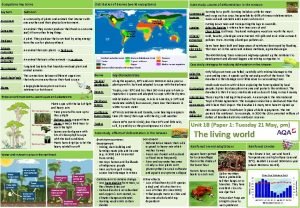
Ecosystems key terms Key term Definition Ecosystem A
- Slides: 2
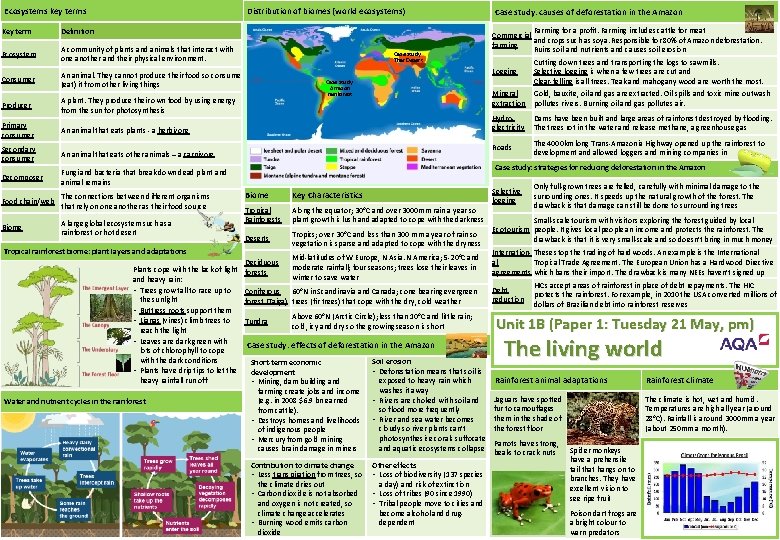
Ecosystems key terms Key term Definition Ecosystem A community of plants and animals that interact with one another and their physical environment. Consumer An animal. They cannot produce their food so consume (eat) it from other living things Producer A plant. They produce their own food by using energy from the sun for photosynthesis Primary consumer An animal that eats plants - a herbivore Secondary consumer An animal that eats other animals – a carnivore Decomposer Fungi and bacteria that break down dead plant and animal remains Food chain/web The connections between different organisms that rely on one another as their food source Biome A large global ecosystem such as a rainforest or hot desert Tropical rainforest biome: plant layers and adaptations Distribution of biomes (world ecosystems) Case study: Thar Desert Case study: Amazon rainforest Case study: causes of deforestation in the Amazon Farming for a profit. Farming includes cattle for meat Commercial and crops such as soya. Responsible for 80% of Amazon deforestation. farming Ruins soil and nutrients and causes soil erosion Logging Cutting down trees and transporting the logs to sawmills. Selective logging is when a few trees are cut and Clear-felling is all trees. Teak and mahogany wood are worth the most. Mineral extraction Gold, bauxite, oil and gas are extracted. Oil spills and toxic mine outwash pollutes rivers. Burning oil and gas pollutes air. Hydroelectricity Dams have been built and large areas of rainforest destroyed by flooding. The trees rot in the water and release methane, a greenhouse gas Roads The 4000 km long Trans-Amazonia Highway opened up the rainforest to development and allowed loggers and mining companies in Case study: strategies for reducing deforestation in the Amazon Biome Key Characteristics Tropical Rainforests Along the equator; 30°C and over 3000 mm rain a year so plant growth is lush and adapted to cope with the darkness Deserts Tropics; over 30°C and less than 300 mm a year of rain so vegetation is sparse and adapted to cope with the dryness Mid-latitudes of W Europe, N Asia. N America; 5 -20°C and Deciduous moderate rainfall; four seasons; trees lose their leaves in Plants cope with the lack of light forests winter to save water and heavy rain: • Trees grow tall to race up to Coniferous 60°N in Scandinavia and Canada; cone bearing evergreen the sunlight forest (Taiga) trees (fir trees) that cope with the dry, cold weather • Buttress roots support them Above 60°N (Arctic Circle); less than 10°C and little rain; • Lianas (vines) climb trees to Tundra cold, icy and dry so the growing season is short reach the light • Leaves are dark green with Case study: effects of deforestation in the Amazon lots of chlorophyll to cope with the dark conditions Soil erosion Short-term economic • Plants have drip tips to let the • Deforestation means that soil is development heavy rainfall run off exposed to heavy rain which • Mining, dam building and washes it away farming create jobs and income • Rivers are choked with soil and (e. g. in 2008 $6. 9 bn earned Water and nutrient cycles in the rainforest so flood more frequently from cattle). • Destroys homes and livelihoods • River and sea water becomes cloudy so river plants can’t of indigenous people photosynthesize corals suffocate • Mercury from gold mining and aquatic ecosystems collapse causes brain damage in miners Contribution to climate change • Less transpiration from trees, so the climate dries out • Carbon dioxide is not absorbed and oxygen is not created, so climate change accelerates • Burning wood emits carbon dioxide Other effects • Loss of biodiversity (137 species a day) and risk of extinction • Loss of tribes (90 since 1990) • Tribal people move to cities and become alcohol and drugdependent Selective logging Only full-grown trees are felled, carefully with minimal damage to the surrounding ones. It speeds up the natural growth of the forest. The drawback is that damage can still be done to surrounding trees Small-scale tourism with visitors exploring the forest guided by local Ecotourism people. It gives local people an income and protects the rainforest. The drawback is that it is very small-scale and so doesn’t bring in much money Internation- These stop the trading of hardwoods. An example is the International al Tropical Trade Agreement. The European Union has a Hardwood Directive agreements which bans their import. The drawback is many NEEs haven’t signed up Debt reduction HICs accept areas of rainforest in place of debt repayments. The HIC protects the rainforest. For example, in 2010 the USA converted millions of dollars of Brazilian debt into rainforest reserves Unit 1 B (Paper 1: Tuesday 21 May, pm) The living world Rainforest animal adaptations Rainforest climate Jaguars have spotted fur to camouflages them in the shade of the forest floor The climate is hot, wet and humid. Temperatures are high all year (around 28°C). Rainfall is around 3000 mm a year (about 250 mm a month). Parrots have strong, beaks to crack nuts Spider monkeys have a prehensile tail that hangs on to branches. They have excellent vision to see ripe fruit Poison dart frogs are a bright colour to warn predators
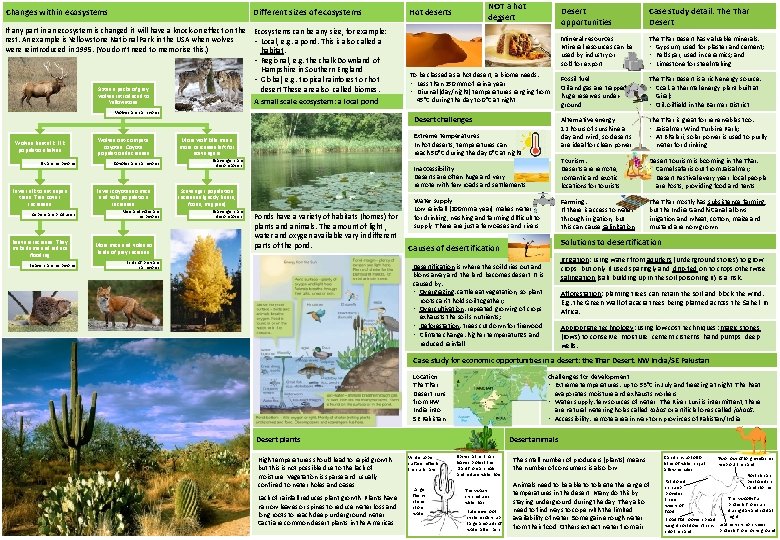
Different sizes of ecosystems Changes within ecosystems If any part in an ecosystem is changed it will have a knock-on effect on the Ecosystems can be any size, for example: rest. An example is Yellowstone National Park in the USA when wolves • Local, e. g. a pond. This is also called a were reintroduced in 1995. (You don’t need to memorise this. ) habitat. • Regional, e. g. the chalk Downland of Hampshire in Southern England • Global, e. g. tropical rainforest or hot Sixteen packs of grey desert These are also called biomes. wolves introduced to Yellowstone A small scale ecosystem: a local pond Wolves are carnivores Wolves hunt elk. Elk population halves Elk are herbivores Fewer elk to eat aspen trees. Tree cover increases Aspens are producers Beavers increase. They make dams and reduce flooding Beavers are herbivores Wolves out-compete coyotes. Coyote population decreases Coyotes are carnivores Fewer coyotes so mice and vole population increases Mice and voles are herbivores More mice and voles so birds of prey increase NOT a hot dessert Desert opportunities Case study detail: The Thar Desert Mineral resources: Mineral resources can be used by industry or sold for export. The Thar Desert has valuable minerals: • Gypsum, used for plaster and cement; • Feldspar, used in ceramics; and • Limestone for steelmaking. Fossil fuel Oil and gas are trapped in huge reserves underground. The Thar Desert is a rich energy source: • Coal: a thermal energy plant built at Giral; • Oil: oilfield in the Barmer District. Alternative energy 12 hours of sunshine a day and wind, so deserts are ideal for clean power The Thar is great for renewables too: • Jaisalmer Wind Turbine Park; • At Bhaleri, solar power is used to purify water for drinking. Inaccessibility: Deserts are often huge and very remote with few roads and settlements Tourism: Deserts are remote, romantic and exotic locations for tourists Desert tourism is booming in the Thar: • Camel safaris out from Jaisalmer; • Desert Festival every year. local people are hosts, providing food and tents. Water supply: Low rainfall (200 mm a year) makes water for drinking, washing and farming difficult to supply. There are just a few oases and rivers Farming: If there is access to water through irrigation, but this can cause salinization The Thar mostly has subsistence farming, but the Indira Gandhi Canal allows irrigation and wheat, cotton, maize and mustard are now grown. Hot deserts To be classed as a hot desert, a biome needs: • Less than 250 mm of rain a year. • Diurnal (day/night) temperatures ranging from 45°C during the day to 0°C at night. Desert challenges Extreme temperatures: In hot deserts, temperatures can reach 50°C during the day 0°C at night More wolf kills mean more carcasses left for scavengers Scavengers are decomposers Scavenger population increases (grizzly bears, foxes, magpies) Scavengers are decomposers Ponds have a variety of habitats (homes) for plants and animals. The amount of light , water and oxygen available vary in different parts of the pond. Birds of prey are carnivores Solutions to desertification Causes of desertification Irrigation: using water from aquifers (underground stores) to grow crops, but only if used sparingly and drip-fed on to crops otherwise salinization (salt building up in the soil poisoning it) is a risk. Desertification is where the soil dries out and blows away and the land becomes desert. It is caused by: • Overgrazing: cattle eat vegetation, so plant roots can’t hold soil together; • Overcultivation: repeated growing of crops exhausts the soil’s nutrients; • Deforestation: trees cut down for firewood • Climate change: higher temperatu res and reduced rainfall. Afforestation: planting trees can retain the soil and block the wind. E. g. the Green Wall of acacia trees being planted across the Sahel in Africa. Appropriate technology: using low-cost techniques: magic stones (rows) to conserve moisture, cement cisterns, hand pumps, deep wells. Case study for economic opportunities in a desert: the Thar Desert. NW India/SE Pakistan Location: The Thar Desert runs from NW India into SE Pakistan Challenges for development: • Extreme temperatures: up to 53°C in July and freezing at night. The heat evaporates moisture and exhausts workers. • Water supply: few sources of water. The River Luni is intermittent, there are natural watering holes called tobas or artificial ones called johads. • Accessibility: remote area in war-torn provinces of Pakistan/India. Desert plants High temperatures should lead to rapid growth but this is not possible due to the lack of moisture. Vegetation is sparse and usually confined to water holes and oases. Lack of rainfall reduces plant growth. Plants have narrow leaves or spines to reduce water loss and long roots to reach deep underground water. Cacti are common desert plants in the Americas Desert animals White upper surface reflects the sun’s rays. Large fleshy stems store water. Spikes rather than leaves protect the plant from animals and reduce water loss. Thick waxy skin reduces water loss. Extensive root system soaks up large amounts of water after rain. The small number of producers (plants) means the number of consumers is also low. Can drink up to 50 litres of water in just a few minutes. Animals need to be able to tolerate the range of temperatures in the desert. Many do this by staying underground during the day. They also need to find ways to cope with the limited availability of water. Some gain enough water from their food. Others extract water from air. Fat stored in hump provides three weeks of food. Two rows of long eyelashes keep out the sand. Nostrils can be closed in sand storms. Thick woolly fur protects from sun during day and cold at night. Broad flat hooves spread weight so it doesn’t sink Leathery skin on knees protects from rocky ground. into the sand.