Dr Joshua Chua Dr Farish Auleear Dr Tony

- Slides: 4
Dr Joshua Chua, Dr Farish Auleear, Dr Tony Weir, Dr Brett Kerr, Dr Elissa Freer Discipline of Orthodontics, University of Queensland INTRODUCTION Posterior dental expansion with aligners has been shown to occur primarily via buccal crown tip. 1 In 2013, Align Technology, the manufacturers of Invisalign appliances, replaced the previously employed Ex 30® with a new aligner material, Smart. Track®, which they reported was superior both in terms of biomechanical properties and clinical outcomes to the Ex 30 material and to other available clear aligner materials 2, 3. While there have been numerous studies on clinical outcomes with individual aligner materials, 4 -7 to date, there have been few, if any, detailed studies carried out comparing this new Smart. Track material to Ex 30. This study was a pilot study carried out by undergraduate dental students to compare the old material (Ex 30®) with the new material (Smart. Track®) to determine if there were significant differences between the predicted outcome from the Clin. Check® virtual treatment plan and the clinically achieved treatment between the two materials. A more comprehensive study is planned to follow this current pilot. SUBJECTS & METHODOLOGY 50 Invisalign® patients, from the AARD database provided by Dr Tony Weir, were divided into 2 groups based on the type of aligner material they were treated with. Subjects in group A (n=25) were treated with Ex 30® aligner material. Subjects in group B (n=25) were treated with Smart. Track® material. Group A had 8 males and 17 females with a mean age of 27 years 8 months. Group B had 10 males and 15 females with a mean age of 25 years 10 months. Patients who met the inclusion and exclusion criteria were randomly selected. Those whose growth was complete (more than 18 years of age), had full permanent dentition, treated non-extraction, and without auxiliaries other than Invisalign attachments were selected. Patients who had restorative care during orthodontic treatment, orthodontic elastics or temporary anchorage devices placed were excluded. Stereolithography (. stl) files were exported from Clin. Check®. Digital models were taken pre-treatment (Initial), immediately post-treatment (Achieved) and final Clin. Check® (Predicted). A total of 300 casts were available including both upper and lower jaws. The digital models were imported into Geomagic Control X (Version 2017. 0. 3. 69; Geomagic, Morissville, NC, USA) and measurements were carried out by 2 operators, each measuring all 300 casts for all 3 variables. The following variables were measured: ● Intercanine distance: the distance between the cusps of the canines (Fig 1 a) ● First intermolar distance: the distance between the mesiobuccal cusps of the first molars (Fig 1 b) ● Arch Depth: the distance from a point midway between the facial surfaces of the central incisor to a line tangent to the first inter- molar distance (Fig 1 c) Fig 1. Measurement of digital casts In the case of wear facets on the canine tip and mesiobuccal cusp of the first permanent molar, an estimation of the cusp tip point was used. The mean differences obtained between the final Clin. Check® prediction and the actual post-treatment casts were calculated and compared.
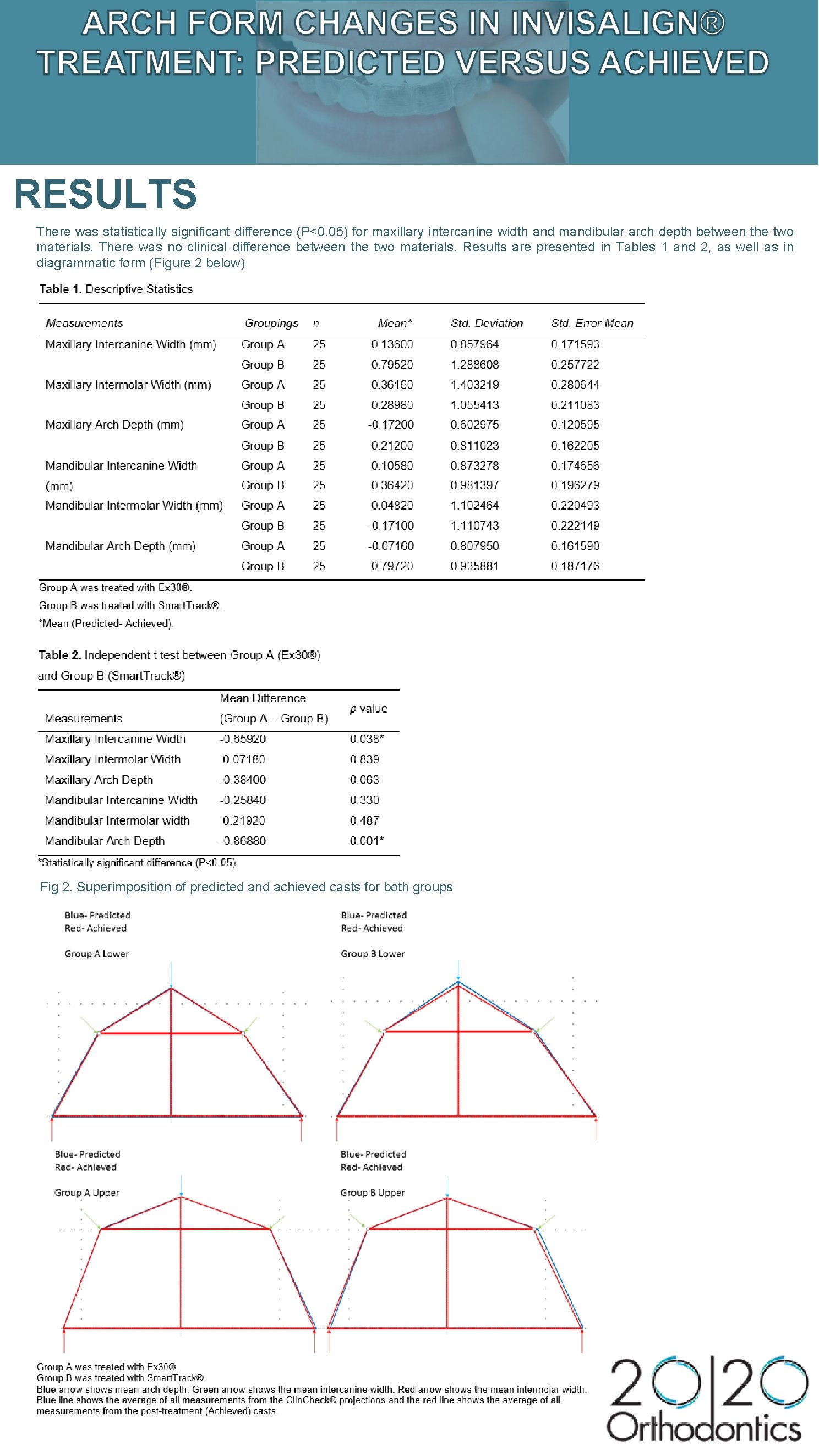
RESULTS There was statistically significant difference (P<0. 05) for maxillary intercanine width and mandibular arch depth between the two materials. There was no clinical difference between the two materials. Results are presented in Tables 1 and 2, as well as in diagrammatic form (Figure 2 below) Fig 2. Superimposition of predicted and achieved casts for both groups
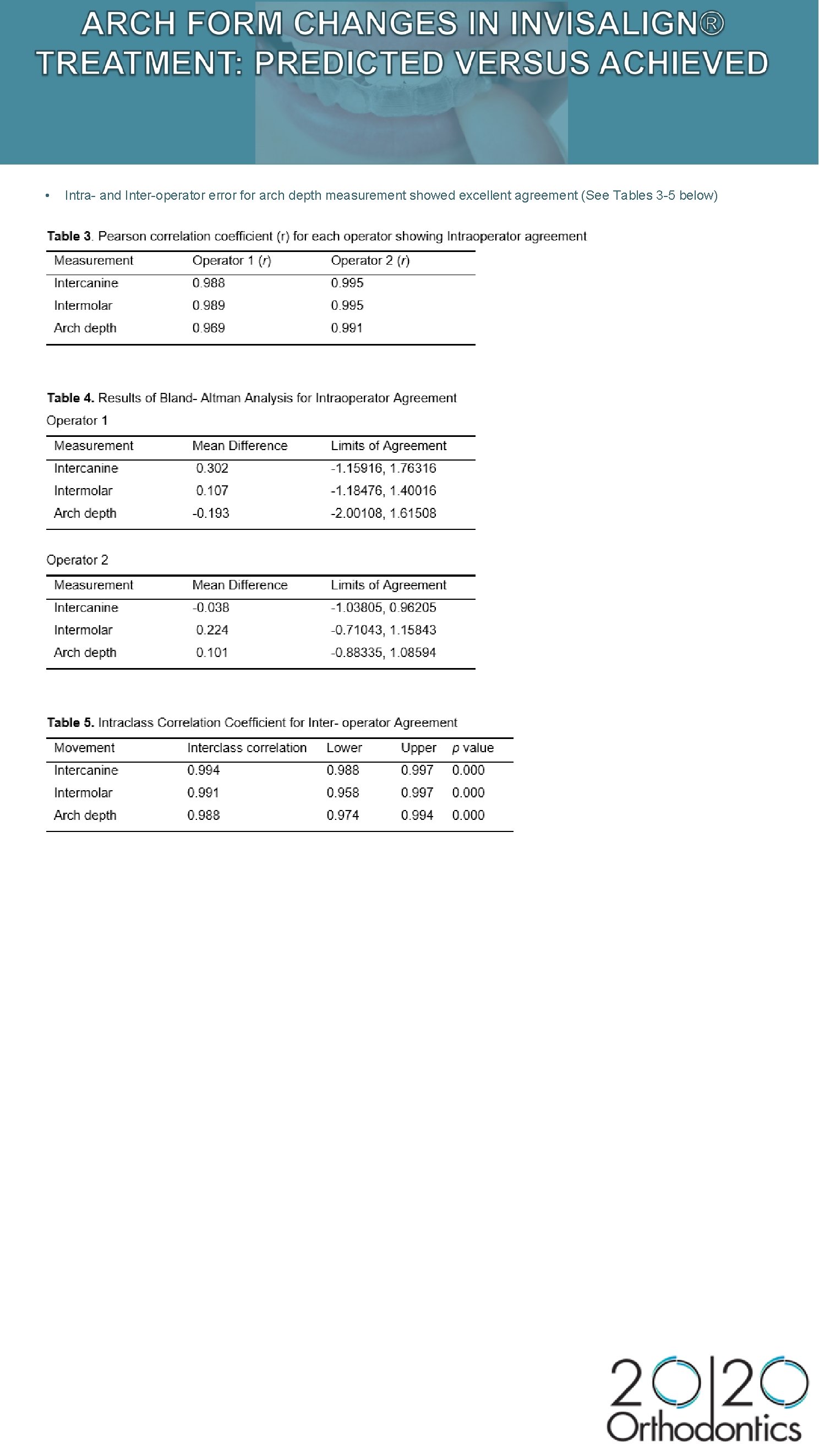
• Intra- and Inter-operator error for arch depth measurement showed excellent agreement (See Tables 3 -5 below)
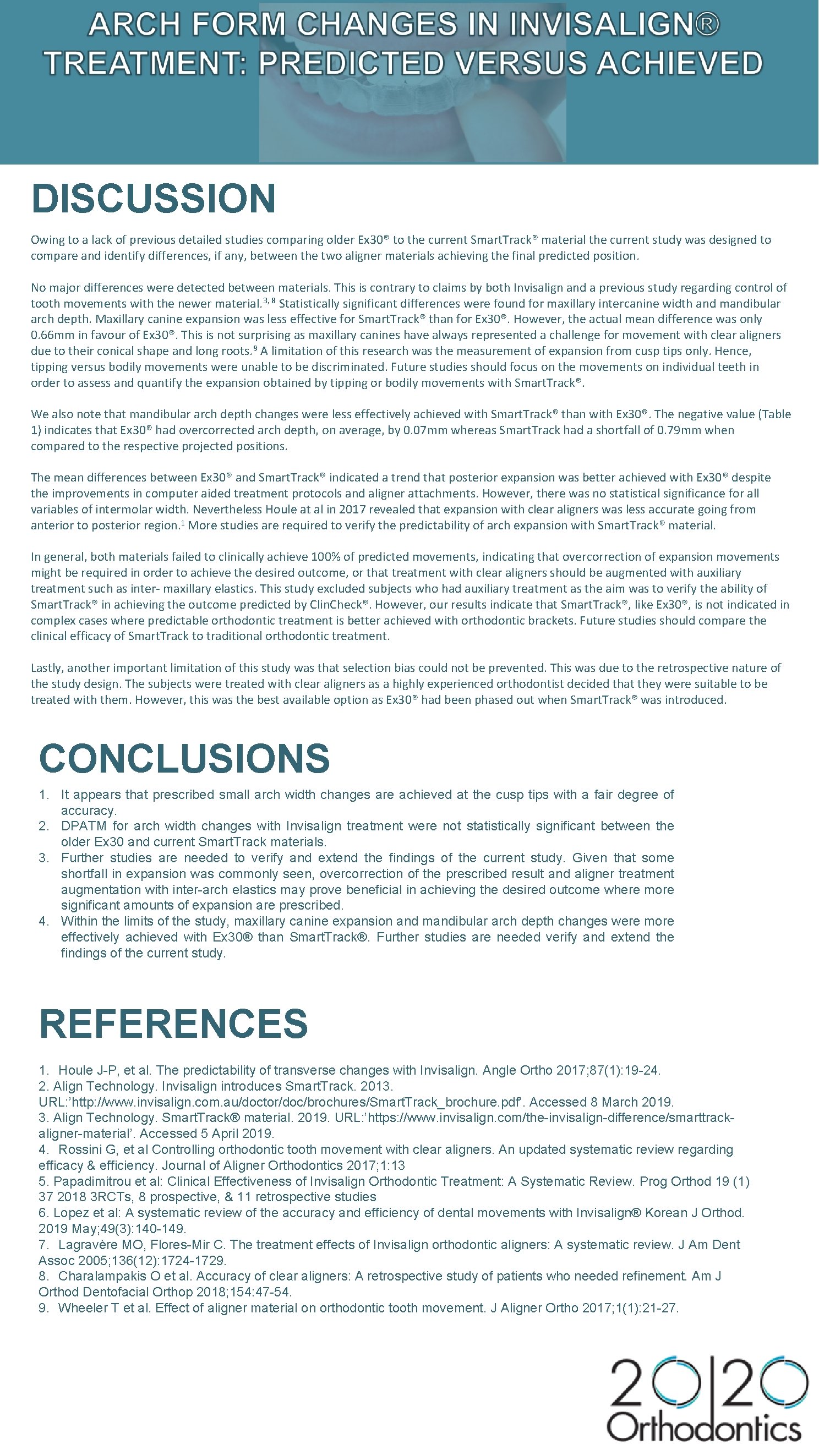
DISCUSSION Owing to a lack of previous detailed studies comparing older Ex 30® to the current Smart. Track® material the current study was designed to compare and identify differences, if any, between the two aligner materials achieving the final predicted position. No major differences were detected between materials. This is contrary to claims by both Invisalign and a previous study regarding control of tooth movements with the newer material. 3, 8 Statistically significant differences were found for maxillary intercanine width and mandibular arch depth. Maxillary canine expansion was less effective for Smart. Track® than for Ex 30®. However, the actual mean difference was only 0. 66 mm in favour of Ex 30®. This is not surprising as maxillary canines have always represented a challenge for movement with clear aligners due to their conical shape and long roots. 9 A limitation of this research was the measurement of expansion from cusp tips only. Hence, tipping versus bodily movements were unable to be discriminated. Future studies should focus on the movements on individual teeth in order to assess and quantify the expansion obtained by tipping or bodily movements with Smart. Track®. We also note that mandibular arch depth changes were less effectively achieved with Smart. Track® than with Ex 30®. The negative value (Table 1) indicates that Ex 30® had overcorrected arch depth, on average, by 0. 07 mm whereas Smart. Track had a shortfall of 0. 79 mm when compared to the respective projected positions. The mean differences between Ex 30® and Smart. Track® indicated a trend that posterior expansion was better achieved with Ex 30® despite the improvements in computer aided treatment protocols and aligner attachments. However, there was no statistical significance for all variables of intermolar width. Nevertheless Houle at al in 2017 revealed that expansion with clear aligners was less accurate going from anterior to posterior region. 1 More studies are required to verify the predictability of arch expansion with Smart. Track® material. In general, both materials failed to clinically achieve 100% of predicted movements, indicating that overcorrection of expansion movements might be required in order to achieve the desired outcome, or that treatment with clear aligners should be augmented with auxiliary treatment such as inter- maxillary elastics. This study excluded subjects who had auxiliary treatment as the aim was to verify the ability of Smart. Track® in achieving the outcome predicted by Clin. Check®. However, our results indicate that Smart. Track®, like Ex 30®, is not indicated in complex cases where predictable orthodontic treatment is better achieved with orthodontic brackets. Future studies should compare the clinical efficacy of Smart. Track to traditional orthodontic treatment. Lastly, another important limitation of this study was that selection bias could not be prevented. This was due to the retrospective nature of the study design. The subjects were treated with clear aligners as a highly experienced orthodontist decided that they were suitable to be treated with them. However, this was the best available option as Ex 30® had been phased out when Smart. Track® was introduced. CONCLUSIONS 1. It appears that prescribed small arch width changes are achieved at the cusp tips with a fair degree of accuracy. 2. DPATM for arch width changes with Invisalign treatment were not statistically significant between the older Ex 30 and current Smart. Track materials. 3. Further studies are needed to verify and extend the findings of the current study. Given that some shortfall in expansion was commonly seen, overcorrection of the prescribed result and aligner treatment augmentation with inter-arch elastics may prove beneficial in achieving the desired outcome where more significant amounts of expansion are prescribed. 4. Within the limits of the study, maxillary canine expansion and mandibular arch depth changes were more effectively achieved with Ex 30® than Smart. Track®. Further studies are needed verify and extend the findings of the current study. REFERENCES 1. Houle J-P, et al. The predictability of transverse changes with Invisalign. Angle Ortho 2017; 87(1): 19 -24. 2. Align Technology. Invisalign introduces Smart. Track. 2013. URL: ’http: //www. invisalign. com. au/doctor/doc/brochures/Smart. Track_brochure. pdf’. Accessed 8 March 2019. 3. Align Technology. Smart. Track® material. 2019. URL: ’https: //www. invisalign. com/the-invisalign-difference/smarttrackaligner-material’. Accessed 5 April 2019. 4. Rossini G, et al Controlling orthodontic tooth movement with clear aligners. An updated systematic review regarding efficacy & efficiency. Journal of Aligner Orthodontics 2017; 1: 13 5. Papadimitrou et al: Clinical Effectiveness of Invisalign Orthodontic Treatment: A Systematic Review. Prog Orthod 19 (1) 37 2018 3 RCTs, 8 prospective, & 11 retrospective studies 6. Lopez et al: A systematic review of the accuracy and efficiency of dental movements with Invisalign® Korean J Orthod. 2019 May; 49(3): 140 -149. 7. Lagravère MO, Flores-Mir C. The treatment effects of Invisalign orthodontic aligners: A systematic review. J Am Dent Assoc 2005; 136(12): 1724 -1729. 8. Charalampakis O et al. Accuracy of clear aligners: A retrospective study of patients who needed refinement. Am J Orthod Dentofacial Orthop 2018; 154: 47 -54. 9. Wheeler T et al. Effect of aligner material on orthodontic tooth movement. J Aligner Ortho 2017; 1(1): 21 -27.