Dividing Polynomials Using Synthetic Division Synthetic Division There

- Slides: 4
Dividing Polynomials Using Synthetic Division
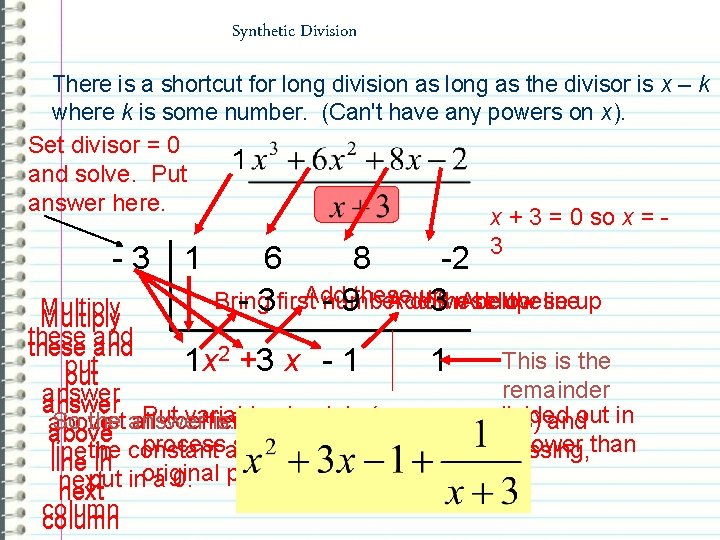
Synthetic Division There is a shortcut for long division as long as the divisor is x – k where k is some number. (Can't have any powers on x). Set divisor = 0 1 and solve. Put answer here. x + 3 = 0 so x = 3 -3 1 6 8 -2 up Bring number Add down Add below up these lineup - 3 first. Add - 9 these 3 these Multiply these and 2 +3 x - 1 This is the 1 x 1 put remainder answer Put variables back in (one x was divided out in So the List answer all coefficients is: (numbers in front of x's) and above process so first number is one less power than the constant along the top. If a term is missing, line in in original problem). put in a 0. next column
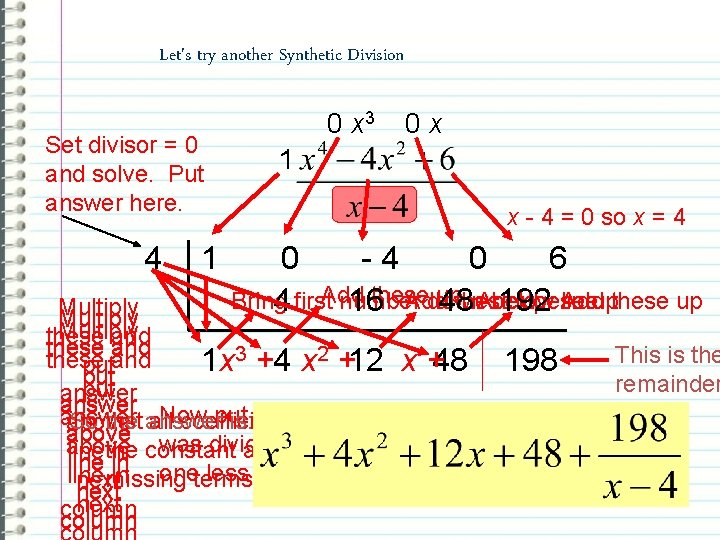
Let's try another Synthetic Division Set divisor = 0 and solve. Put answer here. 4 1 0 x 3 0 x 1 x - 4 = 0 so x = 4 0 -4 0 6 up Bring number Add down these Add below up these line Add upthese up 4 first. Add 16 these 48 192 Multiply these and 3 +4 x 2 +12 x + This is these and 1 x 48 198 put remainder put answer Now put variables back in (remember one x answer So the List answer all coefficients is: (numbers in front of x's) and above was divided out in process so first number is above the constant along the top. Don't forget the 0's for line in in one less power than original problem so x 3). line in missing terms. next column
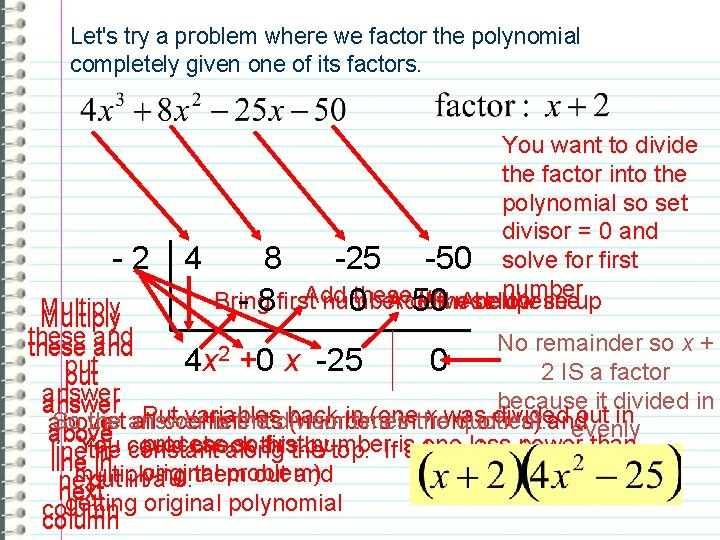
Let's try a problem where we factor the polynomial completely given one of its factors. -2 4 You want to divide the factor into the polynomial so set divisor = 0 and 8 -25 -50 solve for first number. upthese Bring number Add down Add below up these lineup - 8 first. Add 0 these 50 Multiply these No remainder so x + these and 2 4 x +0 x -25 0 put 2 IS a factor put answer because it divided in answer Put variables back in (one x was divided out in So the List answer all coefficients is the divisor (numbers timesinthe front quotient: of x's) and above evenly above process so first number is one less power You could check thisthe by top. If a term is missing, than the constant along line in original problem). multiplying out and put in a 0. them next getting original polynomial column