Decolonization Regents Questions 1 Which factor most limited

- Slides: 3
Decolonization Regents Questions 1. Which factor most limited the development of African nationalism? 1. uropean support of an educational system based on local traditions and language 2. he prior experience of Africans with economic self-sufficiency 3. olitical boundaries imposed by Europeans that had little relationship to African tribal boundaries 4. he European practice of making decisions based on local customs 2. Mohandas Gandhi is best known for his 1. se of passive resistance to achieve Indian independence 2. esire to establish and Islamic nations 3. pposition to Hindus holding political office 4. ncouragement of violence to end British rule 3. The primary goal of the Indian National Congress (1855 -1947) was to 1. eform the Hindu religion 2. artition India between Muslims and Hindus 3. reate a socialist economy 4. ain independence from Great Britain 4. One similarity between the Sepoys in India, the Boxers in China, and the Mau in Kenya is that these groups 1. ried to drive Europeans out of their countries 2. epended on Western support for their success 3. dopted Marxist economic and political principles 4. ought independence through nonviolence
5. The war between India and Pakistan in Kashmir in 1965, the sending of Indian troops to Sir Lanka in 1987, and the assassination of Rajiv in 1991 all demonstrate that in South Asia 1. . the Shino religion is a significant force 2. . United Nations peacekeeping forces are ineffective 3. . regional and ethnic rivalries remain strong 4. . nations are vulnerable to a communist takeover 6. The caste system is still practiced in India today primarily because it is 1. ncouraged by village customs and traditions 2. nforced by the military 3. upported by Christian and Muslim teachings 4. andated by law 7. The actions of Jomo Kenyatta, Kwame Nkrumah, Leopold Senghor, and Julius Nyerere were most closely associated with 1. rise in nationalism in several African countries 2. he end of apartheid in South Africa 3. resurgence of colonialism in east Africa 4. he revival of Islam in northern Africa 8. During the Cold War period, India’s foreign policy was committed to 1. upporting communism in Asia 2. ejecting democracy in Pakistan 3. onalignment with the world powers 4. solationism in international commerce
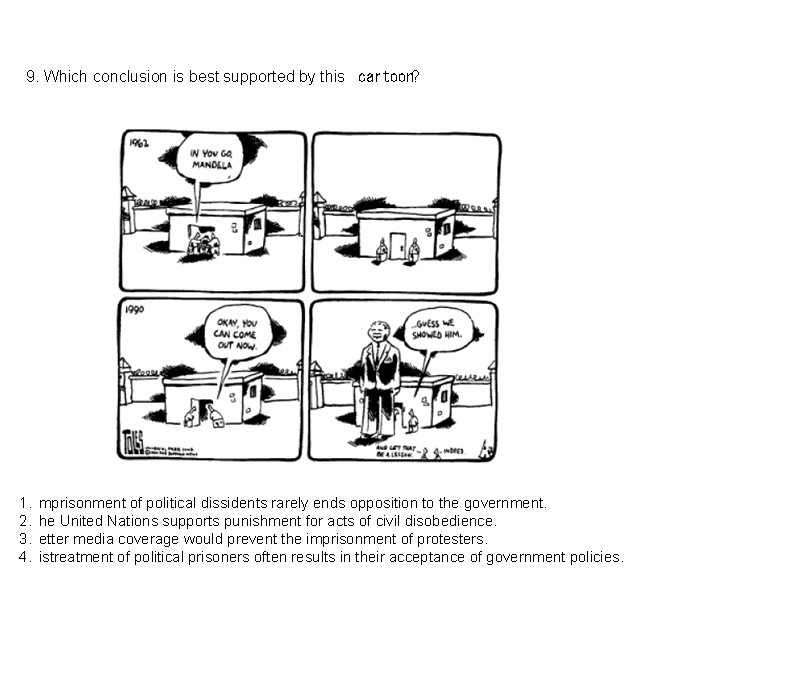
9. Which conclusion is best supported by this cartoon? 1. 2. 3. 4. mprisonment of political dissidents rarely ends opposition to the government. he United Nations supports punishment for acts of civil disobedience. etter media coverage would prevent the imprisonment of protesters. istreatment of political prisoners often results in their acceptance of government policies.