DEATH Meaning Manner Mechanism Cause and Time Death


- Slides: 16
DEATH Meaning, Manner, Mechanism, Cause and Time
Death n n n Defined as the “irreversible cessation of circulation of blood” May also be defined as the cessation of all brain activity Not easy to pinpoint the exact moment of death (death is a process, not an instant event) In cases of suspicious or unnatural deaths, an autopsy is performed Autopsy determines the manner, cause and mechanism of death
Manner of Death Natural death – results from age or disease n Accidental death – ex. ; car accident n Suicidal death – purposeful killing of oneself n Homicidal death – death of one person caused by another n Undetermined n
Cause and Mechanism of Death n n Reason someone dies is cause of death Disease, physical injury, stroke, heart attack all cause death “proximate cause of death” refers to an underlying cause of death as opposed to the final cause Mechanism of death describes the specific change in the body that brought about cessation of life
Time of Death n By establishing a time of death, a suspect may be proved guilty or innocent simply because he or she was or was not in the same place as the victim at the time of death.
Liver Mortis n n Translated, means “death color” Purplish color is present on the body wherever blood pools…this is called lividity.
Lividity n n helps determine time of death, position of the body during the first 8 hours after death and if the body has been moved begins 2 hours after death; discoloration becomes permanent after 8 hours Temperature affects the time it takes lividity to set in (faster in heat) Pooling of blood can help determine if the body was moved from one location to another
Rigor Mortis n n n Means “death stiffness” This is temporary and helps determine the time of death Starts within 2 hours after death and remains for 48 hours At 12 hours, body is in its most rigid state Stiffness occurs because skeletal muscles are unable to relax and remain contracted and hard
Rigor Mortis and Time of Death If body shows no visible rigor, it’s been dead less than 2 hours or more than 48 hours n If very rigid, it’s been dead approx. 12 hours n If rigor in face and neck only, rigor has just begun and body has only been dead approx 2 hours n
Other Factors Affecting Rigor n n n Temperature (cooler the body, the slower the onset of rigor) Body weight (higher weight slows the onset) Type of clothing (heavier clothes accelerates rigor) Illness (fever vs hypothermia) Level of physical activity shortly before death (exercise or a struggle accelerates rigor) Sun exposure
Algor Mortis Describes the temperature loss in a corpse n To take a corpse’s temperature, forensic investigators insert a thermometer into the liver n Rule of thumb is that body loses approximately 1 degree Fahrenheit per hour. n
Stomach and Intestinal Contents n n n If undigested stomach contents are present, death occurred 0 -2 hours after the last meal If stomach is empty but food is in small intestine, death occurred at least 4 -6 hours after a meal If small intestine is empty but there is waste in the large intestine, death occurred 12 or more hours after a meal
Changes of the Eye n If eyes were open at time of death, there is a thin film observed within 2 -3 hours n If eyes were covered at death, film is observed within 24 hours
Stages of Decomposition n Within 2 days: n n n After 4 days: n n n Cell autolysis begins Green & purplish staining occurs from blood decomposition Skin looks “marbled” Face becomes discolored Skin blisters Abdomen swells with CO 2 Within 6 -10 days: n n Corpse bloats with CO 2; chest & abdomen burst Fluids leak from body openings Eyeballs liquefy Skin sloughs off
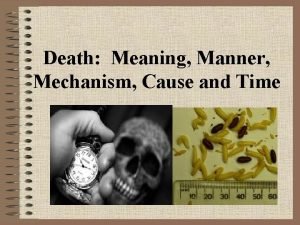
Clues from Insects n n n Forensic entomologists – observes and records data about temperature, wind and moisture around the body as well as below it Insects are attracted to the smell of decompostion and lay their eggs on the dead body within minutes of death Eggs hatch and feed on the decomposing tissues
Life Cycle of a Blowfly n n Exhibit different stages as they develop from egg, larva stages, pupa and adult Each stage of development is present at different times on a corpse and is used to help determine the time of death