Culmination of Coaxial Injector Mixing Studies Ivett Leyva


- Slides: 4
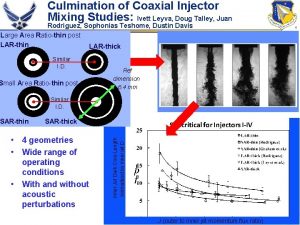
Culmination of Coaxial Injector Mixing Studies: Ivett Leyva, Doug Talley, Juan Rodriguez, Sophonias Teshome, Dustin Davis Large Area Ratio-thin post LAR-thin LAR-thick Similar I. D. Small Area Ratio-thin post Ref dimension 6. 4 mm Similar I. D. SAR-thick • 4 geometries • Wide range of operating conditions • With and without acoustic perturbations Inner Jet Dark Core Length normalized by inner jet D SAR-thin J (outer to inner jet momentum flux ratio) 1
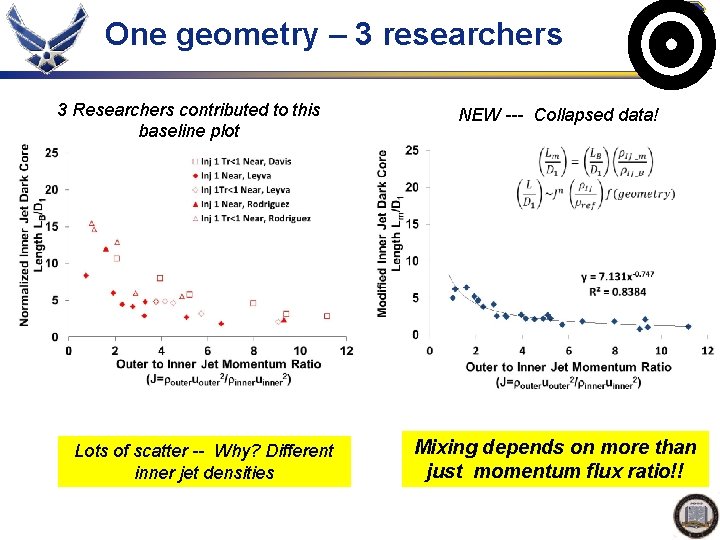
One geometry – 3 researchers 2 3 Researchers contributed to this baseline plot NEW --- Collapsed data! Lots of scatter -- Why? Different inner jet densities Mixing depends on more than just momentum flux ratio!!
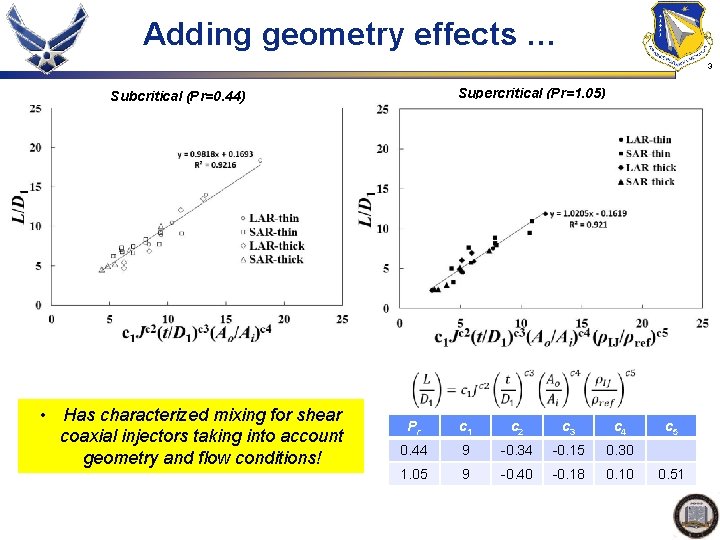
Adding geometry effects … 3 Supercritical (Pr=1. 05) Subcritical (Pr=0. 44) • Has characterized mixing for shear coaxial injectors taking into account geometry and flow conditions! Pr c 1 c 2 c 3 c 4 0. 44 9 -0. 34 -0. 15 0. 30 1. 05 9 -0. 40 -0. 18 0. 10 c 5 0. 51
Other Conclusions 4 • Outer to inner jet momentum flux ratio (J) is not the only parameter to characterize mixing in shear coaxial jets - area ratio (Ao/Ai), inner jet post thickness (t), and reduced densities matter! • Found functional correlations for dark core lengths • Based on four geometries, mixing is enhanced with increasing J and inner jet post thickness but less efficient with increasing Ao/Ai • Through LES we found relevant St numbers for one geometry for different J values • Helical instabilities were observed for LAR-thin and SAR-thick, SAR-thin geometries at large J for baseline conditions • Applying POD analysis for baseline and acoustically excited cases, able to discern stability characteristics for the different geometries for a wide range of flow conditions