Copyright and Fair use Using Google Images Search

- Slides: 13
Copyright and Fair use: Using Google Images Search Jamey Bearden Kennesaw State University ITEC 7445 Multimedia and Web Design in Education
BEFORE WE GET STARTED, THERE A FEW TERMS WE NEED TO KNOW: What is Copyright? What is Fair Use? What is Creative Commons License?
COPYRIGHT LAW & USING GOOGLE IMAGES Have you ever needed a quick “pic” or image for your lesson? Did you think, “Google It!” ? FACT: Images found online may be protected by copyright law.
“GOOGLING” AN IMAGE IS TEMPTING, BUT… “Google is a search engine that helps you locate content such as images and photos. It is not a content depository, and it is not a collection of public domain or copyright-free works” (Copyright Law) We must consider that “copying and pasting” images that appear from a Google search are likely copyrighted. It is important to know copyright & fair use law for online & digital images before we copy and paste.
MYTHS ABOUT FAIR USE: Myth #1: If I give credit to the copyright owner, my use is automatically fair use. Myth #2: If I post a disclaimer on my video, my use is fair use. Myth #3: “Entertainment” or “non-profit” uses are automatically fair use. Myth #4: If I add any original material I created to someone else’s copyrighted work, my use is fair use.
HOW WE SHOULD USE “GOOGLE IMAGES” IN RESPECT TO COPYRIGHT LAW… Here are some helpful tips when doing a Google image search: Assume that all online images are protected by copyright Do some research (just a few more clicks) to determine if the image you actually requires permission to use it. Ask yourself: Is there a Creative Commons license attached to the image or photograph that permits limited or unlimited use of that image without communication with the copyright owner? Are there terms of use attached to the image or photograph?
IS IT COPYRIGHTED? WHAT DO I DO? If you do not see permission to use an image or photo, then you need to CONTACT AUTHOR and OBTAIN PERMISSION to use the image. If you contact the author and there is not response, then you cannot legally use the image. YOU MUST RECEIVE CONSENT from the AUTHOR to use the image or photo.
ALTERNATIVE WAYS TO LEGALLY USE A DIGITAL IMAGE OR PHOTO IN ONLINE EDUCATION: Link to the images if possible rather than making an electronic copy available to students. If copying an image, use the lowest image resolution possible to achieve your purpose. Avoid copying images from materials created and marketed primarily for use in courses such as the one at hand (e. g. from a textbook, workbook, or other instructional materials designed for the course). Make sure that the images serve a pedagogical purpose.
CONT’D… Place the images in the context of the course, explaining why they were chosen and what they are intended to illustrate. Limit access to the images to students enrolled in the course. Notify students that images are being made available for teaching, study, and research only. Provide attributions to known copyright owners of the images and any works depicted in the images.
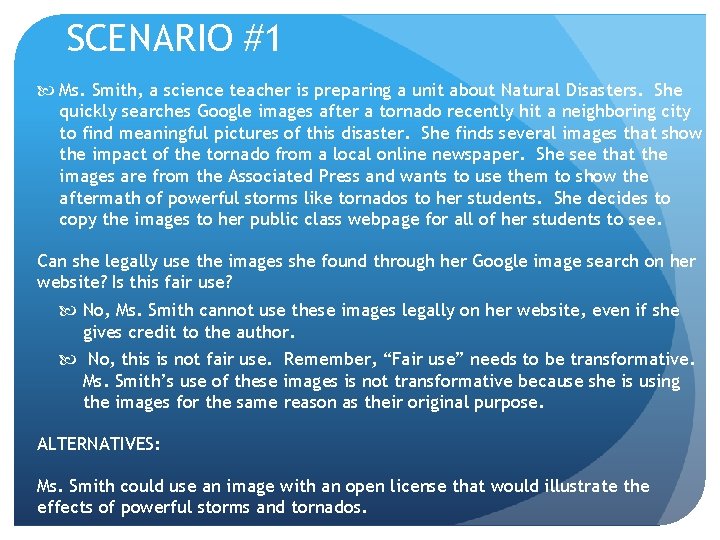
SCENARIO #1 Ms. Smith, a science teacher is preparing a unit about Natural Disasters. She quickly searches Google images after a tornado recently hit a neighboring city to find meaningful pictures of this disaster. She finds several images that show the impact of the tornado from a local online newspaper. She see that the images are from the Associated Press and wants to use them to show the aftermath of powerful storms like tornados to her students. She decides to copy the images to her public class webpage for all of her students to see. Can she legally use the images she found through her Google image search on her website? Is this fair use? No, Ms. Smith cannot use these images legally on her website, even if she gives credit to the author. No, this is not fair use. Remember, “Fair use” needs to be transformative. Ms. Smith’s use of these images is not transformative because she is using the images for the same reason as their original purpose. ALTERNATIVES: Ms. Smith could use an image with an open license that would illustrate the effects of powerful storms and tornados.
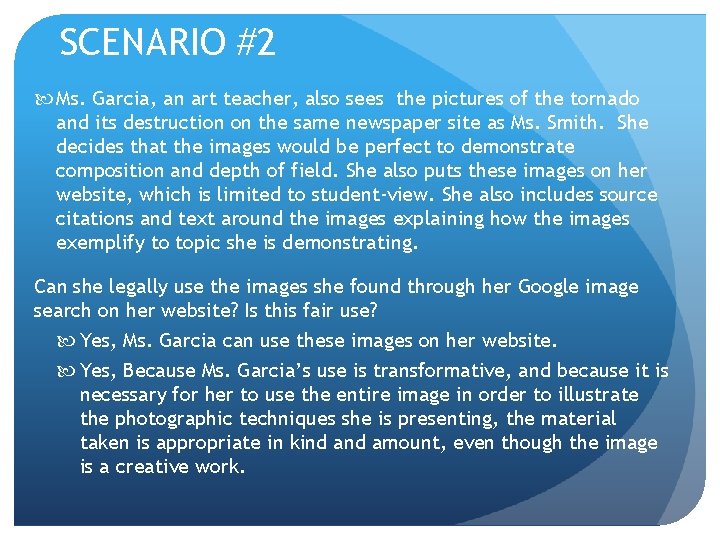
SCENARIO #2 Ms. Garcia, an art teacher, also sees the pictures of the tornado and its destruction on the same newspaper site as Ms. Smith. She decides that the images would be perfect to demonstrate composition and depth of field. She also puts these images on her website, which is limited to student-view. She also includes source citations and text around the images explaining how the images exemplify to topic she is demonstrating. Can she legally use the images she found through her Google image search on her website? Is this fair use? Yes, Ms. Garcia can use these images on her website. Yes, Because Ms. Garcia’s use is transformative, and because it is necessary for her to use the entire image in order to illustrate the photographic techniques she is presenting, the material taken is appropriate in kind amount, even though the image is a creative work.
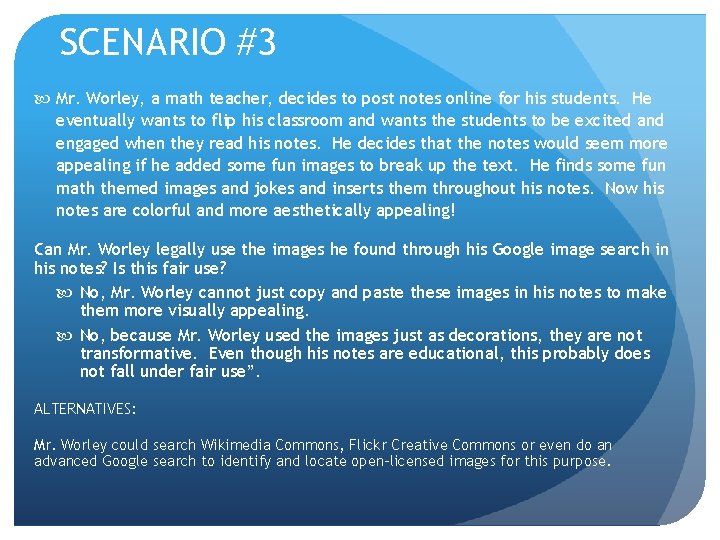
SCENARIO #3 Mr. Worley, a math teacher, decides to post notes online for his students. He eventually wants to flip his classroom and wants the students to be excited and engaged when they read his notes. He decides that the notes would seem more appealing if he added some fun images to break up the text. He finds some fun math themed images and jokes and inserts them throughout his notes. Now his notes are colorful and more aesthetically appealing! Can Mr. Worley legally use the images he found through his Google image search in his notes? Is this fair use? No, Mr. Worley cannot just copy and paste these images in his notes to make them more visually appealing. No, because Mr. Worley used the images just as decorations, they are not transformative. Even though his notes are educational, this probably does not fall under fair use”. ALTERNATIVES: Mr. Worley could search Wikimedia Commons, Flickr Creative Commons or even do an advanced Google search to identify and locate open-licensed images for this purpose.
REFERENCES Copyright. (n. d. ). Retrieved April 25, 2016, from http: //www. wikipedia. org/ Fair Use and Copyright for Online Education. (n. d. ). Retrieved April 25, 2016, from http: //uri. libguides. com/fairuse Harris, L. E. (2016, March 31). Copyrightlaws. com: Copyright, licensing, digital property. Retrieved April 25, 2016, from http: //www. copyrightlaws. com/ Lessig, L. , & Ito, J. (2016, April 23). Creative Commons License. Retrieved April 25, 2016, from http: //www. wikipedia. org/ Stim, R. (2010). What is Fair Use? Retrieved April 25, 2016, from http: //fairuse. stanford. edu/