Contemplation Dialogue and Discernment Why contemplation Contemplationtaking a

- Slides: 17
Contemplation, Dialogue, and Discernment
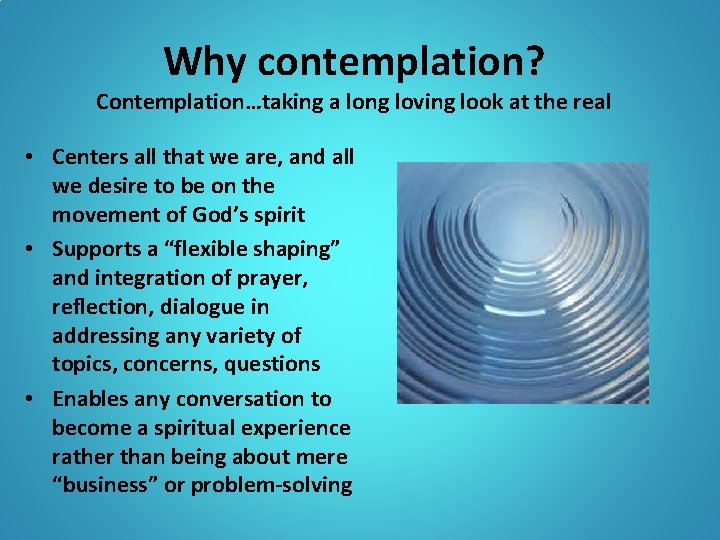
Why contemplation? Contemplation…taking a long loving look at the real • Centers all that we are, and all we desire to be on the movement of God’s spirit • Supports a “flexible shaping” and integration of prayer, reflection, dialogue in addressing any variety of topics, concerns, questions • Enables any conversation to become a spiritual experience rather than being about mere “business” or problem-solving
• Engages our minds and hearts in movement toward a new consciousness – a new way of seeing, a new way of being • Assists a group in moving from “I” to “We” • Invites silence which supports slowing down, reflection, and deeper conversation • Allows for creative possibilities, emerging options, and peaceful resolution
Contemplatio - templum • A piece of ground consecrated for worship • A place reserved or cut out • A cleared space in front of the altar LIVE OUT of a “cleared space” in which God’s spirit dwells.
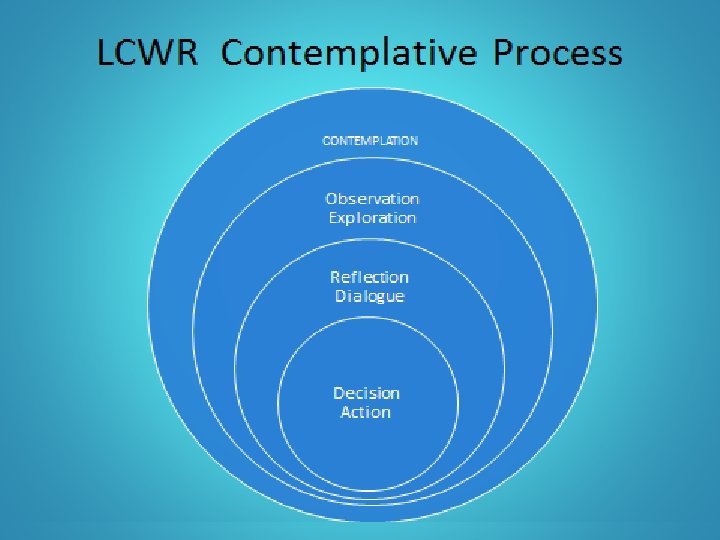
Movements in the Contemplative Process Noticing what is … OBSERVE • Without judgment • Pay attention • Take time and not rush to conclusions • Slow down and wait
Coming to Quiet REFLECT • Externally: Listening… A still body to myself, External Silence to/with others, • Internally: to the situation, Stilling the mind Letting go of thoughts and chatter Quieting the heart Letting go/letting come
Act • Offer what I/we see and hear freely • Come to a decision and/or course of action • Returning to quiet receptivity “Take a long, loving look at what is. ”
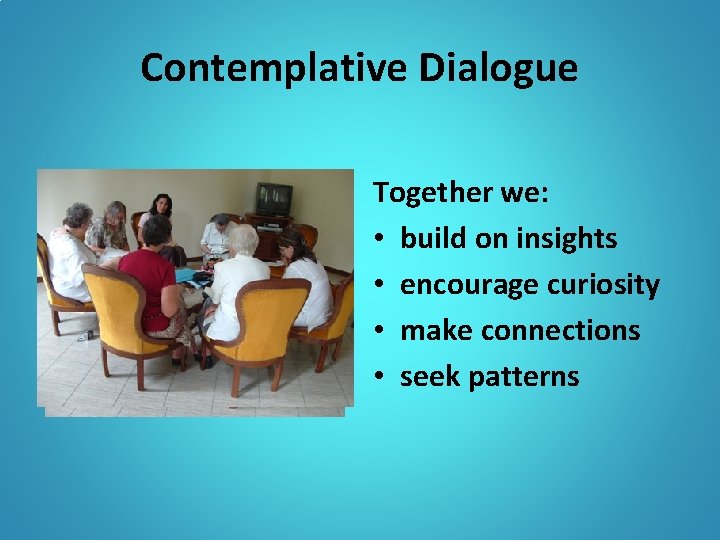
Contemplative Dialogue Together we: • build on insights • encourage curiosity • make connections • seek patterns
Three Movements: • Observe, observe - What are you noticing in yourself, in others, in what is happening around you? • Reflect - What meaning/understanding/conclusions do you draw from what you are observing? • Act - What response will be made in light of observation and reflection?
Inner Dispositions • Open Mind (commitment to truth) - see with fresh eyes • Open Heart (commitment to love) - walk in the shoes of another • Open Will (commitment to courage) - let go of fear, new will come
Three Voices • Voice of Judgment - stifles creativity • Voice of Cynicism - only my way of thinking, doing • Voice of Fear - cannot let go so new can come
Levels of Listening • Downloading: confirms what you already know • Factual Listening: you notice something new • Empathic listening: changes your perspective when you see through the eyes of another • Generative listening: you are changed as a person
Levels of Conversation • Downloading: talking nice, “same old” • Debate: talking tough, “my way” or no way • Dialogue: reflective inquiry, seeing myself as part of the whole • Deep Conversation: collective creativity, shifting from “I” to “we”
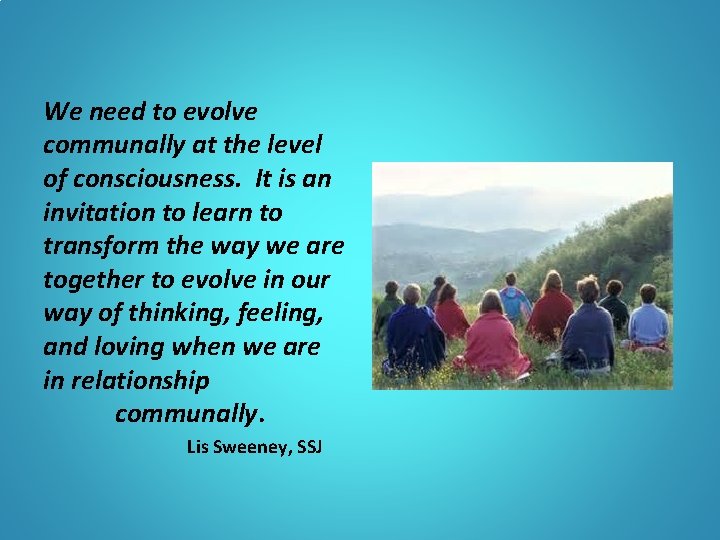
We need to evolve communally at the level of consciousness. It is an invitation to learn to transform the way we are together to evolve in our way of thinking, feeling, and loving when we are in relationship communally. Lis Sweeney, SSJ
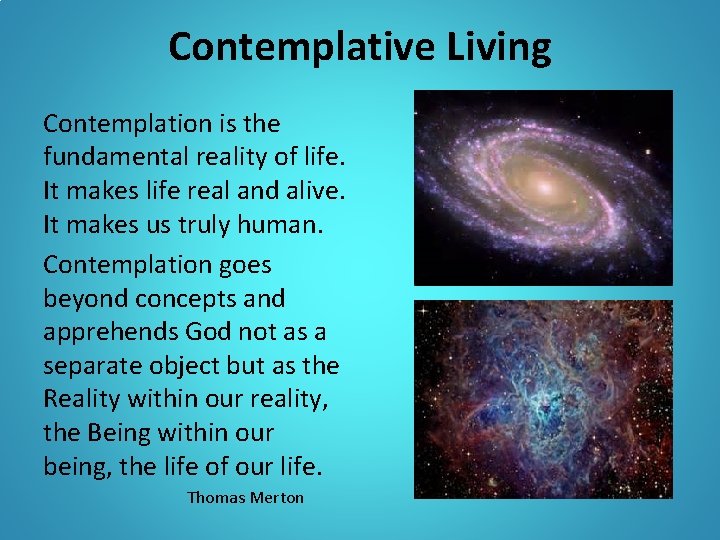
Contemplative Living Contemplation is the fundamental reality of life. It makes life real and alive. It makes us truly human. Contemplation goes beyond concepts and apprehends God not as a separate object but as the Reality within our reality, the Being within our being, the life of our life. Thomas Merton
Sources include: Adaptions and quotations from the work of Catherine Bertrand, SSND Marie Mc. Carthy, SP Mary Jo Nelson, OLVM Carole Shinnick, SSND Liz Sweeney, SSJ Otto Scharmer & Peter Senge Presented by Catherine Bertrand, SSND and Mary Jo Nelson, OLVM (LCWR 2015 National Assembly)