Conflict Prevention and ManagementSystem in large Food Security
- Slides: 1
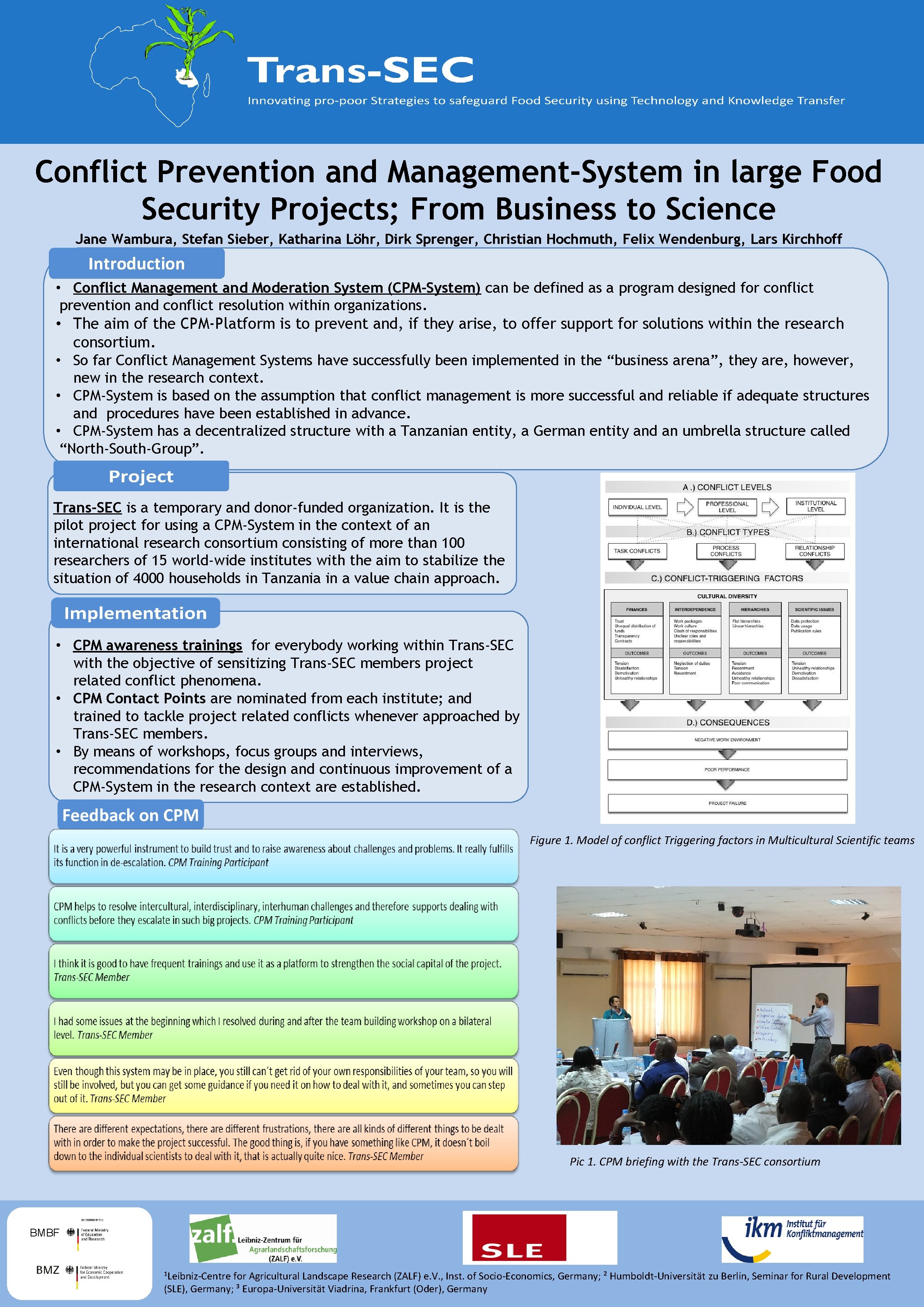
Conflict Prevention and Management-System in large Food Security Projects; From Business to Science Jane Wambura, Stefan Sieber, Katharina Löhr, Dirk Sprenger, Christian Hochmuth, Felix Wendenburg, Lars Kirchhoff Introduction • Conflict Management and Moderation System (CPM-System) can be defined as a program designed for conflict prevention and conflict resolution within organizations. • The aim of the CPM-Platform is to prevent and, if they arise, to offer support for solutions within the research consortium. • So far Conflict Management Systems have successfully been implemented in the “business arena”, they are, however, new in the research context. • CPM-System is based on the assumption that conflict management is more successful and reliable if adequate structures and procedures have been established in advance. • CPM-System has a decentralized structure with a Tanzanian entity, a German entity and an umbrella structure called “North-South-Group”. Trans-SEC is a temporary and donor-funded organization. It is the pilot project for using a CPM-System in the context of an international research consortium consisting of more than 100 researchers of 15 world-wide institutes with the aim to stabilize the situation of 4000 households in Tanzania in a value chain approach. • CPM awareness trainings for everybody working within Trans-SEC with the objective of sensitizing Trans-SEC members project related conflict phenomena. • CPM Contact Points are nominated from each institute; and trained to tackle project related conflicts whenever approached by Trans-SEC members. • By means of workshops, focus groups and interviews, recommendations for the design and continuous improvement of a CPM-System in the research context are established. Figure 1. Model of conflict Triggering factors in Multicultural Scientific teams Pic 1. CPM briefing with the Trans-SEC consortium BMBF 1 Leibniz-Centre for Agricultural Landscape Research (ZALF) e. V. , Inst. of Socio-Economics, Germany; ² Humboldt-Universität zu Berlin, Seminar for Rural Development (SLE), Germany; ³ Europa-Universität Viadrina, Frankfurt (Oder), Germany