Computers and Scientific Thinking David Reed Creighton University

- Slides: 16
Computers and Scientific Thinking David Reed, Creighton University Conditional Execution 1
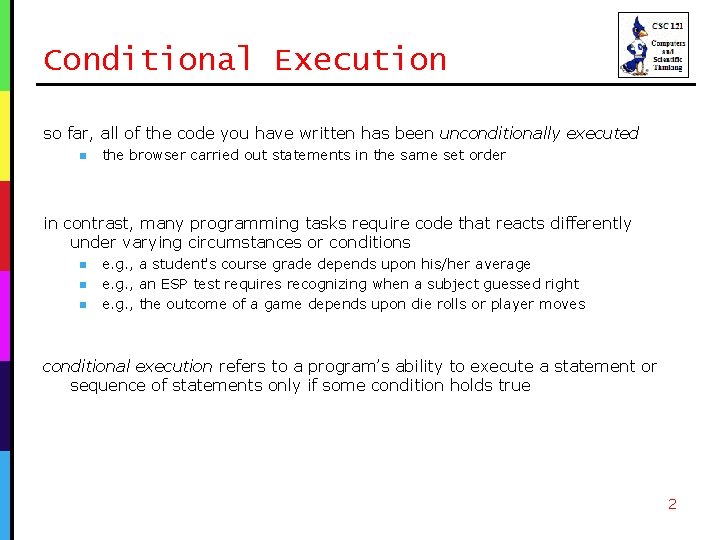
Conditional Execution so far, all of the code you have written has been unconditionally executed n the browser carried out statements in the same set order in contrast, many programming tasks require code that reacts differently under varying circumstances or conditions n n n e. g. , a student's course grade depends upon his/her average e. g. , an ESP test requires recognizing when a subject guessed right e. g. , the outcome of a game depends upon die rolls or player moves conditional execution refers to a program’s ability to execute a statement or sequence of statements only if some condition holds true 2
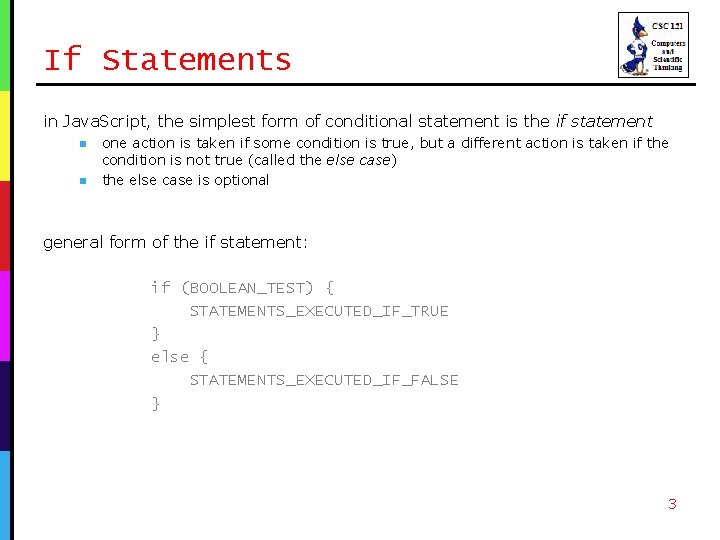
If Statements in Java. Script, the simplest form of conditional statement is the if statement n n one action is taken if some condition is true, but a different action is taken if the condition is not true (called the else case) the else case is optional general form of the if statement: if (BOOLEAN_TEST) { STATEMENTS_EXECUTED_IF_TRUE } else { STATEMENTS_EXECUTED_IF_FALSE } 3
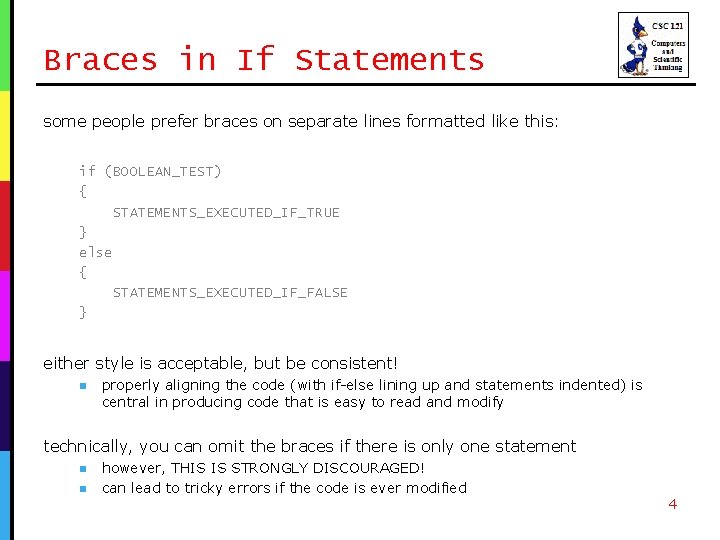
Braces in If Statements some people prefer braces on separate lines formatted like this: if (BOOLEAN_TEST) { STATEMENTS_EXECUTED_IF_TRUE } else { STATEMENTS_EXECUTED_IF_FALSE } either style is acceptable, but be consistent! n properly aligning the code (with if-else lining up and statements indented) is central in producing code that is easy to read and modify technically, you can omit the braces if there is only one statement n n however, THIS IS STRONGLY DISCOURAGED! can lead to tricky errors if the code is ever modified 4
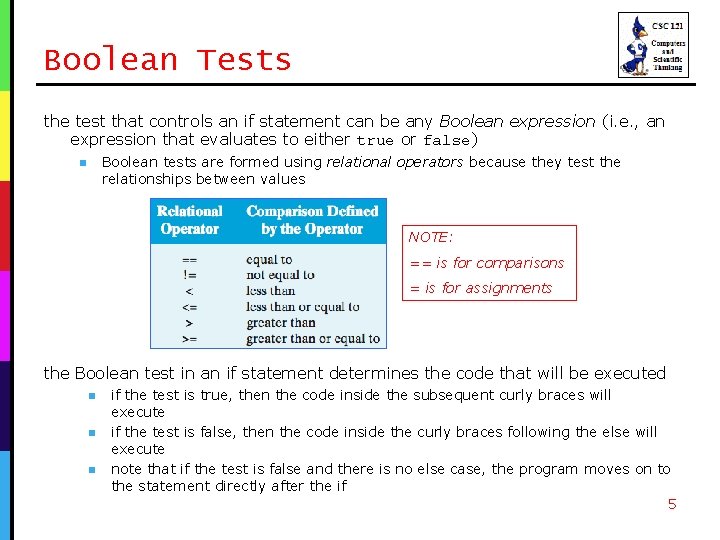
Boolean Tests the test that controls an if statement can be any Boolean expression (i. e. , an expression that evaluates to either true or false) Boolean tests are formed using relational operators because they test the relationships between values n NOTE: == is for comparisons = is for assignments the Boolean test in an if statement determines the code that will be executed n n n if the test is true, then the code inside the subsequent curly braces will execute if the test is false, then the code inside the curly braces following the else will execute note that if the test is false and there is no else case, the program moves on to the statement directly after the if 5
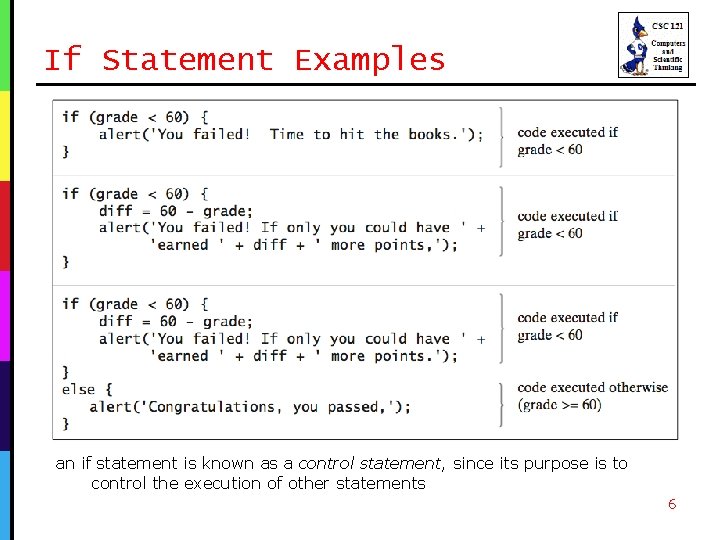
If Statement Examples an if statement is known as a control statement, since its purpose is to control the execution of other statements 6
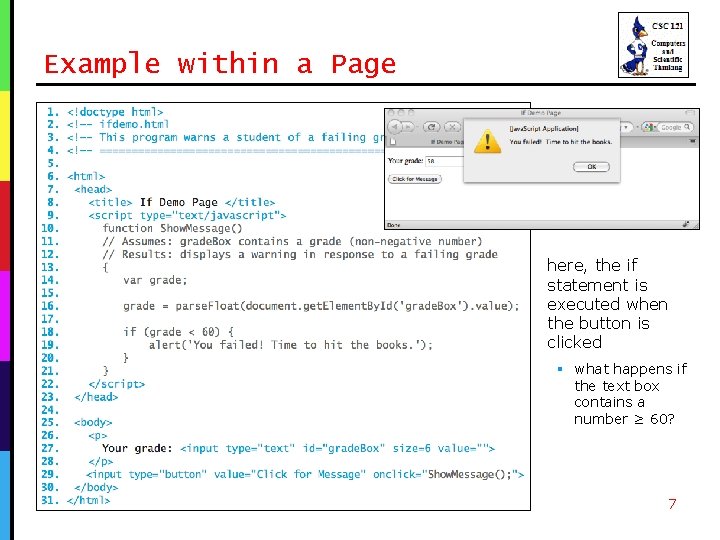
Example within a Page here, the if statement is executed when the button is clicked § what happens if the text box contains a number ≥ 60? 7
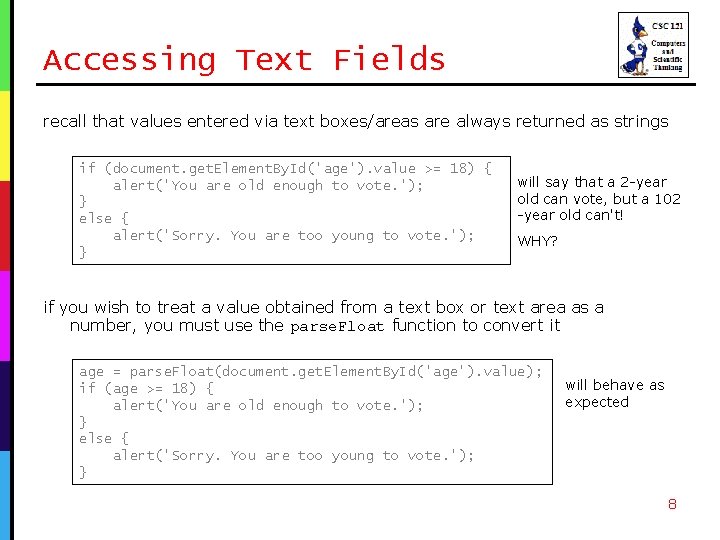
Accessing Text Fields recall that values entered via text boxes/areas are always returned as strings if (document. get. Element. By. Id('age'). value >= 18) { alert('You are old enough to vote. '); } else { alert('Sorry. You are too young to vote. '); } will say that a 2 -year old can vote, but a 102 -year old can't! WHY? if you wish to treat a value obtained from a text box or text area as a number, you must use the parse. Float function to convert it age = parse. Float(document. get. Element. By. Id('age'). value); if (age >= 18) { alert('You are old enough to vote. '); } else { alert('Sorry. You are too young to vote. '); } will behave as expected 8
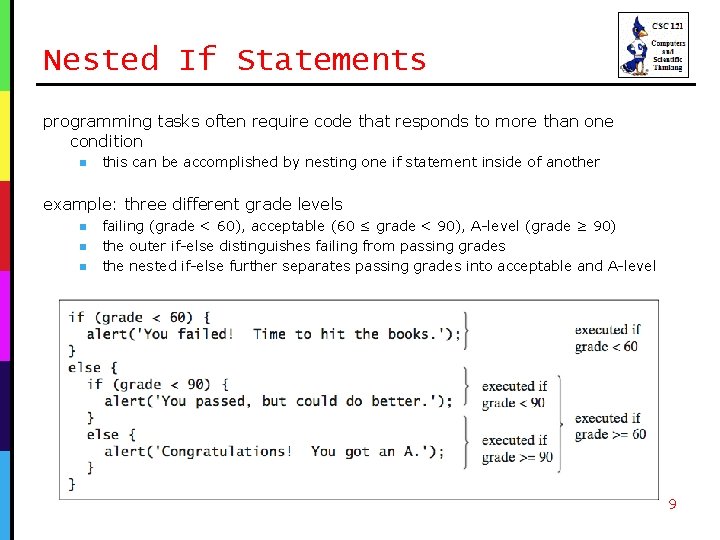
Nested If Statements programming tasks often require code that responds to more than one condition n this can be accomplished by nesting one if statement inside of another example: three different grade levels n n n failing (grade < 60), acceptable (60 ≤ grade < 90), A-level (grade ≥ 90) the outer if-else distinguishes failing from passing grades the nested if-else further separates passing grades into acceptable and A-level 9
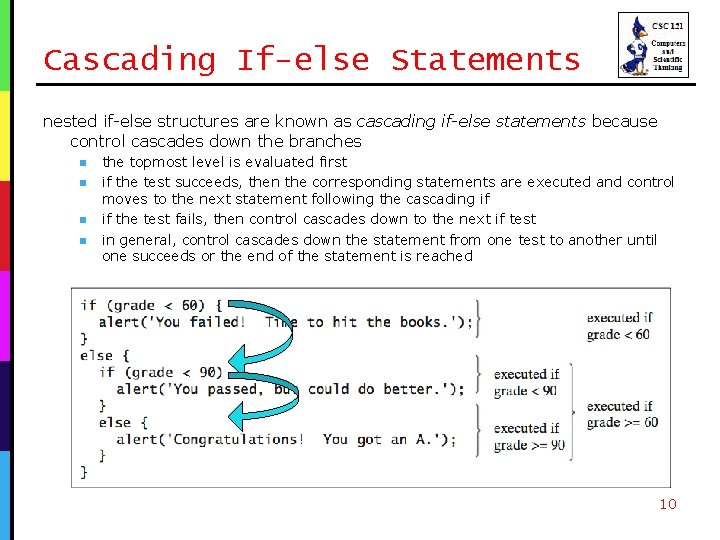
Cascading If-else Statements nested if-else structures are known as cascading if-else statements because control cascades down the branches n n the topmost level is evaluated first if the test succeeds, then the corresponding statements are executed and control moves to the next statement following the cascading if if the test fails, then control cascades down to the next if test in general, control cascades down the statement from one test to another until one succeeds or the end of the statement is reached 10
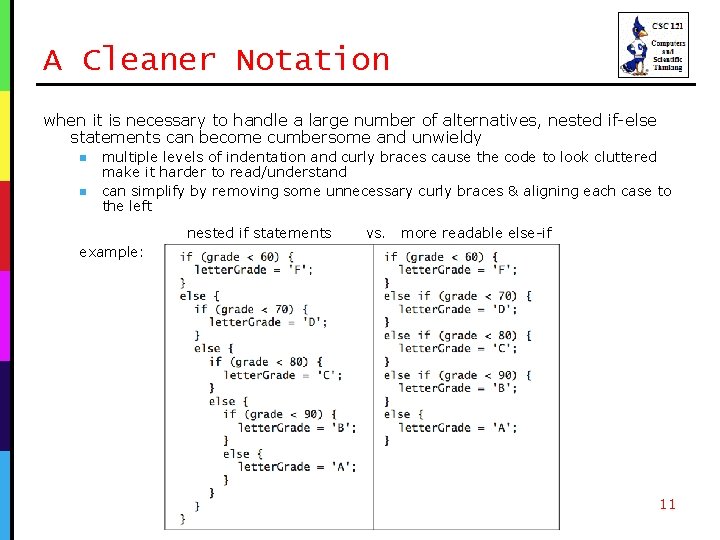
A Cleaner Notation when it is necessary to handle a large number of alternatives, nested if-else statements can become cumbersome and unwieldy n n multiple levels of indentation and curly braces cause the code to look cluttered make it harder to read/understand can simplify by removing some unnecessary curly braces & aligning each case to the left nested if statements vs. more readable else-if example: 11
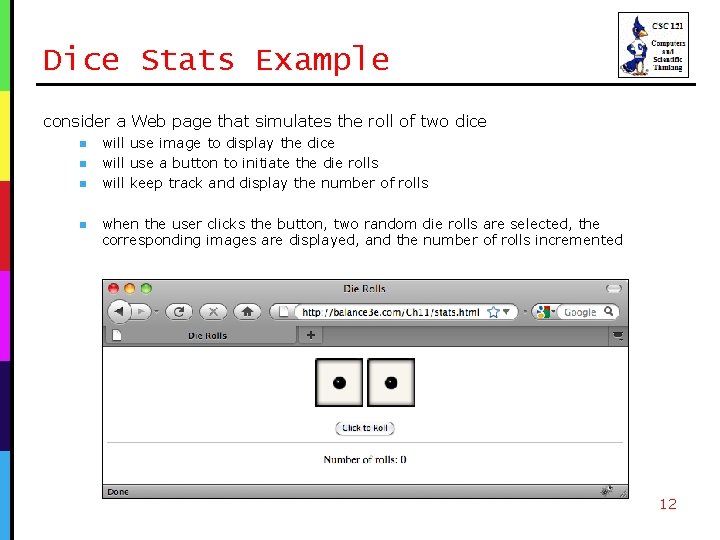
Dice Stats Example consider a Web page that simulates the roll of two dice n n will use image to display the dice will use a button to initiate the die rolls will keep track and display the number of rolls when the user clicks the button, two random die rolls are selected, the corresponding images are displayed, and the number of rolls incremented 12
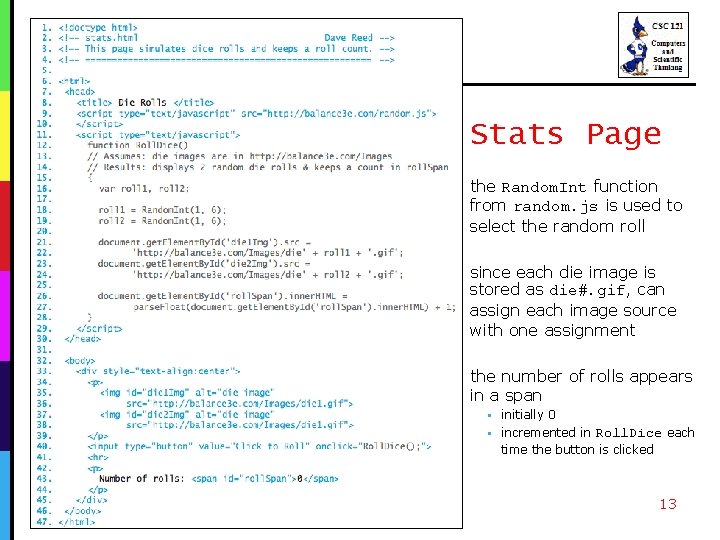
Stats Page the Random. Int function from random. js is used to select the random roll since each die image is stored as die#. gif, can assign each image source with one assignment the number of rolls appears in a span § initially 0 § incremented in Roll. Dice each time the button is clicked 13
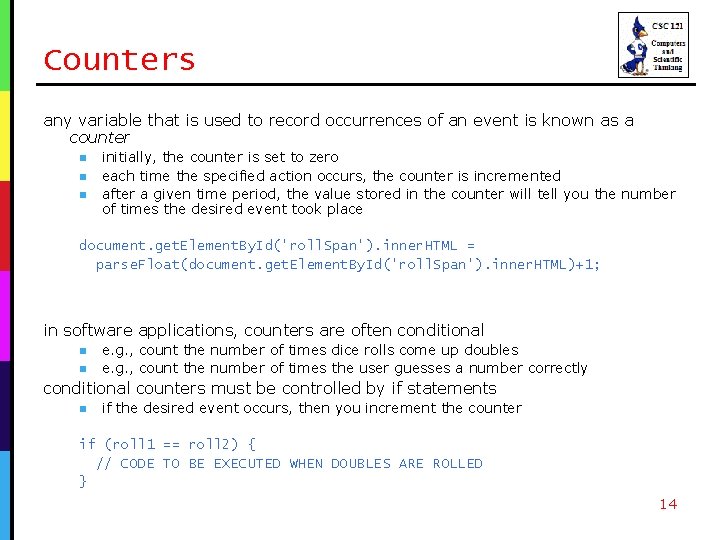
Counters any variable that is used to record occurrences of an event is known as a counter n n n initially, the counter is set to zero each time the specified action occurs, the counter is incremented after a given time period, the value stored in the counter will tell you the number of times the desired event took place document. get. Element. By. Id('roll. Span'). inner. HTML = parse. Float(document. get. Element. By. Id('roll. Span'). inner. HTML)+1; in software applications, counters are often conditional n n e. g. , count the number of times dice rolls come up doubles e. g. , count the number of times the user guesses a number correctly conditional counters must be controlled by if statements n if the desired event occurs, then you increment the counter if (roll 1 == roll 2) { // CODE TO BE EXECUTED WHEN DOUBLES ARE ROLLED } 14
Boolean Expressions sometimes, simple comparisons between two values may not be adequate to express the conditions under which code should execute Java. Script provides operators for expressing multipart tests n logical AND (&&): represents the conjunction of two things p (TEST 1 && TEST 2) is true if both TEST 1 and TEST 2 are true if (roll 1 == 4 && roll 2 == 4) { // CODE TO BE EXECUTED WHEN DOUBE FOURS ARE ROLLED } n logical OR (||): represents the disjunction of two things p (TEST 1 || TEST 2) is true if either TEST 1 or TEST 2 are true if (roll 1 == 4 || roll 2 == 4) { // CODE TO BE EXECUTED WHEN AT LEAST ONE FOUR IS ROLLED } n logical NOT (!): represents negation p (!TEST 1) is true only if TEST 1 is false if (!(roll 1 == 4 || roll 2 == 4)) { // CODE TO BE EXECUTED WHEN NEITHER ROLL IS A FOUR } 15
Slot Machine initially, displays three random slot images at the click of a button need to displayer's credits n n player starts with 20 credits each spin costs 1 credit, three matching slots earns 13 credits disallow play if no credits possibly give a loan when broke 16