Computational Plenoptic Imaging Gordon Wetzstein 1 Ivo Ihrke

- Slides: 7
Computational Plenoptic Imaging Gordon Wetzstein 1 Ivo Ihrke 2 Douglas Lanman 3 Wolfgang Heidrich 1 1 University of British Columbia 2 Saarland University 3 MIT Media Lab VIII. Discussion Eurographics 2011 – State of the Art Report EG 2011 | Computational Plenoptic Imaging STAR | I. Introduction 1
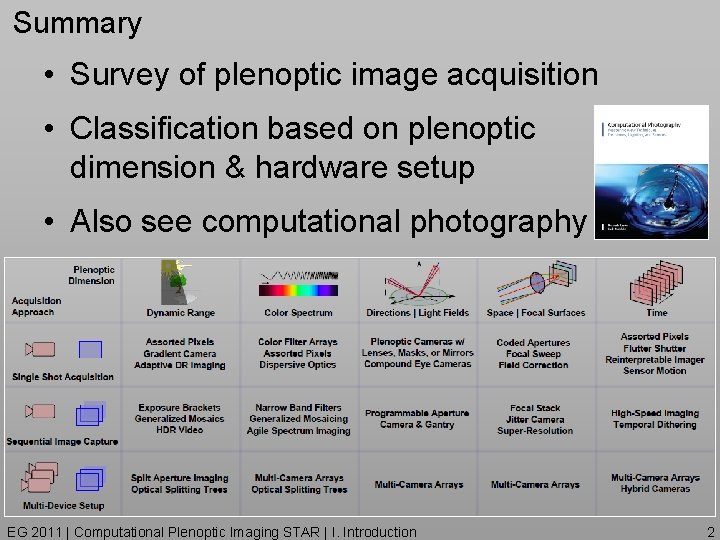
Summary • Survey of plenoptic image acquisition • Classification based on plenoptic dimension & hardware setup • Also see computational photography EG 2011 | Computational Plenoptic Imaging STAR | I. Introduction 2
Observations • Most approaches use fixed plenoptic resolution tradeoffs • Strong correlations between plenoptic dimensions • Need for sophisticated reconstruction techniques (e. g. compressive sensing) EG 2011 | Computational Plenoptic Imaging STAR | I. Introduction 3
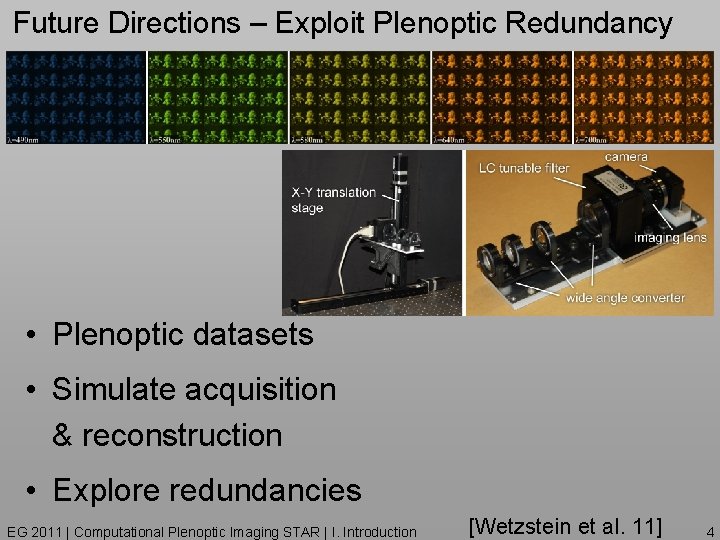
Future Directions – Exploit Plenoptic Redundancy • Plenoptic datasets • Simulate acquisition & reconstruction • Explore redundancies EG 2011 | Computational Plenoptic Imaging STAR | I. Introduction [Wetzstein et al. 11] 4
The End EG 2011 | Computational Plenoptic Imaging STAR | I. Introduction 5
Future Directions – Exploit Plenoptic Redundancy • Explore plenoptic priors – mathematical formulations for correlations between and within dimensions • Common practice in – Color demosaicking – Extended DOF and light field acquisition (dimensionality gap prior) [Levin et al. 09, 10] • Extend to time, polarization, plenoptic manifolds EG 2011 | Computational Plenoptic Imaging STAR | I. Introduction 6
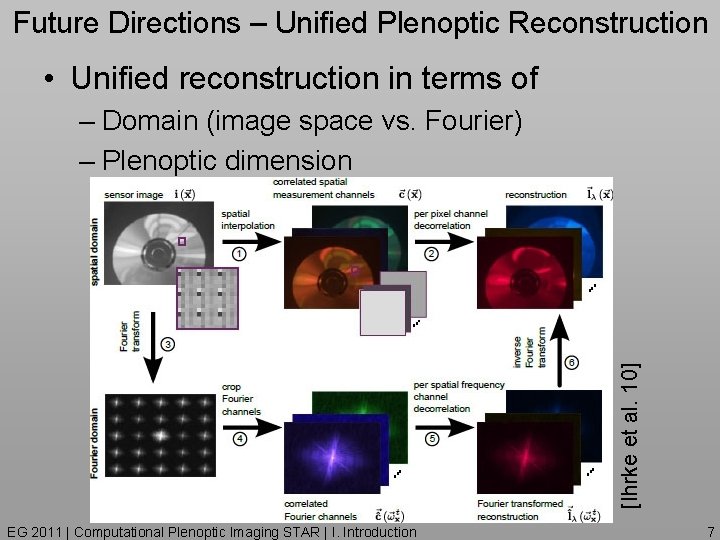
Future Directions – Unified Plenoptic Reconstruction • Unified reconstruction in terms of [Ihrke et al. 10] – Domain (image space vs. Fourier) – Plenoptic dimension EG 2011 | Computational Plenoptic Imaging STAR | I. Introduction 7