Communicative Language Promoting The importance of speaking in

- Slides: 19
Communicative Language Promoting • The importance of speaking in language learning. • Speech is the most basic means of human communication. • Speaking's trends.
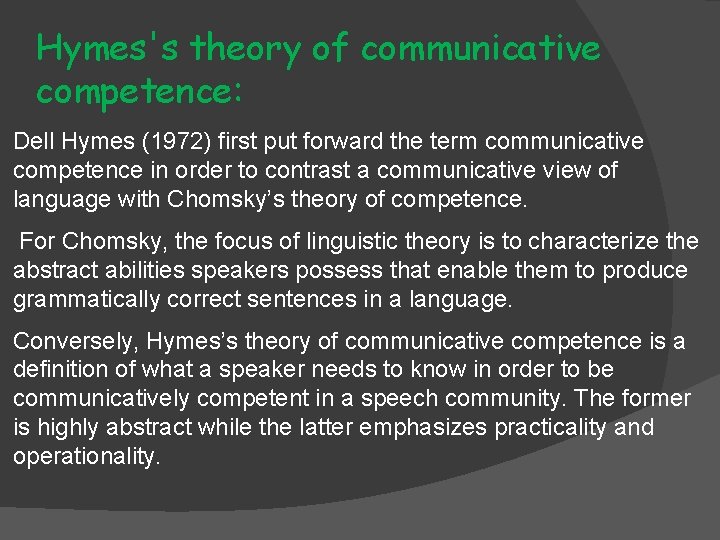
Hymes's theory of communicative competence: Dell Hymes (1972) first put forward the term communicative competence in order to contrast a communicative view of language with Chomsky’s theory of competence. For Chomsky, the focus of linguistic theory is to characterize the abstract abilities speakers possess that enable them to produce grammatically correct sentences in a language. Conversely, Hymes’s theory of communicative competence is a definition of what a speaker needs to know in order to be communicatively competent in a speech community. The former is highly abstract while the latter emphasizes practicality and operationality.
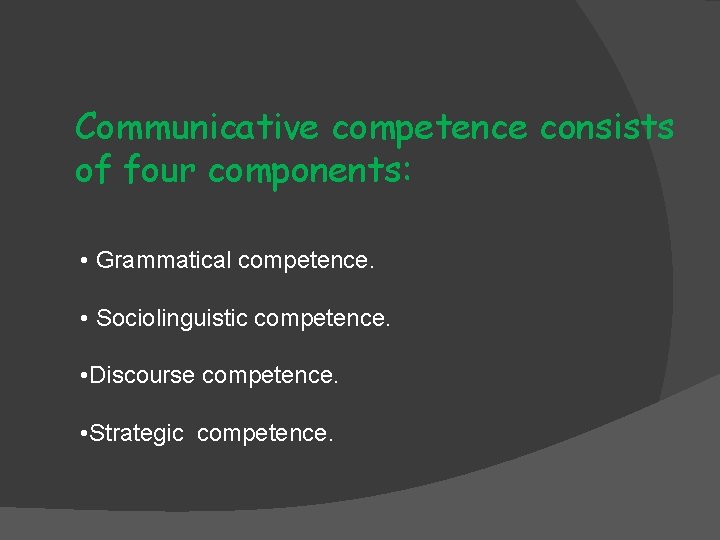
Communicative competence consists of four components: • Grammatical competence. • Sociolinguistic competence. • Discourse competence. • Strategic competence.
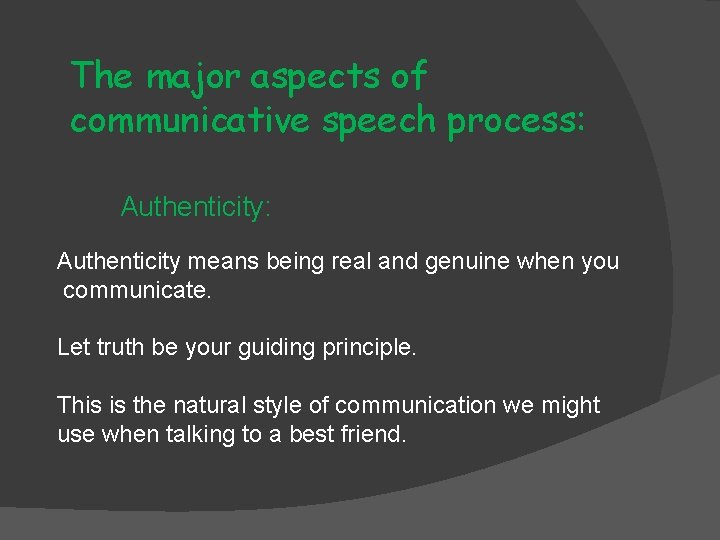
The major aspects of communicative speech process: Authenticity means being real and genuine when you communicate. Let truth be your guiding principle. This is the natural style of communication we might use when talking to a best friend.
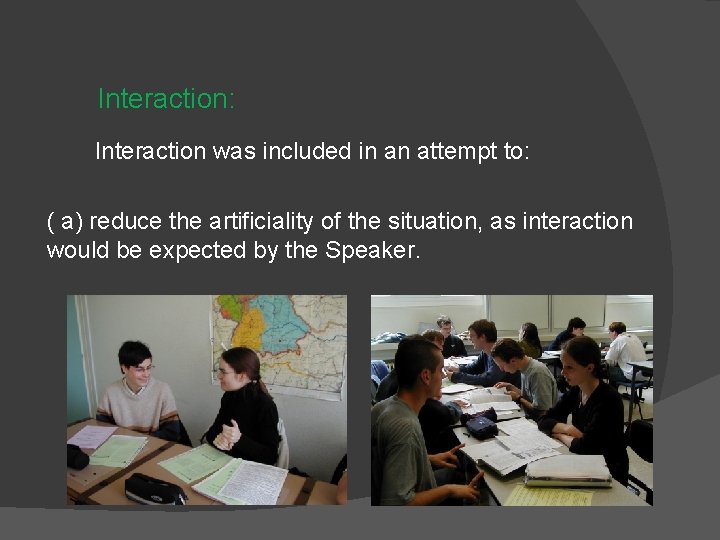
Interaction: Interaction was included in an attempt to: ( a) reduce the artificiality of the situation, as interaction would be expected by the Speaker.
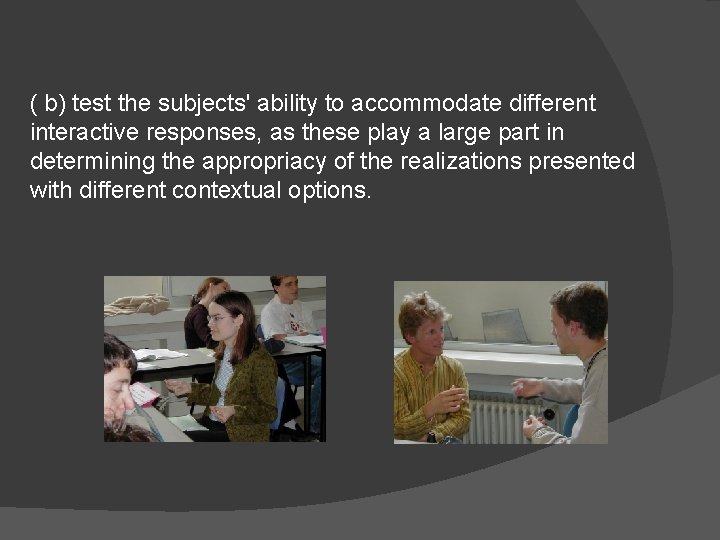
( b) test the subjects' ability to accommodate different interactive responses, as these play a large part in determining the appropriacy of the realizations presented with different contextual options.
Sociolinguistic competence: Definition: Sociolinguistic competence is the ability to interpret the social meaning of the choice of linguistic varieties and to use language with the appropriate social meaning for the communication situation. Examples: When greeting someone in a very formal situation an American might say, Hello, how are you? or Nice to see you again, but if he were meeting a friend in an informal situation it would be much more appropriate to say Hi, or Hey, whatcha been doing?
Why do learners learn sociolinguistic competence? Good sociolinguistic skills in a second language are important because if you make serious mistakes in this type of competence, people will not simply think that you are ignorant (which they may think if you have poor grammar); rather, they will think that you are illmannered, dishonest, insincere, rude, pushy, etc.
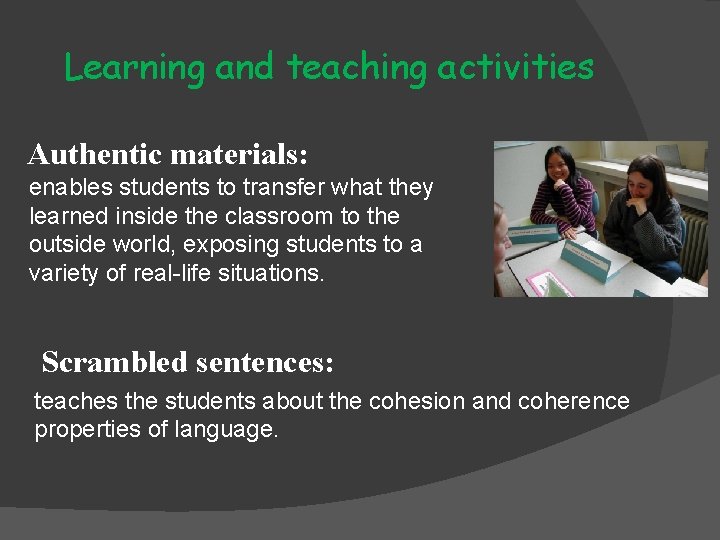
Learning and teaching activities Authentic materials: enables students to transfer what they learned inside the classroom to the outside world, exposing students to a variety of real-life situations. Scrambled sentences: teaches the students about the cohesion and coherence properties of language.
Language games: they give to students valuable communicative practice. Picture strip story: they can be structured so that the students share information or work together to arrive at a solution. Role-Play: give to students an opportunity to practice communicating in different social context and in different social roles.
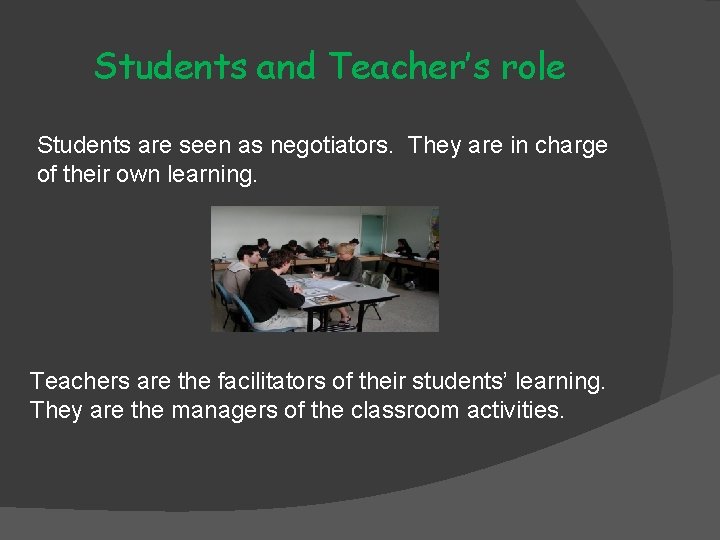
Students and Teacher’s role Students are seen as negotiators. They are in charge of their own learning. Teachers are the facilitators of their students’ learning. They are the managers of the classroom activities.
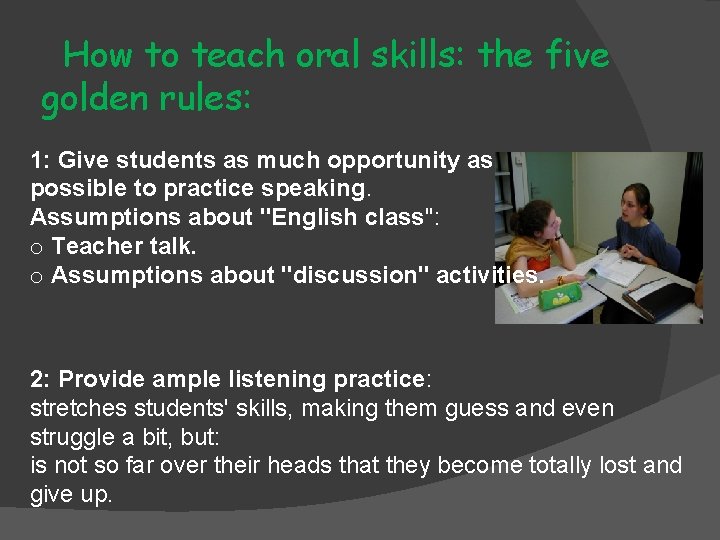
How to teach oral skills: the five golden rules: 1: Give students as much opportunity as possible to practice speaking. Assumptions about "English class": o Teacher talk. o Assumptions about "discussion" activities. 2: Provide ample listening practice: stretches students' skills, making them guess and even struggle a bit, but: is not so far over their heads that they become totally lost and give up.
3: Create opportunity for real communication: Conversation should involve an "information gap. " In other words, student A should tell student B something student B doesn't already know Students should be given opportunity to express their own ideas, especially to talk about topics they are interested in, care about, and are relevant to their lives.
4: Expand the range of topics students practice talking about: The development of speaking skills can be viewed as an expanding of a circle with the student at the center. In the beginning, the easiest kinds of topics for students to talk about are those which are relatively concrete, conceptually simple, and close and familiar to the student. Often these are the topics of daily life. Then, as students' skills advance, they should be encouraged to practice talking about topics a little further out in their circle -- topics concerning other people, times, and places.
5: Build discussion skills: Speaking and listening is not something one usually does solo; rather they usually involve interacting with other people. So one important aspect of building oral skills is learning how to interact with other people effectively in English.
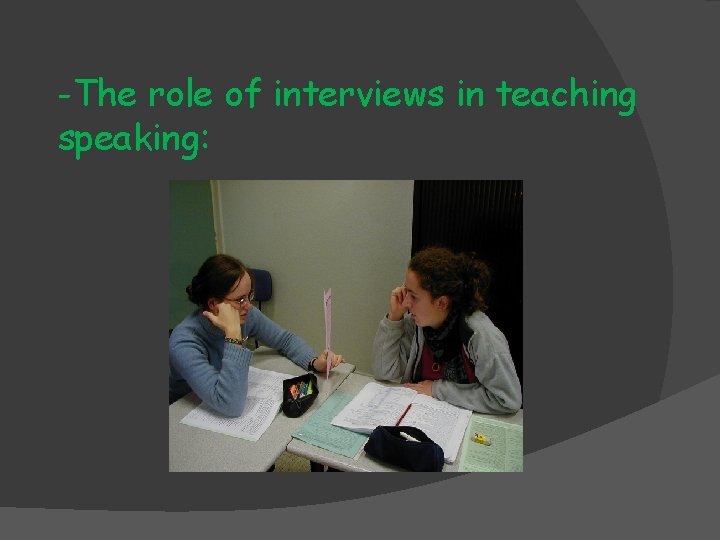
-The role of interviews in teaching speaking:
We conclude that speaking is essential in learning languages. Learners can reach both fluency and accuracy by practicing oral skills in and out their classrooms depending on their sociolinguistic competence. So, the more they practice the oral skills, the more fluent they become.
Thank you for your attention!
And thanks a lot for all students who have attended our seminar. Good Luck and all the best! We thank all those who helped us in making this humble seminar, and especially doctor George Saour. And thanks a lot for all students who have attended our seminar. Good Luck and all the best! This presentation was given by AHMAD KHORSHEED, HAMEED We thank all those. KEIRUZ, who helped us in making ABBOOD , HAZEM JEVEEN and RASHA ALEWE on 28 / 4/ 2009. this humble seminar, and especially doctor George Saour. And thanks a lot for all students who have Aleppo University Faculty ofthe Arts and Human Sciences attended our seminar. Good–Luck and all best! English Department We thank all those who helped us in making this humble seminar, and especially doctor George Saour. And thanks a lot for all students who have attended our seminar. Good Luck and all the best! For more information concerning our presentation: We thank all those who helped us in making You can e-mail us: this humble seminar, and especially Hazem: syrianstudent 85@hotmail. com doctor George Saour. And thanks a lot for all students who have attended our seminar. Good Luck and all the best!