CMPU145 Foundations of Computer Science Spring 2019 Chapter
- Slides: 19
CMPU-145: Foundations of Computer Science Spring, 2019 Chapter Lab Preview 2/12 CMPU 145 – Foundations of Computer Science Peter Lemieszewski
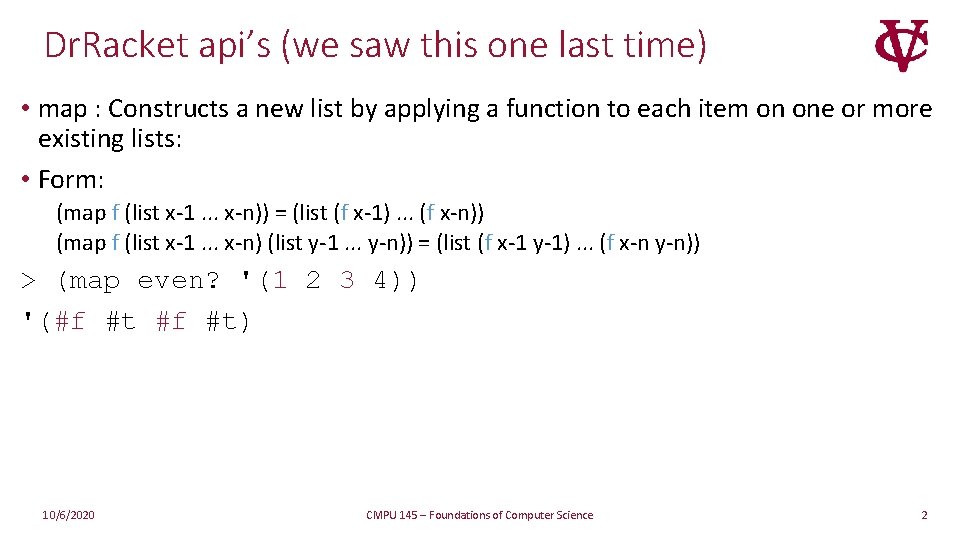
Dr. Racket api’s (we saw this one last time) • map : Constructs a new list by applying a function to each item on one or more existing lists: • Form: (map f (list x-1. . . x-n)) = (list (f x-1). . . (f x-n)) (map f (list x-1. . . x-n) (list y-1. . . y-n)) = (list (f x-1 y-1). . . (f x-n y-n)) > (map even? '(1 2 3 4)) '(#f #t) 10/6/2020 CMPU 145 – Foundations of Computer Science 2
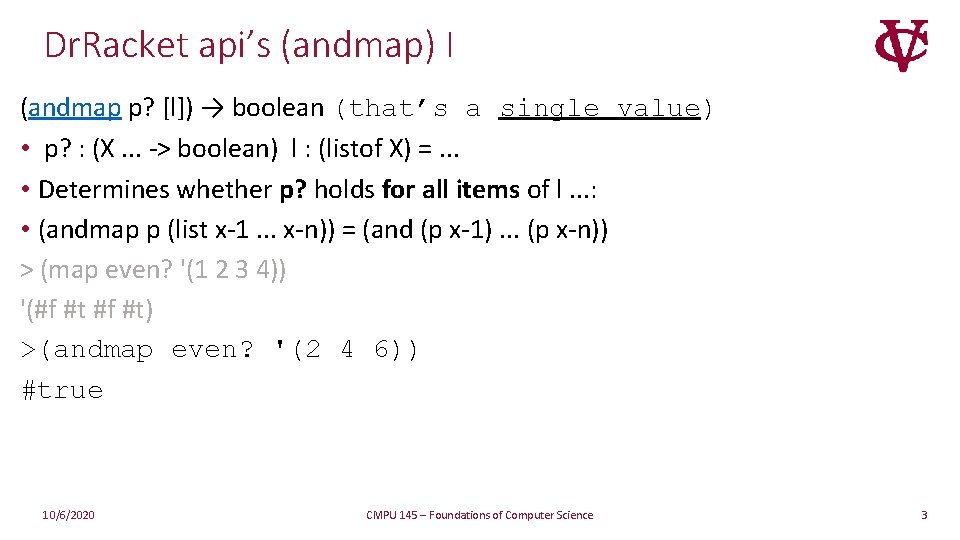
Dr. Racket api’s (andmap) I (andmap p? [l]) → boolean (that’s a single value) • p? : (X. . . -> boolean) l : (listof X) =. . . • Determines whether p? holds for all items of l. . . : • (andmap p (list x-1. . . x-n)) = (and (p x-1). . . (p x-n)) > (map even? '(1 2 3 4)) '(#f #t) >(andmap even? '(2 4 6)) #true 10/6/2020 CMPU 145 – Foundations of Computer Science 3
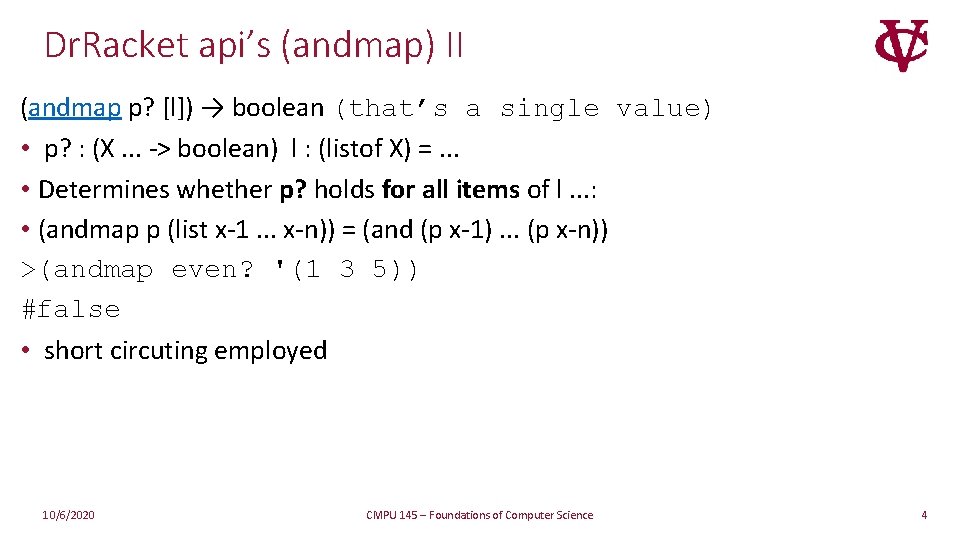
Dr. Racket api’s (andmap) II (andmap p? [l]) → boolean (that’s a single value) • p? : (X. . . -> boolean) l : (listof X) =. . . • Determines whether p? holds for all items of l. . . : • (andmap p (list x-1. . . x-n)) = (and (p x-1). . . (p x-n)) >(andmap even? '(1 3 5)) #false • short circuting employed 10/6/2020 CMPU 145 – Foundations of Computer Science 4
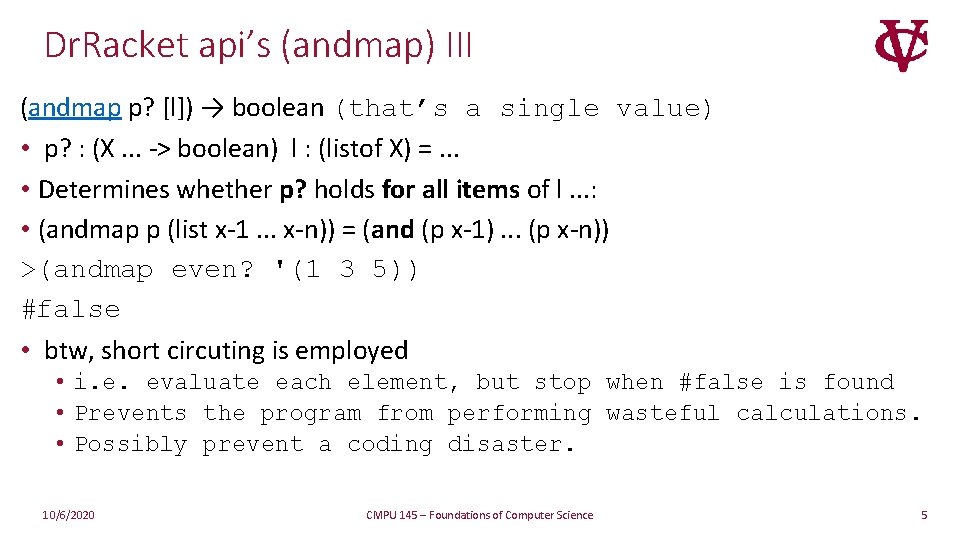
Dr. Racket api’s (andmap) III (andmap p? [l]) → boolean (that’s a single value) • p? : (X. . . -> boolean) l : (listof X) =. . . • Determines whether p? holds for all items of l. . . : • (andmap p (list x-1. . . x-n)) = (and (p x-1). . . (p x-n)) >(andmap even? '(1 3 5)) #false • btw, short circuting is employed • i. e. evaluate each element, but stop when #false is found • Prevents the program from performing wasteful calculations. • Possibly prevent a coding disaster. 10/6/2020 CMPU 145 – Foundations of Computer Science 5
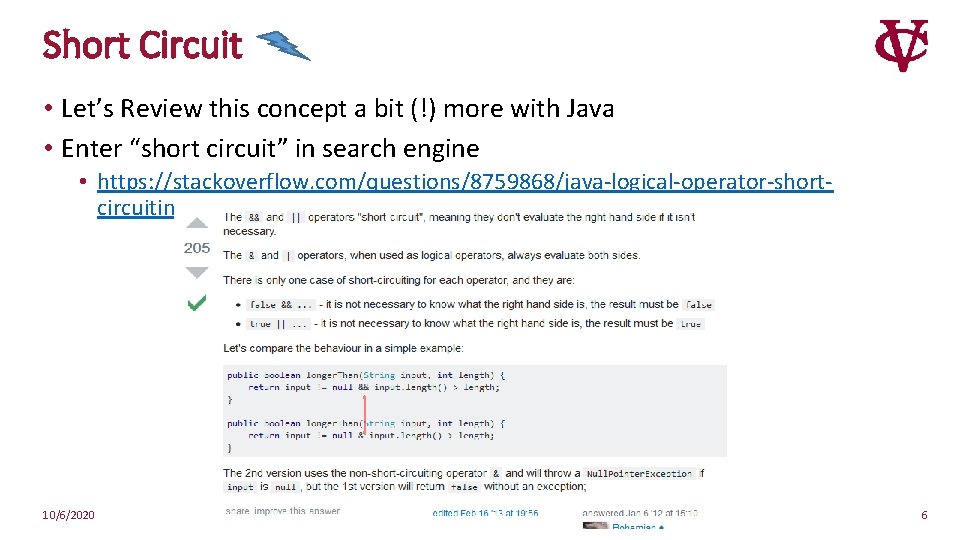
Short Circuit • Let’s Review this concept a bit (!) more with Java • Enter “short circuit” in search engine • https: //stackoverflow. com/questions/8759868/java-logical-operator-shortcircuiting 10/6/2020 CMPU 145 – Foundations of Computer Science 6
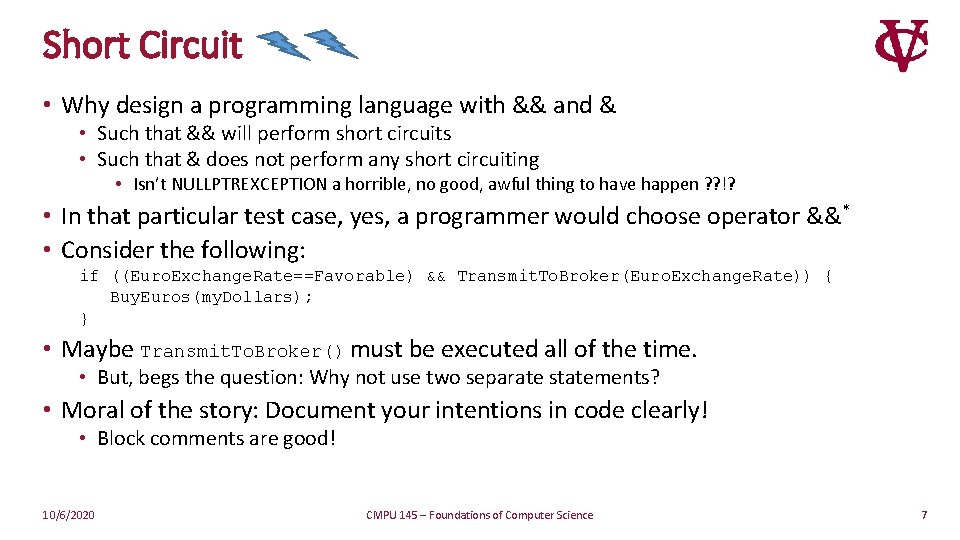
Short Circuit • Why design a programming language with && and & • Such that && will perform short circuits • Such that & does not perform any short circuiting • Isn’t NULLPTREXCEPTION a horrible, no good, awful thing to have happen ? ? !? • In that particular test case, yes, a programmer would choose operator &&* • Consider the following: if ((Euro. Exchange. Rate==Favorable) && Transmit. To. Broker(Euro. Exchange. Rate)) { Buy. Euros(my. Dollars); } • Maybe Transmit. To. Broker() must be executed all of the time. • But, begs the question: Why not use two separate statements? • Moral of the story: Document your intentions in code clearly! • Block comments are good! 10/6/2020 CMPU 145 – Foundations of Computer Science 7
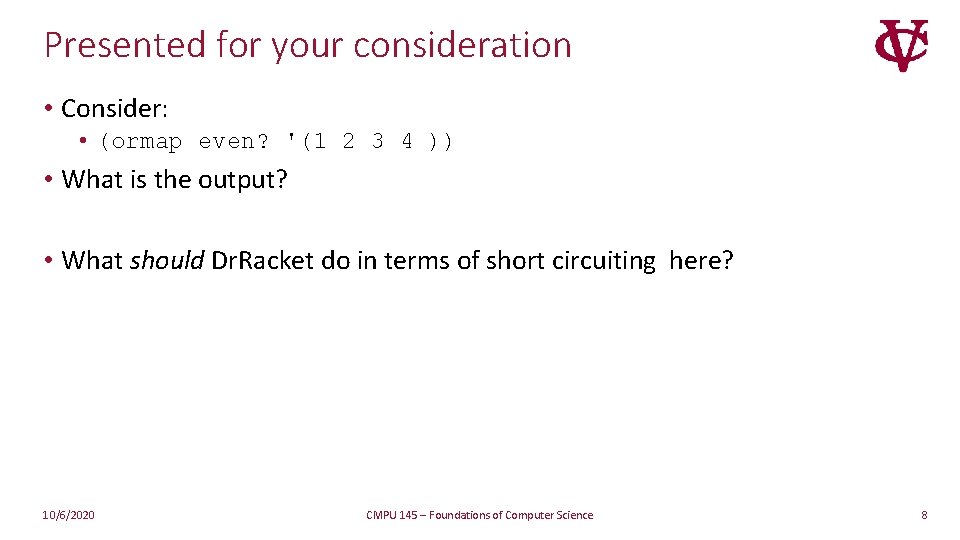
Presented for your consideration • Consider: • (ormap even? '(1 2 3 4 )) • What is the output? • What should Dr. Racket do in terms of short circuiting here? 10/6/2020 CMPU 145 – Foundations of Computer Science 8
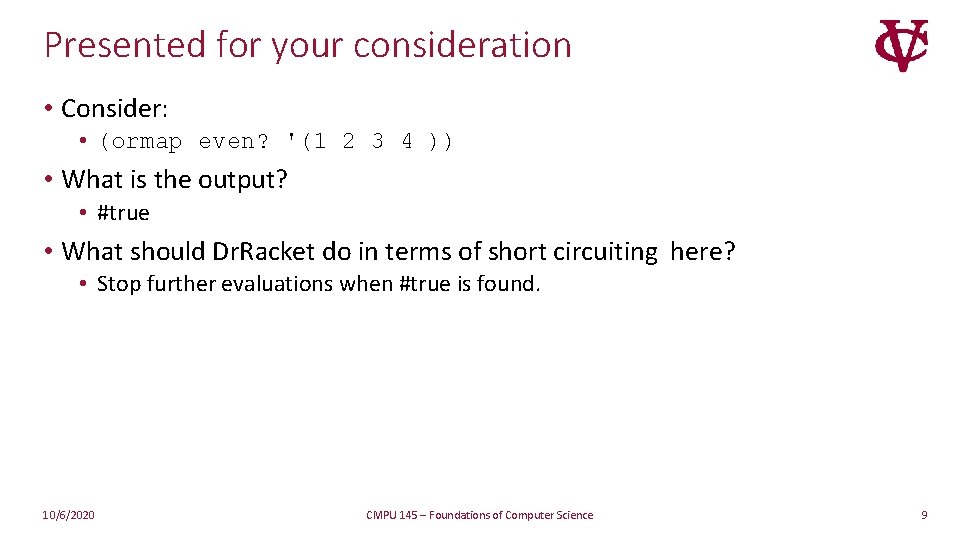
Presented for your consideration • Consider: • (ormap even? '(1 2 3 4 )) • What is the output? • #true • What should Dr. Racket do in terms of short circuiting here? • Stop further evaluations when #true is found. 10/6/2020 CMPU 145 – Foundations of Computer Science 9
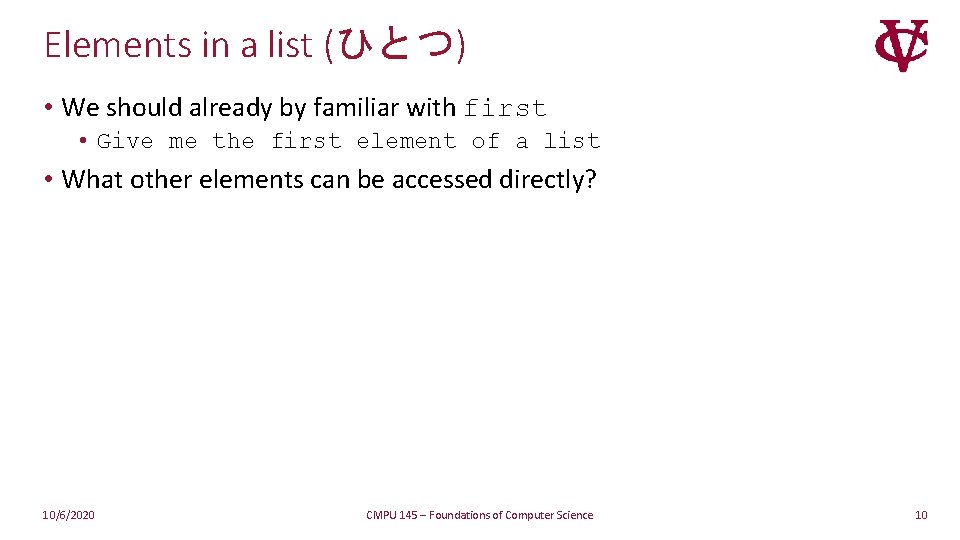
Elements in a list (ひとつ) • We should already by familiar with first • Give me the first element of a list • What other elements can be accessed directly? 10/6/2020 CMPU 145 – Foundations of Computer Science 10
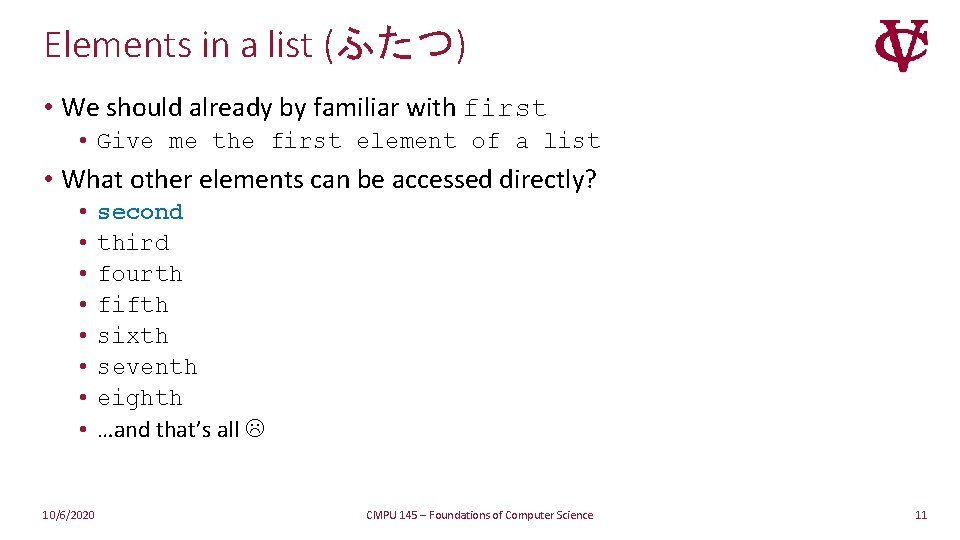
Elements in a list (ふたつ) • We should already by familiar with first • Give me the first element of a list • What other elements can be accessed directly? • • 10/6/2020 second third fourth fifth sixth seventh eighth …and that’s all CMPU 145 – Foundations of Computer Science 11
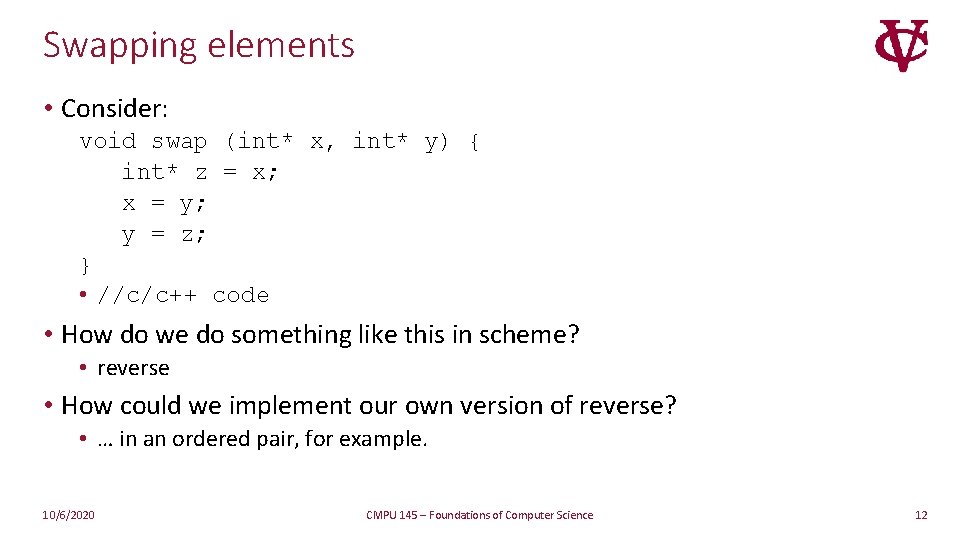
Swapping elements • Consider: void swap (int* x, int* y) { int* z = x; x = y; y = z; } • //c/c++ code • How do we do something like this in scheme? • reverse • How could we implement our own version of reverse? • … in an ordered pair, for example. 10/6/2020 CMPU 145 – Foundations of Computer Science 12
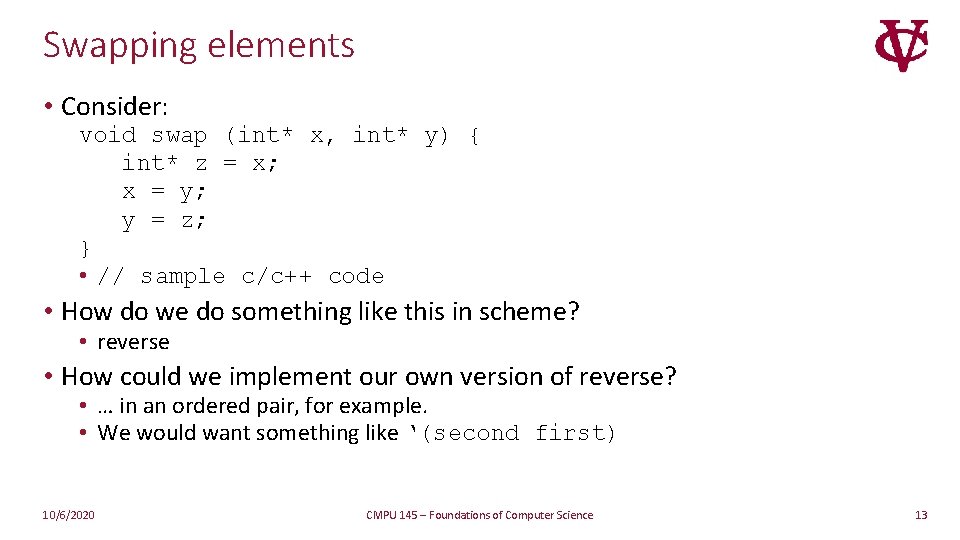
Swapping elements • Consider: void swap (int* x, int* y) { int* z = x; x = y; y = z; } • // sample c/c++ code • How do we do something like this in scheme? • reverse • How could we implement our own version of reverse? • … in an ordered pair, for example. • We would want something like ‘(second first) 10/6/2020 CMPU 145 – Foundations of Computer Science 13
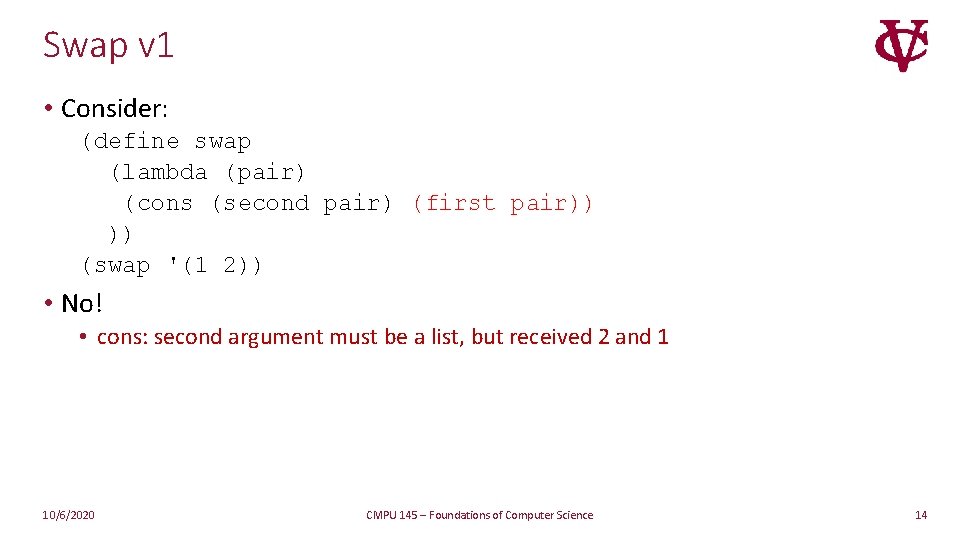
Swap v 1 • Consider: (define swap (lambda (pair) (cons (second pair) (first pair)) )) (swap '(1 2)) • No! • cons: second argument must be a list, but received 2 and 1 10/6/2020 CMPU 145 – Foundations of Computer Science 14
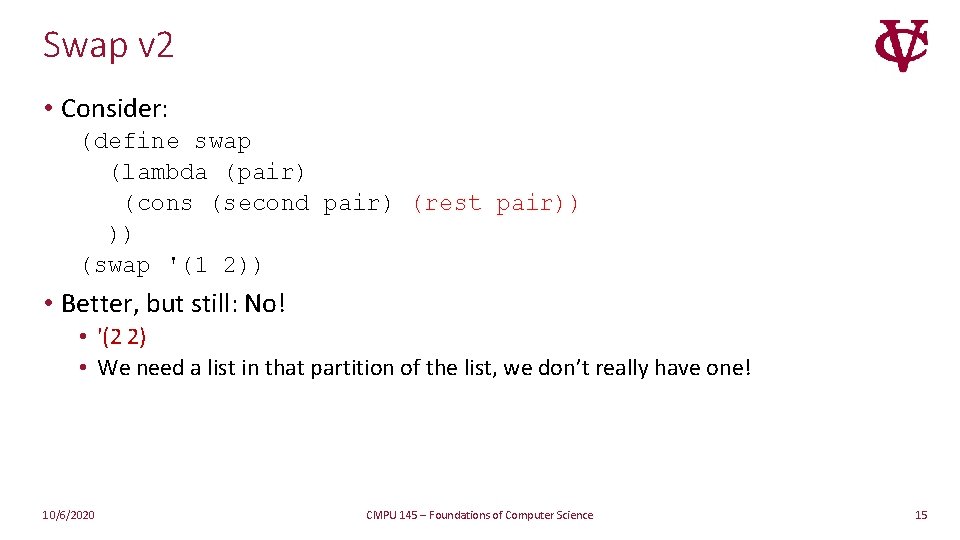
Swap v 2 • Consider: (define swap (lambda (pair) (cons (second pair) (rest pair)) )) (swap '(1 2)) • Better, but still: No! • '(2 2) • We need a list in that partition of the list, we don’t really have one! 10/6/2020 CMPU 145 – Foundations of Computer Science 15
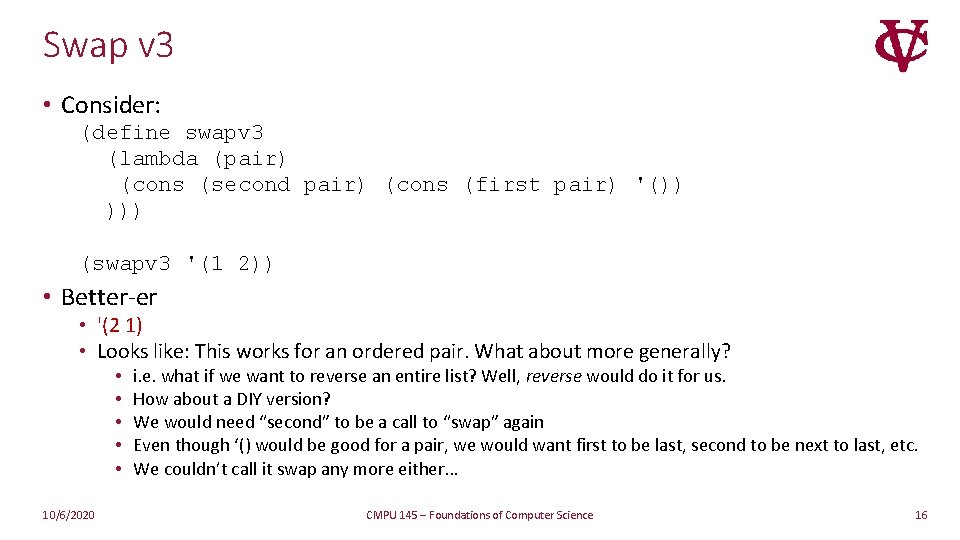
Swap v 3 • Consider: (define swapv 3 (lambda (pair) (cons (second pair) (cons (first pair) '()) ))) (swapv 3 '(1 2)) • Better-er • '(2 1) • Looks like: This works for an ordered pair. What about more generally? • • • 10/6/2020 i. e. what if we want to reverse an entire list? Well, reverse would do it for us. How about a DIY version? We would need “second” to be a call to “swap” again Even though ‘() would be good for a pair, we would want first to be last, second to be next to last, etc. We couldn’t call it swap any more either… CMPU 145 – Foundations of Computer Science 16
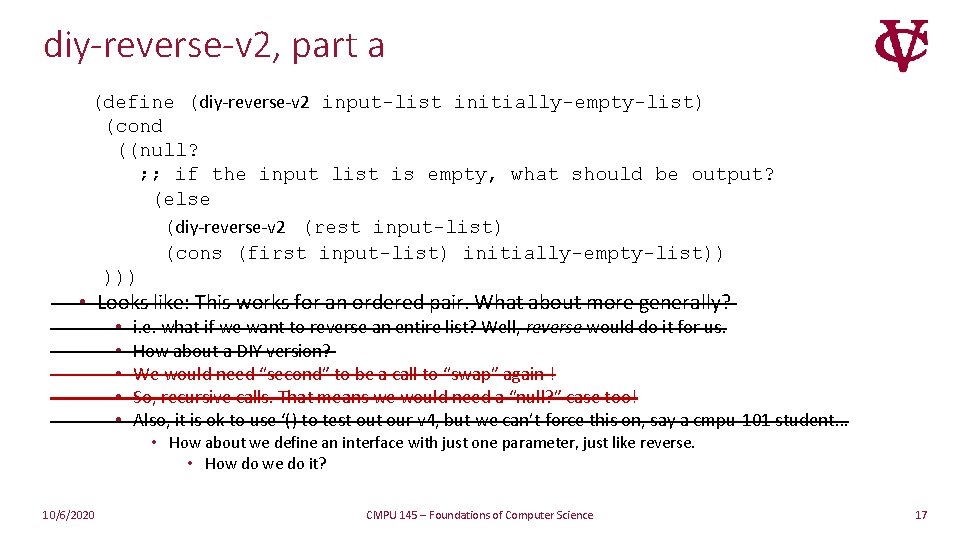
diy-reverse-v 2, part a (define (diy-reverse-v 2 input-list initially-empty-list) (cond ((null? ; ; if the input list is empty, what should be output? (else (diy-reverse-v 2 (rest input-list) (cons (first input-list) initially-empty-list)) ))) • Looks like: This works for an ordered pair. What about more generally? • • • i. e. what if we want to reverse an entire list? Well, reverse would do it for us. How about a DIY version? We would need “second” to be a call to “swap” again ! So, recursive calls. That means we would need a “null? ” case too! Also, it is ok to use ‘() to test our v 4, but we can’t force this on, say a cmpu-101 student… • How about we define an interface with just one parameter, just like reverse. • How do we do it? 10/6/2020 CMPU 145 – Foundations of Computer Science 17
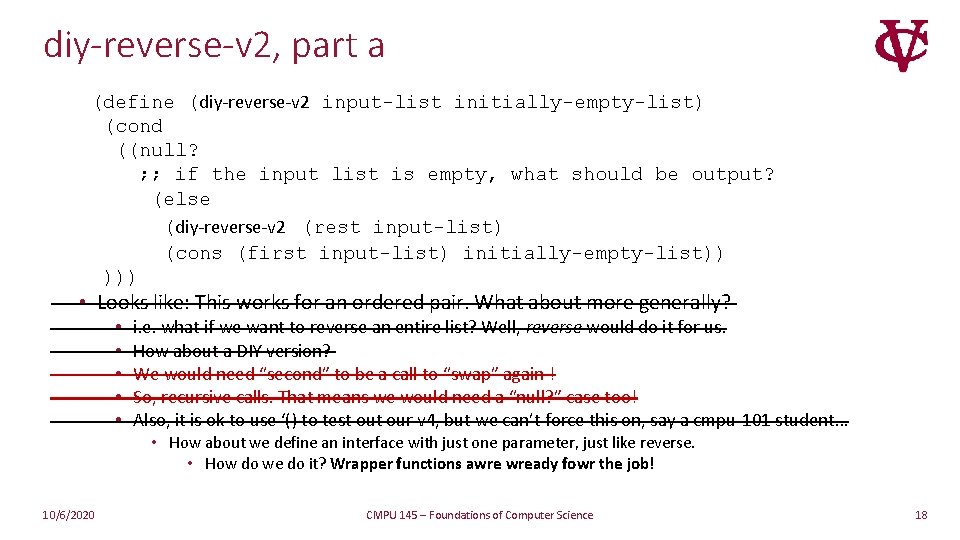
diy-reverse-v 2, part a (define (diy-reverse-v 2 input-list initially-empty-list) (cond ((null? ; ; if the input list is empty, what should be output? (else (diy-reverse-v 2 (rest input-list) (cons (first input-list) initially-empty-list)) ))) • Looks like: This works for an ordered pair. What about more generally? • • • i. e. what if we want to reverse an entire list? Well, reverse would do it for us. How about a DIY version? We would need “second” to be a call to “swap” again ! So, recursive calls. That means we would need a “null? ” case too! Also, it is ok to use ‘() to test our v 4, but we can’t force this on, say a cmpu-101 student… • How about we define an interface with just one parameter, just like reverse. • How do we do it? Wrapper functions awre wready fowr the job! 10/6/2020 CMPU 145 – Foundations of Computer Science 18
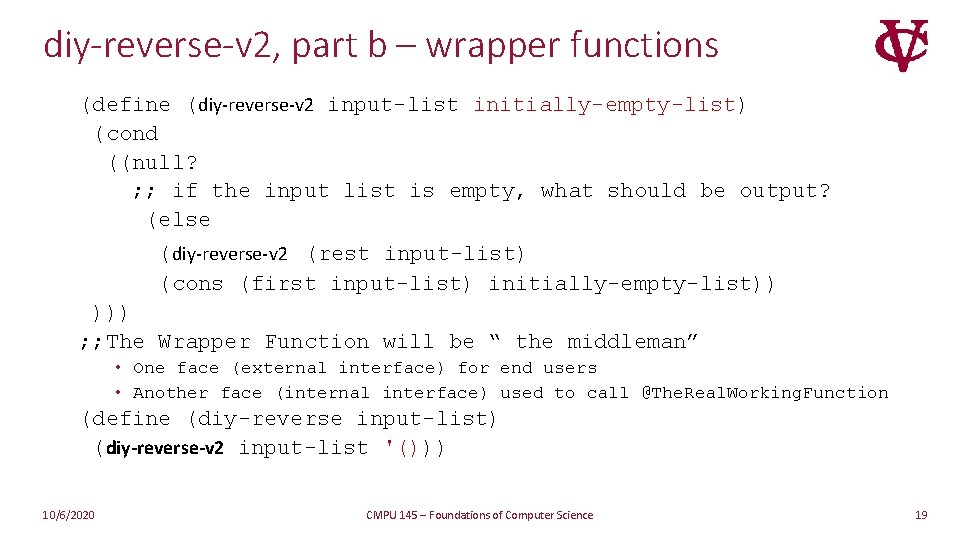
diy-reverse-v 2, part b – wrapper functions (define (diy-reverse-v 2 input-list initially-empty-list) (cond ((null? ; ; if the input list is empty, what should be output? (else (diy-reverse-v 2 (rest input-list) (cons (first input-list) initially-empty-list)) ))) ; ; The Wrapper Function will be “ the middleman” • One face (external interface) for end users • Another face (internal interface) used to call @The. Real. Working. Function (define (diy-reverse input-list) (diy-reverse-v 2 input-list '())) 10/6/2020 CMPU 145 – Foundations of Computer Science 19