Chapter 8 Corporate Strategy Vertical Integration and Diversification
- Slides: 23
Chapter 8 Corporate Strategy: Vertical Integration and Diversification Copyright © 2015 Mc. Graw-Hill Education. All rights reserved. No reproduction or distribution without the prior written consent of Mc. Graw-Hill Education.
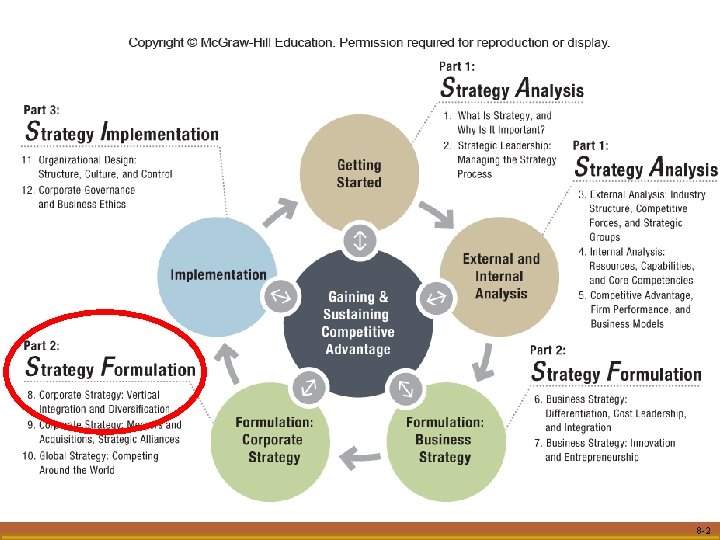
8 -2
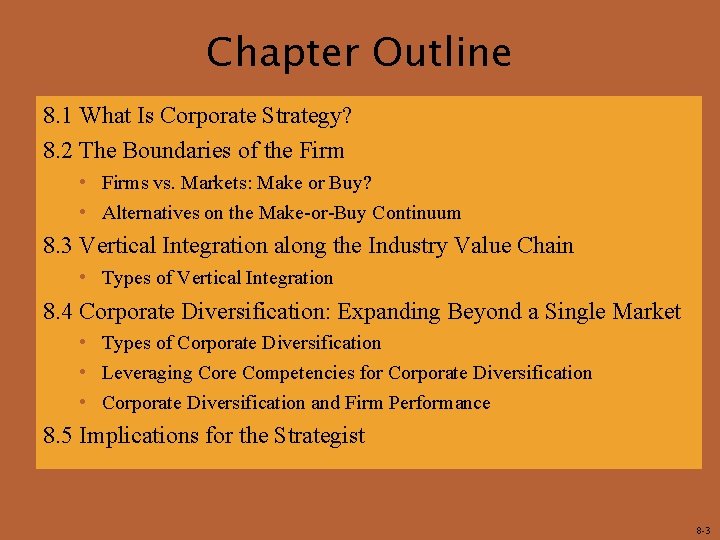
Chapter Outline 8. 1 What Is Corporate Strategy? 8. 2 The Boundaries of the Firm • Firms vs. Markets: Make or Buy? • Alternatives on the Make-or-Buy Continuum 8. 3 Vertical Integration along the Industry Value Chain • Types of Vertical Integration 8. 4 Corporate Diversification: Expanding Beyond a Single Market • Types of Corporate Diversification • Leveraging Core Competencies for Corporate Diversification • Corporate Diversification and Firm Performance 8. 5 Implications for the Strategist 8 -3
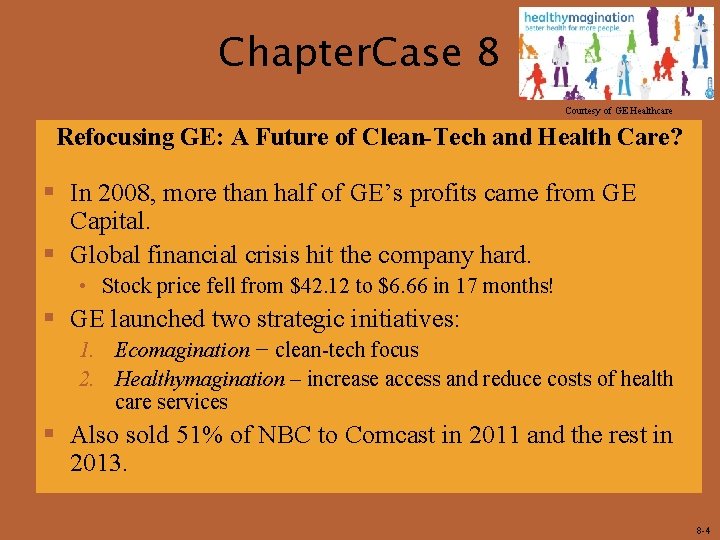
Chapter. Case 8 Courtesy of GE Healthcare Refocusing GE: A Future of Clean-Tech and Health Care? § In 2008, more than half of GE’s profits came from GE Capital. § Global financial crisis hit the company hard. • Stock price fell from $42. 12 to $6. 66 in 17 months! § GE launched two strategic initiatives: 1. Ecomagination − clean-tech focus 2. Healthymagination – increase access and reduce costs of health care services § Also sold 51% of NBC to Comcast in 2011 and the rest in 2013. 8 -4
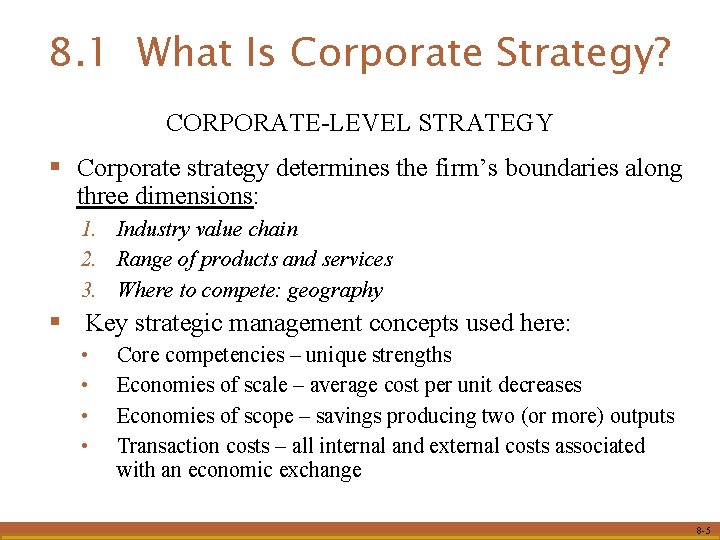
8. 1 What Is Corporate Strategy? CORPORATE-LEVEL STRATEGY § Corporate strategy determines the firm’s boundaries along three dimensions: 1. Industry value chain 2. Range of products and services 3. Where to compete: geography § Key strategic management concepts used here: • • Core competencies – unique strengths Economies of scale – average cost per unit decreases Economies of scope – savings producing two (or more) outputs Transaction costs – all internal and external costs associated with an economic exchange 8 -5
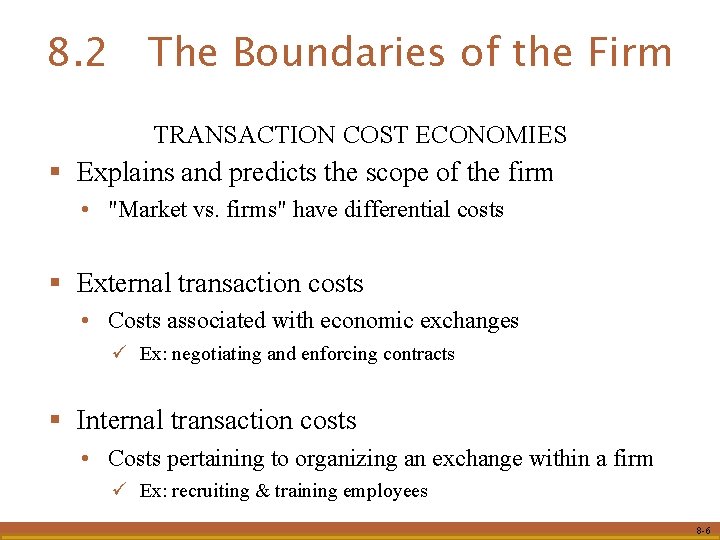
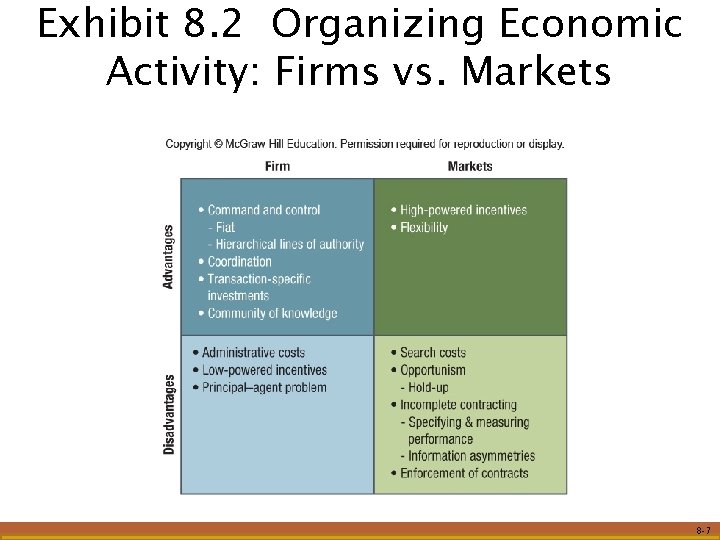
8. 2 The Boundaries of the Firm TRANSACTION COST ECONOMIES § Explains and predicts the scope of the firm • "Market vs. firms" have differential costs § External transaction costs • Costs associated with economic exchanges ü Ex: negotiating and enforcing contracts § Internal transaction costs • Costs pertaining to organizing an exchange within a firm ü Ex: recruiting & training employees 8 -6
Exhibit 8. 2 Organizing Economic Activity: Firms vs. Markets 8 -7
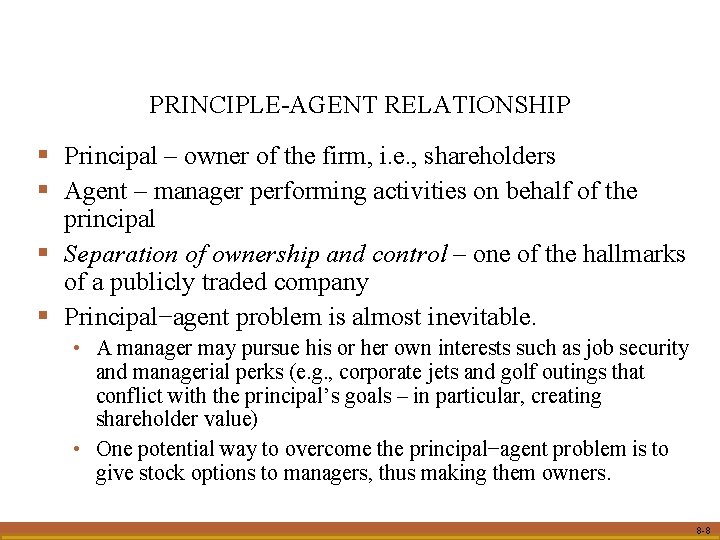
PRINCIPLE-AGENT RELATIONSHIP § Principal – owner of the firm, i. e. , shareholders § Agent – manager performing activities on behalf of the principal § Separation of ownership and control – one of the hallmarks of a publicly traded company § Principal−agent problem is almost inevitable. • A manager may pursue his or her own interests such as job security and managerial perks (e. g. , corporate jets and golf outings that conflict with the principal’s goals – in particular, creating shareholder value) • One potential way to overcome the principal−agent problem is to give stock options to managers, thus making them owners. 8 -8
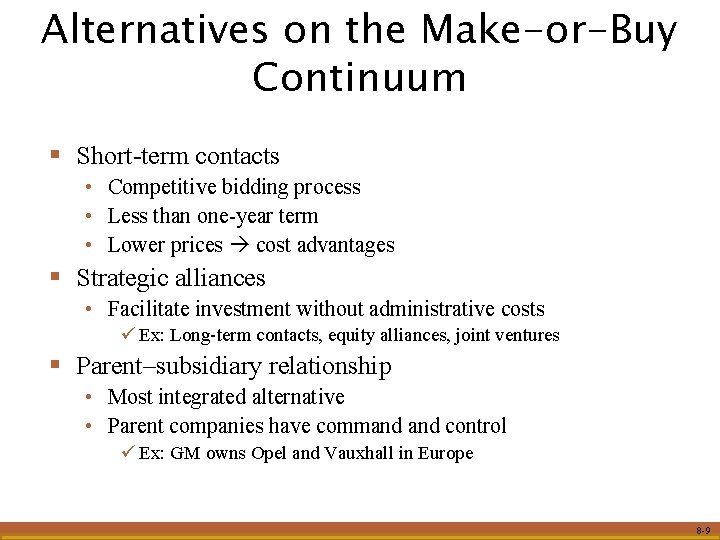
Alternatives on the Make-or-Buy Continuum § Short-term contacts • Competitive bidding process • Less than one-year term • Lower prices cost advantages § Strategic alliances • Facilitate investment without administrative costs ü Ex: Long-term contacts, equity alliances, joint ventures § Parent–subsidiary relationship • Most integrated alternative • Parent companies have command control ü Ex: GM owns Opel and Vauxhall in Europe 8 -9
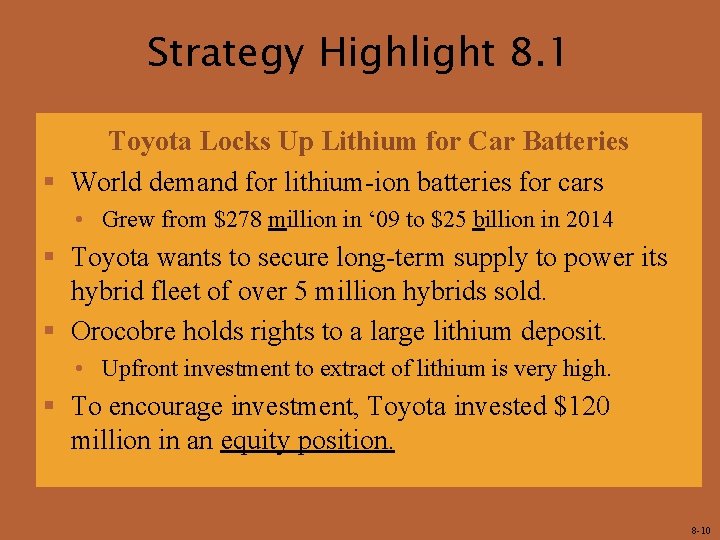
Strategy Highlight 8. 1 Toyota Locks Up Lithium for Car Batteries § World demand for lithium-ion batteries for cars • Grew from $278 million in ‘ 09 to $25 billion in 2014 § Toyota wants to secure long-term supply to power its hybrid fleet of over 5 million hybrids sold. § Orocobre holds rights to a large lithium deposit. • Upfront investment to extract of lithium is very high. § To encourage investment, Toyota invested $120 million in an equity position. 8 -10
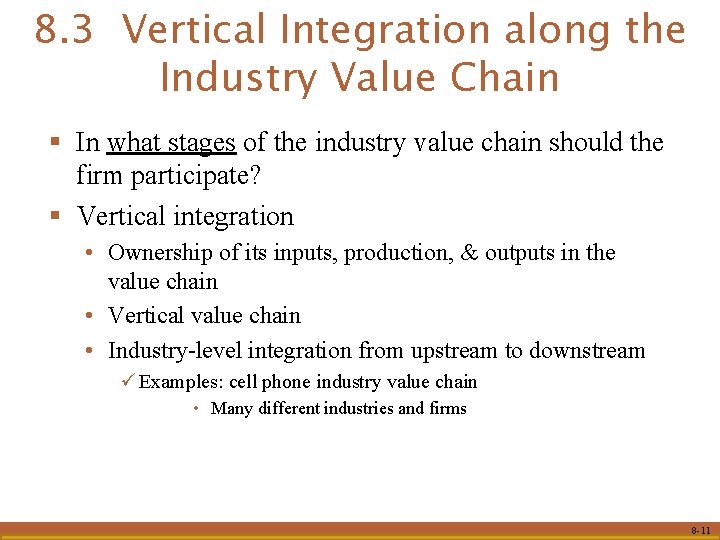
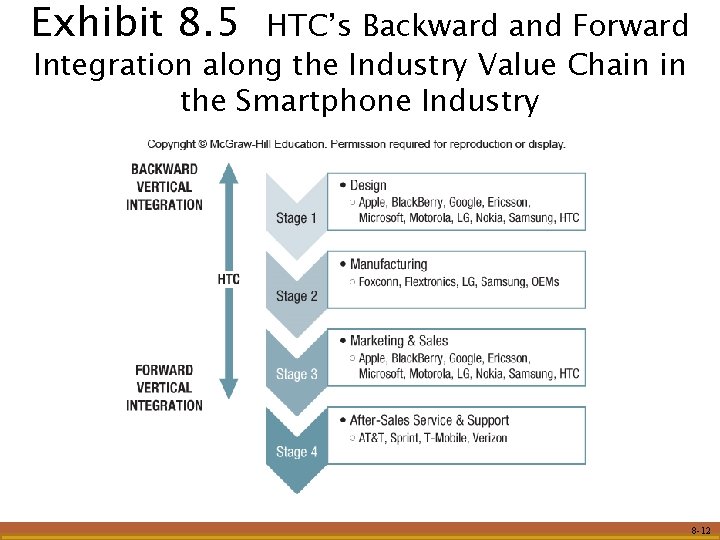
8. 3 Vertical Integration along the Industry Value Chain § In what stages of the industry value chain should the firm participate? § Vertical integration • Ownership of its inputs, production, & outputs in the value chain • Vertical value chain • Industry-level integration from upstream to downstream ü Examples: cell phone industry value chain • Many different industries and firms 8 -11
Exhibit 8. 5 HTC’s Backward and Forward Integration along the Industry Value Chain in the Smartphone Industry 8 -12
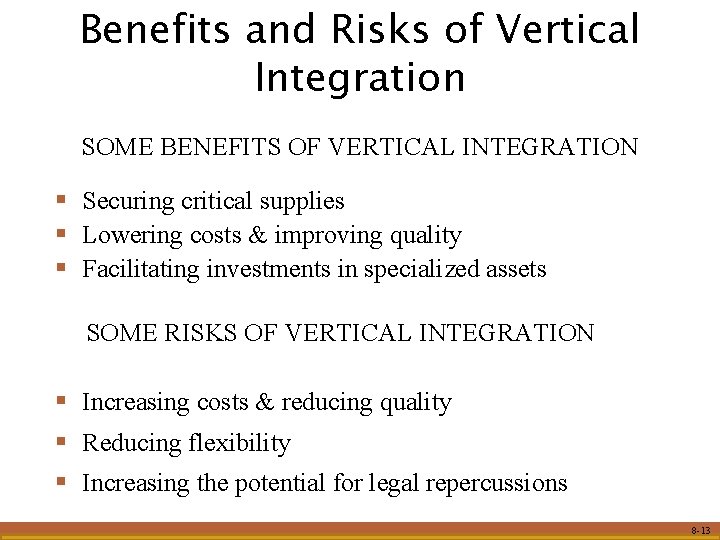
Benefits and Risks of Vertical Integration SOME BENEFITS OF VERTICAL INTEGRATION § Securing critical supplies § Lowering costs & improving quality § Facilitating investments in specialized assets SOME RISKS OF VERTICAL INTEGRATION § Increasing costs & reducing quality § Reducing flexibility § Increasing the potential for legal repercussions 8 -13
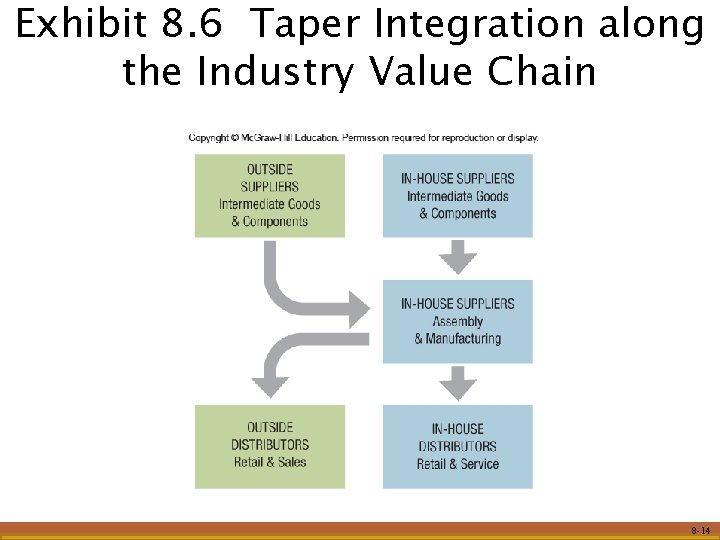
Exhibit 8. 6 Taper Integration along the Industry Value Chain 8 -14
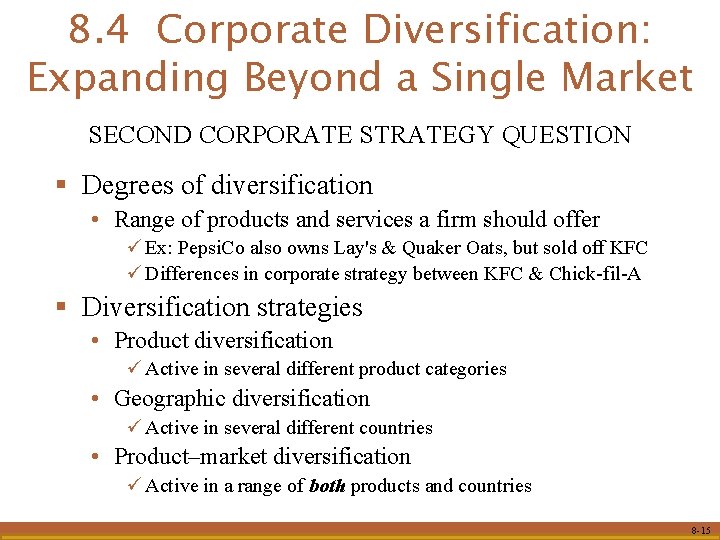
8. 4 Corporate Diversification: Expanding Beyond a Single Market SECOND CORPORATE STRATEGY QUESTION § Degrees of diversification • Range of products and services a firm should offer ü Ex: Pepsi. Co also owns Lay's & Quaker Oats, but sold off KFC ü Differences in corporate strategy between KFC & Chick-fil-A § Diversification strategies • Product diversification ü Active in several different product categories • Geographic diversification ü Active in several different countries • Product–market diversification ü Active in a range of both products and countries 8 -15
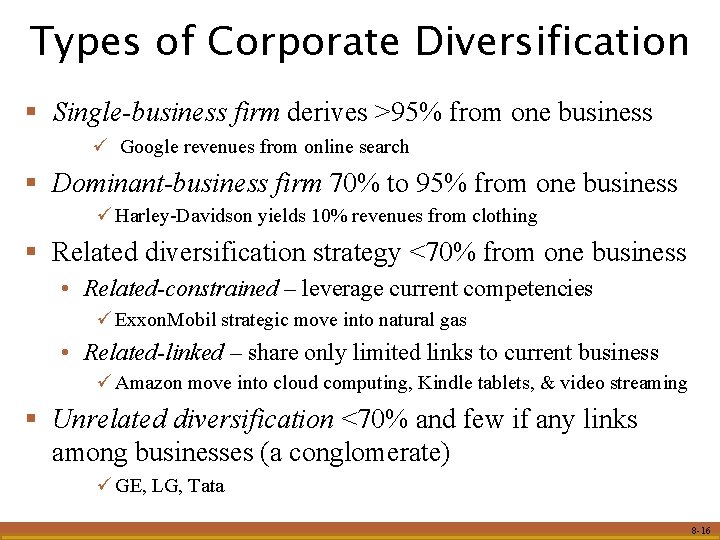
Types of Corporate Diversification § Single-business firm derives >95% from one business ü Google revenues from online search § Dominant-business firm 70% to 95% from one business ü Harley-Davidson yields 10% revenues from clothing § Related diversification strategy <70% from one business • Related-constrained – leverage current competencies ü Exxon. Mobil strategic move into natural gas • Related-linked – share only limited links to current business ü Amazon move into cloud computing, Kindle tablets, & video streaming § Unrelated diversification <70% and few if any links among businesses (a conglomerate) ü GE, LG, Tata 8 -16
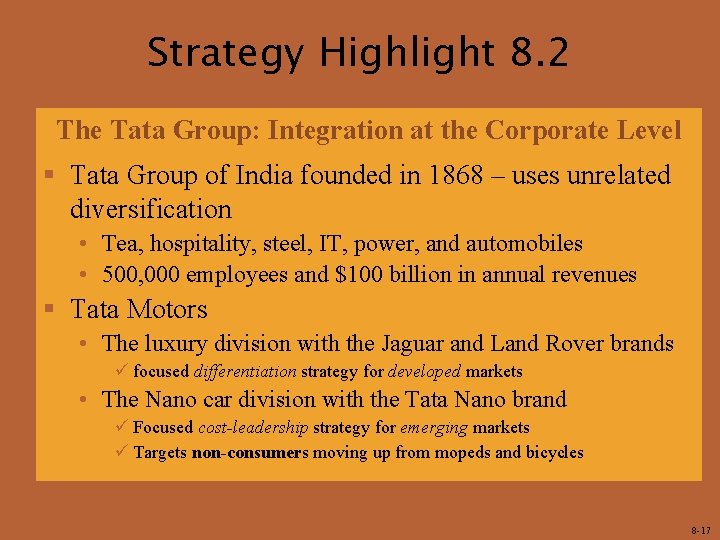
Strategy Highlight 8. 2 The Tata Group: Integration at the Corporate Level § Tata Group of India founded in 1868 – uses unrelated diversification • Tea, hospitality, steel, IT, power, and automobiles • 500, 000 employees and $100 billion in annual revenues § Tata Motors • The luxury division with the Jaguar and Land Rover brands ü focused differentiation strategy for developed markets • The Nano car division with the Tata Nano brand ü Focused cost-leadership strategy for emerging markets ü Targets non-consumers moving up from mopeds and bicycles 8 -17
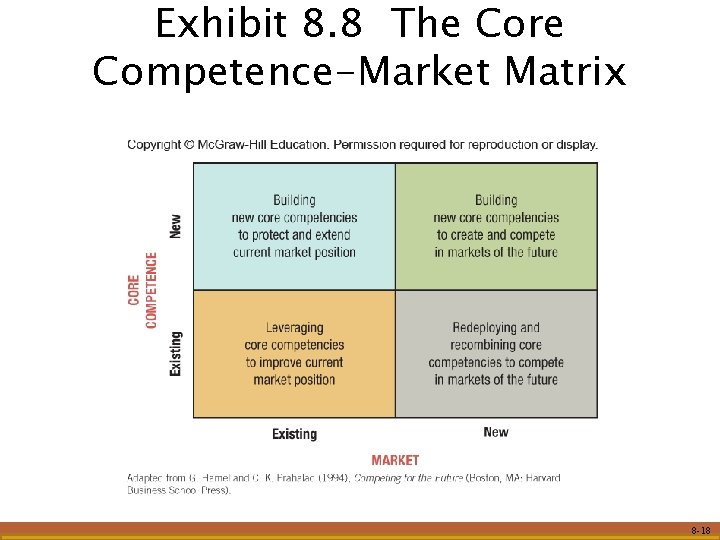
Exhibit 8. 8 The Core Competence-Market Matrix 8 -18
Corporate Diversification and Firm Performance § Does corporate diversification lead to superior performance? § The critical question to ask: • Are the individual businesses worth more under the company’s management than if each were managed in separate firms? § Research finds an inverted U-shaped relationship • Type of diversification • Overall firm performance 8 -19
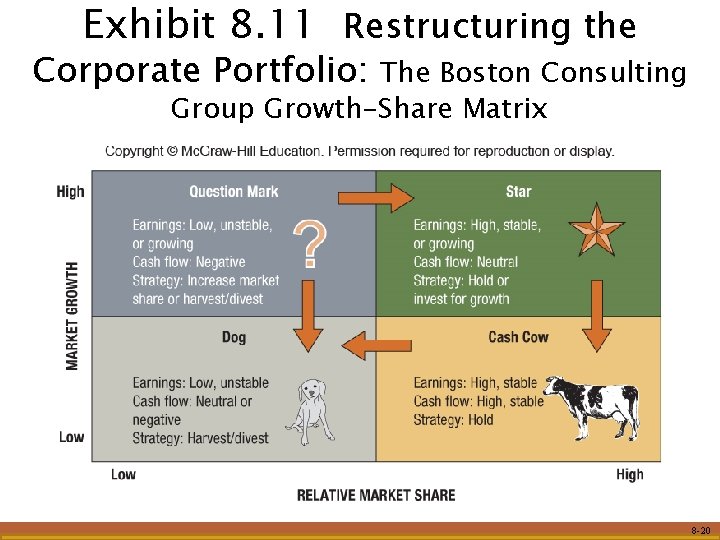
Exhibit 8. 11 Restructuring the Corporate Portfolio: The Boston Consulting Group Growth-Share Matrix 8 -20
8. 5 Implications for the Strategist § Effective corporate strategy helps to gain and sustain a competitive advantage. § Corporate strategy needs to be dynamic over time. • GE CEO Jeffrey Immelt formulated a new corporate strategy in clean-tech and health care. (Chapter. Case 8) • Strategic positions of Nike and adidas another example ü adidas founded in 1924 focused on athletic shoes § Integrated manufacturing model ü Globalization led adidas to less integration and wider sports apparel § 2013 − 40% shoes, 50% apparel, 10% equipment ü Nike started in 1978 as a vertically disintegrated firm. 8 -21
Chapter. Case 8 Courtesy of GE Healthcare Consider This… • 2012 – GE split the energy business into three SBUs: Power and Water; Oil and Gas; and Energy Management. ü This move has both internal and external benefits. • GE increasing its global footprint ü International sales were 19% in 1980; to over 52% in 2012. ü Tackling big problems isa strength for a conglomerate. • India is seeking to replicate a “leap frog” approach in energy similar to that used in telecommunications. ü Challenges for firms based in developed economies ü Need robust solutions yet very economical 8 -22
8 -23