
REPUBLIC OF BOTSWANA ECONOMIC DIVERSIFICATION POLICIES AND STRATEGIES
REPUBLIC OF BOTSWANA ECONOMIC DIVERSIFICATION POLICIES AND STRATEGIES: What Is Different From What We Have Always Done? Joel Sentsho, Ph. D Trade Policy Advisor Ministry Of Trade And Industry 27 th August 2014 MINISTRY OF TRADE AND INDUSTRY BOTSWANA
PRESENTATION OUTLINE 1. INTRODUCTION 2. WHAT IS DIFFERENT FROM WHAT WE HAVE ALWAYS DONE? 2. 1 Market Approach visa-a-vis Pragmatic Approach 2. 2 Economic Policy and Implementation Matrix 2. 3 Development of Priority List of Sectors/Sub-Sectors 2. 4 Development of Sector Specific Strategies 2. 5 Institutional Setup 3. ACHIEVEMENTS SO FAR 4. CONCLUSION: to? Where are our Policies and Strategies pointing

INTRODUCTION This will be based on Economic Policies, Strategies and Sector-Specific Strategies ECONOMIC POLICIES: Industrial Development Policy for Botswana (July 2014) Special Economic Zones Policy for Botswana (February, 2011) Trade Policy for Botswana (2009) Citizen Economic Empowerment Policy (CEEP)

INTRODUCTION ECONOMIC STRATEGIES: Botswana’s Cooperative Transformation Strategy (September 2012) Economic Diversification Drive (EDD) Strategy for Botswana (2010) Botswana National Export Strategy (2010) Investment Strategy for Botswana (2010) SPEDU Strategy for Selebi-Phikwe Regional Economic Diversification (2013)
INTRODUCTION SECTOR SPECIFIC STRATEGIES The Strategy for Development of the Dairy Sector in Botswana (2013) Botswana Textile and Clothing Development Strategy (2013) A High Level Strategy for the Development of the Leather Industry in Botswana (2012)

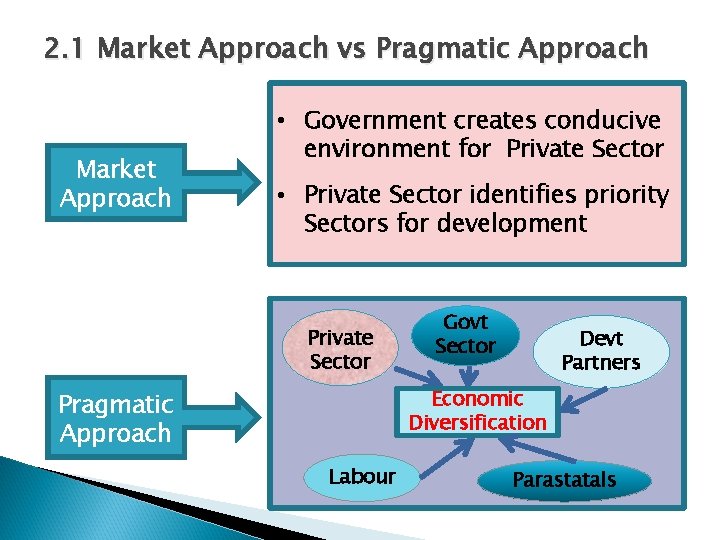
2. 1 Market Approach vs Pragmatic Approach Market Approach • Government creates conducive environment for Private Sector • Private Sector identifies priority Sectors for development Private Sector Govt Sector Devt Partners Economic Diversification Pragmatic Approach Labour Parastatals
Economic Policy and Implementation Each Policy has a Vision, Mission, Theme and Implementation Matrix. For IDP 2014 we have: Vision: To have diversified, sustainable, and globally competitive industries. Mission: IDP 2013 aims at promoting development of diversified and viable industries as well as commercial sectors, using skilled personnel and appropriate technology whilst leveraging on active private sector collaboration and participation. Theme: Placing Botswana among the Industrialized Economies of the 21 st Century. Implementation Matrix with milestones, Strategic Initiatives, Responsible Implementer and Timeframes
Development of Priority Sectors/Sub-Sectors A priority list of sectors is developed by all Stakeholders The list includes sectors/Subsectors with potential for domestic and international market growth, export potential and employment growth The identified list is developed by the private sector which is the engine of growth for Botswana

Development of Sector Specific Strategies For each sector/sub-sector a Sector specific strategy is developed which includes: SWOT Analysis Value Chain Analysis Cluster Development of Business Linkages 10
2. Value Chain Mapping Value Chain Analysis breaks a production chain into its constituent parts to identify and understand: Value adding activities in the chain; Value chain business opportunities and challenges; Economic actors at each stage of the value chain; Value chain leadership or governance; Domestic, international and global value chains; Required policy interventions to sustain the sector.
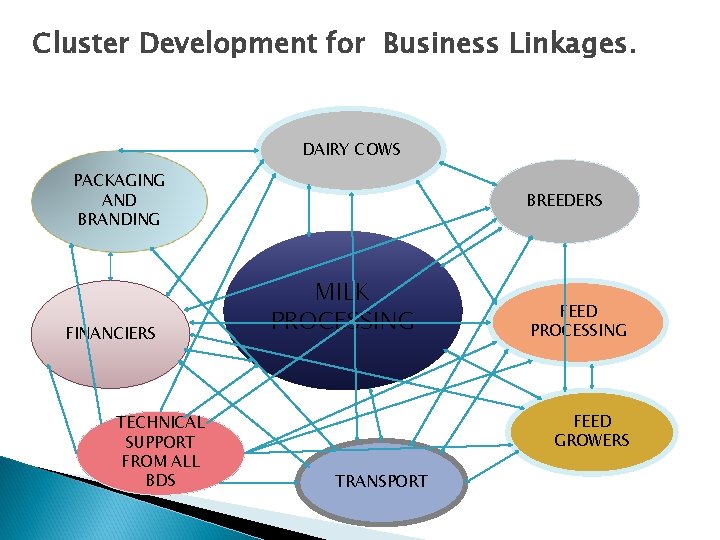
Cluster Development for Business Linkages. DAIRY COWS PACKAGING AND BRANDING FINANCIERS TECHNICAL SUPPORT FROM ALL BDS BREEDERS MILK PROCESSING FEED GROWERS TRANSPORT
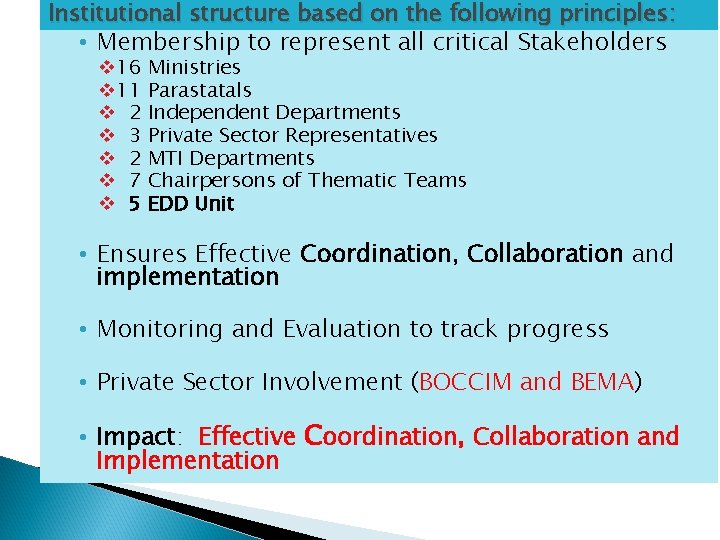
Institutional structure based on the following principles: • Membership to represent all critical Stakeholders v 16 v 11 v 2 v 3 v 2 v 7 v 5 Ministries Parastatals Independent Departments Private Sector Representatives MTI Departments Chairpersons of Thematic Teams EDD Unit • Ensures Effective Coordination, Collaboration and implementation • Monitoring and Evaluation to track progress • Private Sector Involvement (BOCCIM and BEMA) • Impact: Effective Coordination, Collaboration and Implementation
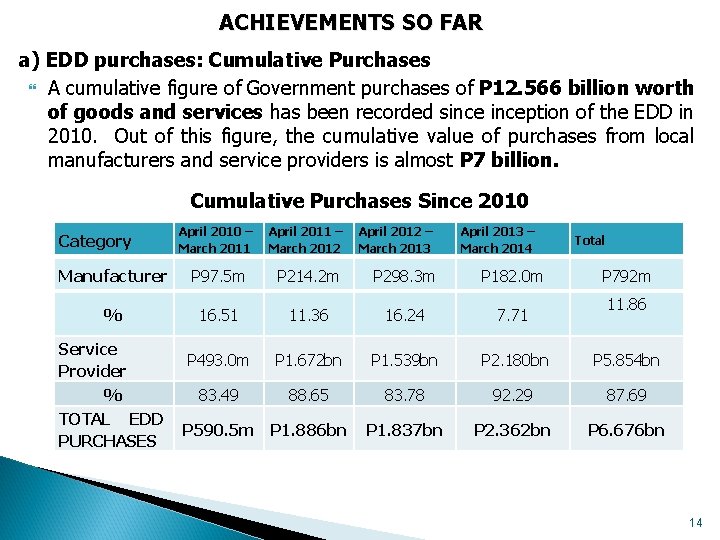
ACHIEVEMENTS SO FAR a) EDD purchases: Cumulative Purchases A cumulative figure of Government purchases of P 12. 566 billion worth of goods and services has been recorded sinception of the EDD in 2010. Out of this figure, the cumulative value of purchases from local manufacturers and service providers is almost P 7 billion. Cumulative Purchases Since 2010 April 2010 – March 2011 April 2011 – March 2012 Manufacturer P 97. 5 m P 214. 2 m P 298. 3 m P 182. 0 m % 16. 51 11. 36 16. 24 7. 71 P 1. 539 bn P 2. 180 bn P 5. 854 bn 83. 78 92. 29 87. 69 P 1. 837 bn P 2. 362 bn P 6. 676 bn Category Service P 493. 0 m P 1. 672 bn Provider % 83. 49 88. 65 TOTAL EDD P 590. 5 m P 1. 886 bn PURCHASES April 2012 – March 2013 April 2013 – March 2014 Total P 792 m 11. 86 14
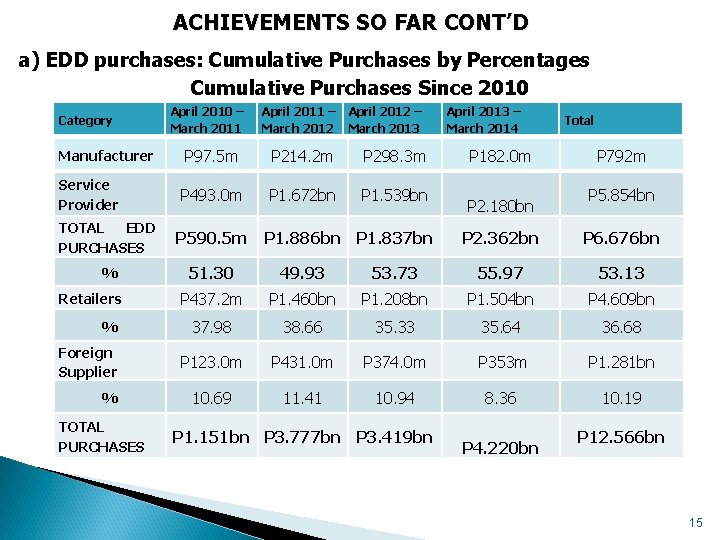
ACHIEVEMENTS SO FAR CONT’D a) EDD purchases: Cumulative Purchases by Percentages Cumulative Purchases Since 2010 Category Manufacturer Service Provider April 2010 – March 2011 April 2011 – April 2012 – March 2012 March 2013 April 2013 – March 2014 Total P 97. 5 m P 214. 2 m P 298. 3 m P 182. 0 m P 792 m P 493. 0 m P 1. 672 bn P 1. 539 bn P 2. 180 bn P 5. 854 bn P 2. 362 bn P 6. 676 bn TOTAL EDD PURCHASES P 590. 5 m % 51. 30 49. 93 53. 73 55. 97 53. 13 P 437. 2 m P 1. 460 bn P 1. 208 bn P 1. 504 bn P 4. 609 bn 37. 98 38. 66 35. 33 35. 64 36. 68 P 123. 0 m P 431. 0 m P 374. 0 m P 353 m P 1. 281 bn 10. 69 11. 41 10. 94 8. 36 10. 19 P 4. 220 bn P 12. 566 bn Retailers % Foreign Supplier % TOTAL PURCHASES P 1. 886 bn P 1. 837 bn P 1. 151 bn P 3. 777 bn P 3. 419 bn 15
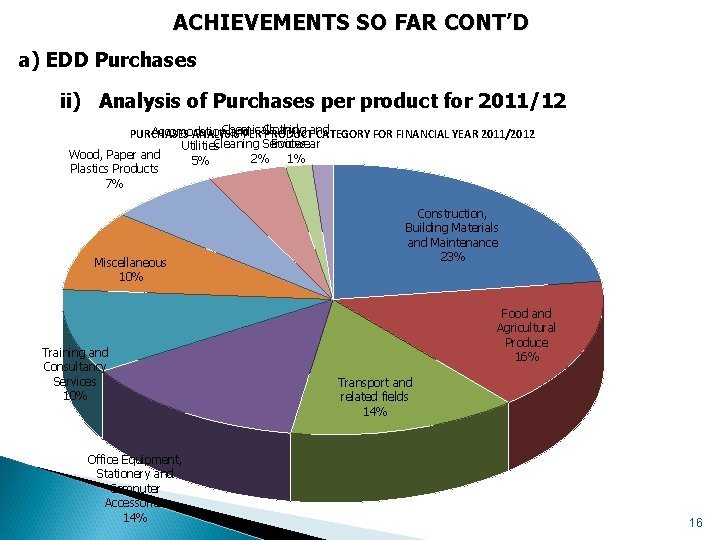
ACHIEVEMENTS SO FAR CONT’D a) EDD Purchases ii) Analysis of Purchases per product for 2011/12 Chemicals and Accomodation and PURCHASES ANALYSIS PER Clothing and PRODUCT CATEGORY FOR FINANCIAL YEAR 2011/2012 Cleaning Services Footwear Utilities Wood, Paper and 2% 1% 5% Plastics Products 7% Miscellaneous 10% Training and Consultancy Services 10% Office Equipment, Stationery and Computer Accessories 14% Construction, Building Materials and Maintenance 23% Food and Agricultural Produce 16% Transport and related fields 14% 16
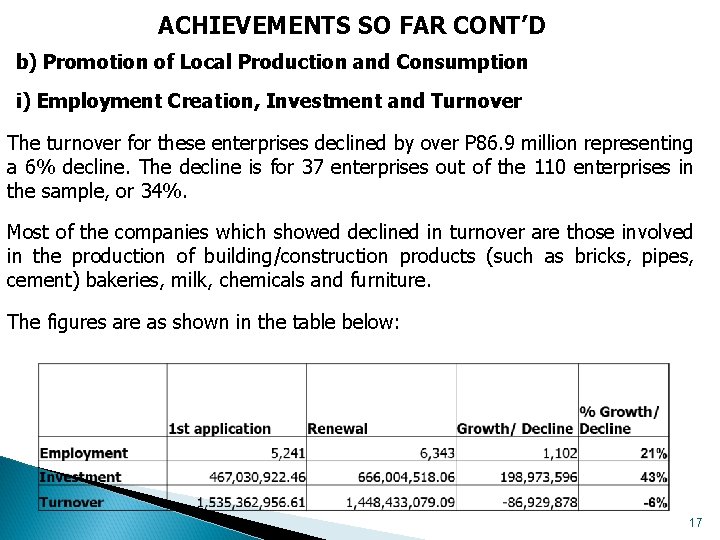
ACHIEVEMENTS SO FAR CONT’D b) Promotion of Local Production and Consumption i) Employment Creation, Investment and Turnover The turnover for these enterprises declined by over P 86. 9 million representing a 6% decline. The decline is for 37 enterprises out of the 110 enterprises in the sample, or 34%. Most of the companies which showed declined in turnover are those involved in the production of building/construction products (such as bricks, pipes, cement) bakeries, milk, chemicals and furniture. The figures are as shown in the table below: 17
SPEDU Strategy for Selebi-Phikwe Regional Economic Diversification SPEDU Strategy – works that are underway: ◦ Turning the old mine shaft into a mining museum; ◦ Refurbishment of Selebi-Phikwe Airport; ◦ Beneficiation of copper ◦ Steel Manufacturing and Casting ◦ Use water from the mine for Horticulture 18
Strategy for the Development of the Leather Industry A Leather Park is planned to be developed at Lobatse. Benchmarking studies [2014] have already been undertaken to Brazil, Ethiopia, India and Italy. A feasibility study for the Leather Park will be undertaken and is expected to be completed by December 2014 19
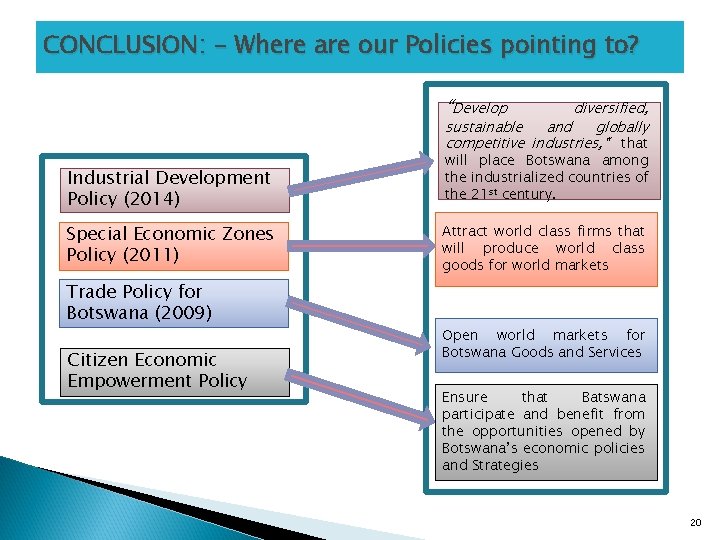
CONCLUSION: - Where are our Policies pointing to? “Develop diversified, sustainable and globally competitive industries, “ that Industrial Development Policy (2014) Special Economic Zones Policy (2011) Trade Policy for Botswana (2009) Citizen Economic Empowerment Policy will place Botswana among the industrialized countries of the 21 st century. Attract world class firms that will produce world class goods for world markets Open world markets for Botswana Goods and Services Ensure that Batswana participate and benefit from the opportunities opened by Botswana’s economic policies and Strategies 20
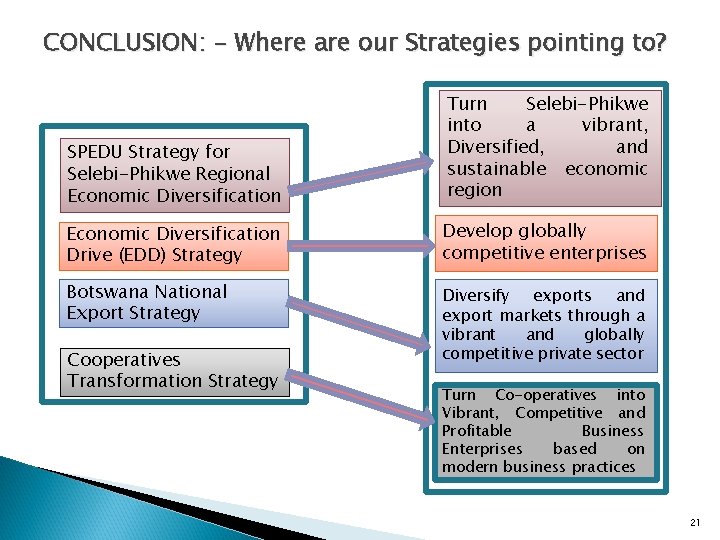
CONCLUSION: - Where are our Strategies pointing to? SPEDU Strategy for Selebi-Phikwe Regional Economic Diversification Turn Selebi-Phikwe into a vibrant, Diversified, and sustainable economic region Economic Diversification Drive (EDD) Strategy Develop globally competitive enterprises Botswana National Export Strategy Diversify exports and export markets through a vibrant and globally competitive private sector Cooperatives Transformation Strategy Turn Co-operatives into Vibrant, Competitive and Profitable Business Enterprises based on modern business practices 21
Placing Botswana Among The Industrliazed Countries Of The 21 St Century
- Slides: 22