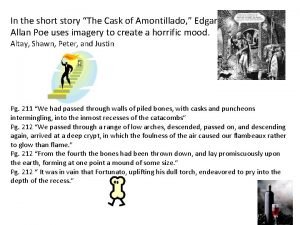
CASK OF AMONTILLADO Imagery tone mood irony imagery

- Slides: 26
CASK OF AMONTILLADO Imagery, tone, mood, & irony imagery
IMAGERY • The use of language to create mental images and sensory impressions. Imagery can be used for emotional effect and to intensify the impact on the reader. • Example: “such sweet sorrow”
SENSORY DETAILS • Sensory details are details in writing that describe what is seen, heard, smelled, tasted, or touched. • Writers often use sensory details to enhance the mood and theme in writing.
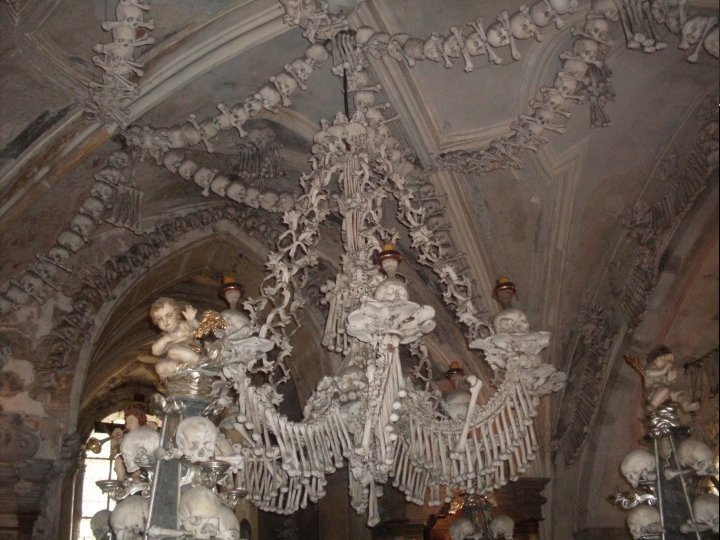
MOOD The mood of a story is the atmosphere or feeling created by the writer and expressed through setting. (what the reader feels)
TONE • Tone indicates the writer’s attitude. • Often an author's tone is described by adjectives, such as: • cynical, depressed, sympathetic, cheerful, outraged, positive, angry, sarcastic, prayerful, ironic, solemn, vindictive, intense, excited.
TONE …not an action. It is an attitude.
REAL LIFE EXAMPLES You can say the same phrase in different ways, each showing a different attitude or tone. Try saying, “Come here, Sally” using the following tones: • Commanding or bossy • Secretive • Loving • Angry • Excited • Playful
TONE CONTINUED… • Tone is not explained or expressed directly. • A reader must “read between the lines” to feel the author’s attitude and identify the tone. • Tone is different than “mood. ”
TONE IS THE AUTHOR’S OWN ATTITUDE TOWARD THE SUBJECT. • Mood is the emotion the author wanted the readers to feel while reading about the subject. • An author’s tone influences the story’s mood and atmosphere.
TONE VS. MOOD • An author writes a horror story using a serious and sinister tone. • That tone helps create a scary atmosphere and a nervous, frightened mood for the readers.
ANOTHER EXAMPLE • An author writes a satire, making fun of a horror story using a playful or sarcastic tone. • That playful tone helps create a humorous mood for the readers
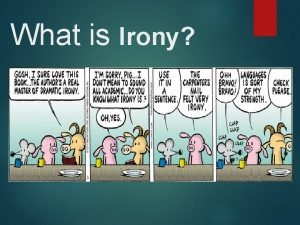
IRONY • A surprising plot twist! • It is the difference between what we expect to happen, and what actually does happen. • It is often used to add suspense and interest. • It is also used to keep the reader thinking about the moral of the story.
3 TYPES OF IRONY Verbal Irony Situational Irony Dramatic Irony
VERBAL IRONY • The simplest kind of irony. • You use it everyday when you say one thing and really mean another. • It is essentially sarcasm. Example: • When you appear to be sick and someone asks you if you’re okay. You say “Of course!” But in the meantime you are vomiting and fainting.
SITUATIONAL IRONY • Occurs when a situation turns out to be the opposite of what you thought it would be. Examples: • The teacher’s daughter is a high school drop out. • The police chief’s wife gets caught stealing. • The chef won’t eat his/her own cooking. • The barber always needs a hair cut himself.
DRAMATIC IRONY • Occurs when the audience knows something that the characters in the story, on the screen, or on the stage do not know. • The audience is more aware of what’s going on than the people in the production. • This is used to engage the audience and keep them actively involved in the storyline.
DRAMATIC IRONY CONTINUED … In all of the Friday the 13 th movies, we know Jason is in the woods. The characters do not. When they go out into the woods we are afraid for them because we know that they are in danger. We scream for them to run, we get excited when they fall, we cringe when we know that Jason is right behind the tree.
IRONY REVIEW Irony is the difference between what is expected to happen, and what actually does happen. Irony is like a glitch, a twist, or a last minute switch in the game. It is an interruption of events that cause an unexpected outcome. There are three types of irony: • Verbal • Situational • Dramatic