CAPTULO 3 Notes GUSTAR WITH INFINITIVES 1 An


- Slides: 18
CAPÍTULO 3 Notes
GUSTAR WITH INFINITIVES 1. An infinitive tells the meaning of the verb without naming any subject or tense. There are three kinds of infinitives in Spanish: those ending in –ar, -er, -ir. � cantar, comer, escribir 2. Just like nouns, infinitives can be used after a verb like gustar to say what you and others like to do. � Me gusta la música. I like music. � Me gusta cantar. I like to sing. Always use gusta (not gustan) with infinitives. � Me gustan los deportes. I like sports. � Me gusta jugar los deportes. I like to play sports.
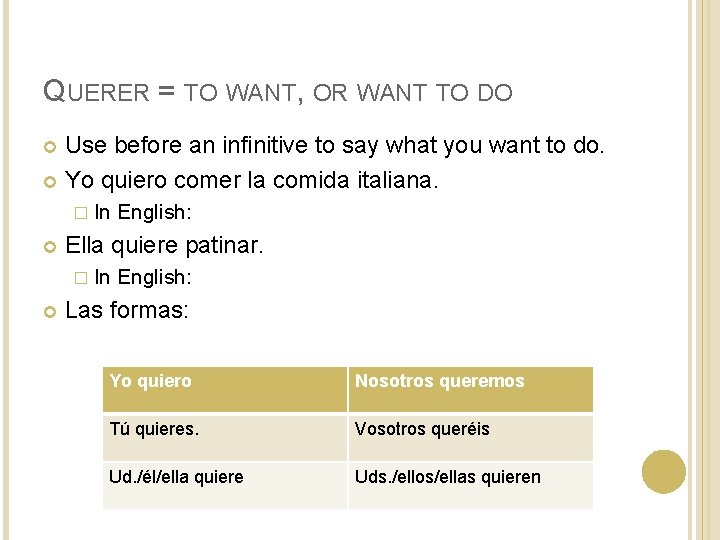
QUERER = TO WANT, OR WANT TO DO Use before an infinitive to say what you want to do. Yo quiero comer la comida italiana. � In Ella quiere patinar. � In English: Las formas: Yo quiero Nosotros queremos Tú quieres. Vosotros queréis Ud. /él/ella quiere Uds. /ellos/ellas quieren
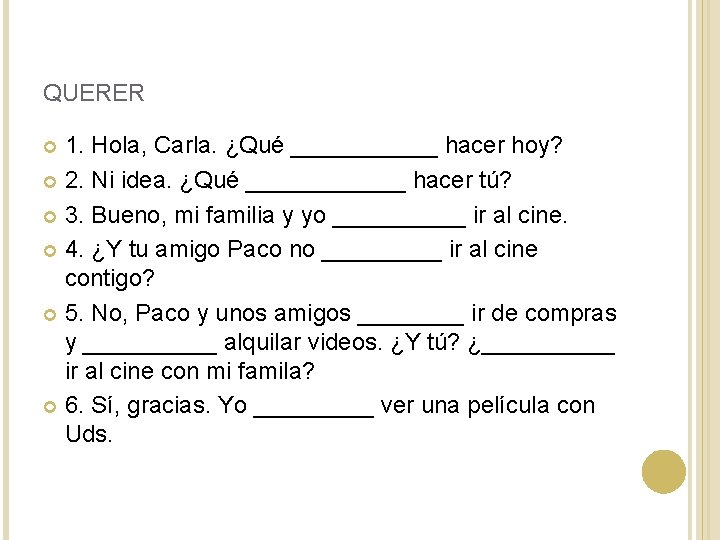
QUERER 1. Hola, Carla. ¿Qué ______ hacer hoy? 2. Ni idea. ¿Qué ______ hacer tú? 3. Bueno, mi familia y yo _____ ir al cine. 4. ¿Y tu amigo Paco no _____ ir al cine contigo? 5. No, Paco y unos amigos ____ ir de compras y _____ alquilar videos. ¿Y tú? ¿_____ ir al cine con mi famila? 6. Sí, gracias. Yo _____ ver una película con Uds.
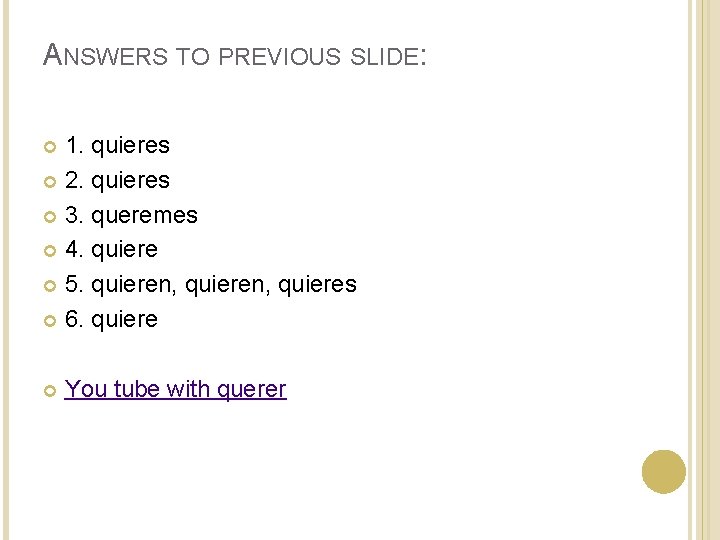
ANSWERS TO PREVIOUS SLIDE: 1. quieres 2. quieres 3. queremes 4. quiere 5. quieren, quieres 6. quiere You tube with querer
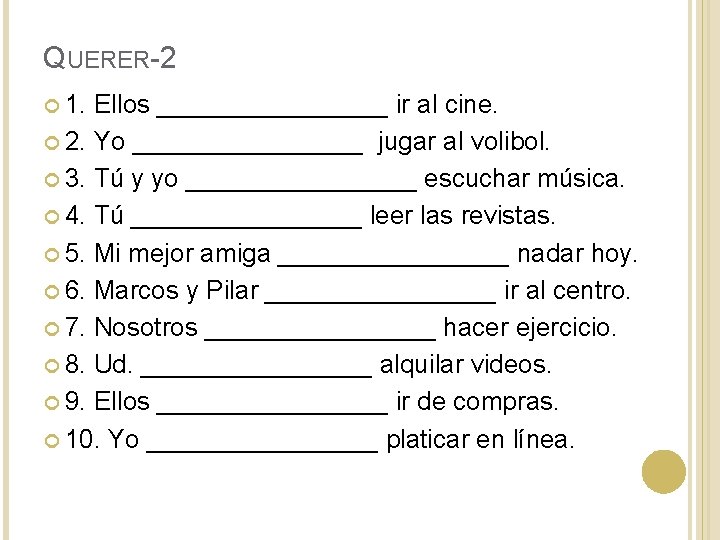
QUERER-2 1. Ellos ________ ir al cine. 2. Yo ________ jugar al volibol. 3. Tú y yo ________ escuchar música. 4. Tú ________ leer las revistas. 5. Mi mejor amiga ________ nadar hoy. 6. Marcos y Pilar ________ ir al centro. 7. Nosotros ________ hacer ejercicio. 8. Ud. ________ alquilar videos. 9. Ellos ________ ir de compras. 10. Yo ________ platicar en línea.
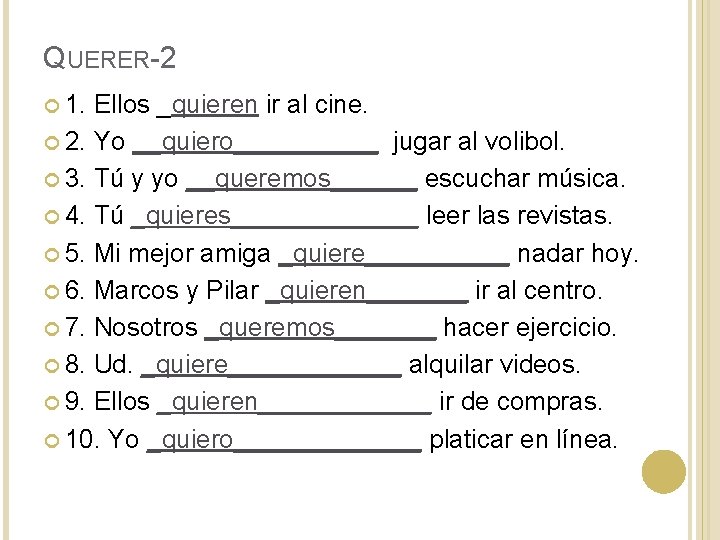
QUERER-2 1. Ellos _quieren ir al cine. 2. Yo __quiero_____ jugar al volibol. 3. Tú y yo __queremos______ escuchar música. 4. Tú _quieres_______ leer las revistas. 5. Mi mejor amiga _quiere_____ nadar hoy. 6. Marcos y Pilar _quieren_______ ir al centro. 7. Nosotros _queremos_______ hacer ejercicio. 8. Ud. _quiere______ alquilar videos. 9. Ellos _quieren______ ir de compras. 10. Yo _quiero_______ platicar en línea.
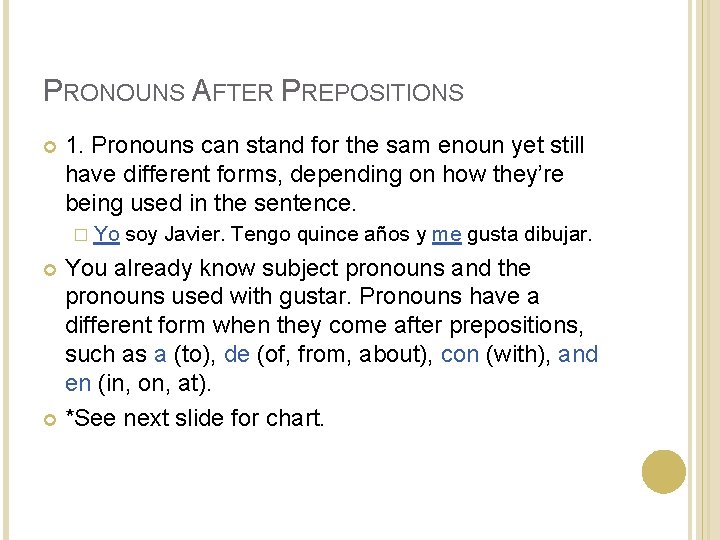
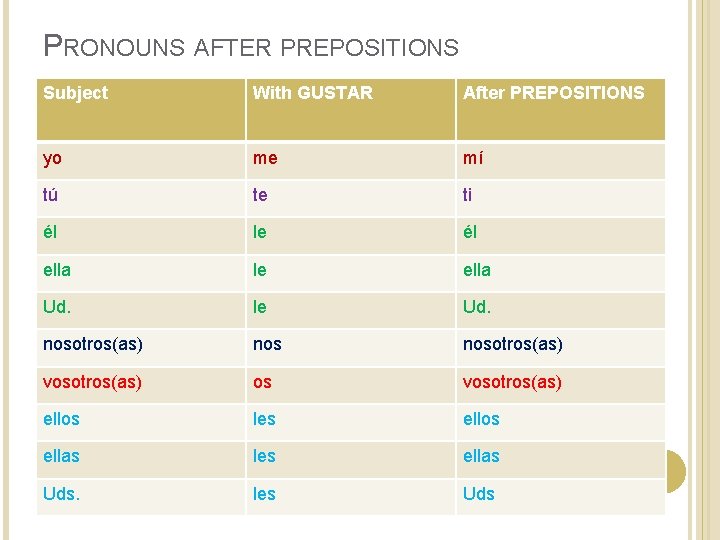
PRONOUNS AFTER PREPOSITIONS 1. Pronouns can stand for the sam enoun yet still have different forms, depending on how they’re being used in the sentence. � Yo soy Javier. Tengo quince años y me gusta dibujar. You already know subject pronouns and the pronouns used with gustar. Pronouns have a different form when they come after prepositions, such as a (to), de (of, from, about), con (with), and en (in, on, at). *See next slide for chart.
PRONOUNS AFTER PREPOSITIONS Subject With GUSTAR After PREPOSITIONS yo me mí tú te ti él le él ella le ella Ud. le Ud. nosotros(as) vosotros(as) os vosotros(as) ellos les ellos ellas les ellas Uds. les Uds
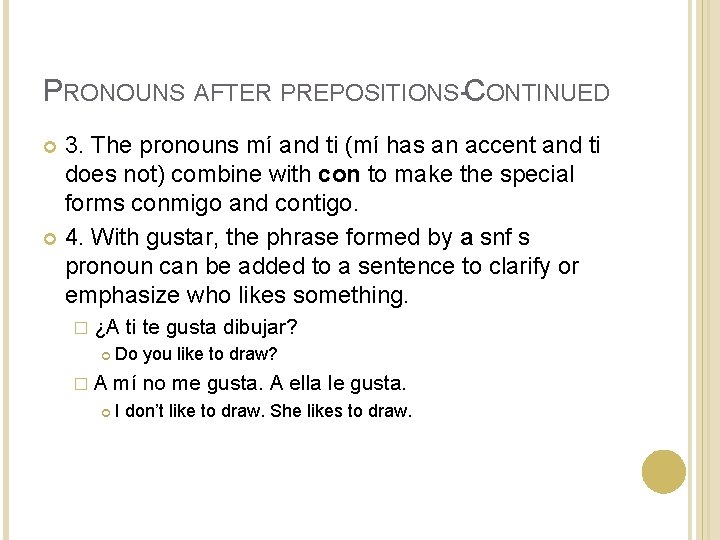
PRONOUNS AFTER PREPOSITIONS-CONTINUED 3. The pronouns mí and ti (mí has an accent and ti does not) combine with con to make the special forms conmigo and contigo. 4. With gustar, the phrase formed by a snf s pronoun can be added to a sentence to clarify or emphasize who likes something. � ¿A �A ti te gusta dibujar? Do you like to draw? mí no me gusta. A ella le gusta. I don’t like to draw. She likes to draw.
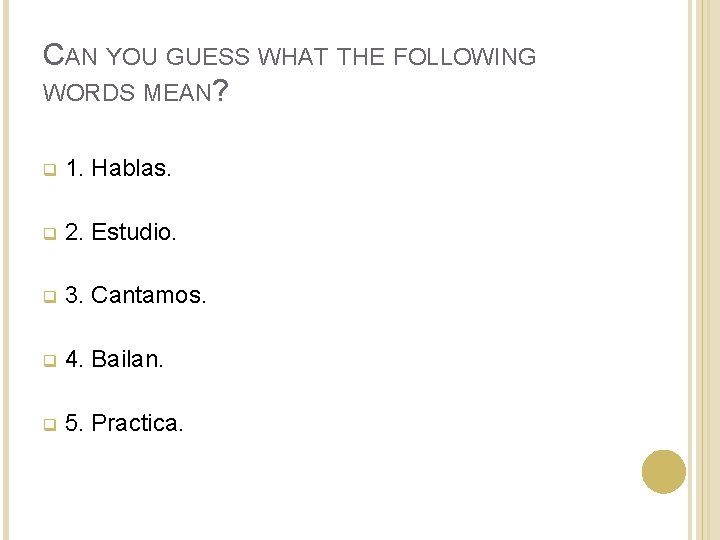
CAN YOU GUESS WHAT THE FOLLOWING WORDS MEAN? q 1. Hablas. q 2. Estudio. q 3. Cantamos. q 4. Bailan. q 5. Practica.
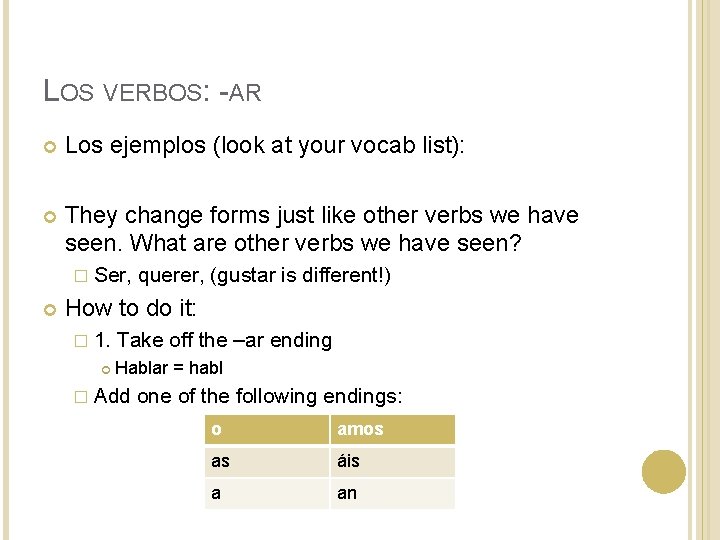
LOS VERBOS: -AR Los ejemplos (look at your vocab list): They change forms just like other verbs we have seen. What are other verbs we have seen? � Ser, querer, (gustar is different!) How to do it: � 1. Take off the –ar ending Hablar = habl � Add one of the following endings: o amos as áis a an
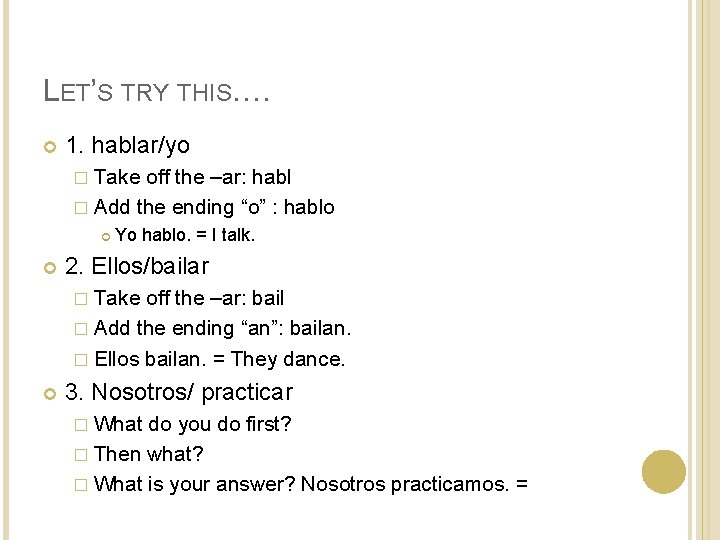
LET’S TRY THIS…. 1. hablar/yo � Take off the –ar: habl � Add the ending “o” : hablo Yo hablo. = I talk. 2. Ellos/bailar � Take off the –ar: bail � Add the ending “an”: bailan. � Ellos bailan. = They dance. 3. Nosotros/ practicar � What do you do first? � Then what? � What is your answer? Nosotros practicamos. =
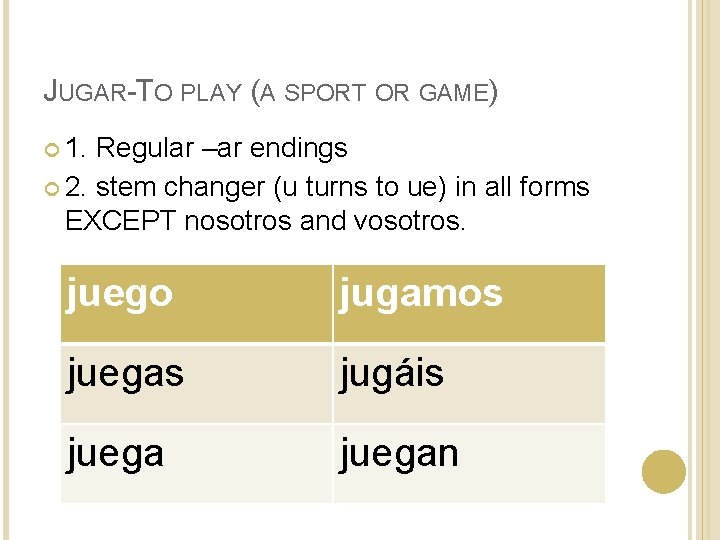
JUGAR-TO PLAY (A SPORT OR GAME) 1. Regular –ar endings 2. stem changer (u turns to ue) in all forms EXCEPT nosotros and vosotros. juego jugamos juegas jugáis juegan
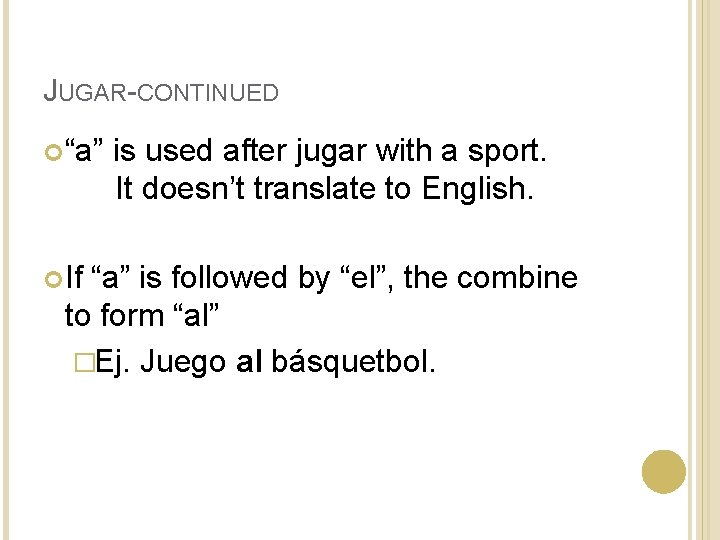
JUGAR-CONTINUED “a” If is used after jugar with a sport. It doesn’t translate to English. “a” is followed by “el”, the combine to form “al” �Ej. Juego al básquetbol.
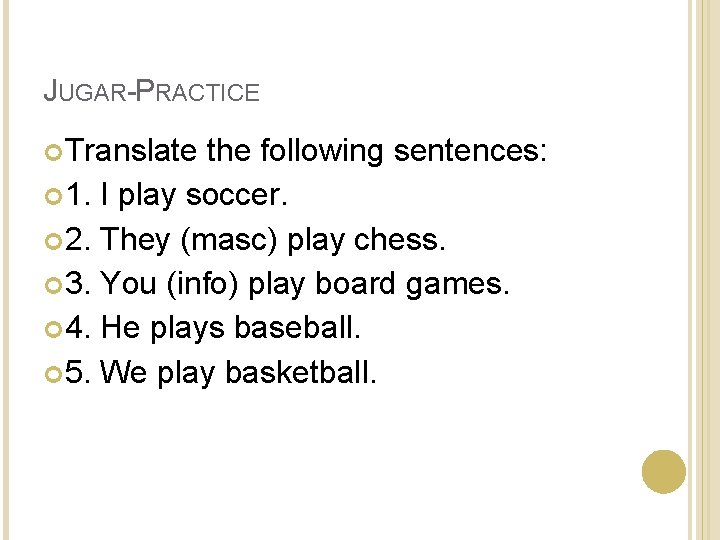
JUGAR-PRACTICE Translate the following sentences: 1. I play soccer. 2. They (masc) play chess. 3. You (info) play board games. 4. He plays baseball. 5. We play basketball.
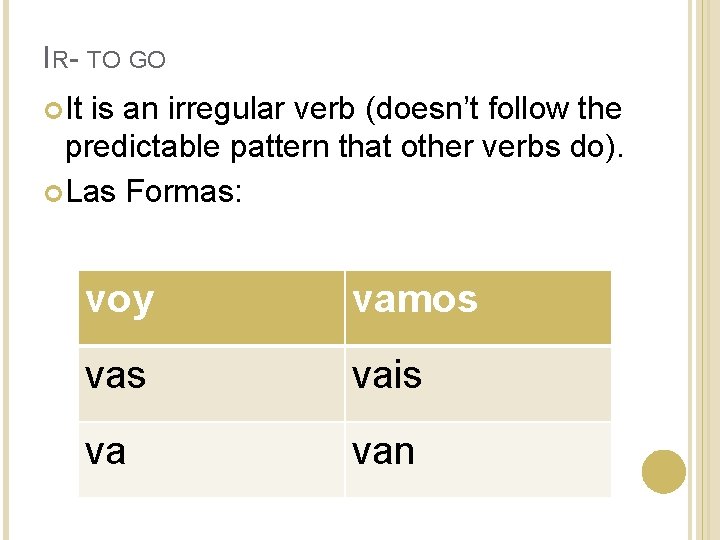
IR- TO GO It is an irregular verb (doesn’t follow the predictable pattern that other verbs do). Las Formas: voy vamos vais va van
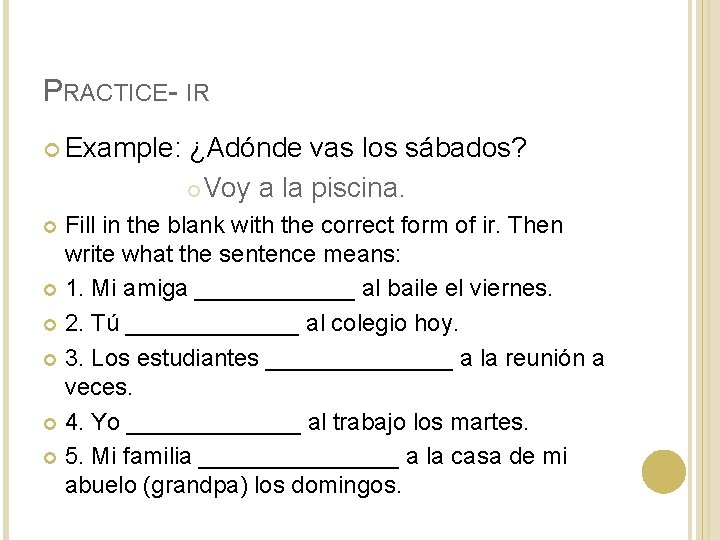
PRACTICE- IR Example: ¿Adónde vas los sábados? Voy a la piscina. Fill in the blank with the correct form of ir. Then write what the sentence means: 1. Mi amiga ______ al baile el viernes. 2. Tú _______ al colegio hoy. 3. Los estudiantes _______ a la reunión a veces. 4. Yo _______ al trabajo los martes. 5. Mi familia ________ a la casa de mi abuelo (grandpa) los domingos.