ATLAS Software Status Pile Up TestProdRZG qAtlasRome Pileup
- Slides: 5
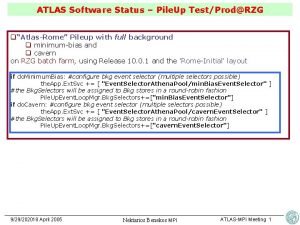
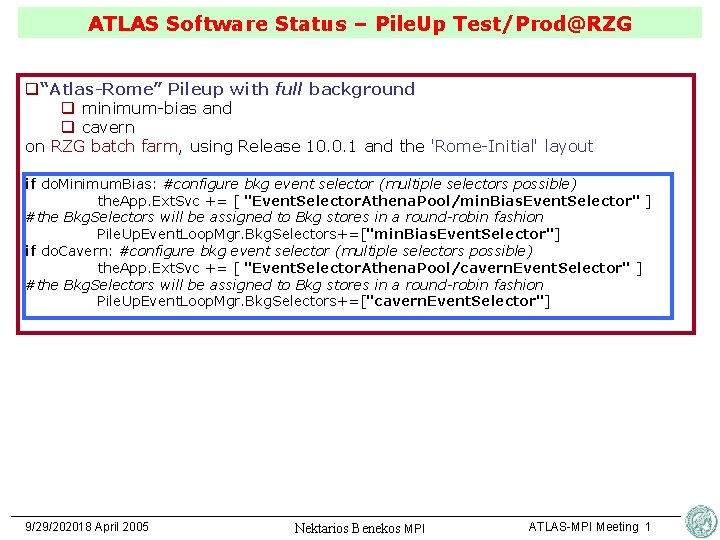
ATLAS Software Status – Pile. Up Test/Prod@RZG q“Atlas-Rome” Pileup with full background q minimum-bias and q cavern on RZG batch farm, using Release 10. 0. 1 and the 'Rome-Initial' layout if do. Minimum. Bias: #configure bkg event selector (multiple selectors possible) the. App. Ext. Svc += [ "Event. Selector. Athena. Pool/min. Bias. Event. Selector" ] #the Bkg. Selectors will be assigned to Bkg stores in a round-robin fashion Pile. Up. Event. Loop. Mgr. Bkg. Selectors+=["min. Bias. Event. Selector"] if do. Cavern: #configure bkg event selector (multiple selectors possible) the. App. Ext. Svc += [ "Event. Selector. Athena. Pool/cavern. Event. Selector" ] #the Bkg. Selectors will be assigned to Bkg stores in a round-robin fashion Pile. Up. Event. Loop. Mgr. Bkg. Selectors+=["cavern. Event. Selector"] 9/29/202018 April 2005 Nektarios Benekos MPI ATLAS-MPI Meeting 1
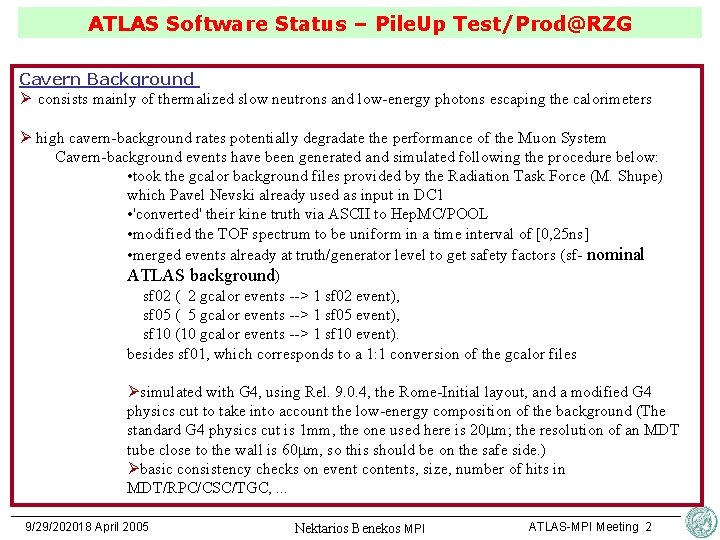
ATLAS Software Status – Pile. Up Test/Prod@RZG Cavern Background Ø consists mainly of thermalized slow neutrons and low-energy photons escaping the calorimeters Ø high cavern-background rates potentially degradate the performance of the Muon System Cavern-background events have been generated and simulated following the procedure below: • took the gcalor background files provided by the Radiation Task Force (M. Shupe) which Pavel Nevski already used as input in DC 1 • 'converted' their kine truth via ASCII to Hep. MC/POOL • modified the TOF spectrum to be uniform in a time interval of [0, 25 ns] • merged events already at truth/generator level to get safety factors (sf- nominal ATLAS background) sf 02 ( 2 gcalor events --> 1 sf 02 event), sf 05 ( 5 gcalor events --> 1 sf 05 event), sf 10 (10 gcalor events --> 1 sf 10 event). besides sf 01, which corresponds to a 1: 1 conversion of the gcalor files Øsimulated with G 4, using Rel. 9. 0. 4, the Rome-Initial layout, and a modified G 4 physics cut to take into account the low-energy composition of the background (The standard G 4 physics cut is 1 mm, the one used here is 20 mm; the resolution of an MDT tube close to the wall is 60 mm, so this should be on the safe side. ) Øbasic consistency checks on event contents, size, number of hits in MDT/RPC/CSC/TGC, . . . 9/29/202018 April 2005 Nektarios Benekos MPI ATLAS-MPI Meeting 2
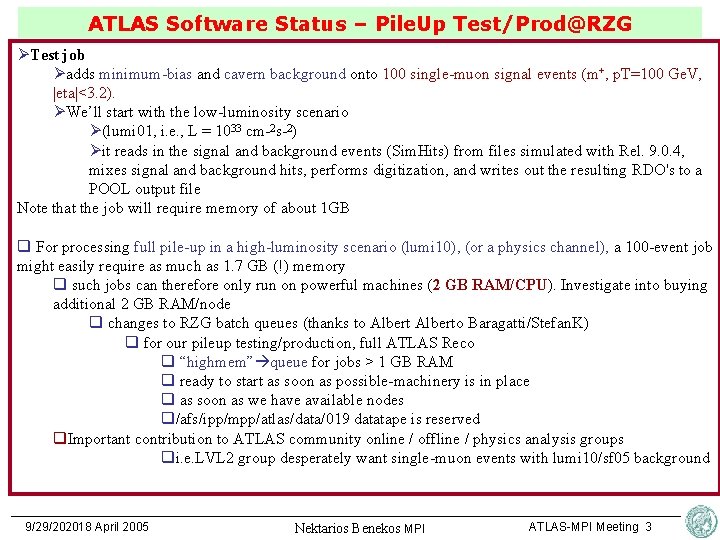
ATLAS Software Status – Pile. Up Test/Prod@RZG ØTest job Øadds minimum-bias and cavern background onto 100 single-muon signal events (m+, p. T=100 Ge. V, |eta|<3. 2). ØWe’ll start with the low-luminosity scenario Ø(lumi 01, i. e. , L = 1033 cm-2 s-2) Øit reads in the signal and background events (Sim. Hits) from files simulated with Rel. 9. 0. 4, mixes signal and background hits, performs digitization, and writes out the resulting RDO's to a POOL output file Note that the job will require memory of about 1 GB q For processing full pile-up in a high-luminosity scenario (lumi 10), (or a physics channel), a 100 -event job might easily require as much as 1. 7 GB (!) memory q such jobs can therefore only run on powerful machines (2 GB RAM/CPU). Investigate into buying additional 2 GB RAM/node q changes to RZG batch queues (thanks to Alberto Baragatti/Stefan. K) q for our pileup testing/production, full ATLAS Reco q “highmem” queue for jobs > 1 GB RAM q ready to start as soon as possible-machinery is in place q as soon as we have available nodes q/afs/ipp/mpp/atlas/data/019 datatape is reserved q. Important contribution to ATLAS community online / offline / physics analysis groups qi. e. LVL 2 group desperately want single-muon events with lumi 10/sf 05 background 9/29/202018 April 2005 Nektarios Benekos MPI ATLAS-MPI Meeting 3
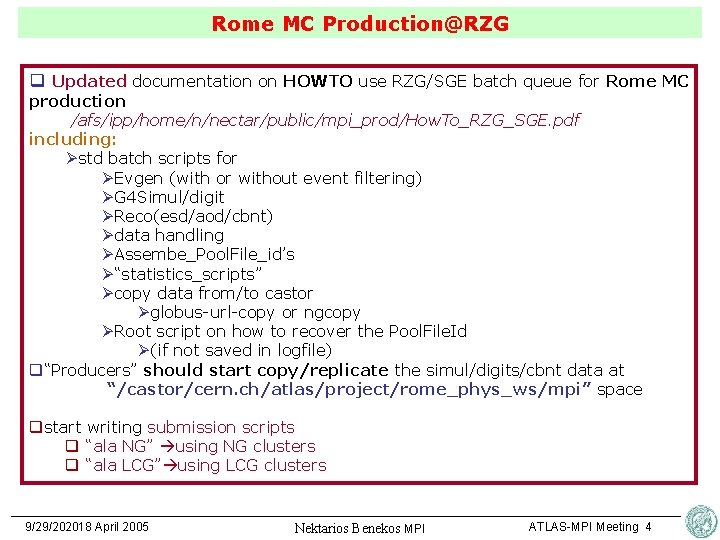
Rome MC Production@RZG q Updated documentation on HOWTO use RZG/SGE batch queue for Rome MC production /afs/ipp/home/n/nectar/public/mpi_prod/How. To_RZG_SGE. pdf including: Østd batch scripts for ØEvgen (with or without event filtering) ØG 4 Simul/digit ØReco(esd/aod/cbnt) Ødata handling ØAssembe_Pool. File_id’s Ø“statistics_scripts” Øcopy data from/to castor Øglobus-url-copy or ngcopy ØRoot script on how to recover the Pool. File. Id Ø(if not saved in logfile) q“Producers” should start copy/replicate the simul/digits/cbnt data at “/castor/cern. ch/atlas/project/rome_phys_ws/mpi” space qstart writing submission scripts q “ala NG” using NG clusters q “ala LCG” using LCG clusters 9/29/202018 April 2005 Nektarios Benekos MPI ATLAS-MPI Meeting 4
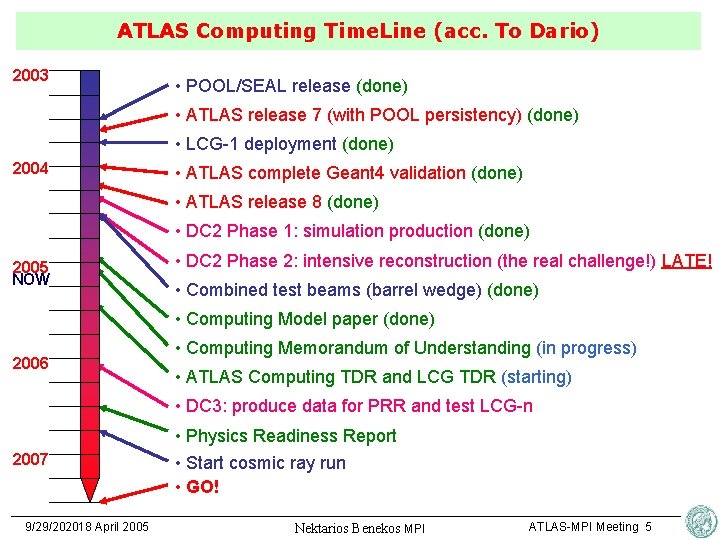
ATLAS Computing Time. Line (acc. To Dario) 2003 • POOL/SEAL release (done) • ATLAS release 7 (with POOL persistency) (done) • LCG-1 deployment (done) 2004 • ATLAS complete Geant 4 validation (done) • ATLAS release 8 (done) • DC 2 Phase 1: simulation production (done) 2005 NOW • DC 2 Phase 2: intensive reconstruction (the real challenge!) LATE! • Combined test beams (barrel wedge) (done) • Computing Model paper (done) 2006 • Computing Memorandum of Understanding (in progress) • ATLAS Computing TDR and LCG TDR (starting) • DC 3: produce data for PRR and test LCG-n 2007 9/29/202018 April 2005 • Physics Readiness Report • Start cosmic ray run • GO! Nektarios Benekos MPI ATLAS-MPI Meeting 5