
Assessment of a CDA rotary atomizer for weed
- Slides: 1
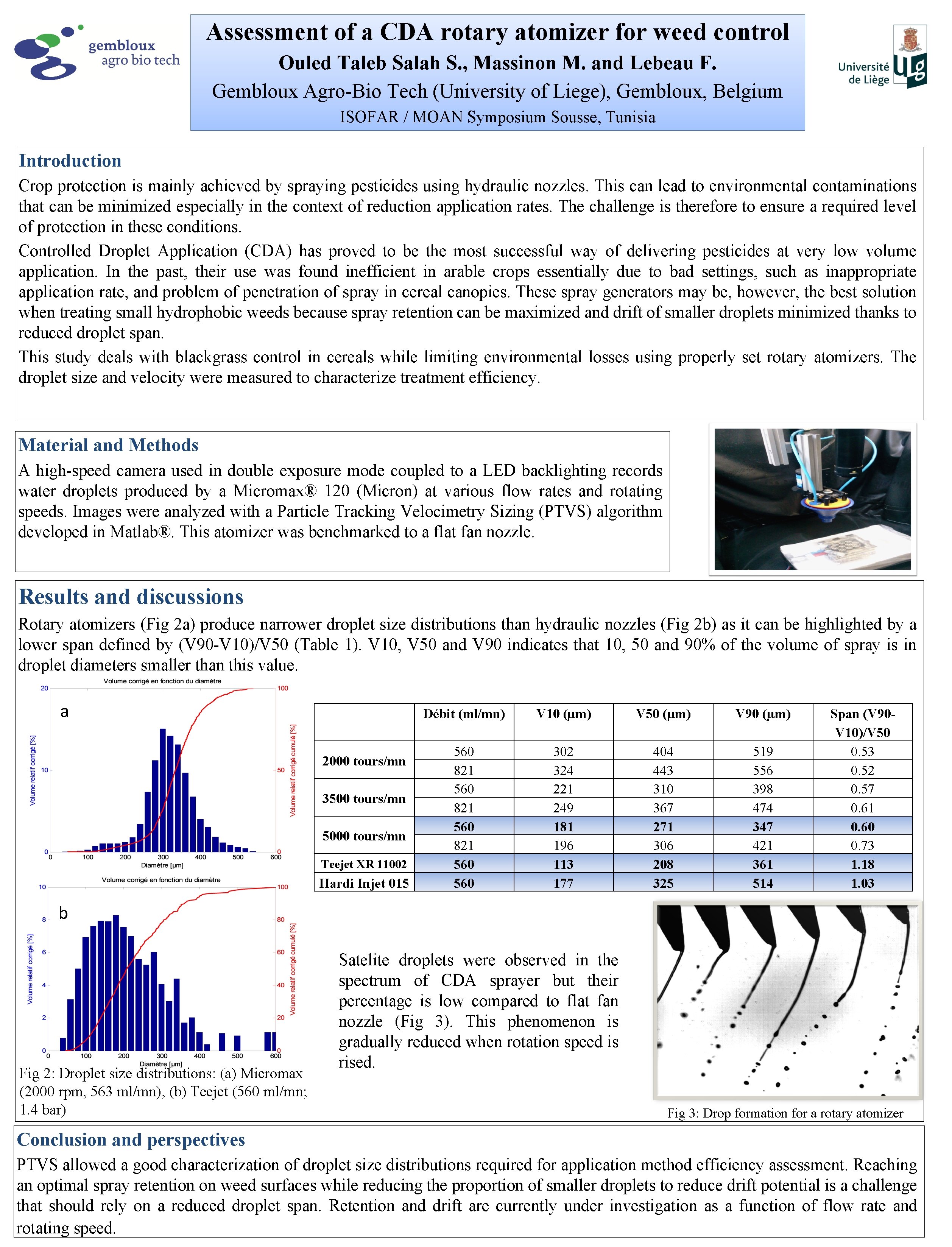
Assessment of a CDA rotary atomizer for weed control Ouled Taleb Salah S. , Massinon M. and Lebeau F. Gembloux Agro-Bio Tech (University of Liege), Gembloux, Belgium ISOFAR / MOAN Symposium Sousse, Tunisia Introduction Crop protection is mainly achieved by spraying pesticides using hydraulic nozzles. This can lead to environmental contaminations that can be minimized especially in the context of reduction application rates. The challenge is therefore to ensure a required level of protection in these conditions. Controlled Droplet Application (CDA) has proved to be the most successful way of delivering pesticides at very low volume application. In the past, their use was found inefficient in arable crops essentially due to bad settings, such as inappropriate application rate, and problem of penetration of spray in cereal canopies. These spray generators may be, however, the best solution when treating small hydrophobic weeds because spray retention can be maximized and drift of smaller droplets minimized thanks to reduced droplet span. This study deals with blackgrass control in cereals while limiting environmental losses using properly set rotary atomizers. The droplet size and velocity were measured to characterize treatment efficiency. Material and Methods A high-speed camera used in double exposure mode coupled to a LED backlighting records water droplets produced by a Micromax® 120 (Micron) at various flow rates and rotating speeds. Images were analyzed with a Particle Tracking Velocimetry Sizing (PTVS) algorithm developed in Matlab®. This atomizer was benchmarked to a flat fan nozzle. Results and discussions Rotary atomizers (Fig 2 a) produce narrower droplet size distributions than hydraulic nozzles (Fig 2 b) as it can be highlighted by a lower span defined by (V 90 -V 10)/V 50 (Table 1). V 10, V 50 and V 90 indicates that 10, 50 and 90% of the volume of spray is in droplet diameters smaller than this value. a 2000 tours/mn 3500 tours/mn 5000 tours/mn Teejet XR 11002 Hardi Injet 015 Débit (ml/mn) V 10 (µm) V 50 (µm) V 90 (µm) 560 821 560 302 324 221 249 181 196 113 177 404 443 310 367 271 306 208 325 519 556 398 474 347 421 361 514 Span (V 90 V 10)/V 50 0. 53 0. 52 0. 57 0. 61 0. 60 0. 73 1. 18 1. 03 b Fig 2: Droplet size distributions: (a) Micromax (2000 rpm, 563 ml/mn), (b) Teejet (560 ml/mn; 1. 4 bar) Satelite droplets were observed in the spectrum of CDA sprayer but their percentage is low compared to flat fan nozzle (Fig 3). This phenomenon is gradually reduced when rotation speed is rised. Fig 3: Drop formation for a rotary atomizer Conclusion and perspectives PTVS allowed a good characterization of droplet size distributions required for application method efficiency assessment. Reaching an optimal spray retention on weed surfaces while reducing the proportion of smaller droplets to reduce drift potential is a challenge that should rely on a reduced droplet span. Retention and drift are currently under investigation as a function of flow rate and rotating speed.

