A Flawed Peace The Treaty of Versailles Ch



- Slides: 11
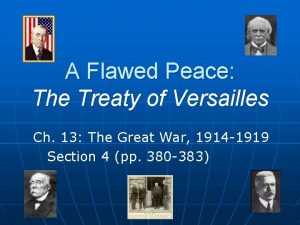
A Flawed Peace: The Treaty of Versailles Ch. 13: The Great War, 1914 -1919 Section 4 (pp. 380 -383)
The U. S. Enters the War, 1917 American Neutrality, 1914 -1917: n The U. S. tried to stay out of the events unfolding in Europe, but this proved to be impossible U. S. Enters the War, April, 1917 n n n Attacks on U. S. ships from German U-boats (Lusitania, 1915) Closer cultural ties to Allies Financial investments/loans more with Allies Zimmermann Note Russia’s 1 st revolution was attempt at democracy
The End of Fighting n n n With the U. S. involved, the Allies had an advantage • Fresh troops/new supplies • Financial backing • New source of food Soon they were able to halt the German offensive on Western Front and put them in retreat November 11, 1918 at 11: 00 am, the armistice ending the fighting was signed; now the world must make peace (11 th hour of the 11 th day, of the 11 th month)
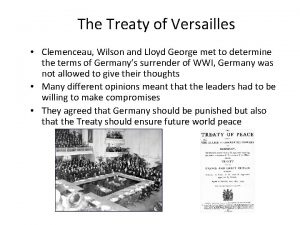
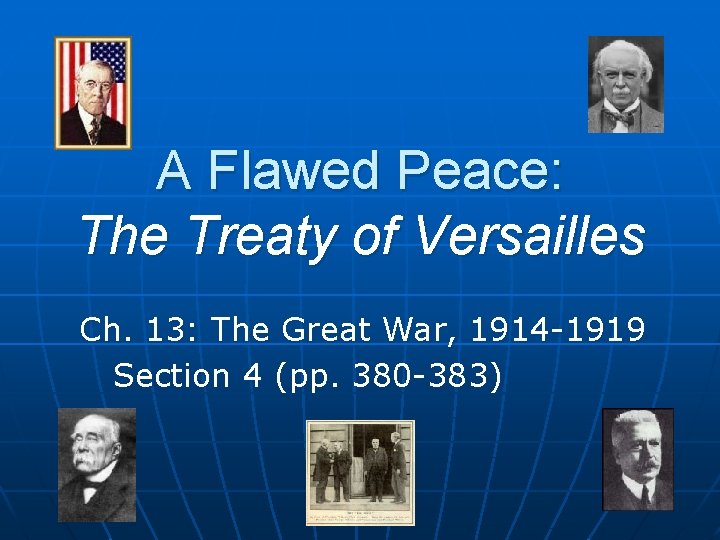
The Allies Meet at Versailles “The Big Four” n Woodrow Wilson – U. S. n David Lloyd George – Great Britain n Georges Clemenceau – France n Vittorio Orlando – Italy Uninvited Nations n The Central Powers n Russia
Wilson’s Plan for Peace The Fourteen Points (Jan. 1918) n Points 1 -5: causes of the war 1. 2. 3. • No secret treaties Freedom of the seas Reduced armaments Points 6 -13: changing borders and creation of new nations • • 4. Free trade 5. colonial claims Guiding principle to be self-determination Point 14: Creation of international peacekeeping organization ; The League of Nations
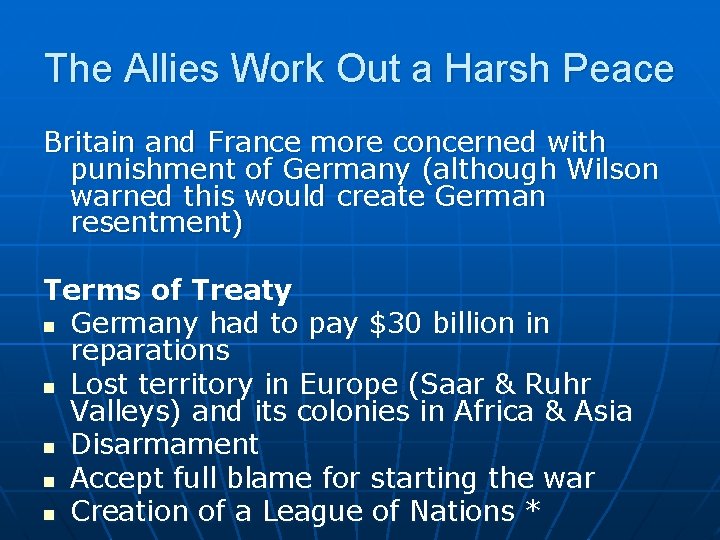
The Allies Work Out a Harsh Peace Britain and France more concerned with punishment of Germany (although Wilson warned this would create German resentment) Terms of Treaty n Germany had to pay $30 billion in reparations n Lost territory in Europe (Saar & Ruhr Valleys) and its colonies in Africa & Asia n Disarmament n Accept full blame for starting the war n Creation of a League of Nations *
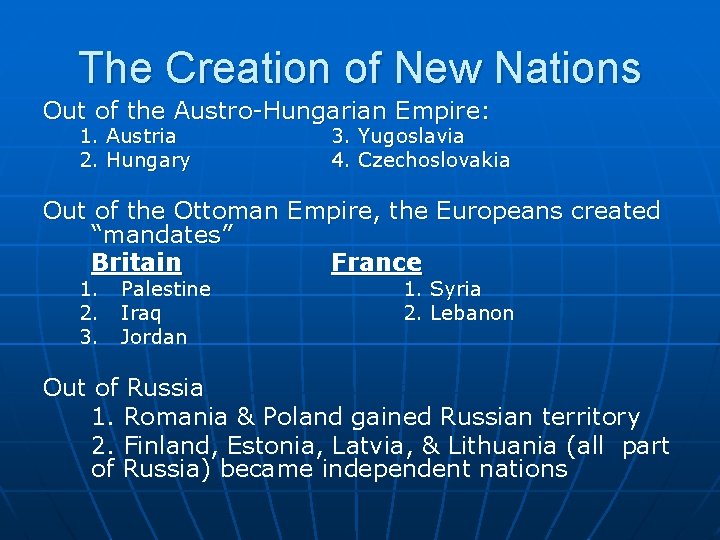
The Creation of New Nations Out of the Austro-Hungarian Empire: 1. 2. Austria Hungary 3. 4. Yugoslavia Czechoslovakia Out of the Ottoman Empire, the Europeans created “mandates” Britain France 1. 2. 3. Palestine Iraq Jordan 1. 2. Syria Lebanon Out of Russia 1. Romania & Poland gained Russian territory 2. Finland, Estonia, Latvia, & Lithuania (all part of Russia) became independent nations
A Treaty “Built on Quicksand” Treaty of Versailles fell far short of its goal of preserving future peace n n The U. S. never joined the League of Nations The provisions of the treaty left a bitter legacy in the hearts of Germans The peoples of Asia and Africa were angry at the way the treaty ignored their desires for independence Japan and Italy felt they had been cheated at the peace table
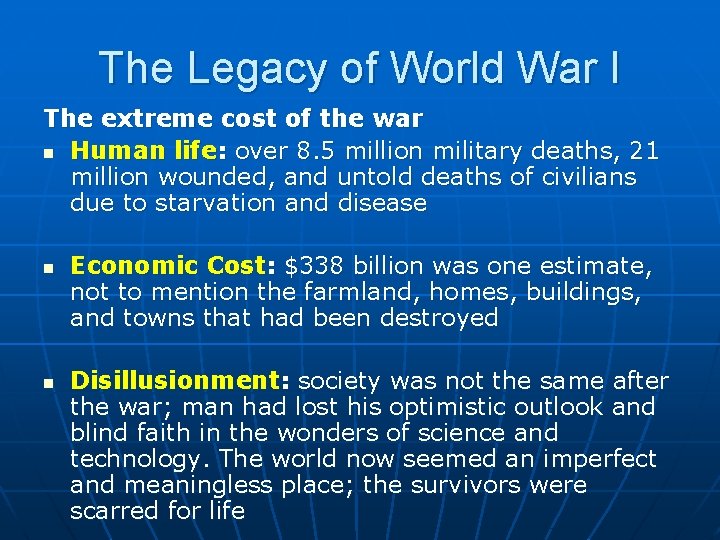
The Legacy of World War I The extreme cost of the war n Human life: over 8. 5 million military deaths, 21 million wounded, and untold deaths of civilians due to starvation and disease n n Economic Cost: $338 billion was one estimate, not to mention the farmland, homes, buildings, and towns that had been destroyed Disillusionment: society was not the same after the war; man had lost his optimistic outlook and blind faith in the wonders of science and technology. The world now seemed an imperfect and meaningless place; the survivors were scarred for life
Summary n n n . WWI ends -11 th hour of 11 th month of 11 th day -Treaty of Versailles ends WWI -President Woodrow Wilson writes 14 points for international peace, which sets up League of Nations, but the U. S. never joins and it is not successful. He also warns punishing Germany. -France and Britain want to punish Germany and do, dismantling army and forcing them to pay war REPARATIONS. This will lead to the Global Great Depression, and ultimately WWII, as Germany can not pay reparations, and allows Hitler to come to power, promising to return Germany to glory, and refusing to pay reparations while building up his army.
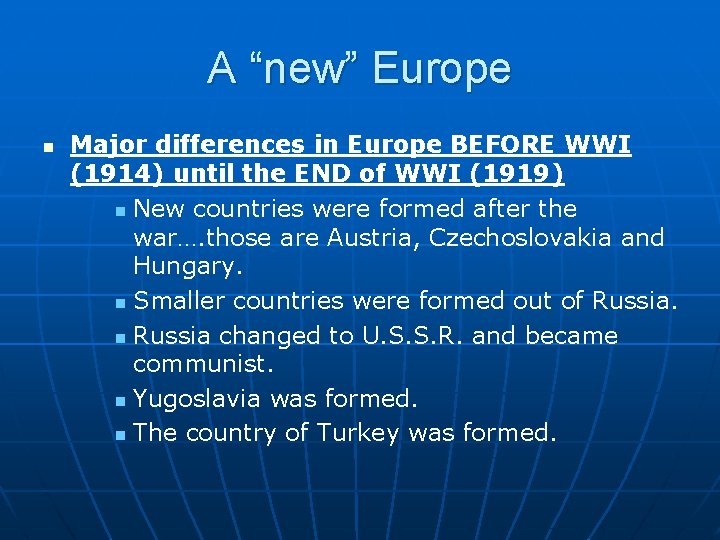
A “new” Europe n Major differences in Europe BEFORE WWI (1914) until the END of WWI (1919) n New countries were formed after the war…. those are Austria, Czechoslovakia and Hungary. n Smaller countries were formed out of Russia. n Russia changed to U. S. S. R. and became communist. n Yugoslavia was formed. n The country of Turkey was formed.