A Computational Approach to Ramsey Theory Stephan Krach
- Slides: 1
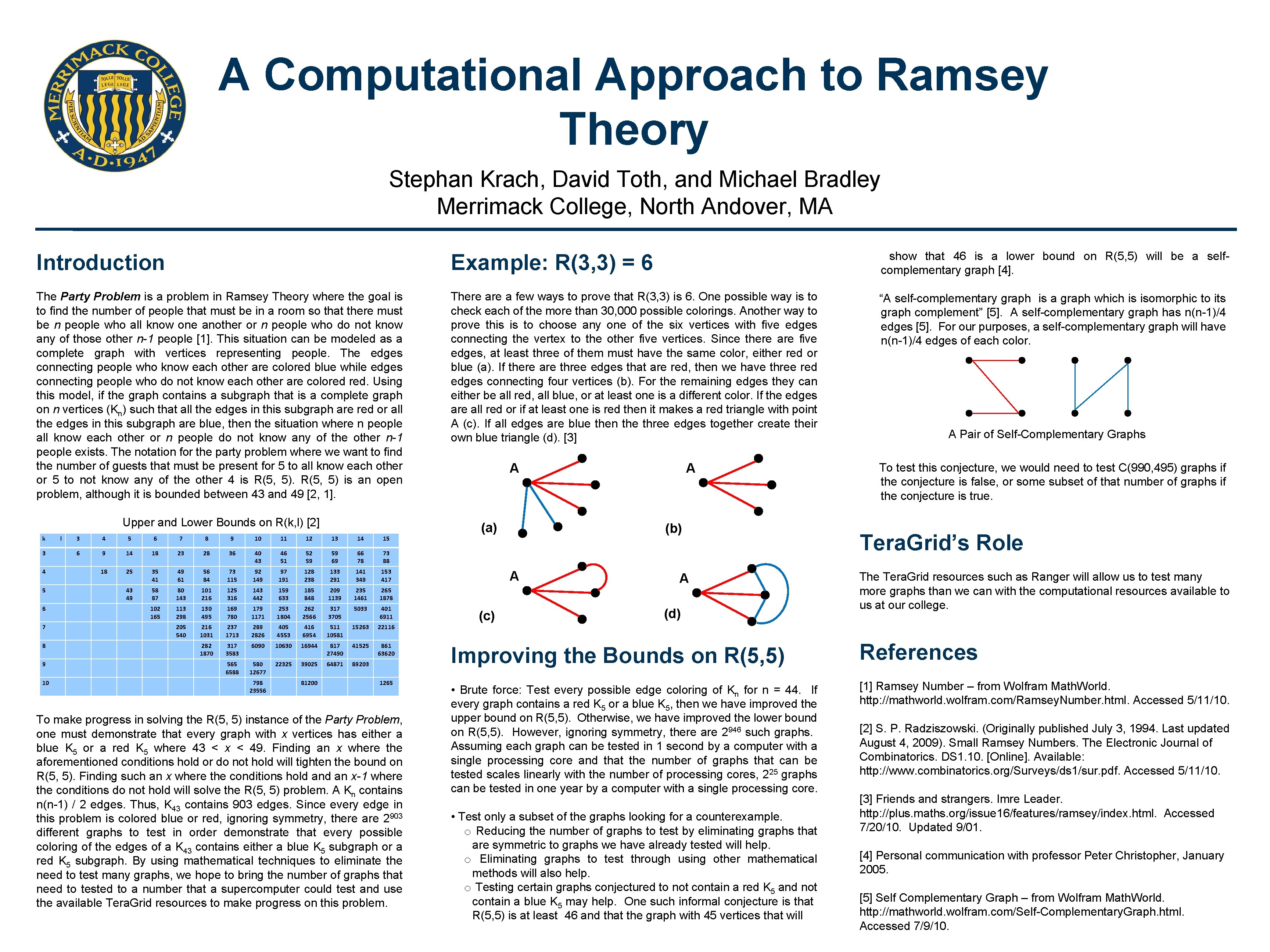
A Computational Approach to Ramsey Theory Stephan Krach, David Toth, and Michael Bradley Merrimack College, North Andover, MA Introduction Example: R(3, 3) = 6 show that 46 is a lower bound on R(5, 5) will be a selfcomplementary graph [4]. The Party Problem is a problem in Ramsey Theory where the goal is to find the number of people that must be in a room so that there must be n people who all know one another or n people who do not know any of those other n-1 people [1]. This situation can be modeled as a complete graph with vertices representing people. The edges connecting people who know each other are colored blue while edges connecting people who do not know each other are colored red. Using this model, if the graph contains a subgraph that is a complete graph on n vertices (Kn) such that all the edges in this subgraph are red or all the edges in this subgraph are blue, then the situation where n people all know each other or n people do not know any of the other n-1 people exists. The notation for the party problem where we want to find the number of guests that must be present for 5 to all know each other or 5 to not know any of the other 4 is R(5, 5) is an open problem, although it is bounded between 43 and 49 [2, 1]. There a few ways to prove that R(3, 3) is 6. One possible way is to check each of the more than 30, 000 possible colorings. Another way to prove this is to choose any one of the six vertices with five edges connecting the vertex to the other five vertices. Since there are five edges, at least three of them must have the same color, either red or blue (a). If there are three edges that are red, then we have three red edges connecting four vertices (b). For the remaining edges they can either be all red, all blue, or at least one is a different color. If the edges are all red or if at least one is red then it makes a red triangle with point A (c). If all edges are blue then the three edges together create their own blue triangle (d). [3] “A self-complementary graph is a graph which is isomorphic to its graph complement” [5]. A self-complementary graph has n(n-1)/4 edges [5]. For our purposes, a self-complementary graph will have n(n-1)/4 edges of each color. Upper and Lower Bounds on R(k, l) [2] k 3 4 5 6 7 8 9 10 l 3 4 5 6 7 8 9 10 11 12 13 14 15 6 9 14 18 23 28 36 40 43 46 51 52 59 59 69 66 78 73 88 18 25 35 41 49 61 56 84 73 115 92 149 97 191 128 238 133 291 141 349 153 417 43 49 58 87 80 143 101 216 125 316 143 442 159 633 185 848 209 1139 235 1461 265 1878 102 165 113 298 130 495 169 780 179 1171 253 1804 262 2566 317 3705 5033 401 6911 205 540 216 1031 237 1713 289 2826 405 4553 416 6954 511 10581 15263 22116 282 1870 317 3583 6090 10630 16944 817 27490 41525 861 63620 565 6588 580 12677 22325 39025 64871 89203 798 23556 81200 1265 To make progress in solving the R(5, 5) instance of the Party Problem, one must demonstrate that every graph with x vertices has either a blue K 5 or a red K 5 where 43 < x < 49. Finding an x where the aforementioned conditions hold or do not hold will tighten the bound on R(5, 5). Finding such an x where the conditions hold an x-1 where the conditions do not hold will solve the R(5, 5) problem. A Kn contains n(n-1) / 2 edges. Thus, K 43 contains 903 edges. Since every edge in this problem is colored blue or red, ignoring symmetry, there are 2903 different graphs to test in order demonstrate that every possible coloring of the edges of a K 43 contains either a blue K 5 subgraph or a red K 5 subgraph. By using mathematical techniques to eliminate the need to test many graphs, we hope to bring the number of graphs that need to tested to a number that a supercomputer could test and use the available Tera. Grid resources to make progress on this problem. A (a) (b) A (c) A A (d) A Pair of Self-Complementary Graphs To test this conjecture, we would need to test C(990, 495) graphs if the conjecture is false, or some subset of that number of graphs if the conjecture is true. Tera. Grid’s Role The Tera. Grid resources such as Ranger will allow us to test many more graphs than we can with the computational resources available to us at our college. Improving the Bounds on R(5, 5) References • Brute force: Test every possible edge coloring of Kn for n = 44. If every graph contains a red K 5 or a blue K 5, then we have improved the upper bound on R(5, 5). Otherwise, we have improved the lower bound on R(5, 5). However, ignoring symmetry, there are 2946 such graphs. Assuming each graph can be tested in 1 second by a computer with a single processing core and that the number of graphs that can be tested scales linearly with the number of processing cores, 225 graphs can be tested in one year by a computer with a single processing core. [1] Ramsey Number – from Wolfram Math. World. http: //mathworld. wolfram. com/Ramsey. Number. html. Accessed 5/11/10. • Test only a subset of the graphs looking for a counterexample. o Reducing the number of graphs to test by eliminating graphs that are symmetric to graphs we have already tested will help. o Eliminating graphs to test through using other mathematical methods will also help. o Testing certain graphs conjectured to not contain a red K 5 and not contain a blue K 5 may help. One such informal conjecture is that R(5, 5) is at least 46 and that the graph with 45 vertices that will [2] S. P. Radziszowski. (Originally published July 3, 1994. Last updated August 4, 2009). Small Ramsey Numbers. The Electronic Journal of Combinatorics. DS 1. 10. [Online]. Available: http: //www. combinatorics. org/Surveys/ds 1/sur. pdf. Accessed 5/11/10. [3] Friends and strangers. Imre Leader. http: //plus. maths. org/issue 16/features/ramsey/index. html. Accessed 7/20/10. Updated 9/01. [4] Personal communication with professor Peter Christopher, January 2005. [5] Self Complementary Graph – from Wolfram Math. World. http: //mathworld. wolfram. com/Self-Complementary. Graph. html. Accessed 7/9/10.