A Computational Analysis of the LotkaVolterra Equations Delon
- Slides: 1
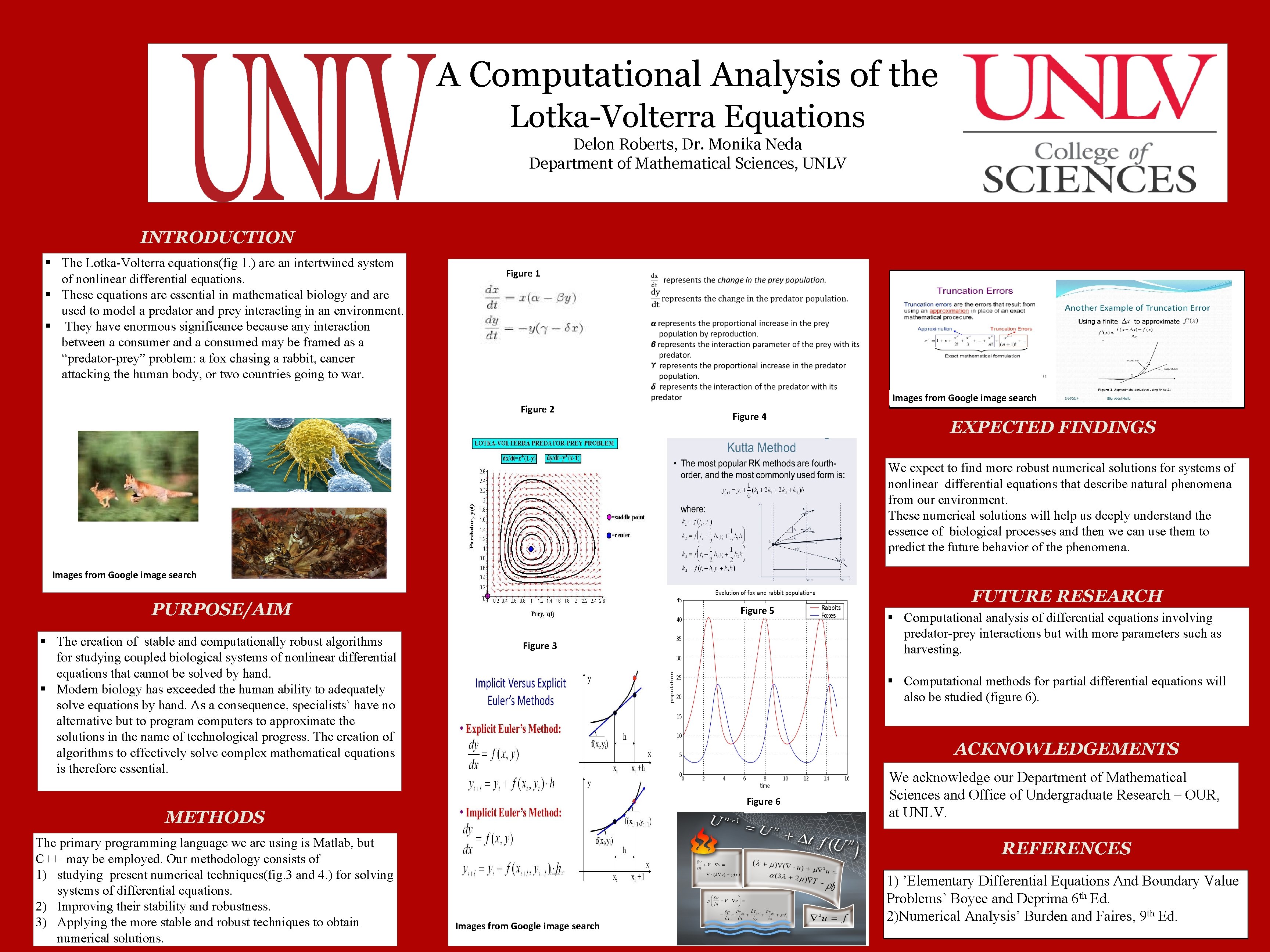
A Computational Analysis of the Lotka-Volterra Equations Delon Roberts, Dr. Monika Neda Department of Mathematical Sciences, UNLV INTRODUCTION § The Lotka-Volterra equations(fig 1. ) are an intertwined system of nonlinear differential equations. § These equations are essential in mathematical biology and are used to model a predator and prey interacting in an environment. § They have enormous significance because any interaction between a consumer and a consumed may be framed as a “predator-prey” problem: a fox chasing a rabbit, cancer attacking the human body, or two countries going to war. Figure 1 Figure 2 Images from Google image search Figure 4 EXPECTED FINDINGS We expect to find more robust numerical solutions for systems of nonlinear differential equations that describe natural phenomena from our environment. These numerical solutions will help us deeply understand the essence of biological processes and then we can use them to predict the future behavior of the phenomena. Images from Google image search PURPOSE/AIM § The creation of stable and computationally robust algorithms for studying coupled biological systems of nonlinear differential equations that cannot be solved by hand. § Modern biology has exceeded the human ability to adequately solve equations by hand. As a consequence, specialists` have no alternative but to program computers to approximate the solutions in the name of technological progress. The creation of algorithms to effectively solve complex mathematical equations is therefore essential. Figure 5 Figure 3 § Computational analysis of differential equations involving predator-prey interactions but with more parameters such as harvesting. § Computational methods for partial differential equations will also be studied (figure 6). ACKNOWLEDGEMENTS Figure 6 METHODS The primary programming language we are using is Matlab, but C++ may be employed. Our methodology consists of 1) studying present numerical techniques(fig. 3 and 4. ) for solving systems of differential equations. 2) Improving their stability and robustness. 3) Applying the more stable and robust techniques to obtain numerical solutions. FUTURE RESEARCH We acknowledge our Department of Mathematical Sciences and Office of Undergraduate Research – OUR, at UNLV. REFERENCES Images from Google image search 1) ’Elementary Differential Equations And Boundary Value Problems’ Boyce and Deprima 6 th Ed. 2)Numerical Analysis’ Burden and Faires, 9 th Ed.