
Zygotic Mutants of the Mangrove Killifish Kryptolebias marmoratus
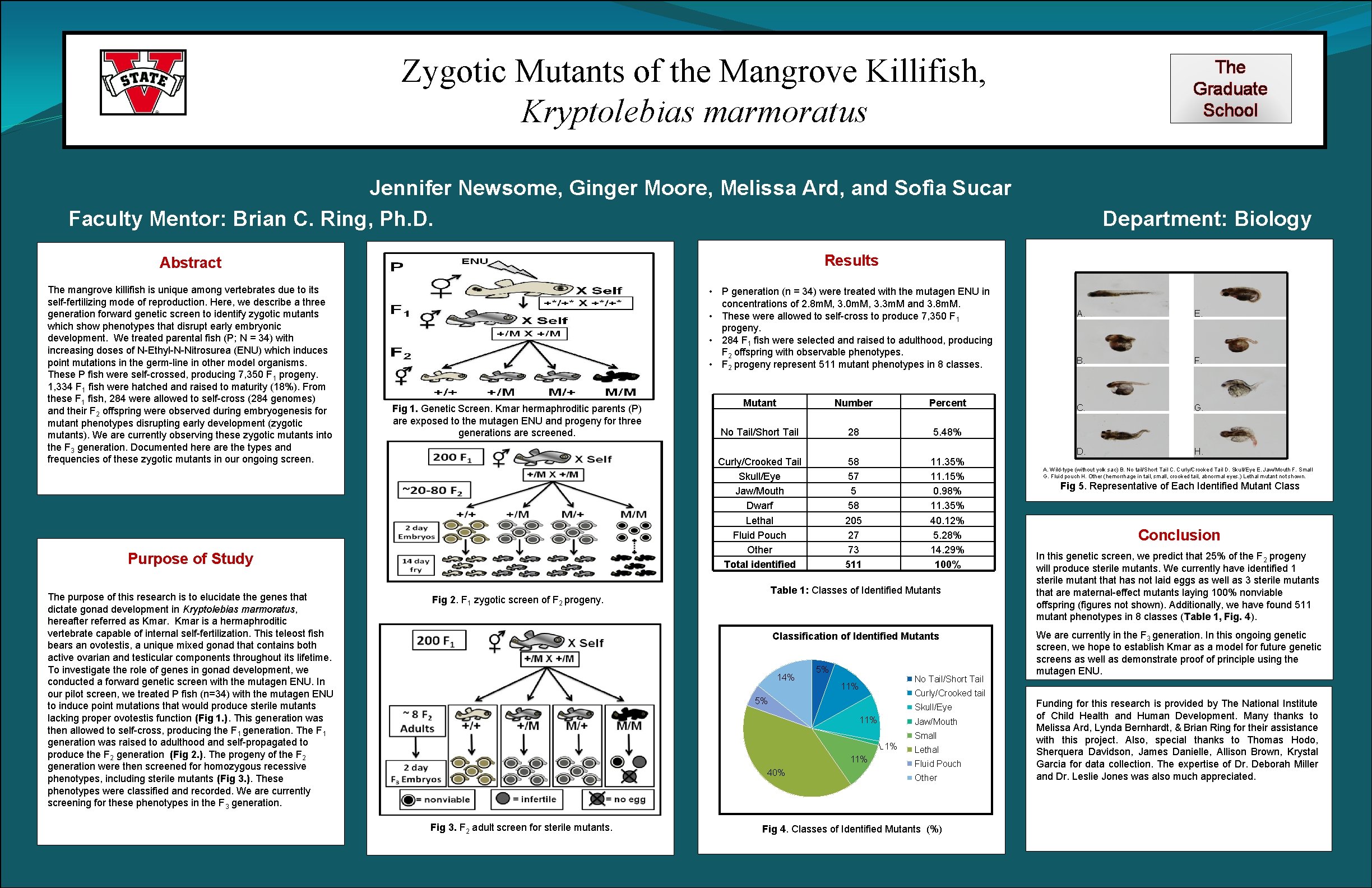
Zygotic Mutants of the Mangrove Killifish, Kryptolebias marmoratus The Graduate School Jennifer Newsome, Ginger Moore, Melissa Ard, and Sofìa Sucar Faculty Mentor: Brian C. Ring, Ph. D. Abstract Results The mangrove killifish is unique among vertebrates due to its self-fertilizing mode of reproduction. Here, we describe a three generation forward genetic screen to identify zygotic mutants which show phenotypes that disrupt early embryonic development. We treated parental fish (P; N = 34) with increasing doses of N-Ethyl-N-Nitrosurea (ENU) which induces point mutations in the germ-line in other model organisms. These P fish were self-crossed, producing 7, 350 F 1 progeny. 1, 334 F 1 fish were hatched and raised to maturity (18%). From these F 1 fish, 284 were allowed to self-cross (284 genomes) and their F 2 offspring were observed during embryogenesis for mutant phenotypes disrupting early development (zygotic mutants). We are currently observing these zygotic mutants into the F 3 generation. Documented here are the types and frequencies of these zygotic mutants in our ongoing screen. • P generation (n = 34) were treated with the mutagen ENU in concentrations of 2. 8 m. M, 3. 0 m. M, 3. 3 m. M and 3. 8 m. M. • These were allowed to self-cross to produce 7, 350 F 1 progeny. • 284 F 1 fish were selected and raised to adulthood, producing F 2 offspring with observable phenotypes. • F 2 progeny represent 511 mutant phenotypes in 8 classes. Fig 1. Genetic Screen. Kmar hermaphroditic parents (P) are exposed to the mutagen ENU and progeny for three generations are screened. Number Percent No Tail/Short Tail 28 5. 48% Curly/Crooked Tail Skull/Eye Jaw/Mouth Dwarf Lethal Fluid Pouch Other Total identified Purpose of Study The purpose of this research is to elucidate the genes that dictate gonad development in Kryptolebias marmoratus, hereafter referred as Kmar is a hermaphroditic vertebrate capable of internal self-fertilization. This teleost fish bears an ovotestis, a unique mixed gonad that contains both active ovarian and testicular components throughout its lifetime. To investigate the role of genes in gonad development, we conducted a forward genetic screen with the mutagen ENU. In our pilot screen, we treated P fish (n=34) with the mutagen ENU to induce point mutations that would produce sterile mutants lacking proper ovotestis function (Fig 1. ). This generation was then allowed to self-cross, producing the F 1 generation. The F 1 generation was raised to adulthood and self-propagated to produce the F 2 generation (Fig 2. ). The progeny of the F 2 generation were then screened for homozygous recessive phenotypes, including sterile mutants (Fig 3. ). These phenotypes were classified and recorded. We are currently screening for these phenotypes in the F 3 generation. Mutant 58 57 5 58 205 27 73 511 11. 35% 11. 15% 0. 98% 11. 35% 40. 12% 5. 28% 14. 29% 100% Table 1: Classes of Identified Mutants Fig 2. F 1 zygotic screen of F 2 progeny. Classification of Identified Mutants 14% 5% No Tail/Short Tail 11% Curly/Crooked tail 5% Skull/Eye 11% Jaw/Mouth Small 1% 11% 40% Fig 3. F 2 adult screen for sterile mutants. Lethal Fluid Pouch Other Fig 4. Classes of Identified Mutants (%) Department: Biology A. E. B. F. C. G. D. D. H. A. Wild-type (without yolk sac) B. No tail/Short Tail C. Curly/Crooked Tail D. Skull/Eye E. Jaw/Mouth F. Small G. Fluid pouch H. Other (hemorrhage in tail, small, crooked tail, abnormal eyes. ) Lethal mutant not shown. Fig 5. Representative of Each Identified Mutant Class Conclusion In this genetic screen, we predict that 25% of the F 2 progeny will produce sterile mutants. We currently have identified 1 sterile mutant that has not laid eggs as well as 3 sterile mutants that are maternal-effect mutants laying 100% nonviable offspring (figures not shown). Additionally, we have found 511 mutant phenotypes in 8 classes (Table 1, Fig. 4). We are currently in the F 3 generation. In this ongoing genetic screen, we hope to establish Kmar as a model for future genetic screens as well as demonstrate proof of principle using the mutagen ENU. Funding for this research is provided by The National Institute of Child Health and Human Development. Many thanks to Melissa Ard, Lynda Bernhardt, & Brian Ring for their assistance with this project. Also, special thanks to Thomas Hodo, Sherquera Davidson, James Danielle, Allison Brown, Krystal Garcia for data collection. The expertise of Dr. Deborah Miller and Dr. Leslie Jones was also much appreciated.
- Slides: 1