
zVM VSwitch Hiper Sockets Bridge Rick Tarcza zVM
z/VM VSwitch Hiper. Sockets Bridge Rick Tarcza z/VM Networking Design Endicott, NY 06/27/2012 © 2012 IBM Corporation
System z z/VM VSwitch Hiper. Sockets Bridge Topics to Cover § VSwitch Circle of Life § Benefits of a Hiper. Sockets Bridge Port § Machine Requirements and Definitions § Bridge Capable Port § New Hiper. Sockets Completion Queue Technology § Bridge Port High Availability (Fail-over) § VSwitch Dynamic Path MTU Support 2 © 2012 IBM Corporation
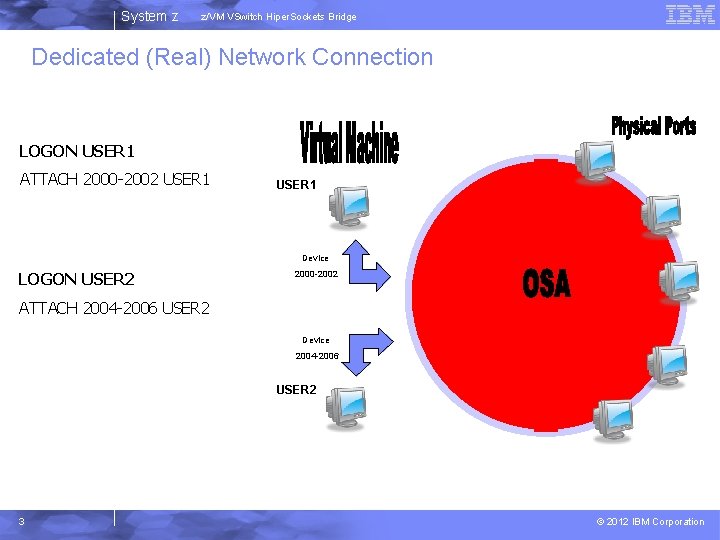
System z z/VM VSwitch Hiper. Sockets Bridge Dedicated (Real) Network Connection LOGON USER 1 ATTACH 2000 -2002 USER 1 Device LOGON USER 2 2000 -2002 ATTACH 2004 -2006 USER 2 Device 2004 -2006 USER 2 3 © 2012 IBM Corporation
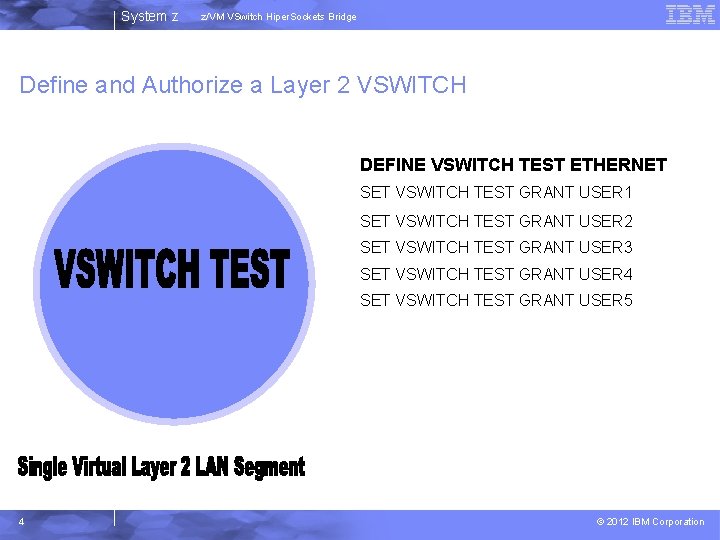
System z z/VM VSwitch Hiper. Sockets Bridge Define and Authorize a Layer 2 VSWITCH DEFINE VSWITCH TEST ETHERNET SET VSWITCH TEST GRANT USER 1 SET VSWITCH TEST GRANT USER 2 SET VSWITCH TEST GRANT USER 3 SET VSWITCH TEST GRANT USER 4 SET VSWITCH TEST GRANT USER 5 4 © 2012 IBM Corporation
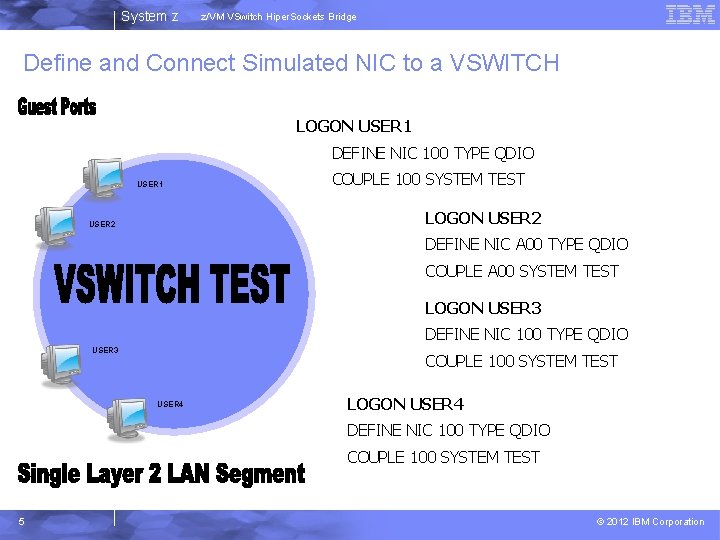
System z z/VM VSwitch Hiper. Sockets Bridge Define and Connect Simulated NIC to a VSWITCH LOGON USER 1 DEFINE NIC 100 TYPE QDIO USER 1 COUPLE 100 SYSTEM TEST LOGON USER 2 DEFINE NIC A 00 TYPE QDIO COUPLE A 00 SYSTEM TEST LOGON USER 3 DEFINE NIC 100 TYPE QDIO USER 3 COUPLE 100 SYSTEM TEST USER 4 LOGON USER 4 DEFINE NIC 100 TYPE QDIO COUPLE 100 SYSTEM TEST 5 © 2012 IBM Corporation
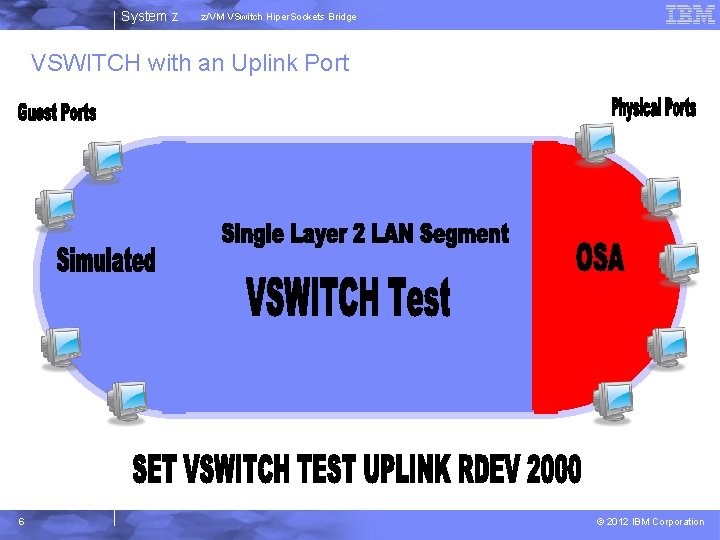
System z z/VM VSwitch Hiper. Sockets Bridge VSWITCH with an Uplink Port 6 © 2012 IBM Corporation
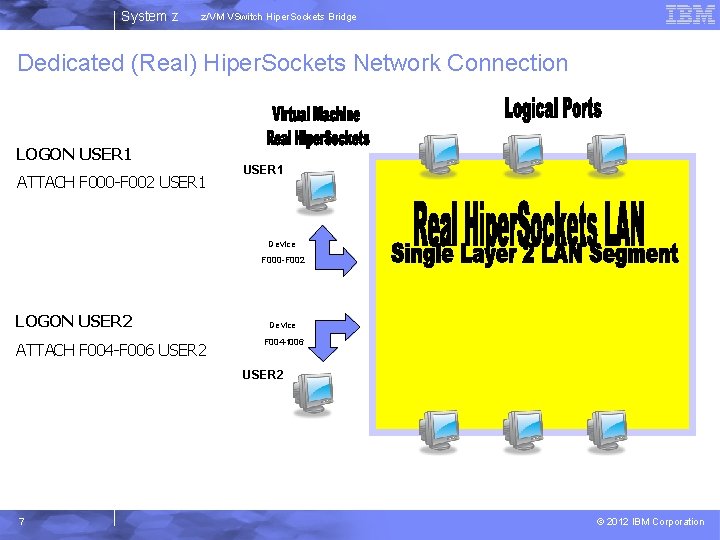
System z z/VM VSwitch Hiper. Sockets Bridge Dedicated (Real) Hiper. Sockets Network Connection LOGON USER 1 ATTACH F 000 -F 002 USER 1 Device F 000 -F 002 LOGON USER 2 ATTACH F 004 -F 006 USER 2 Device F 004 -f 006 USER 2 7 © 2012 IBM Corporation
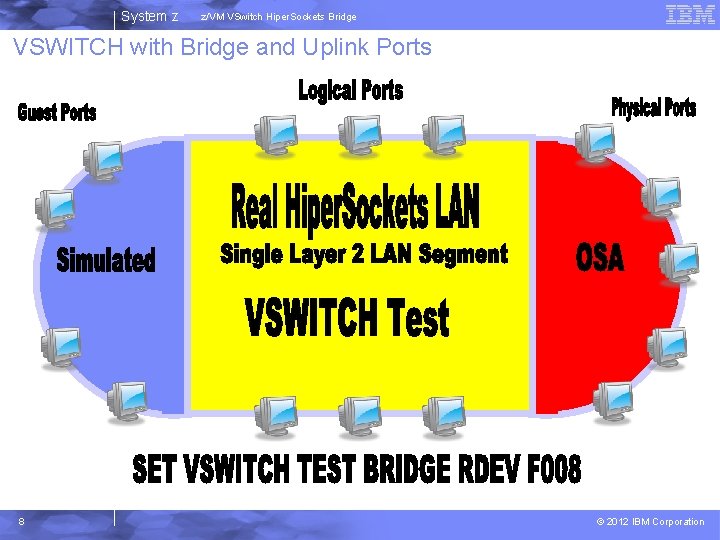
System z z/VM VSwitch Hiper. Sockets Bridge VSWITCH with Bridge and Uplink Ports 8 © 2012 IBM Corporation
System z z/VM VSwitch Hiper. Sockets Bridge Port Real Hiper. Sockets devices now have the ability to communicate with a host residing external to the CEC using a z/VM VSwitch. § Ethernet (Layer 2) Transport Mode Only § Simplified Guest Virtual Machine Network Connections – Single guest Hiper. Sockets network connection exploits both Hiper. Sockets and OSA-E Technologies – Low latency Hiper. Sockets Technology for virtual machine to virtual machine communications. – Hiper. Sockets used for cross LPAR communications – OSA-E Feature for outside the CEC communications – Support current Hiper. Sockets high bandwidth (MTU) concurrently with existing external network destination bandwidth (MTU) – Transparency – Guest is unaware of the Hiper. Sockets Bridge from both a configuration and a functional perspective. – High availability provided by VSwitch – Exploit existing machine QIOAssists 9 © 2012 IBM Corporation
System z z/VM VSwitch Hiper. Sockets Bridge Port (Continue) § Ability to bridge an ensemble IEDN or an external customer network. § Support LGR to external CPC through cross-CEC HS bridging § Managed by z. Manager or existing customer procedure For information on the hardware and software requirements of the Virtual Switch Hiper. Sockets bridge support see http: //www. vm. ibm. com/zvm 620/apars. html 10 © 2012 IBM Corporation
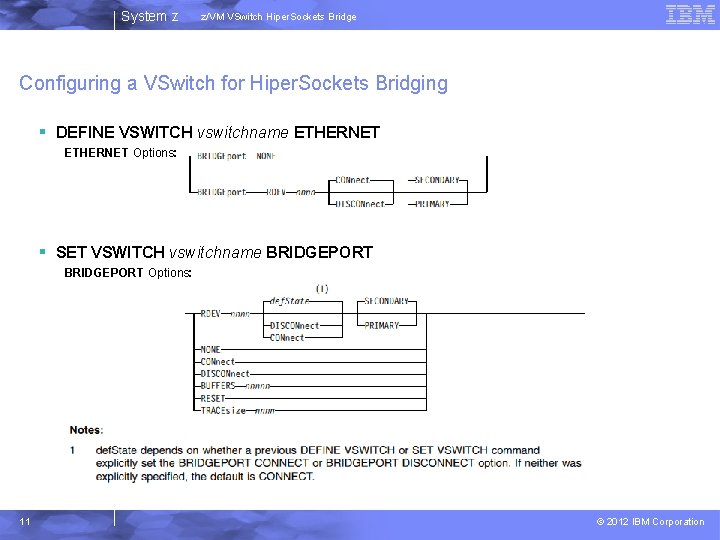
System z z/VM VSwitch Hiper. Sockets Bridge Configuring a VSwitch for Hiper. Sockets Bridging § DEFINE VSWITCH vswitchname ETHERNET Options: § SET VSWITCH vswitchname BRIDGEPORT Options: 11 © 2012 IBM Corporation
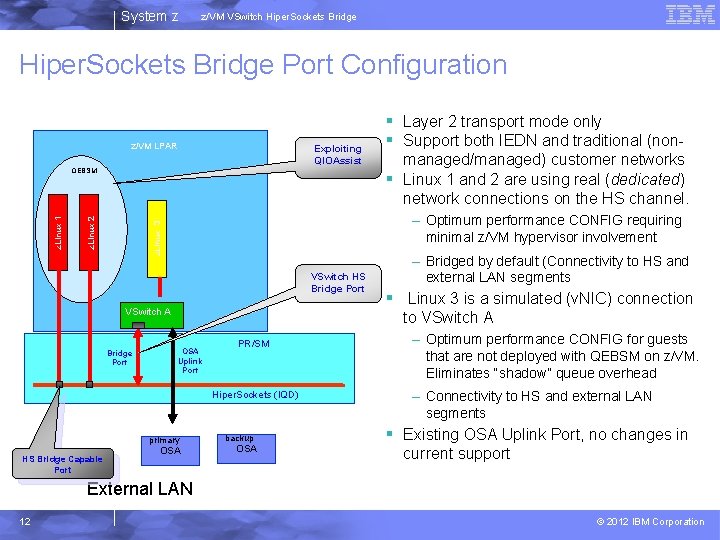
System z z/VM VSwitch Hiper. Sockets Bridge Port Configuration z/VM LPAR Exploiting QIOAssist z. Linux QA 4 z. Linux 3 z. Linux 2 z. Linux 1 QEBSM VSwitch A Bridge Port z. Linux 6 managed/managed) customer networks § Linux 1 and 2 are using real (dedicated) network connections on the HS channel. – Optimum performance CONFIG requiring minimal z/VM hypervisor involvement VSwitch HS Bridge Port – Bridged by default (Connectivity to HS and external LAN segments § Linux 3 is a simulated (v. NIC) connection to VSwitch A OSA Uplink Port PR/SM Hiper. Sockets (IQD) primary HS Bridge Capable Port § Layer 2 transport mode only § Support both IEDN and traditional (non- OSA backup OSA – Optimum performance CONFIG for guests that are not deployed with QEBSM on z/VM. Eliminates “shadow” queue overhead – Connectivity to HS and external LAN segments § Existing OSA Uplink Port, no changes in current support External LAN 12 © 2012 IBM Corporation
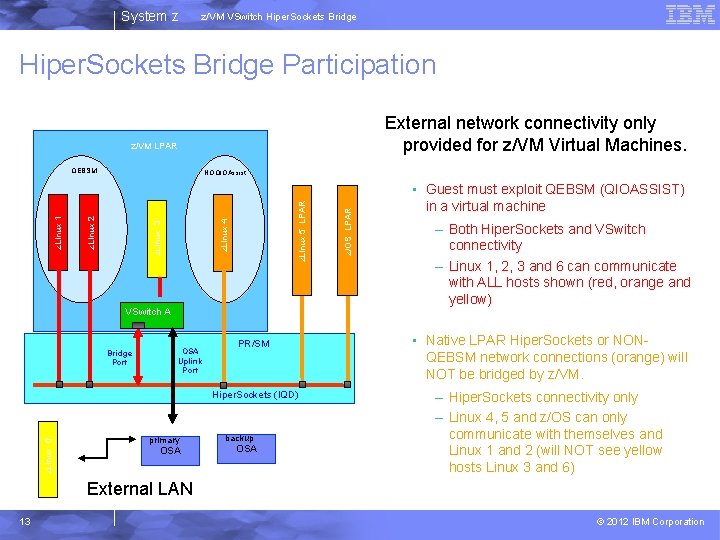
System z z/VM VSwitch Hiper. Sockets Bridge Participation External network connectivity only provided for z/VM Virtual Machines. z/VM LPAR VSwitch A Bridge Port OSA Uplink Port PR/SM z. Linux 6 Hiper. Sockets (IQD) primary OSA backup OSA z/OS LPAR z. Linux 3 z. Linux 4 z. Linux QA 4 z. Linux 5 LPAR NOQIOAssist z. Linux 2 z. Linux 1 QEBSM • Guest must exploit QEBSM (QIOASSIST) in a virtual machine – Both Hiper. Sockets and VSwitch connectivity – Linux 1, 2, 3 and 6 can communicate with ALL hosts shown (red, orange and yellow) • Native LPAR Hiper. Sockets or NONQEBSM network connections (orange) will NOT be bridged by z/VM. – Hiper. Sockets connectivity only – Linux 4, 5 and z/OS can only communicate with themselves and Linux 1 and 2 (will NOT see yellow hosts Linux 3 and 6) External LAN 13 © 2012 IBM Corporation
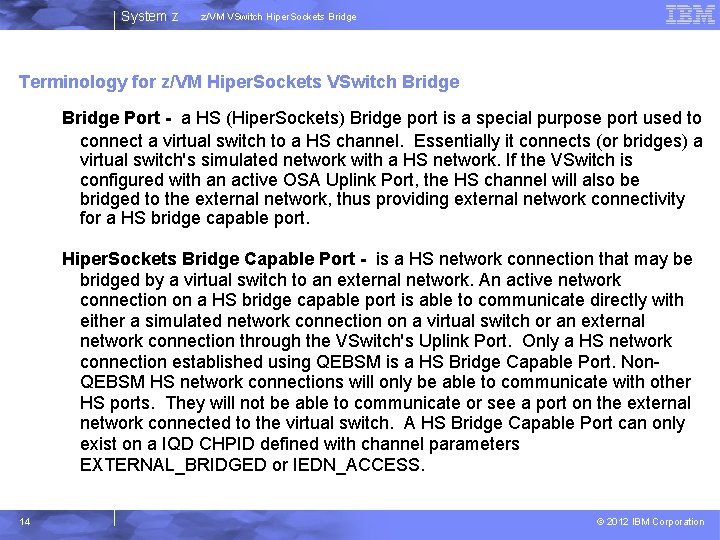
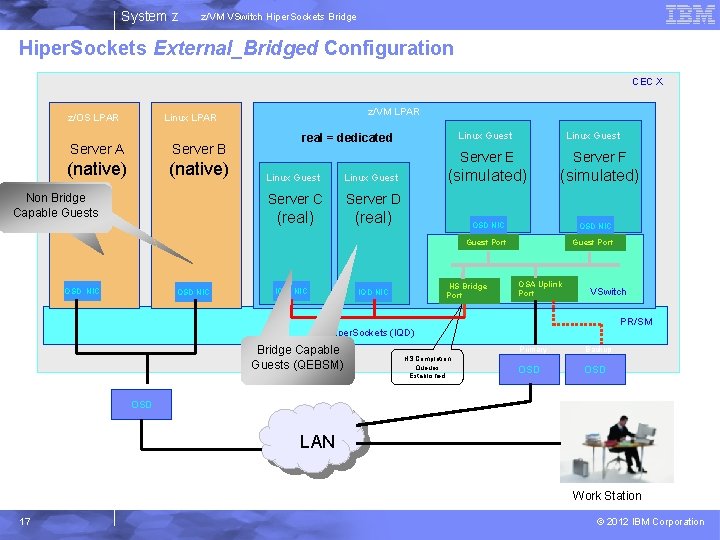
System z z/VM VSwitch Hiper. Sockets Bridge Terminology for z/VM Hiper. Sockets VSwitch Bridge Port - a HS (Hiper. Sockets) Bridge port is a special purpose port used to connect a virtual switch to a HS channel. Essentially it connects (or bridges) a virtual switch's simulated network with a HS network. If the VSwitch is configured with an active OSA Uplink Port, the HS channel will also be bridged to the external network, thus providing external network connectivity for a HS bridge capable port. Hiper. Sockets Bridge Capable Port - is a HS network connection that may be bridged by a virtual switch to an external network. An active network connection on a HS bridge capable port is able to communicate directly with either a simulated network connection on a virtual switch or an external network connection through the VSwitch's Uplink Port. Only a HS network connection established using QEBSM is a HS Bridge Capable Port. Non. QEBSM HS network connections will only be able to communicate with other HS ports. They will not be able to communicate or see a port on the external network connected to the virtual switch. A HS Bridge Capable Port can only exist on a IQD CHPID defined with channel parameters EXTERNAL_BRIDGED or IEDN_ACCESS. 14 © 2012 IBM Corporation
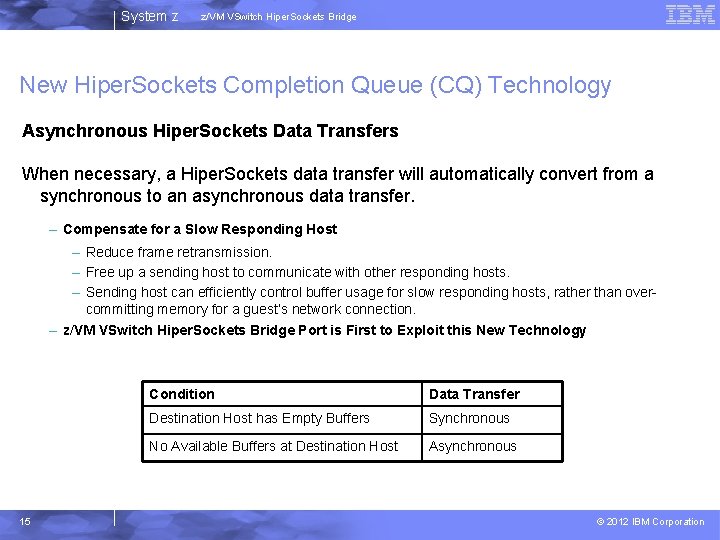
System z z/VM VSwitch Hiper. Sockets Bridge New Hiper. Sockets Completion Queue (CQ) Technology Asynchronous Hiper. Sockets Data Transfers When necessary, a Hiper. Sockets data transfer will automatically convert from a synchronous to an asynchronous data transfer. – Compensate for a Slow Responding Host – Reduce frame retransmission. – Free up a sending host to communicate with other responding hosts. – Sending host can efficiently control buffer usage for slow responding hosts, rather than overcommitting memory for a guest’s network connection. – z/VM VSwitch Hiper. Sockets Bridge Port is First to Exploit this New Technology 15 Condition Data Transfer Destination Host has Empty Buffers Synchronous No Available Buffers at Destination Host Asynchronous © 2012 IBM Corporation
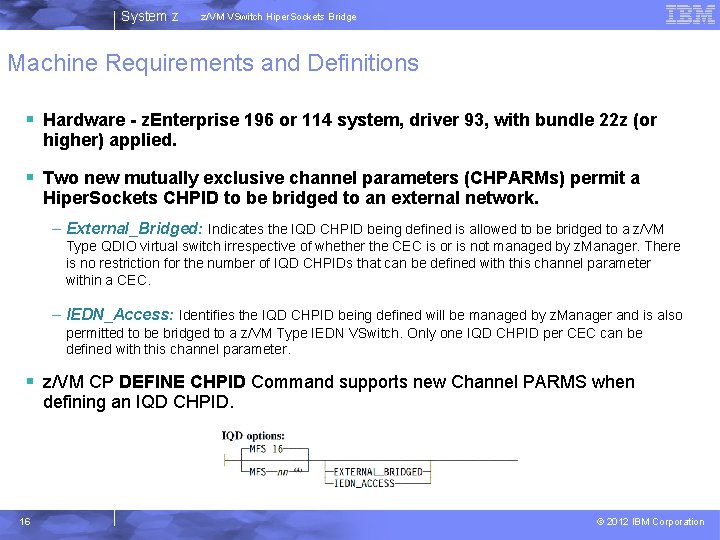
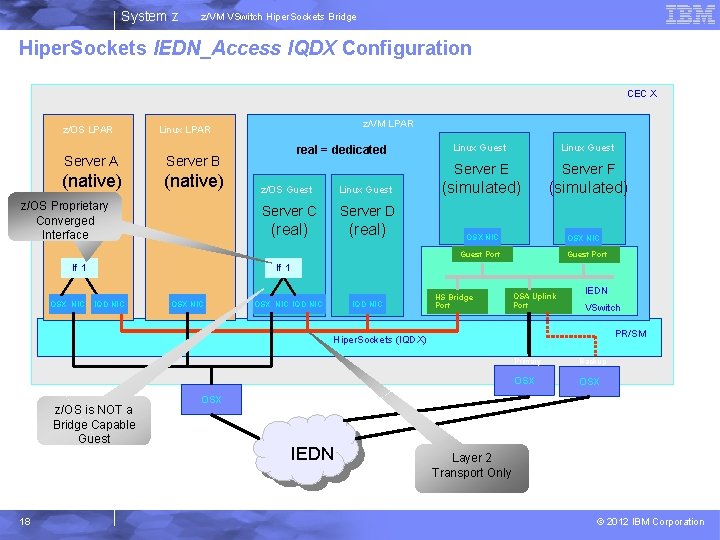
System z z/VM VSwitch Hiper. Sockets Bridge Machine Requirements and Definitions § Hardware - z. Enterprise 196 or 114 system, driver 93, with bundle 22 z (or higher) applied. § Two new mutually exclusive channel parameters (CHPARMs) permit a Hiper. Sockets CHPID to be bridged to an external network. – External_Bridged: Indicates the IQD CHPID being defined is allowed to be bridged to a z/VM Type QDIO virtual switch irrespective of whether the CEC is or is not managed by z. Manager. There is no restriction for the number of IQD CHPIDs that can be defined with this channel parameter within a CEC. – IEDN_Access: Identifies the IQD CHPID being defined will be managed by z. Manager and is also permitted to be bridged to a z/VM Type IEDN VSwitch. Only one IQD CHPID per CEC can be defined with this channel parameter. § z/VM CP DEFINE CHPID Command supports new Channel PARMS when defining an IQD CHPID. 16 © 2012 IBM Corporation
System z z/VM VSwitch Hiper. Sockets Bridge Hiper. Sockets External_Bridged Configuration CEC X z/OS LPAR z/VM LPAR Linux LPAR Server A Server B (native) Non Bridge bridge Non capable. Guests guest Capable OSD NIC Linux Guest real = dedicated Linux Guest Server C Server D (real) IQD NIC Server E Server F (simulated) OSD NIC Guest Port HS Bridge Port IQD NIC Linux Guest OSA Uplink Port VSwitch PR/SM Hiper. Sockets (IQD) Bridge bridge Capable capable Guests guest (QEBSM) HS Completion Queues Established Primary Backup OSD OSD LAN Work Station 17 © 2012 IBM Corporation
System z z/VM VSwitch Hiper. Sockets Bridge Hiper. Sockets IEDN_Access IQDX Configuration CEC X z/OS LPAR z/VM LPAR Linux LPAR Server A Server B (native) z/OS Proprietary Converged Interface real = dedicated z/OS Guest Linux Guest Server C Server D (real) Linux Guest Server E Server F (simulated) OSX NIC Guest Port If 1 IQD NIC OSX NIC IQD NIC HS Bridge Port OSA Uplink Port IEDN VSwitch PR/SM Hiper. Sockets (IQDX) z/OS is NOT a Bridge Capable Guest 18 Primary Backup OSX OSX IEDN Layer 2 Transport Only © 2012 IBM Corporation
System z z/VM VSwitch Hiper. Sockets Bridge High Availability Configuration for Hiper. Sockets Bridge It is highly recommended that multiple VSwitches (preferable in different images of z/VM) be used to bridge a HS Channel. Each VSwitch should be configured with an with a Hiper. Sockets Bridge and an Up. Link Port configured to the same layer 2 external network. 19 © 2012 IBM Corporation
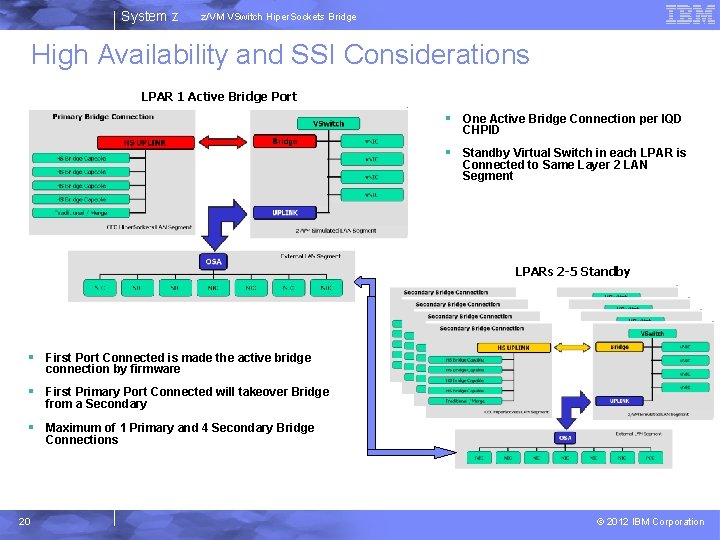
System z z/VM VSwitch Hiper. Sockets Bridge High Availability and SSI Considerations LPAR 1 Active Bridge Port § One Active Bridge Connection per IQD CHPID § Standby Virtual Switch in each LPAR is Connected to Same Layer 2 LAN Segment LPARs 2 -5 Standby § First Port Connected is made the active bridge connection by firmware § First Primary Port Connected will takeover Bridge from a Secondary § Maximum of 1 Primary and 4 Secondary Bridge Connections 20 © 2012 IBM Corporation
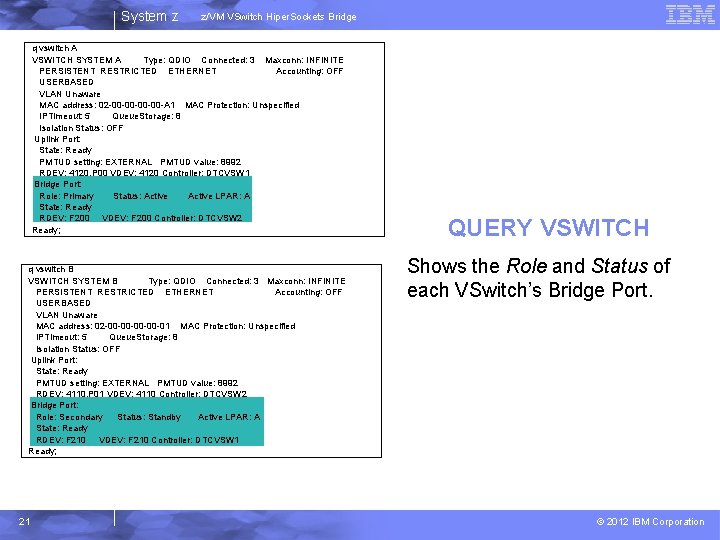
System z z/VM VSwitch Hiper. Sockets Bridge q vswitch A VSWITCH SYSTEM A Type: QDIO Connected: 3 Maxconn: INFINITE PERSISTENT RESTRICTED ETHERNET Accounting: OFF USERBASED VLAN Unaware MAC address: 02 -00 -00 -A 1 MAC Protection: Unspecified IPTimeout: 5 Queue. Storage: 8 Isolation Status: OFF Uplink Port: State: Ready PMTUD setting: EXTERNAL PMTUD value: 8992 RDEV: 4120. P 00 VDEV: 4120 Controller: DTCVSW 1 Bridge Port: Role: Primary Status: Active LPAR: A State: Ready RDEV: F 200 VDEV: F 200 Controller: DTCVSW 2 Ready; q vswitch B VSWITCH SYSTEM B Type: QDIO Connected: 3 Maxconn: INFINITE PERSISTENT RESTRICTED ETHERNET Accounting: OFF USERBASED VLAN Unaware MAC address: 02 -00 -00 -01 MAC Protection: Unspecified IPTimeout: 5 Queue. Storage: 8 Isolation Status: OFF Uplink Port: State: Ready PMTUD setting: EXTERNAL PMTUD value: 8992 RDEV: 4110. P 01 VDEV: 4110 Controller: DTCVSW 2 Bridge Port: Role: Secondary Status: Standby Active LPAR: A State: Ready RDEV: F 210 VDEV: F 210 Controller: DTCVSW 1 Ready; 21 QUERY VSWITCH Shows the Role and Status of each VSwitch’s Bridge Port. © 2012 IBM Corporation
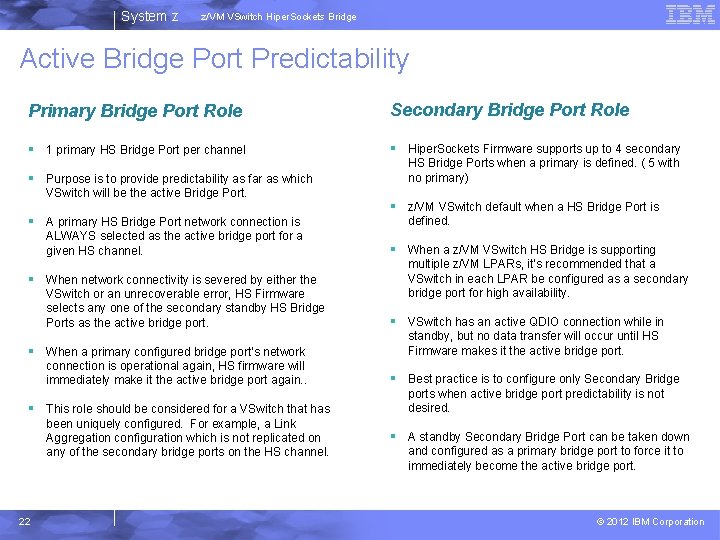
System z z/VM VSwitch Hiper. Sockets Bridge Active Bridge Port Predictability Primary Bridge Port Role Secondary Bridge Port Role § 1 primary HS Bridge Port per channel § Hiper. Sockets Firmware supports up to 4 secondary § Purpose is to provide predictability as far as which VSwitch will be the active Bridge Port. § A primary HS Bridge Port network connection is ALWAYS selected as the active bridge port for a given HS channel. § When network connectivity is severed by either the VSwitch or an unrecoverable error, HS Firmware selects any one of the secondary standby HS Bridge Ports as the active bridge port. § When a primary configured bridge port’s network HS Bridge Ports when a primary is defined. ( 5 with no primary) § z/VM VSwitch default when a HS Bridge Port is defined. § When a z/VM VSwitch HS Bridge is supporting multiple z/VM LPARs, it’s recommended that a VSwitch in each LPAR be configured as a secondary bridge port for high availability. § VSwitch has an active QDIO connection while in standby, but no data transfer will occur until HS Firmware makes it the active bridge port. connection is operational again, HS firmware will immediately make it the active bridge port again. . § Best practice is to configure only Secondary Bridge § This role should be considered for a VSwitch that has ports when active bridge port predictability is not desired. been uniquely configured. For example, a Link Aggregation configuration which is not replicated on any of the secondary bridge ports on the HS channel. 22 § A standby Secondary Bridge Port can be taken down and configured as a primary bridge port to force it to immediately become the active bridge port. © 2012 IBM Corporation
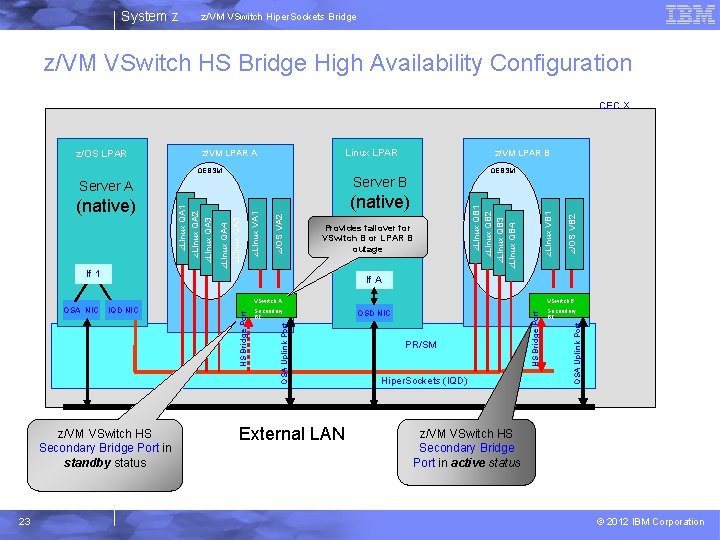
System z z/VM VSwitch Hiper. Sockets Bridge z/VM VSwitch HS Bridge High Availability Configuration CEC X Linux LPAR z/VM LPAR A z/VM LPAR B QEBSM If 1 Provides failover for VSwitch B or LPAR B outage z. Linux VB 1 (native) z/OS VA 2 z. Linux VA 1 z. Linux QA 4 z. Linux QA 3 (native) z. Linux QA 1 z. Linux QA 2 z. Linux QA 3 Server A If A z/VM VSwitch HS Secondary Bridge Port in standby status 23 External LAN VSwitch B PR/SM Hiper. Sockets (IQD) Secondary BC OSA Uplink Port OSD NIC HS Bridge Port Secondary BC OSA Uplink Port IQD NIC HS Bridge Port VSwitch A OSA NIC z/OS VB 2 Server B z. Linux QB 1 z. Linux QB 2 z. Linux QB 3 z. Linux QB 4 z/OS LPAR z/VM VSwitch HS Secondary Bridge Port in active status © 2012 IBM Corporation
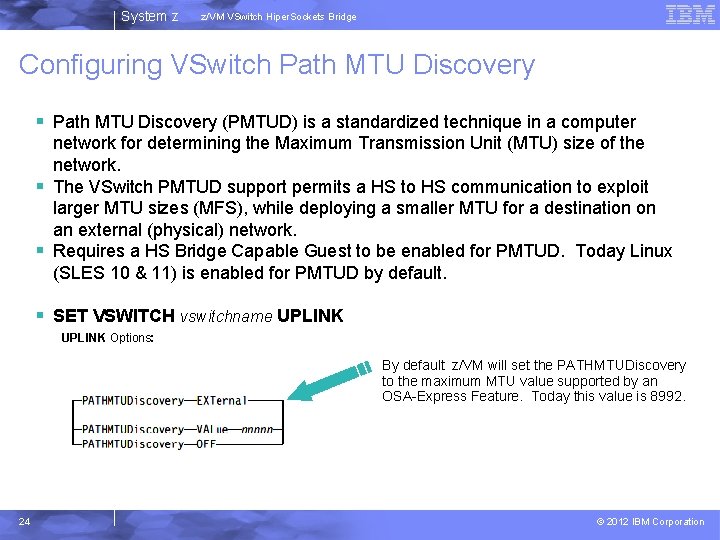
System z z/VM VSwitch Hiper. Sockets Bridge Configuring VSwitch Path MTU Discovery § Path MTU Discovery (PMTUD) is a standardized technique in a computer network for determining the Maximum Transmission Unit (MTU) size of the network. § The VSwitch PMTUD support permits a HS to HS communication to exploit larger MTU sizes (MFS), while deploying a smaller MTU for a destination on an external (physical) network. § Requires a HS Bridge Capable Guest to be enabled for PMTUD. Today Linux (SLES 10 & 11) is enabled for PMTUD by default. § SET VSWITCH vswitchname UPLINK Options: By default z/VM will set the PATHMTUDiscovery to the maximum MTU value supported by an OSA-Express Feature. Today this value is 8992. 24 © 2012 IBM Corporation
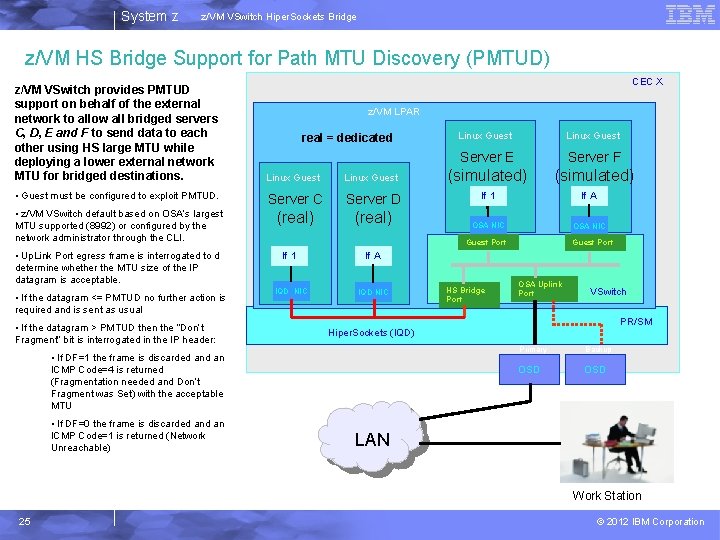
System z z/VM VSwitch Hiper. Sockets Bridge z/VM HS Bridge Support for Path MTU Discovery (PMTUD) z/VM VSwitch provides PMTUD support on behalf of the external network to allow all bridged servers C, D, E and F to send data to each other using HS large MTU while deploying a lower external network MTU for bridged destinations. CEC X z/VM LPAR real = dedicated Linux Guest Server E Server F (simulated) Linux Guest (simulated) • Guest must be configured to exploit PMTUD. Server C Server D If 1 If A • z/VM VSwitch default based on OSA’s largest MTU supported (8992) or configured by the network administrator through the CLI. (real) OSA NIC • Up. Link Port egress frame is interrogated to d determine whether the MTU size of the IP datagram is acceptable. • If the datagram <= PMTUD no further action is required and is sent as usual • If the datagram > PMTUD then the “Don’t Fragment” bit is interrogated in the IP header: Guest Port If 1 If A IQD NIC OSA Uplink Port VSwitch PR/SM Hiper. Sockets (IQD) • If DF=1 the frame is discarded an ICMP Code=4 is returned (Fragmentation needed and Don’t Fragment was Set) with the acceptable MTU • If DF=0 the frame is discarded an ICMP Code=1 is returned (Network Unreachable) HS Bridge Port Guest Port Primary Backup OSD LAN Work Station 25 © 2012 IBM Corporation
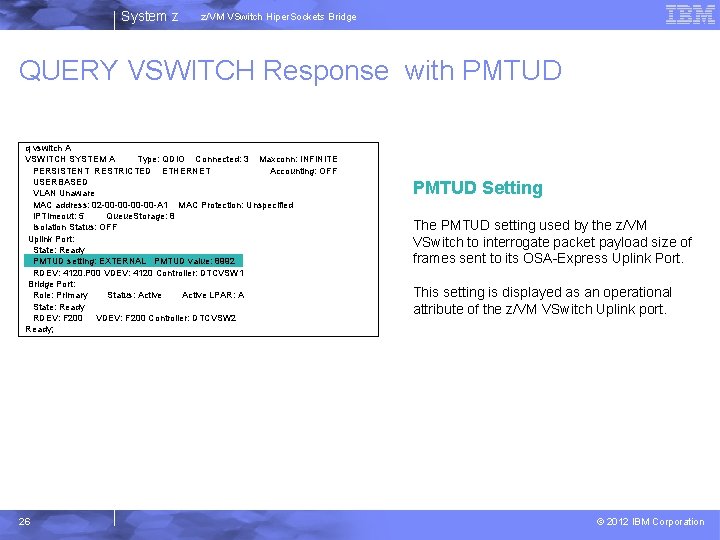
System z z/VM VSwitch Hiper. Sockets Bridge QUERY VSWITCH Response with PMTUD q vswitch A VSWITCH SYSTEM A Type: QDIO Connected: 3 Maxconn: INFINITE PERSISTENT RESTRICTED ETHERNET Accounting: OFF USERBASED VLAN Unaware MAC address: 02 -00 -00 -A 1 MAC Protection: Unspecified IPTimeout: 5 Queue. Storage: 8 Isolation Status: OFF Uplink Port: State: Ready PMTUD setting: EXTERNAL PMTUD value: 8992 RDEV: 4120. P 00 VDEV: 4120 Controller: DTCVSW 1 Bridge Port: Role: Primary Status: Active LPAR: A State: Ready RDEV: F 200 VDEV: F 200 Controller: DTCVSW 2 Ready; 26 PMTUD Setting The PMTUD setting used by the z/VM VSwitch to interrogate packet payload size of frames sent to its OSA-Express Uplink Port. This setting is displayed as an operational attribute of the z/VM VSwitch Uplink port. © 2012 IBM Corporation
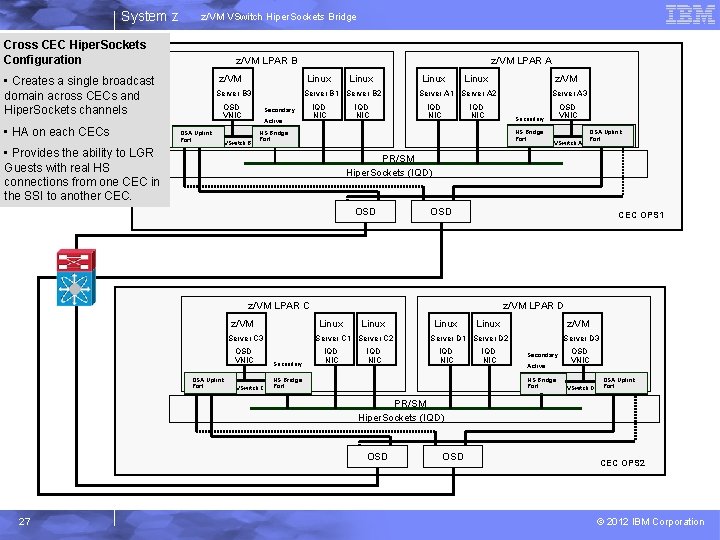
System z z/VM VSwitch Hiper. Sockets Bridge Cross CEC Hiper. Sockets Configuration z/VM LPAR B z/VM • Creates a single broadcast domain across CECs and Hiper. Sockets channels • HA on each CECs • Provides the ability to LGR Guests with real HS connections from one CEC in the SSI to another CEC. Linux Server B 3 Secondary Active VSwitch B Linux Server B 1 Server B 2 OSD VNIC OSA Uplink Port z/VM LPAR A IQD NIC Linux z/VM Server A 1 Server A 2 IQD NIC Server A 3 IQD NIC OSD VNIC Secondary HS Bridge Port VSwitch A OSA Uplink Port PR/SM Hiper. Sockets (IQD) OSD CEC OPS 1 z/VM LPAR C z/VM Linux Server C 3 OSA Uplink Port z/VM LPAR D Linux Server C 1 Server C 2 OSD VNIC Secondary VSwitch C HS Bridge Port IQD NIC Linux z/VM Server D 1 Server D 2 IQD NIC Server D 3 Secondary Active HS Bridge Port OSD VNIC VSwitch D OSA Uplink Port PR/SM Hiper. Sockets (IQD) OSD 27 OSD CEC OPS 2 © 2012 IBM Corporation

System z z/VM VSwitch Hiper. Sockets Bridge For more Information see the following z/VM 6. 2 documentation…. CP Commands and Utilities Reference SC 24 -6175 -03 Connectivity 28 SC 24 -6174 -03 © 2012 IBM Corporation
System z z/VM VSwitch Hiper. Sockets Bridge Backup Charts 29 © 2012 IBM Corporation

System z z/VM VSwitch Hiper. Sockets Bridge q vswitch vsw details VSWITCH SYSTEM VSW Type: QDIO Connected: 5 Maxconn: INFINITE PERSISTENT RESTRICTED ETHERNET Accounting: OFF USERBASED VLAN Unaware MAC address: 02 -00 -00 -0 A MAC Protection: Unspecified IPTimeout: 5 Queue. Storage: 8 Isolation Status: OFF Uplink Port: State: Ready PMTUD setting: EXTERNAL RDEV: 0500. P 01 VDEV: 0500 Controller: DTCVSW 2 Uplink Port Connection: RX Packets: 12 Discarded: 406 Errors: 0 TX Packets: 23 Discarded: 0 Errors: 0 RX Bytes: 888 TX Bytes: 1914 Device: 0500 Unit: 000 Role: DATA Port: 2049 Bridge Port: Role: Secondary Status: Active LPAR: BCT 2 State: Ready RDEV: F 000 VDEV: F 000 Controller: DTCVSW 1 Bridge Port Connection: MFS: 16 K Buffer Limit: 2048 In. Use: 0 Trace Pages: 8 RX Packets: 8 Discarded: 0 Errors: 0 TX Packets: 16809 Discarded: 0 Errors: 0 RX Bytes: 792 TX Bytes: 949486 Asynchronous Requests: 0 Unavailable Buffers: 0 Device: F 000 Unit: 000 Role: DATA Port: 2057 Hiper. Sockets Bridge Capable Ports: Connected: 3 ID: LINUX 1. F 012 Options: Ethernet Broadcast Unicast MAC Addresses: 06 -00 -F 0 -03 -00 -12 Multicast MAC Addresses: 01 -00 -5 E-00 -00 -01 01 -80 -C 2 -00 -00 -21 33 -33 -00 -00 -00 -01 33 -33 -FF-03 -00 -12 ID: LINUX 2. F 015 Options: Ethernet Broadcast Unicast MAC Addresses: 06 -00 -F 0 -03 -00 -15 Multicast MAC Addresses: 01 -00 -5 E-00 -00 -01 01 -80 -C 2 -00 -00 -51 33 -33 -00 -00 -00 -01 33 -33 -FF-03 -00 -15 30 Query VSwitch Details with an Active Bridge Port • Asynchronous Requests – A running count of the number of asynchronous requests serviced on the Bridge Port. • Buffer Limit – Displays the number of asynchronous requests that are allowed to be outstanding on the Bridge Port. 2048 pages have been allocated (default). • In. Use – A point in time display of the number of asynchronous requests waiting for replies from HS bridge capable guests. This counter is decremented when the outstanding asynchronous request completes. • Unavailable Buffers – A running counter of the number of synchronous requests that were discarded because there are no buffers for the asynchronous conversion. Essentially the buffer limit was exceeded. • Trace Pages – Displays the number of pages allocated for the internal trace table to keep track of trace events pertaining to the Bridge Port. 8 pages have been allocated (default) • Bridge Capable Ports – Network configuration data for guests being externally bridged by the z/VM VSwitch. © 2012 IBM Corporation
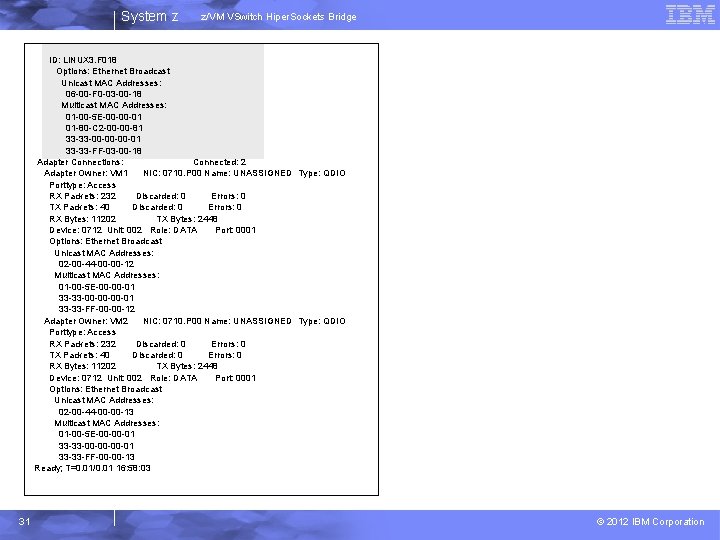
System z z/VM VSwitch Hiper. Sockets Bridge ID: LINUX 3. F 018 Options: Ethernet Broadcast Unicast MAC Addresses: 06 -00 -F 0 -03 -00 -18 Multicast MAC Addresses: 01 -00 -5 E-00 -00 -01 01 -80 -C 2 -00 -00 -81 33 -33 -00 -00 -00 -01 33 -33 -FF-03 -00 -18 Adapter Connections: Connected: 2 Adapter Owner: VM 1 NIC: 0710. P 00 Name: UNASSIGNED Type: QDIO Porttype: Access RX Packets: 232 Discarded: 0 Errors: 0 TX Packets: 40 Discarded: 0 Errors: 0 RX Bytes: 11202 TX Bytes: 2448 Device: 0712 Unit: 002 Role: DATA Port: 0001 Options: Ethernet Broadcast Unicast MAC Addresses: 02 -00 -44 -00 -00 -12 Multicast MAC Addresses: 01 -00 -5 E-00 -00 -01 33 -33 -00 -00 -00 -01 33 -33 -FF-00 -00 -12 Adapter Owner: VM 2 NIC: 0710. P 00 Name: UNASSIGNED Type: QDIO Porttype: Access RX Packets: 232 Discarded: 0 Errors: 0 TX Packets: 40 Discarded: 0 Errors: 0 RX Bytes: 11202 TX Bytes: 2448 Device: 0712 Unit: 002 Role: DATA Port: 0001 Options: Ethernet Broadcast Unicast MAC Addresses: 02 -00 -44 -00 -00 -13 Multicast MAC Addresses: 01 -00 -5 E-00 -00 -01 33 -33 -00 -00 -00 -01 33 -33 -FF-00 -00 -13 Ready; T=0. 01/0. 01 16: 58: 03 31 © 2012 IBM Corporation
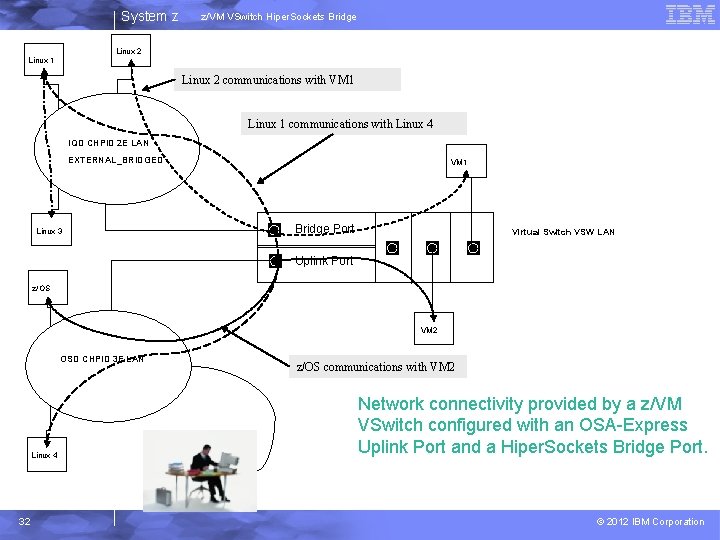
System z z/VM VSwitch Hiper. Sockets Bridge Linux 2 Linux 1 Linux 2 communications with VM 1 Linux 1 communications with Linux 4 IQD CHPID 2 E LAN EXTERNAL_BRIDGED Linux 3 VM 1 ◙ ◙ Bridge Port Uplink Port ◙ ◙ ◙ Virtual Switch VSW LAN z/OS VM 2 OSD CHPID 3 E LAN Linux 4 32 z/OS communications with VM 2 Network connectivity provided by a z/VM VSwitch configured with an OSA-Express Uplink Port and a Hiper. Sockets Bridge Port. © 2012 IBM Corporation
- Slides: 32