
Zooplankton Grazing Mechanisms and Impacts on Phytoplankton Amanda
- Slides: 28
Zooplankton Grazing Mechanisms and Impacts on Phytoplankton Amanda Lee Murby Field Limnology PBIO/ZOOL 719/819 FALL 2005
Grazing: Terrestrial n Consumption of a portion of a plant’s tissue is most often referred to as Grazing. Herbivores eat whole plants or parts of plants. n Functioning as a Predator = Consumption of entire plant. n Functioning as a Parasite = Consumption of tissue, but without killing plant. n n Terrestrial grazing usually applies to grasses and other herbaceous vegetation.
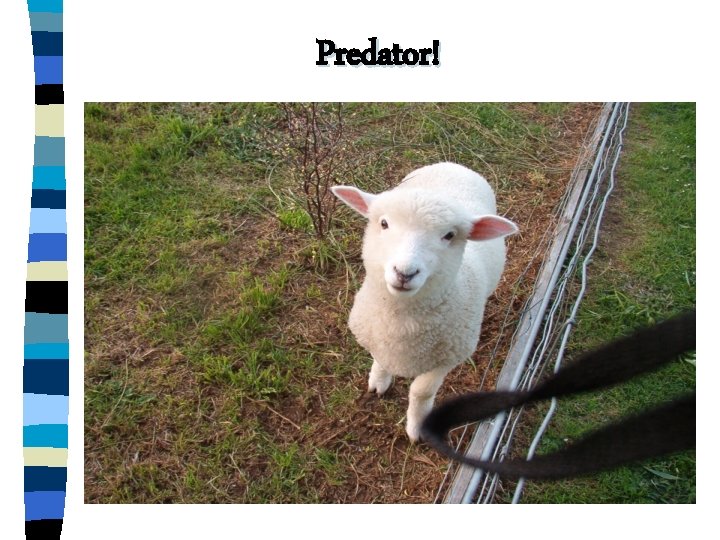
Predator!
Grazing: Aquatic (Plankton) n Grazing refers to the predator- prey interactions in water where algae and bacteria are the prey organisms. n Filtering is an example of grazing in the aquatic world; removal of algae or the portion of water volume that is (ideally) cleaned of particles. n Aquatic grazing usually applies to algae, bacteria, and other plankton.
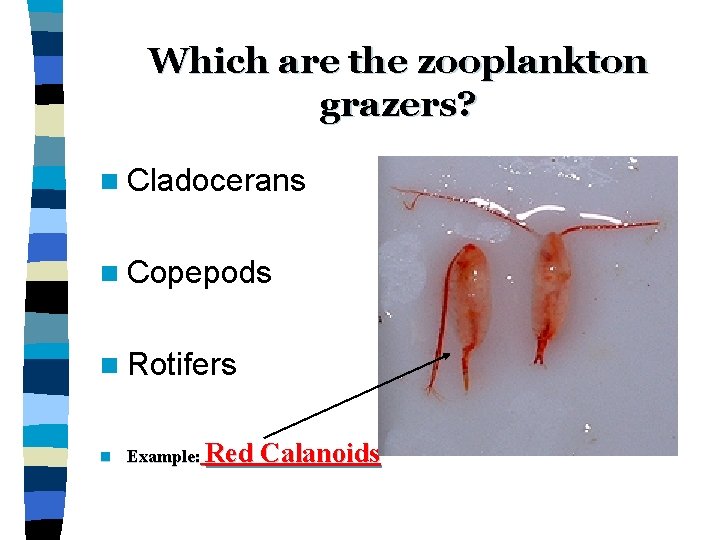
Which are the zooplankton grazers? n Cladocerans n Copepods n Rotifers n Example: Red Calanoids
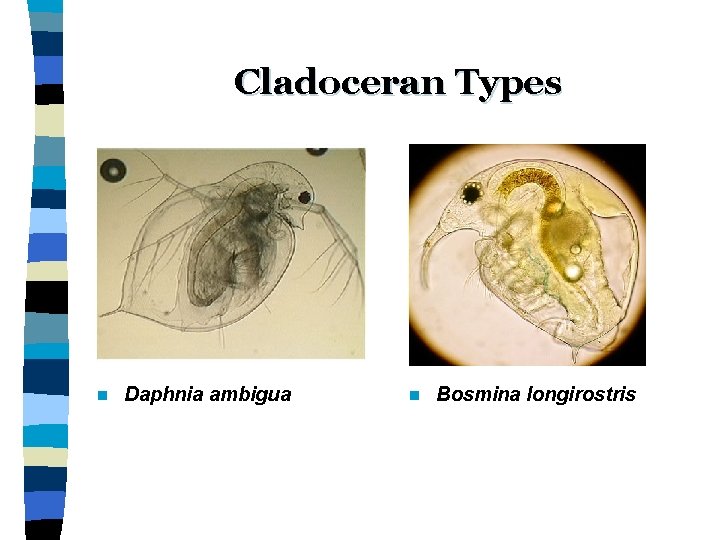
Cladoceran Types n Daphnia ambigua n Bosmina longirostris
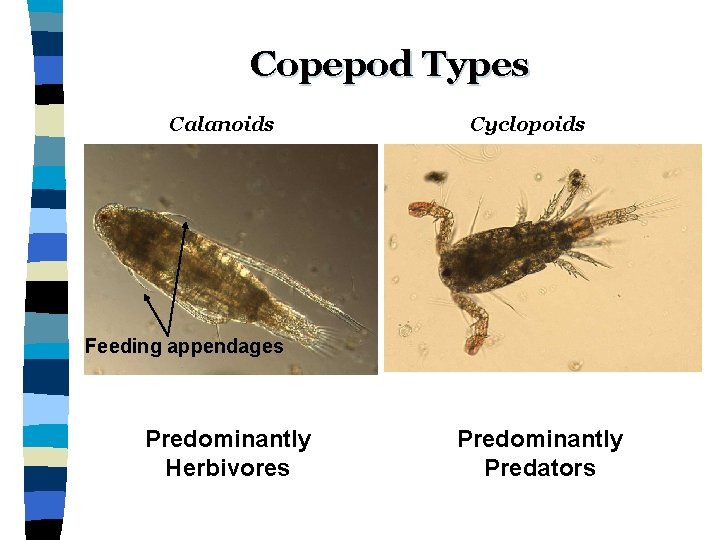
Copepod Types Calanoids Cyclopoids Feeding appendages Predominantly Herbivores Predominantly Predators
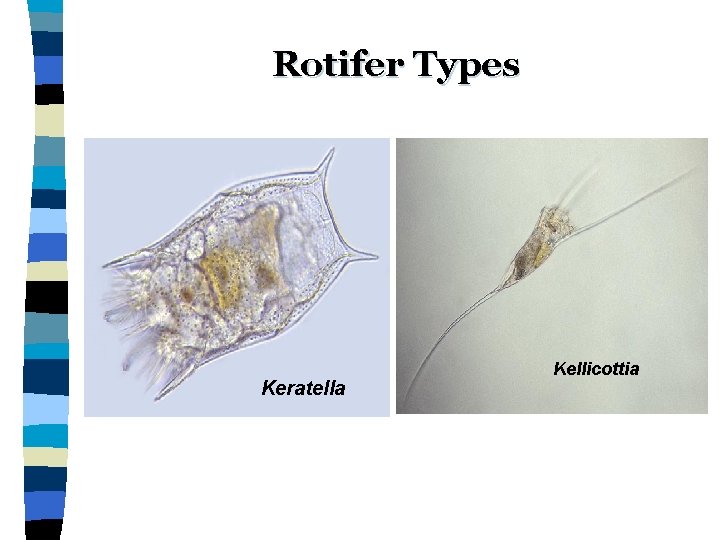
Rotifer Types Keratella Kellicottia
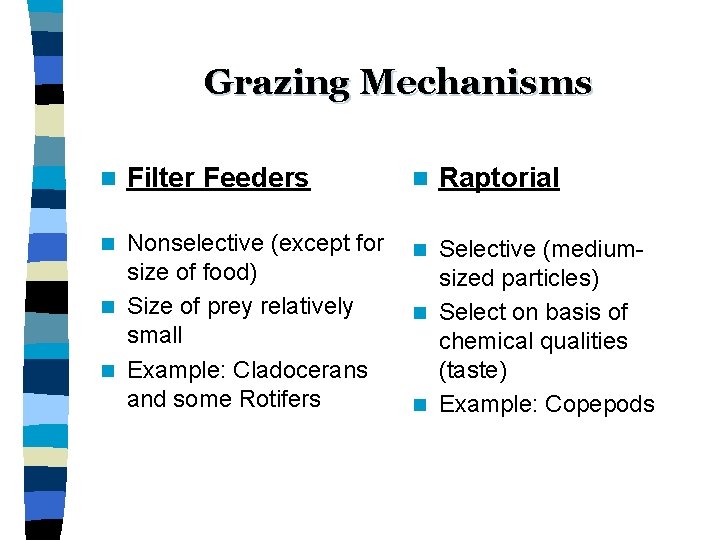
Grazing Mechanisms n Filter Feeders Nonselective (except for size of food) n Size of prey relatively small n Example: Cladocerans and some Rotifers n n Raptorial Selective (mediumsized particles) n Select on basis of chemical qualities (taste) n Example: Copepods n
Zooplankton do not eat all phytoplankton with the same efficiency… Many algae can avoid being eaten or digested.
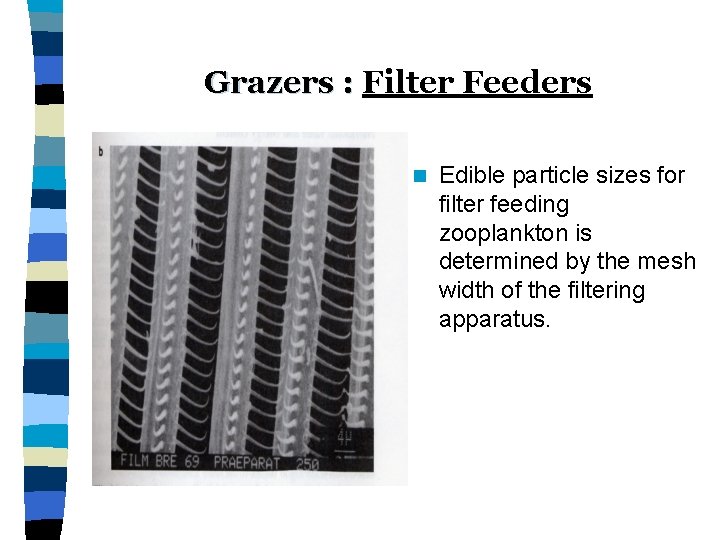
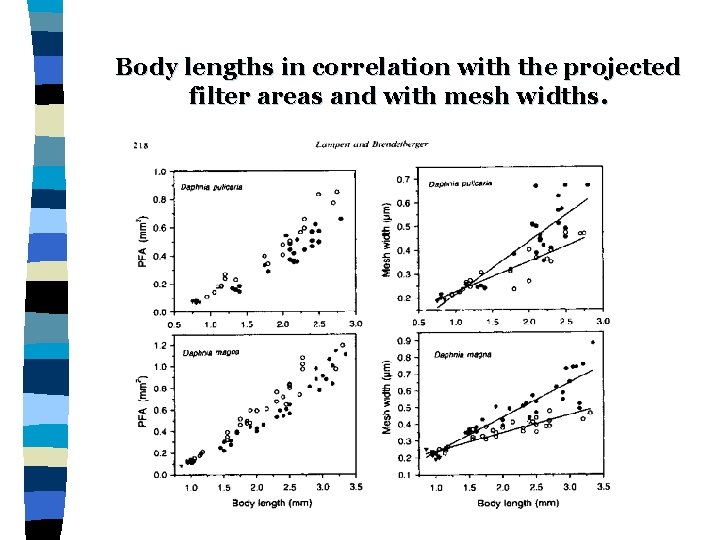
Grazers : Filter Feeders n Edible particle sizes for filter feeding zooplankton is determined by the mesh width of the filtering apparatus.
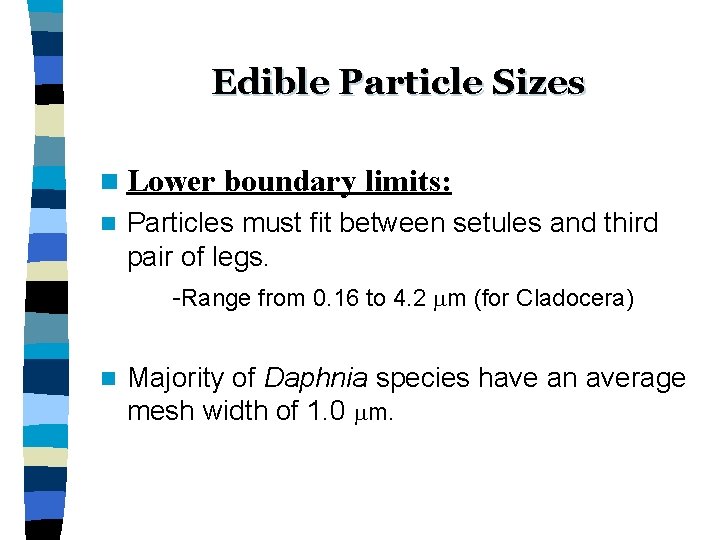
Edible Particle Sizes n Lower boundary limits: n Particles must fit between setules and third pair of legs. -Range from 0. 16 to 4. 2 mm (for Cladocera) n Majority of Daphnia species have an average mesh width of 1. 0 mm.
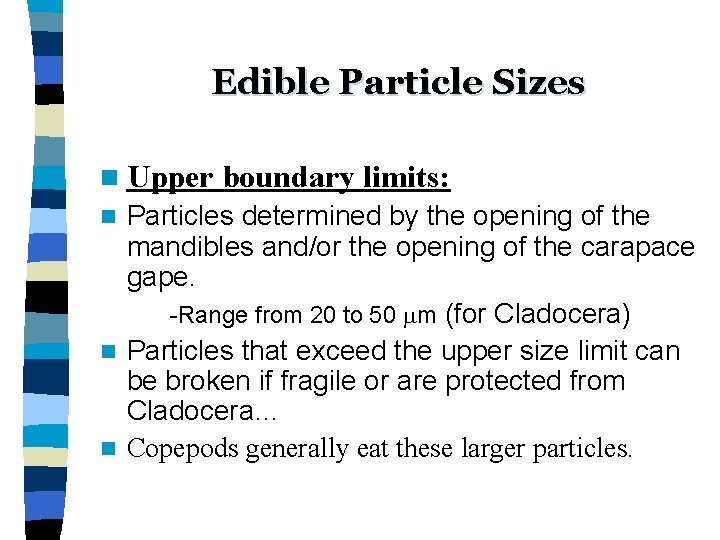
Edible Particle Sizes n Upper boundary limits: Particles determined by the opening of the mandibles and/or the opening of the carapace gape. -Range from 20 to 50 mm (for Cladocera) n Particles that exceed the upper size limit can be broken if fragile or are protected from Cladocera… n Copepods generally eat these larger particles. n
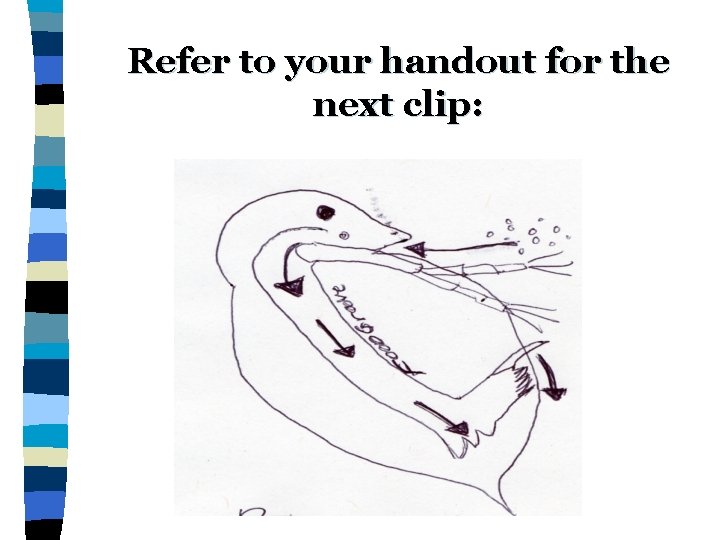
Refer to your handout for the next clip:
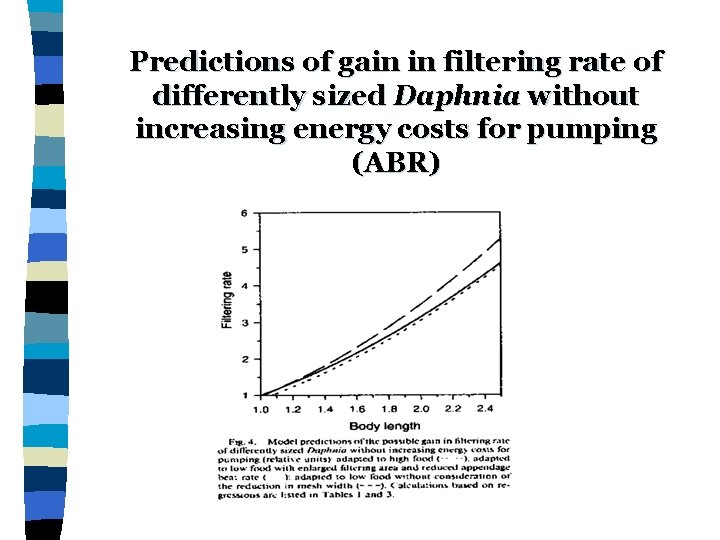
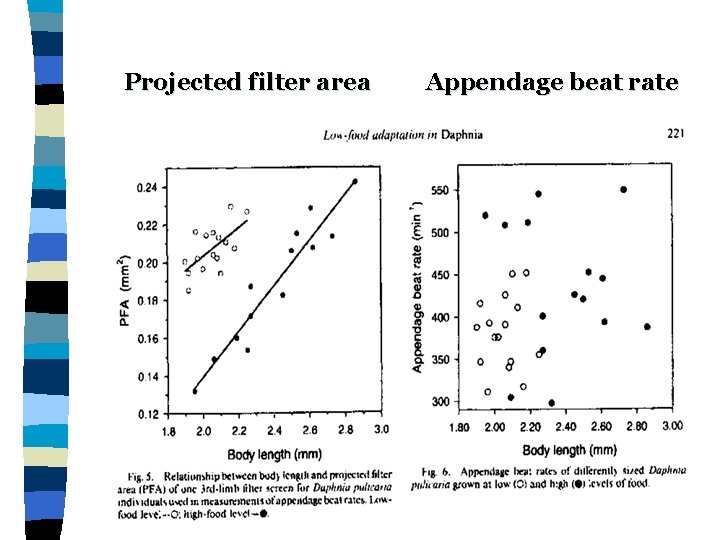
Strategies of Phenotypic Low Food Adaptations in Daphnia: Filter screens, mesh sizes, and appendage beat rates (ABR) W. Lampert & H. Brendelberger (1996)
Predictions of gain in filtering rate of differently sized Daphnia without increasing energy costs for pumping (ABR)
Projected filter area Appendage beat rate
Body lengths in correlation with the projected filter areas and with mesh widths.
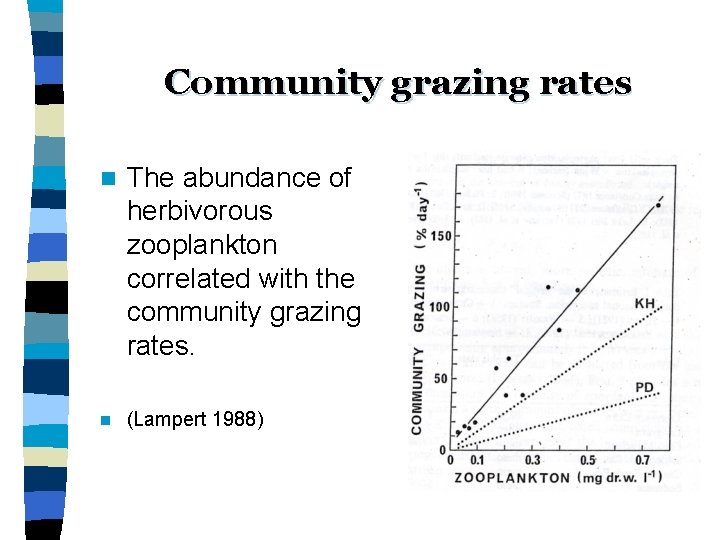
Community grazing rates n The abundance of herbivorous zooplankton correlated with the community grazing rates. n (Lampert 1988)
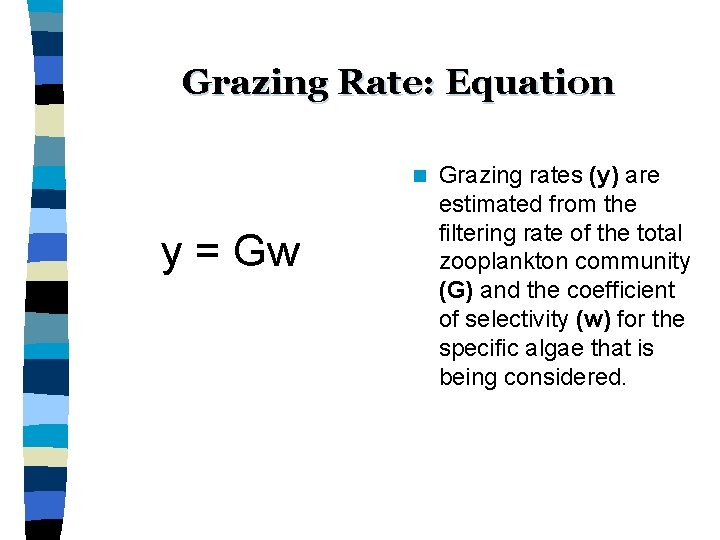
Grazing Rate: Equation n y = Gw Grazing rates (y) are estimated from the filtering rate of the total zooplankton community (G) and the coefficient of selectivity (w) for the specific algae that is being considered.
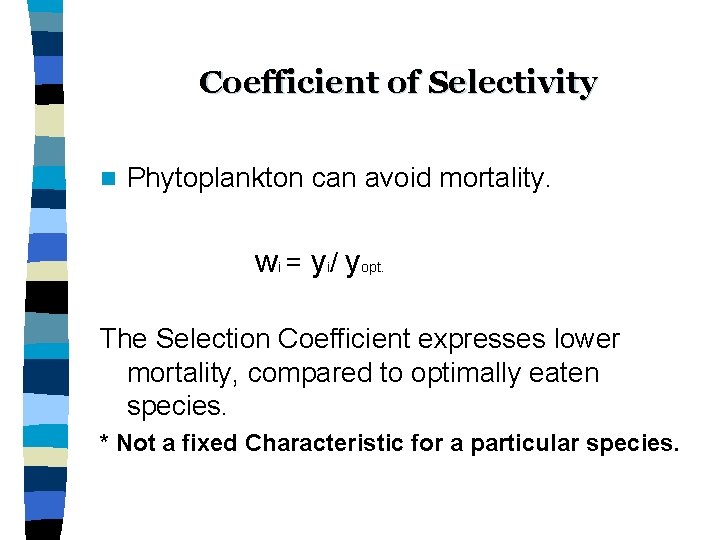
Coefficient of Selectivity n Phytoplankton can avoid mortality. wi = yi/ yopt . The Selection Coefficient expresses lower mortality, compared to optimally eaten species. * Not a fixed Characteristic for a particular species.
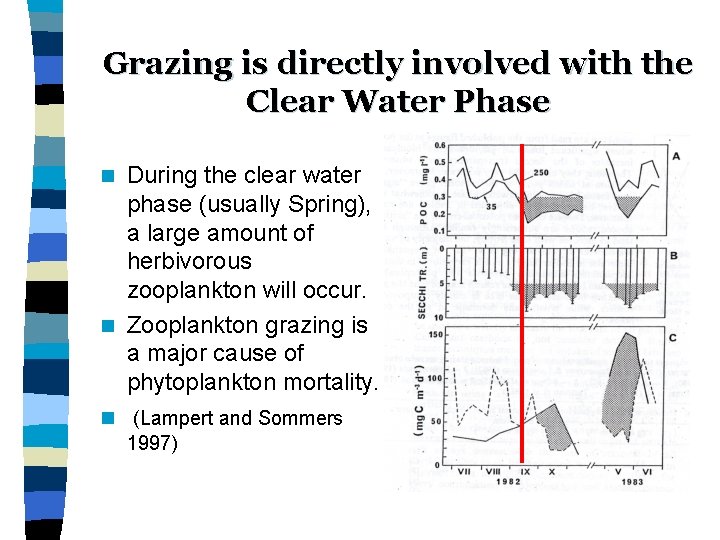
Clear Water Phase “Describes the very regular occurrence of a minimum density of phytoplankton in the middle of the growth period (North temperate latitudes usually in May-June). Most frequently in meso- and eutrophic lakes”. (Lampert and Sommers 1997)
Grazing is directly involved with the Clear Water Phase During the clear water phase (usually Spring), a large amount of herbivorous zooplankton will occur. n Zooplankton grazing is a major cause of phytoplankton mortality. n n (Lampert and Sommers 1997)
Summary Zooplankton grazing applies to the consumption of algae, bacteria, and other planktonic species. n Types: Cladocerans, Copepods, and Rotifers n Grazing mechanisms: Filter-feeder v. Raptorial n n Mesh widths and Edible Particles: upper & lower Filtrations rates correlate with body size n More food is collected at low particle concentrations (and is more efficient) by increasing maximum filtering rate by enlarging its filter screens than by increasing ABR. n n Community grazing rates and the coefficient of selectivity n Clear Water Phase and impacts on Phytoplankton mortality
References Lampert, Sommers. Limnoecology: The Ecology of Lakes and Streams. Oxford University Press. 1997 Ricklefs, R. E. The Economy of Nature (fifth Ed. ) WH Freeman and Company New York. 2001 Lampert, Brendelberger. “Strategies of Phenotypic Low Food Adaptation in Daphnia: Filter screens, mesh sizes, and appendage beat rates”. Limnology. Oceanography – 41(2), (1996): 216 -223. Lampert, Winfried. “The Relationship between Zooplankton Biomass and Grazing : A Review”. Limnology (Berlin) – 19(1), (1988): 11 -20.
Questions?