
Zoology an evolutionary perspective Standards and Essential Question







- Slides: 28
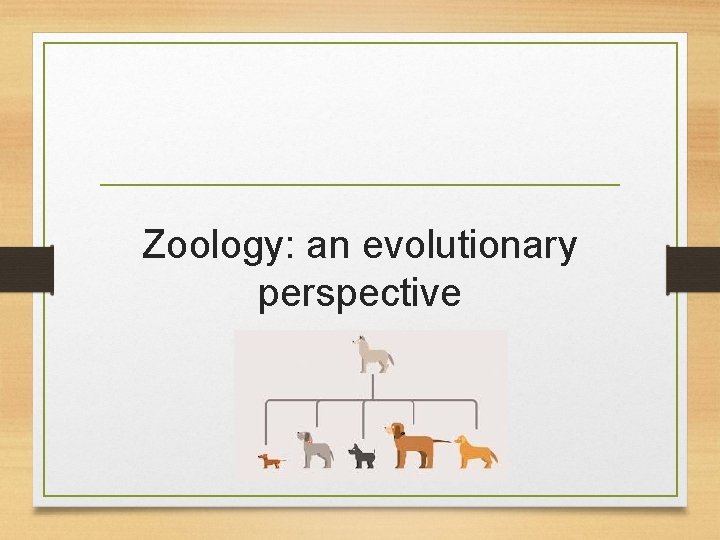
Zoology: an evolutionary perspective
Standards and Essential Question Standard • SZ 2 b. Explain the concepts evolution, adaptation, natural selection, convergence, and speciation. Essential Question • What makes evolution happen?
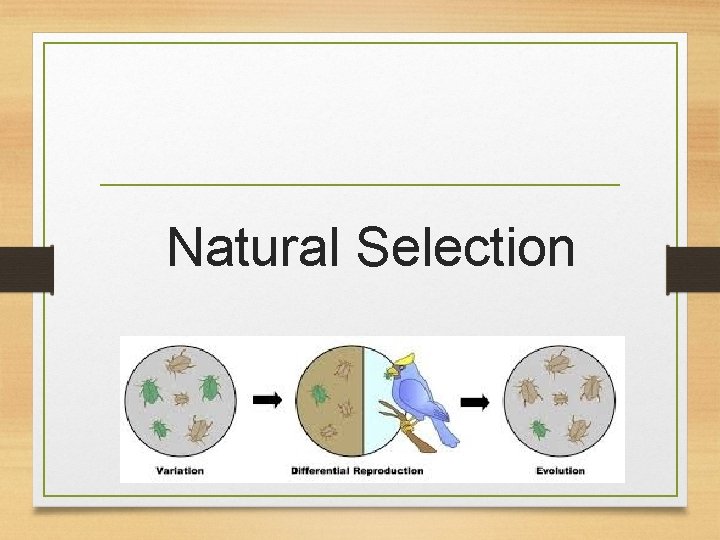
What does the word EVOLUTION mean? Organic Evolution • Change in the genetic makeup of populations of organisms over time. Why is it important? • Source of animal diversity • Explains family relationships within animal groups
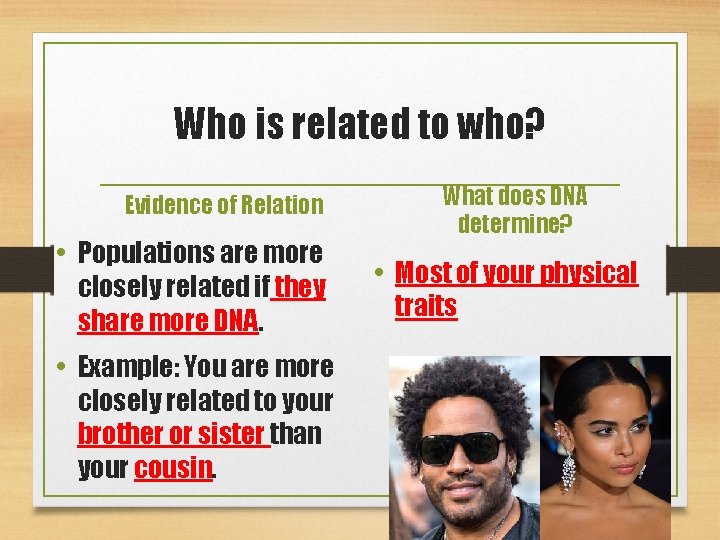
Who is related to who? Evidence of Relation • Populations are more closely related if they share more DNA. • Example: You are more closely related to your brother or sister than your cousin. What does DNA determine? • Most of your physical traits
History of evolution
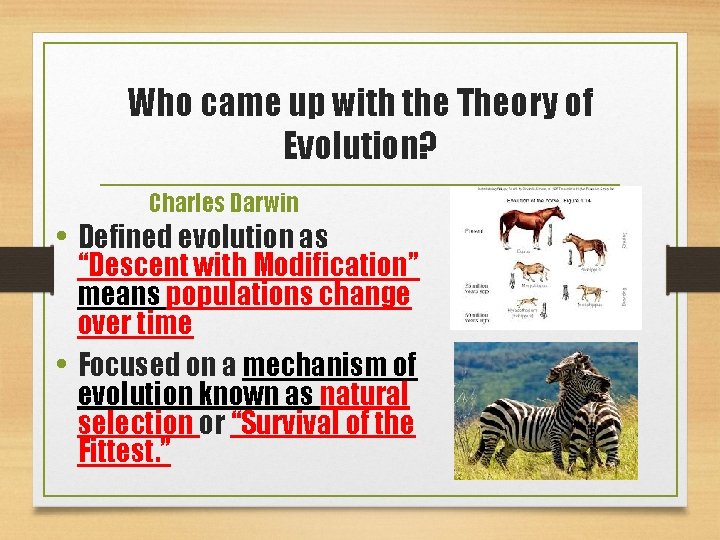
Who came up with the Theory of Evolution? Charles Darwin • Defined evolution as “Descent with Modification” means populations change over time • Focused on a mechanism of evolution known as natural selection or “Survival of the Fittest. ”
Greek Philosophers • Empedocles - Described concepts of change in living organisms over time. • Georges Buffon - Studied structural variations which he attributed environmental factors being responsible for the changes in organisms • Erasmus Darwin - Focused on questions of origin and change, he believed all organisms come from a common ancestor.
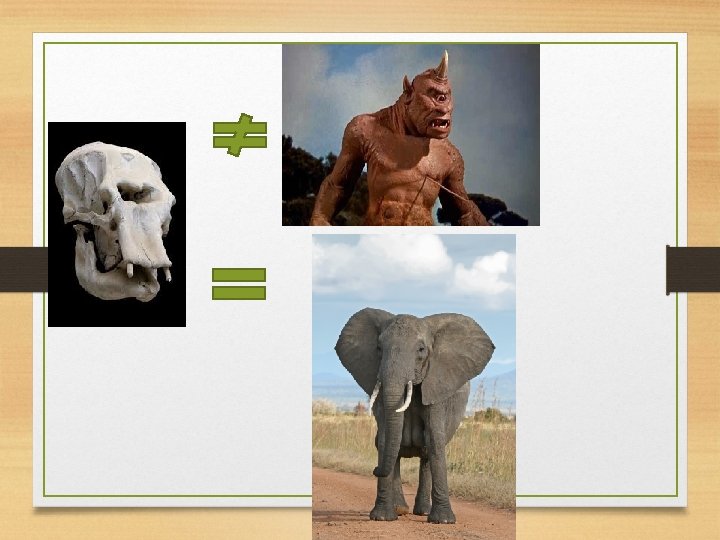
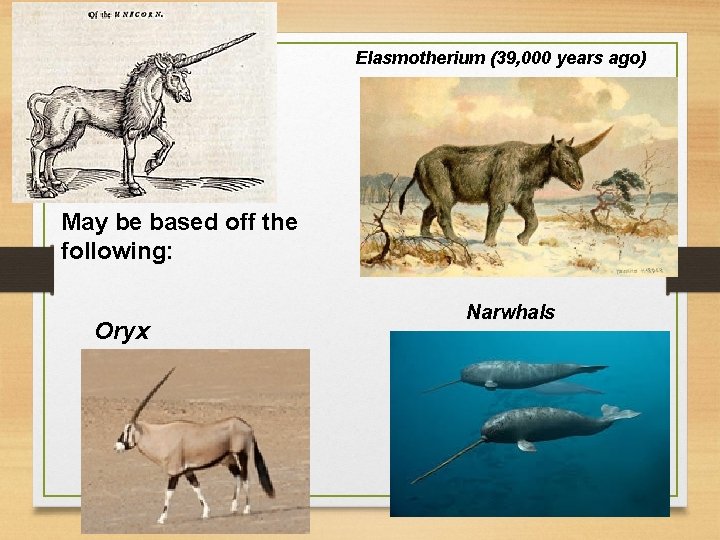
Elasmotherium (39, 000 years ago) May be based off the following: Oryx Narwhals
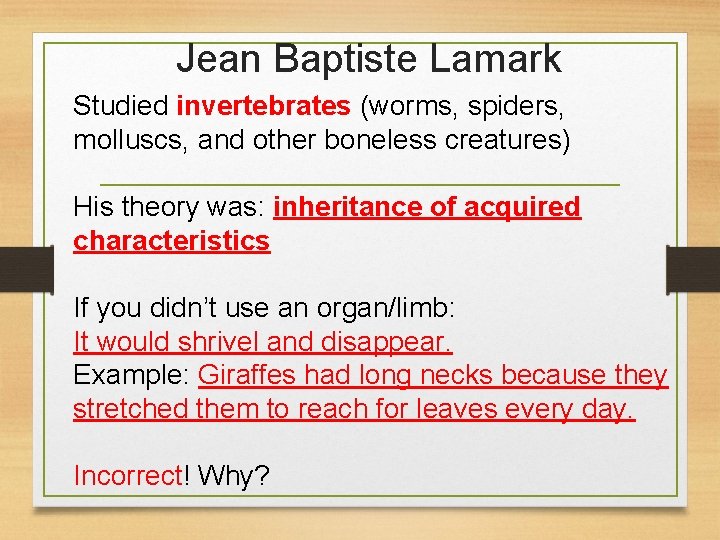
Jean Baptiste Lamark Studied invertebrates (worms, spiders, molluscs, and other boneless creatures) His theory was: inheritance of acquired characteristics If you didn’t use an organ/limb: It would shrivel and disappear. Example: Giraffes had long necks because they stretched them to reach for leaves every day. Incorrect! Why?
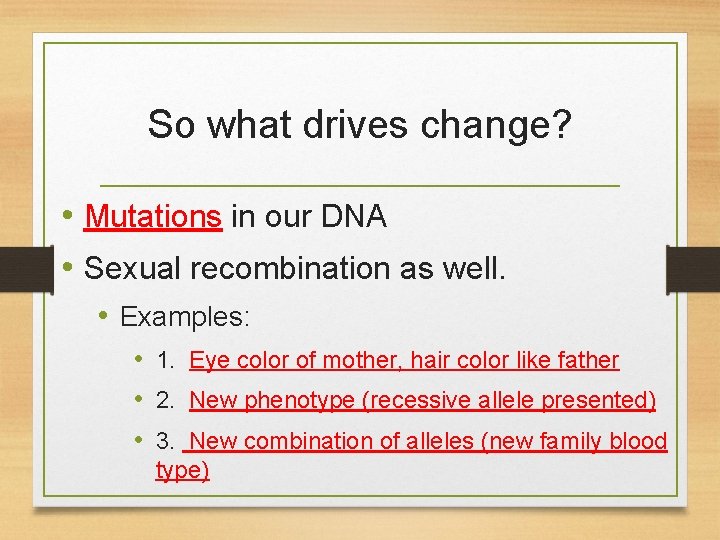
So what drives change? • Mutations in our DNA • Sexual recombination as well. • Examples: • 1. Eye color of mother, hair color like father • 2. New phenotype (recessive allele presented) • 3. New combination of alleles (new family blood type)
Charles Darwin
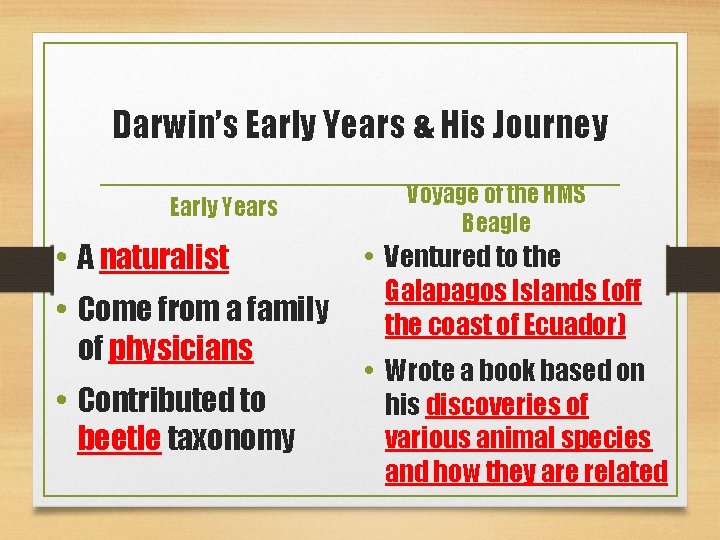
Darwin’s Early Years & His Journey Early Years Voyage of the HMS Beagle • Ventured to the • A naturalist Galapagos Islands (off • Come from a family the coast of Ecuador) of physicians • Contributed to beetle taxonomy • Wrote a book based on his discoveries of various animal species and how they are related
What did Darwin build on? • Lyell provided conclusive evidence for theory of uniformitarianism • • What shaped the earth instead of catastrophic events? Forces of Nature, rain, rivers, Erosion, and rock uplift What ideas did geology lead Darwin to? How old did Darwin initially think the Earth was? 300 Million Years old • Did he now think that the earth is younger or older than he initially thought? Older • If the face of the earth could be changed over time, couldn’t Organisms change over time?
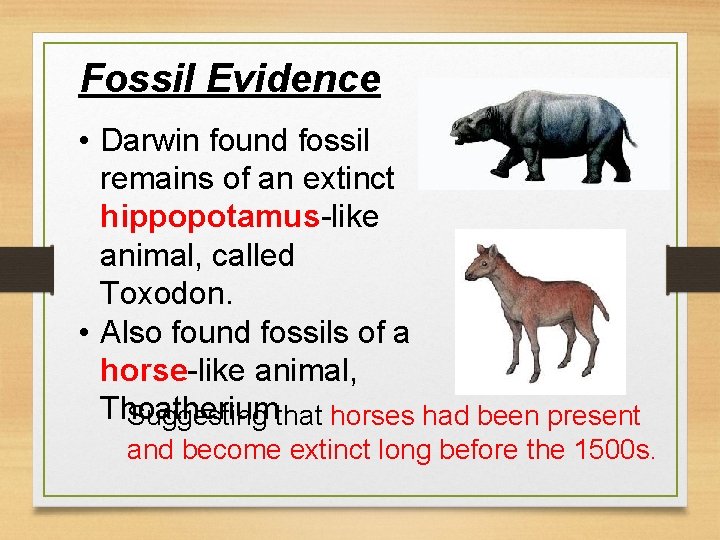
Fossil Evidence • Darwin found fossil remains of an extinct hippopotamus-like animal, called Toxodon. • Also found fossils of a horse-like animal, Thoatherium Suggesting that horses had been present and become extinct long before the 1500 s.
More Fossil Evidence • Darwin also found fossils of giant armadillos and giant sloths.
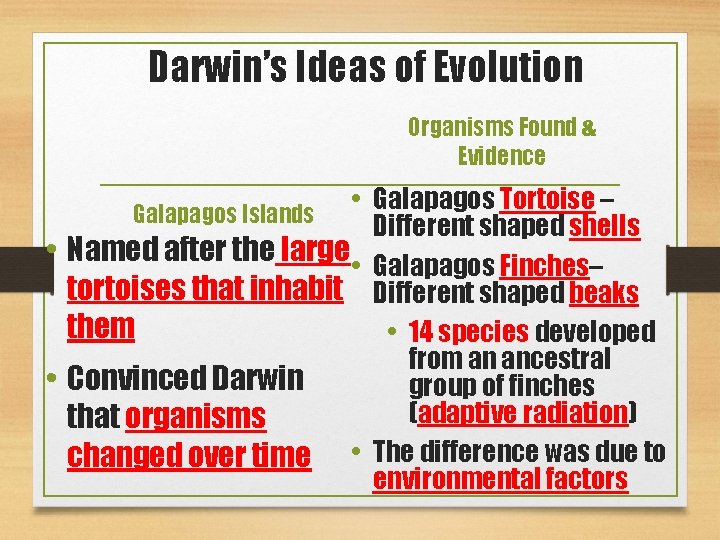
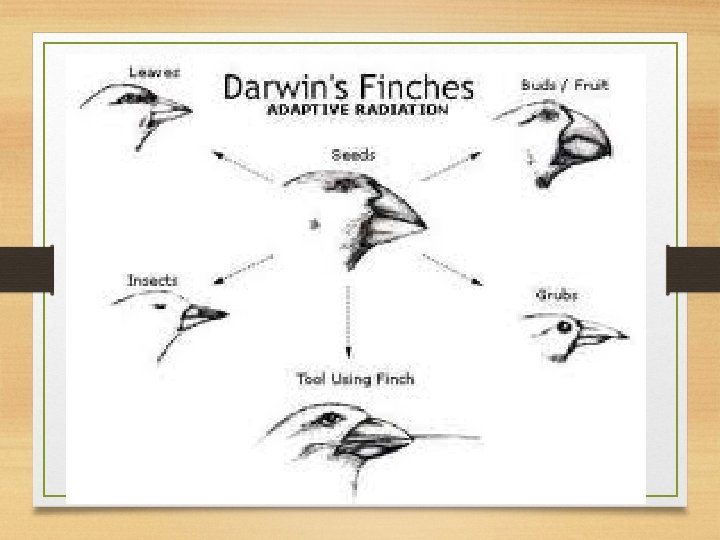
Darwin’s Ideas of Evolution Organisms Found & Evidence • • Galapagos Islands • Galapagos Tortoise – Different shaped shells Named after the large • Galapagos Finches– tortoises that inhabit Different shaped beaks them • 14 species developed from an ancestral Convinced Darwin group of finches (adaptive radiation) that organisms changed over time • The difference was due to environmental factors
Natural Selection
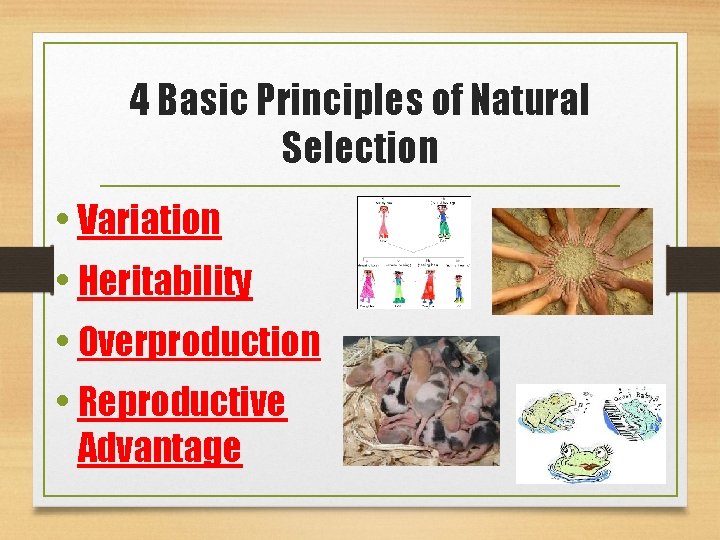
4 Basic Principles of Natural Selection • Variation • Heritability • Overproduction • Reproductive Advantage
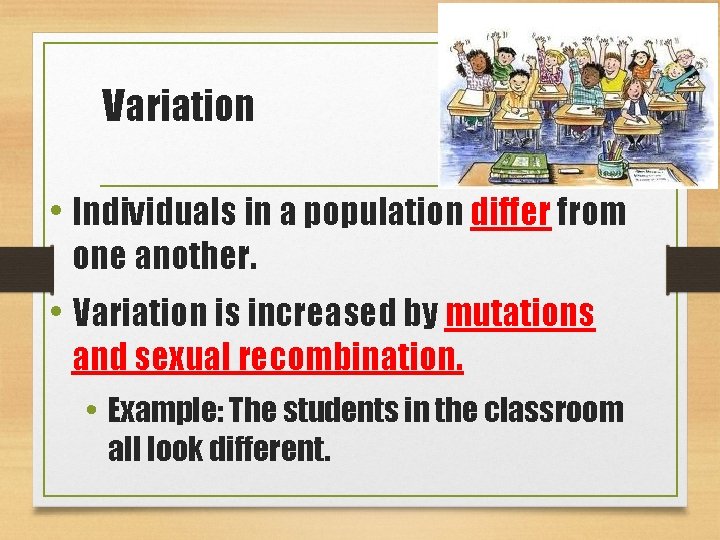
Variation • Individuals in a population differ from one another. • Variation is increased by mutations and sexual recombination. • Example: The students in the classroom all look different.
Heritability • Variations are inherited from parents. • Example: Will’s children inherited their light skin tone from their father. Inherited: derived (a quality, characteristic, or predisposition) genetically from one's parents or ancestors.
Overproduction • Populations produce more offspring than can survive. • Example: Rabbits produce many offspring at once. • Why is it beneficial for rabbits to overproduce?
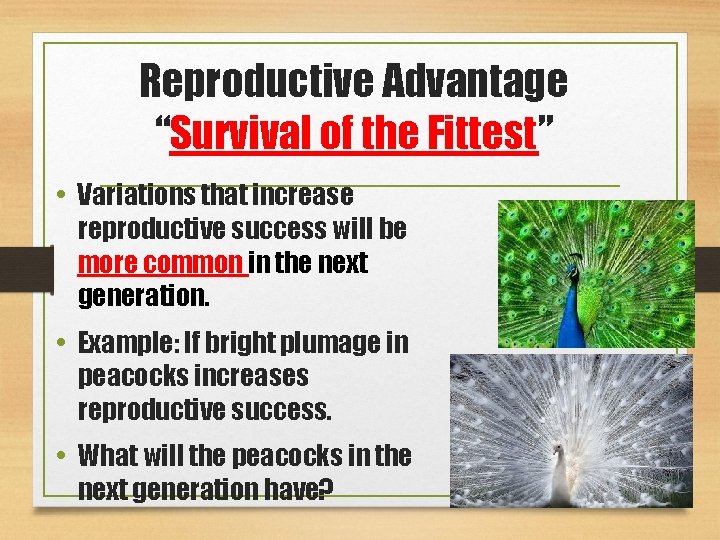
Reproductive Advantage “Survival of the Fittest” • Variations that increase reproductive success will be more common in the next generation. • Example: If bright plumage in peacocks increases reproductive success. • What will the peacocks in the next generation have?
Fitness • The ability to SURVIVE and REPRODUCE in a given environment. • Main concept behind Darwin’s theory of natural selection. • The “fittest” is not always the “strongest”
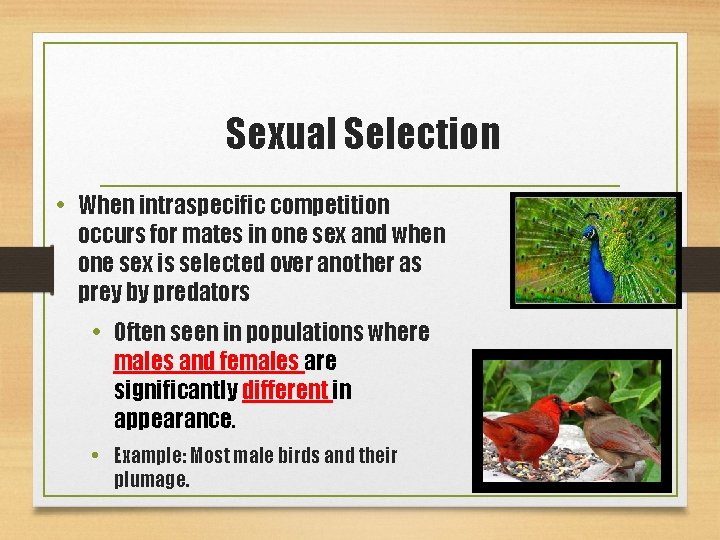
Sexual Selection • When intraspecific competition occurs for mates in one sex and when one sex is selected over another as prey by predators • Often seen in populations where males and females are significantly different in appearance. • Example: Most male birds and their plumage.