
Zoning Map District Approach Agenda Recap Brief Overview
Zoning Map & District Approach
Agenda Recap Brief Overview of Major Changes Discussion of District Formatting Discussion and Feedback on Districts, Standards Matrix Discussion of Heritage Based Zoning Downtown Mapping Exercise Other Business and Discussion
It’s Been A While Kicked off in 2018, basic introduction to what we were trying to accomplish Simpler code that is more user-friendly Code that is attentive to our historic core, opportunities along the Pennsy Discussed heritage-based zoning at a very high level Feedback that a code could improve mixed-use areas, sensitivity to the Downtown, housing design standards, and better prioritize density Bring the code in line with goals and maps from the Comprehensive Plan Fast forward a year or so…
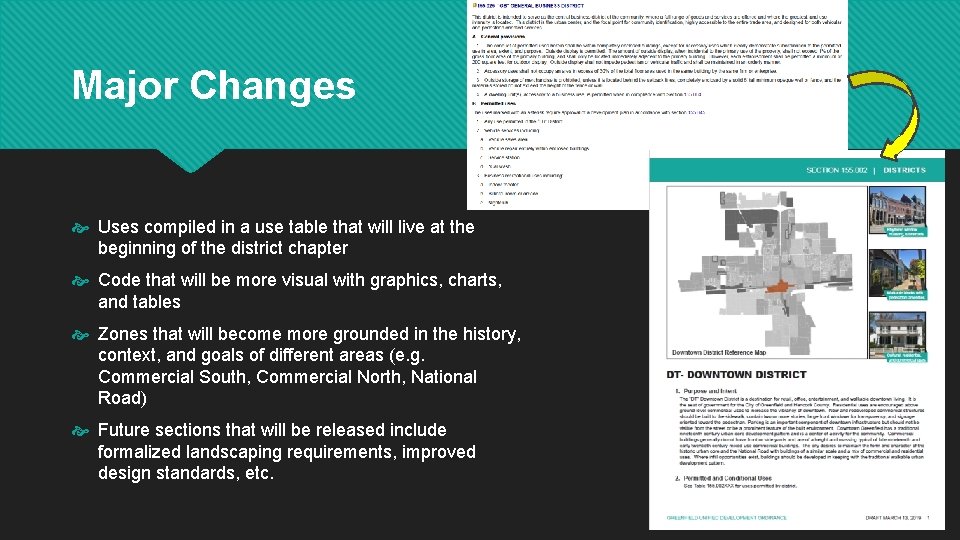
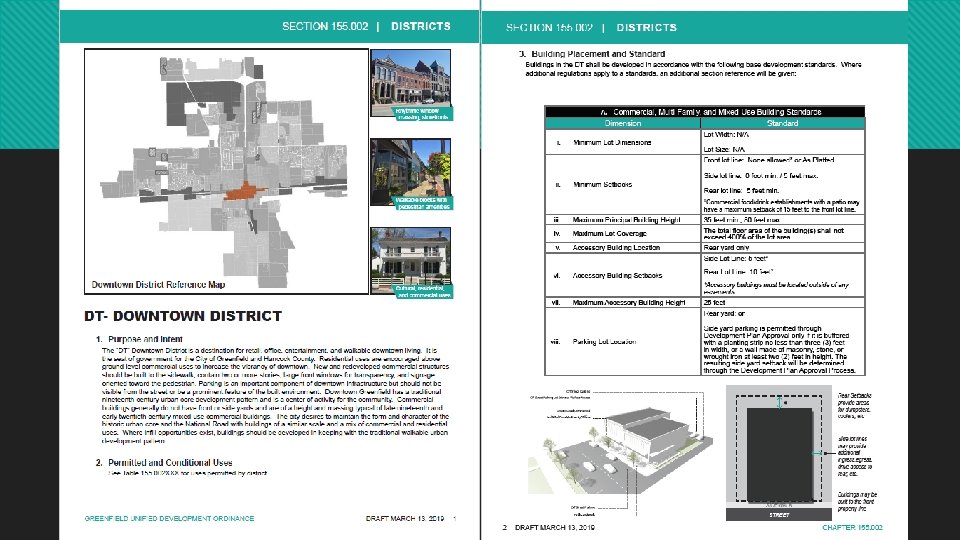
Major Changes Uses compiled in a use table that will live at the beginning of the district chapter Code that will be more visual with graphics, charts, and tables Zones that will become more grounded in the history, context, and goals of different areas (e. g. Commercial South, Commercial North, National Road) Future sections that will be released include formalized landscaping requirements, improved design standards, etc.
Feedback on Districts and Direction Thoughts to this point Notes from Review Do you feel that this will be an improvement from our current code?
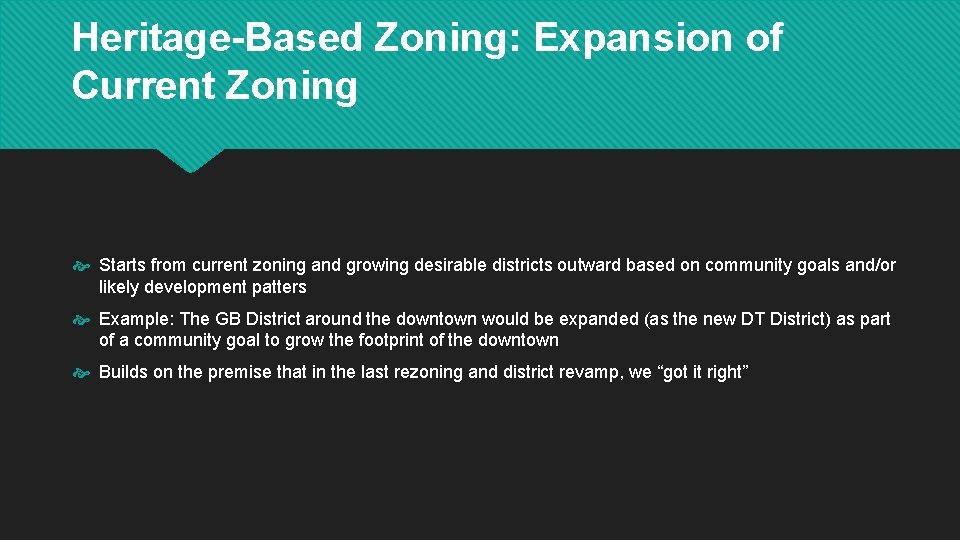
Heritage-Based Zoning: Expansion of Current Zoning Starts from current zoning and growing desirable districts outward based on community goals and/or likely development patters Example: The GB District around the downtown would be expanded (as the new DT District) as part of a community goal to grow the footprint of the downtown Builds on the premise that in the last rezoning and district revamp, we “got it right”
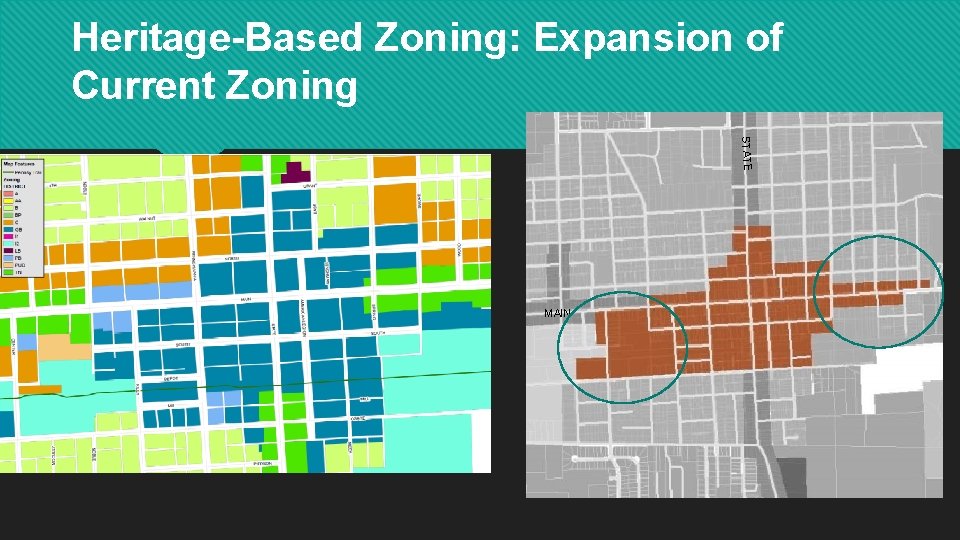
Heritage-Based Zoning: Expansion of Current Zoning STATE MAIN
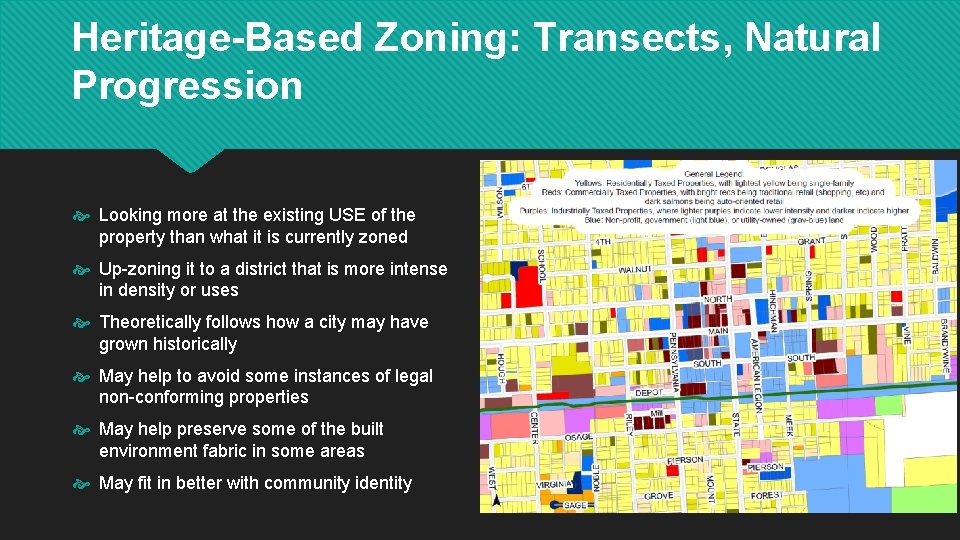
Heritage-Based Zoning: Transects, Natural Progression Looking more at the existing USE of the property than what it is currently zoned Up-zoning it to a district that is more intense in density or uses Theoretically follows how a city may have grown historically May help to avoid some instances of legal non-conforming properties May help preserve some of the built environment fabric in some areas May fit in better with community identity

Heritage-Based Zoning: Transects, Natural Progression
Feedback on Heritage Based Approaches and Mapping Exercise Map the Downtown District! What do you think the boundaries should be Use a red hatch pattern (bounding box with lines) on areas that you feel make up the core of the downtown Use a yellow hatch over areas that you feel could be in the downtown but are not sure Use a purple hatch over areas that you feel should definitely not be in the downtown

Heritage-Based Zoning: Transects, Natural Progression Example 1: This residential area would be legal non-conforming under the DT (similar to current conditions under GB) Zoning this instead to TN would allow for limited commercial uses such as professional offices to be created in existing residential structures This allows a more natural progression and evolution of the neighborhood as it transitions from residential to a commercial part of the walkable core
- Slides: 12