
Ziria Wireless Programming for Hardware Dummies Gordon Stewart

![Hardware Platforms FPGA: Programmer deals with hardware issues WARP, Airblue CPUs: SORA [MSR Asia],](https://slidetodoc.com/presentation_image_h2/8e820b2ec526b0c56cd4baabf754d0e6/image-4.jpg "Hardware Platforms FPGA: Programmer deals with hardware issues WARP, Airblue CPUs: SORA [MSR Asia],")



![Domain-specific optimizations (LUT) ? struct _init_lut { void operator()(uchar (&lut)[256][128]) { int i, j,](https://slidetodoc.com/presentation_image_h2/8e820b2ec526b0c56cd4baabf754d0e6/image-13.jpg "Domain-specific optimizations (LUT) ? struct _init_lut { void operator()(uchar (&lut)[256][128]) { int i, j,")


![Running example: Wi. Fi Scrambler let comp scrambler() = var scrmbl_st: arr[7] bit :](https://slidetodoc.com/presentation_image_h2/8e820b2ec526b0c56cd4baabf754d0e6/image-22.jpg "Running example: Wi. Fi Scrambler let comp scrambler() = var scrmbl_st: arr[7] bit :")
![Start defining computational method let comp scrambler() = var scrmbl_st: arr[7] bit : =](https://slidetodoc.com/presentation_image_h2/8e820b2ec526b0c56cd4baabf754d0e6/image-23.jpg "Start defining computational method let comp scrambler() = var scrmbl_st: arr[7] bit : =")
![let comp scrambler() = var scrmbl_st: arr[7] bit : = {'1, '1, '1, '1};](https://slidetodoc.com/presentation_image_h2/8e820b2ec526b0c56cd4baabf754d0e6/image-25.jpg "let comp scrambler() = var scrmbl_st: arr[7] bit : = {'1, '1, '1, '1};")
![let comp scrambler() = var scrmbl_st: arr[7] bit : = {'1, '1, '1, '1};](https://slidetodoc.com/presentation_image_h2/8e820b2ec526b0c56cd4baabf754d0e6/image-26.jpg "let comp scrambler() = var scrmbl_st: arr[7] bit : = {'1, '1, '1, '1};")
![let comp scrambler() = var scrmbl_st: arr[7] bit : = {'1, '1, '1, '1};](https://slidetodoc.com/presentation_image_h2/8e820b2ec526b0c56cd4baabf754d0e6/image-27.jpg "let comp scrambler() = var scrmbl_st: arr[7] bit : = {'1, '1, '1, '1};")


![Function Expression language - example let build_coeff(pcoeffs: arr[64] complex 16, ave: int 16, delta:](https://slidetodoc.com/presentation_image_h2/8e820b2ec526b0c56cd4baabf754d0e6/image-33.jpg "Function Expression language - example let build_coeff(pcoeffs: arr[64] complex 16, ave: int 16, delta:")



![LUT Optimizations (by example) let comp scrambler() = var scrmbl_st: arr[7] bit : =](https://slidetodoc.com/presentation_image_h2/8e820b2ec526b0c56cd4baabf754d0e6/image-42.jpg "LUT Optimizations (by example) let comp scrambler() = var scrmbl_st: arr[7] bit : =")


- Slides: 49
Ziria: Wireless Programming for Hardware Dummies Gordon Stewart (Princeton), Mahanth Gowda (UIUC), Geoff Mainland (Drexel), Cristina Luengo (UPC), Anton Ekblad (Chalmers) Božidar Radunović (MSR), Dimitrios Vytiniotis (MSR)
Layout Motivation Programming Language Compilation and Execution Platform Conclusions 2
Motivation Lots of innovation in PHY/MAC design Io. T, 5 G, distributed/massive MIMO, DSA/TVWS Popular experimental platform: USRP Relatively easy to program but slow, no real network deployment Modern wireless PHYs require high-rate DSP Real-time platforms [SORA, WARP, …] Achieve protocol processing requirements, difficult to program, no code portability, lots of low-level hand-tuning 3
Hardware Platforms FPGA: Programmer deals with hardware issues WARP, Airblue CPUs: SORA [MSR Asia], USRP SORA was a huge breakthrough, design of RX/TX with PCI interface, 16 Gbps throughput, ~ μs latency Very efficient C++ library We build on top of SORA Many other options now available: E. g. http: //myriadrf. org/ 4
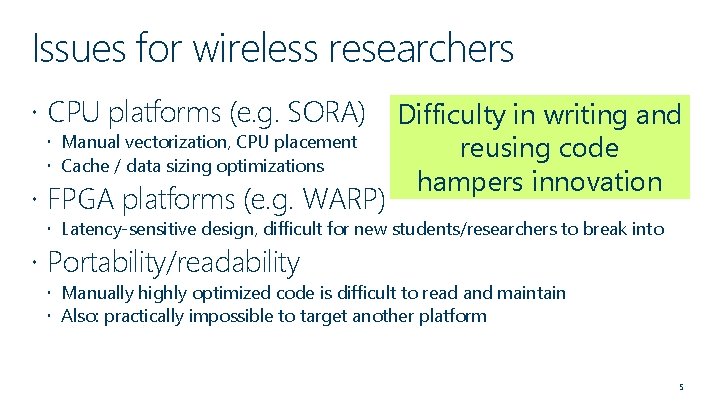
Issues for wireless researchers CPU platforms (e. g. SORA) Manual vectorization, CPU placement Cache / data sizing optimizations FPGA platforms (e. g. WARP) Difficulty in writing and reusing code hampers innovation Latency-sensitive design, difficult for new students/researchers to break into Portability/readability Manually highly optimized code is difficult to read and maintain Also: practically impossible to target another platform 5
What is wrong with current programming tools? 6
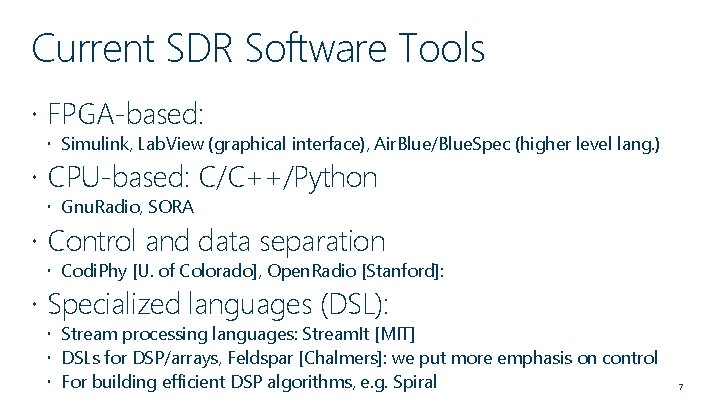
Current SDR Software Tools FPGA-based: Simulink, Lab. View (graphical interface), Air. Blue/Blue. Spec (higher level lang. ) CPU-based: C/C++/Python Gnu. Radio, SORA Control and data separation Codi. Phy [U. of Colorado], Open. Radio [Stanford]: Specialized languages (DSL): Stream processing languages: Stream. It [MIT] DSLs for DSP/arrays, Feldspar [Chalmers]: we put more emphasis on control For building efficient DSP algorithms, e. g. Spiral 7
So far, main focus on data flow PHY design is a sequence of signal processing Many efficient DSP tools and libraries available Volk, Sora, Spiral How to connect these blocks? LTE Example: Few basic building blocks (FFT/IFFT, Viterbi/Turbo decoder, vector operations) 400 pages describing how to connect these blocks This talk (and Ziria) focuses on composing signal processing blocks and expressing control flow 8
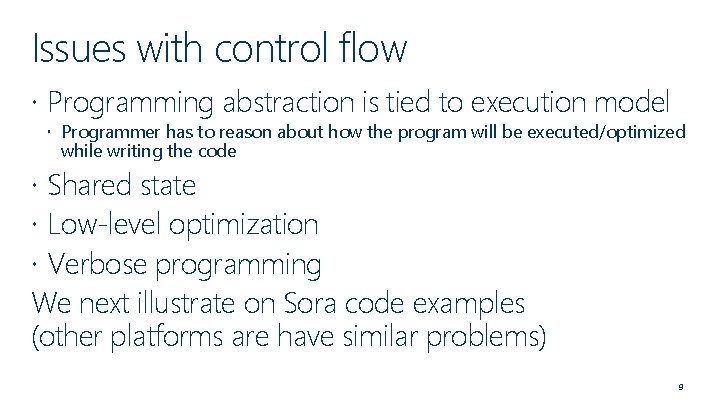
Issues with control flow Programming abstraction is tied to execution model Programmer has to reason about how the program will be executed/optimized while writing the code Shared state Low-level optimization Verbose programming We next illustrate on Sora code examples (other platforms are have similar problems) 9
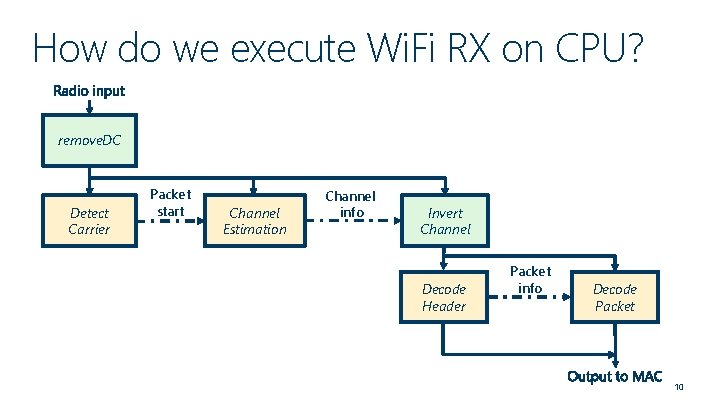
How do we execute Wi. Fi RX on CPU? remove. DC Detect Carrier Packet start Channel Estimation Channel info Invert Channel Decode Header Packet info Decode Packet 10
Limited code reusability Implicit assumptions on control flow: Sora: control encoded in state Gnu. Radio: control encoded in data stream Can vary across components Unclear data and control flow separation: Resetting whoever* is downstream *we don’t know who that is when we write this component 11
Shared state CREATE_BRICK_SINK CREATE_BRICK_FILTER CREATE_BRICK_FILTER CREATE_BRICK_SINK CREATE_BRICK_FILTER CREATE_BRICK_DEMUX 5 CREATE_BRICK_FILTER CREATE_BRICK_FILTER Shared state CREATE_BRICK_FILTER 12
Domain-specific optimizations (LUT) ? struct _init_lut { void operator()(uchar (&lut)[256][128]) { int i, j, k; uchar x, s, o; for ( i=0; i<256; i++) { for ( j=0; j<128; j++) { x = (uchar)i; s = (uchar)j; o = 0; for ( k=0; k<8; k++) { uchar o 1 = (x ^ (s) ^ (s >> 3)) & 0 x 01; s = (s >> 1) | (o 1 << 6); o = (o >> 1) | (o 1 << 7); x = x >> 1; } lut [i][j] = o; } } 13
Verbosity - Host language is not specialized, so often verbose - Hinders fast prototyping - Scrambler: 90 lines in Sora (C++), 20 lines in Ziria 14
My Own Frustrations Implemented several PHY algorithms in FPGA Never been able to reuse them: Complexity of interfacing (timing and precision) was higher than rewriting! Implemented several PHY algorithms in Sora Better reuse but still difficult Spent 2 h figuring out which internal state variable I haven’t initialized when borrowed a piece of code from other project. We need tools to allow us to write reusable code and incrementally build ever more complex systems! 15
Our plan for improving this situation New wireless programming platform 1. 2. 3. Code written in a high-level domain-specific language that allows fast prototyping and code reuse Compiler deals with low-level code optimization and produces code that satisfies timing requirements of modern PHYs Same code compiles on different platforms (not there just yet!) Challenges 1. 2. Design PL abstractions that are intuitive and expressive Design efficient compilation schemes (to multiple platforms) 16
Why (New) Domain Specific Language? Benefits of language: Language design captures specifics of the task This enables compiler to optimize better What is special about wireless 1. … that affects abstractions: large degree of separation b/w data and control Data processing elements: FFT/IFFT, Coding/Decoding, Scrambling/Descrambling Predictable execution and performance, independent of data Control flow elements: Header processing, rate adaptation 2. … that affects compilation: need high-throughput stream processing Need to process millions of samples per second 17
Layout Motivation Programming Language Compilation and Execution Platform Conclusions 18
Ziria: A 2 -layer design Lower layer Imperative C-like code for manipulating bits, bytes, arrays, etc. NB: You can plug-in any C function in this layer Higher layer A monadic language for specifying and staging stream processors Enforces clean separation between control and data flow, clean state semantics Runtime implements low-level execution model Monadic pipeline staging language facilitates aggressive compiler optimizations 19
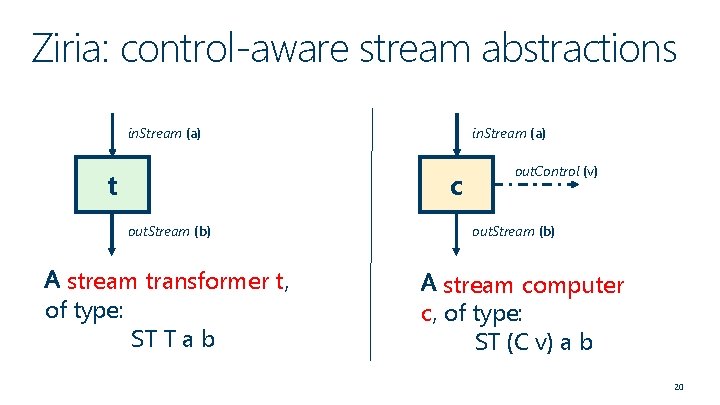
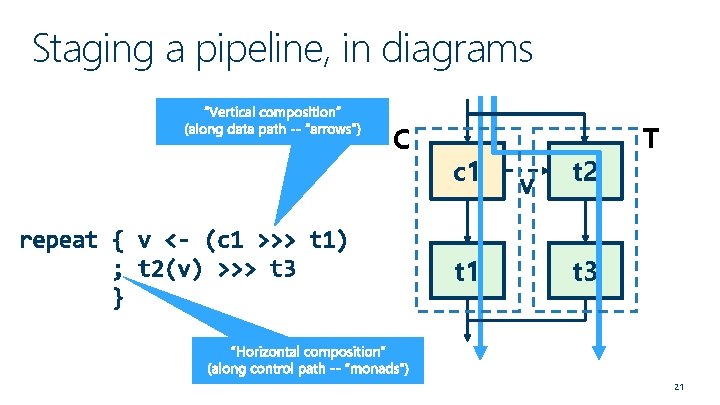
Ziria: control-aware stream abstractions in. Stream (a) t in. Stream (a) c out. Stream (b) stream transformer t, of type: ST T a b out. Control (v) out. Stream (b) stream computer c, of type: ST (C v) a b 20
Staging a pipeline, in diagrams C c 1 t 2 t 1 t 3 T 21
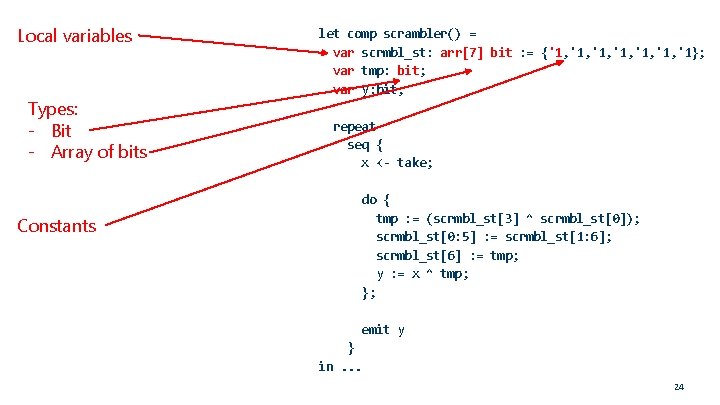
Running example: Wi. Fi Scrambler let comp scrambler() = var scrmbl_st: arr[7] bit : = {'1, '1, '1, '1}; var tmp: bit; var y: bit; repeat seq { x <- take; do { tmp : = (scrmbl_st[3] ^ scrmbl_st[0]); scrmbl_st[0: 5] : = scrmbl_st[1: 6]; scrmbl_st[6] : = tmp; y : = x ^ tmp; }; emit y } in. . . 22
Start defining computational method let comp scrambler() = var scrmbl_st: arr[7] bit : = {'1, '1, '1, '1}; var tmp: bit; var y: bit; repeat seq { x <- take; do { tmp : = (scrmbl_st[3] ^ scrmbl_st[0]); scrmbl_st[0: 5] : = scrmbl_st[1: 6]; scrmbl_st[6] : = tmp; y : = x ^ tmp; }; emit y End defining computational method } in <rest of the code> 23
Local variables Types: - Bit - Array of bits Constants let comp scrambler() = var scrmbl_st: arr[7] bit : = {'1, '1, '1, '1}; var tmp: bit; var y: bit; repeat seq { x <- take; do { tmp : = (scrmbl_st[3] ^ scrmbl_st[0]); scrmbl_st[0: 5] : = scrmbl_st[1: 6]; scrmbl_st[6] : = tmp; y : = x ^ tmp; }; emit y } in. . . 24
let comp scrambler() = var scrmbl_st: arr[7] bit : = {'1, '1, '1, '1}; var tmp: bit; var y: bit; Special-purpose computers: repeat seq { x <- take; do { tmp : = (scrmbl_st[3] ^ scrmbl_st[0]); scrmbl_st[0: 5] : = scrmbl_st[1: 6]; scrmbl_st[6] : = tmp; y : = x ^ tmp; }; emit y } in. . . 25
let comp scrambler() = var scrmbl_st: arr[7] bit : = {'1, '1, '1, '1}; var tmp: bit; var y: bit; repeat seq { x <- take; Imperative (C/Matlab-like) code: do { tmp : = (scrmbl_st[3] ^ scrmbl_st[0]); scrmbl_st[0: 5] : = scrmbl_st[1: 6]; scrmbl_st[6] : = tmp; y : = x ^ tmp; }; emit y } in. . . 26
let comp scrambler() = var scrmbl_st: arr[7] bit : = {'1, '1, '1, '1}; var tmp: bit; var y: bit; repeat take x do y emit Computers and transformers repeat seq { x <- take; do { tmp : = (scrmbl_st[3] ^ scrmbl_st[0]); scrmbl_st[0: 5] : = scrmbl_st[1: 6]; scrmbl_st[6] : = tmp; y : = x ^ tmp; }; emit y } in. . . 27
Whole program read >>> do_something >>> write Reads and writes can come from RF, IP, file, dummy 28
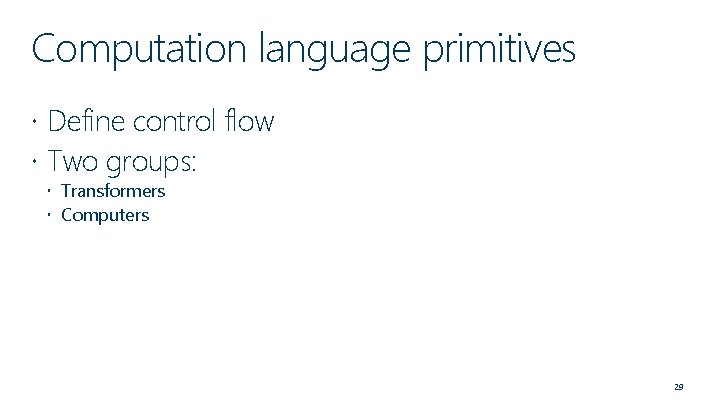
Computation language primitives Define control flow Two groups: Transformers Computers 29
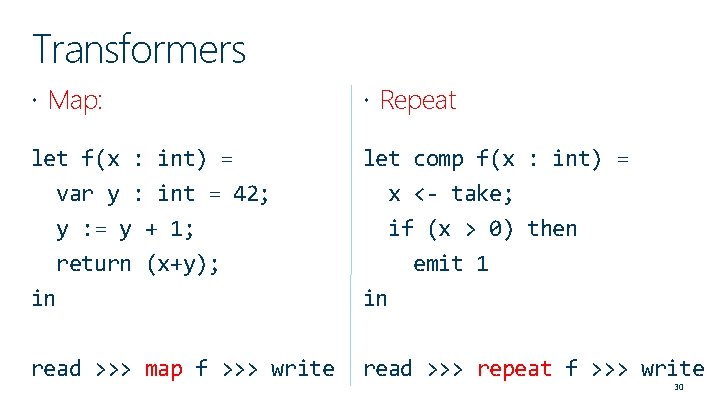
Transformers Map: Repeat let f(x : int) = var y : int = 42; y : = y + 1; return (x+y); in let comp f(x : int) = x <- take; if (x > 0) then emit 1 in read >>> map f >>> write read >>> repeat f >>> write 30
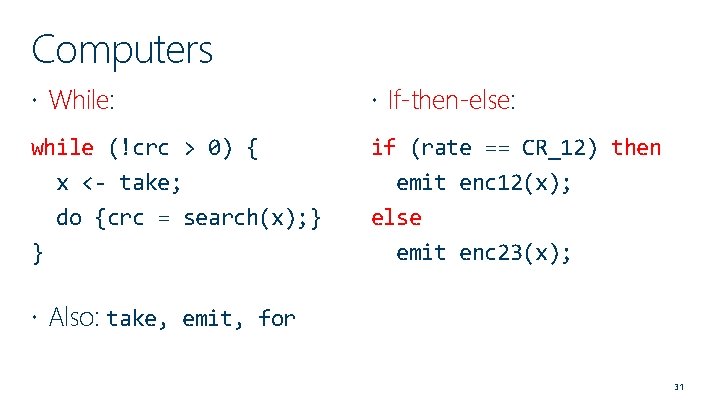
Computers While: If-then-else: while (!crc > 0) { x <- take; do {crc = search(x); } } if (rate == CR_12) then emit enc 12(x); else emit enc 23(x); Also: take, emit, for 31
Putting it all together – Wi. Fi receiver let comp Decode(h : struct Header. Info) = Demap. Limit(0) >>> let comp receiver() = seq { det <- detect. STS() (if (h. modulation == M_BPSK) then ; params <- LTS(det. shift) Demap. BPSK() >>> Deinterleave. BPSK() ; Data. Symbol(det. shift) >>> else if (h. modulation == M_QPSK) then FFT() >>> Demap. QPSK() >>> Deinterleave. QPSK() Channel. Equalization(params) >>> else. . . ) -- QAM 16, QAM 64 cases Pilot. Track() >>> Viterbi(h. coding, h. len*8 + 8) Get. Data() >>> scrambler() receive. Bits() } in let comp detect. STS() = remove. DC() >>> cca() in read >>> repeat{ receiver() } >>> write in let comp receive. Bits() = seq { h <- Decode. PLCP() ; Decode(h) >>> check_crc(h. len) } in 32
Function Expression language - example let build_coeff(pcoeffs: arr[64] complex 16, ave: int 16, delta: int 16) = var th: int 16; Array (equivalent to [64 -26: 64]) th : = ave - delta * 26; for i in [64 -26, 26] Fixed-point complex numbers { pcoeffs[i] : = complex 16{re=cos_int 16(th); im=-sin_int 16(th)}; th : = th + delta }; External C function th : = th + delta; for i in [1, 26] { pcoeffs[i] : = complex 16{re=cos_int 16(th); im=-sin_int 16(th)}; th : = th + delta } in 33
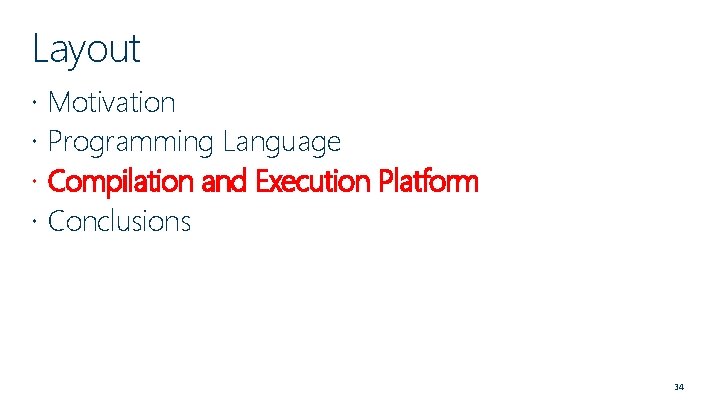
Layout Motivation Programming Language Compilation and Execution Platform Conclusions 34
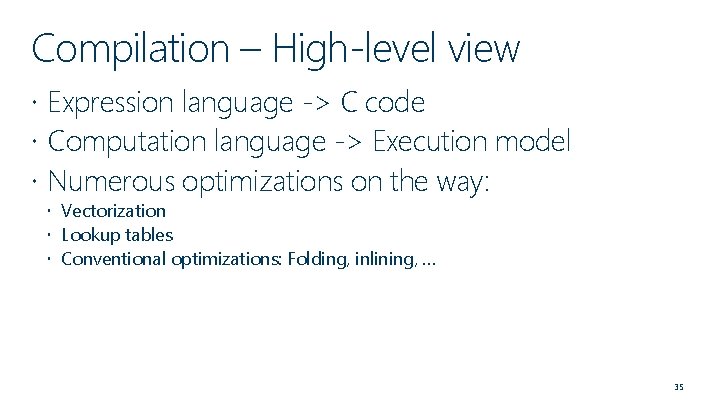
Compilation – High-level view Expression language -> C code Computation language -> Execution model Numerous optimizations on the way: Vectorization Lookup tables Conventional optimizations: Folding, inlining, … 35
Execution model: How to execute code? remove. DC Detect Carrier Packet start Channel Estimation Channel info Invert Channel Decode Header Packet info Decode Packet 36
Runtime Actions: tick() B 1 Return values: YIELD (data_val) process(x) SKIP process(x) tick() B 2 DONE (control_val) Q: Why do we need ticks? A: Example: emit 1; emit 2; emit 3
How about performance? let comp test 1() = repeat{ (x: int) <- take; emit x + 1; } in read[int] >>> test 1() >>> write[int] (((read >>> let auto_map_6(x: int 32) = x + 1 in {map auto_map_6}) >>> let auto_map_7(x: int 32) = x + 1 in {map auto_map_7}) >>> write) buf_getint 32(pbuf_ctx, &__yv_tmp_ln 10_7_buf); __yv_tmp_ln 11_5_buf = auto_map_6_ln 2_9(__yv_tmp_ln 10_7_buf); __yv_tmp_ln 12_3_buf = auto_map_7_ln 2_10(__yv_tmp_ln 11_5_buf); buf_putint 32(pbuf_ctx, __yv_tmp_ln 12_3_buf); 38
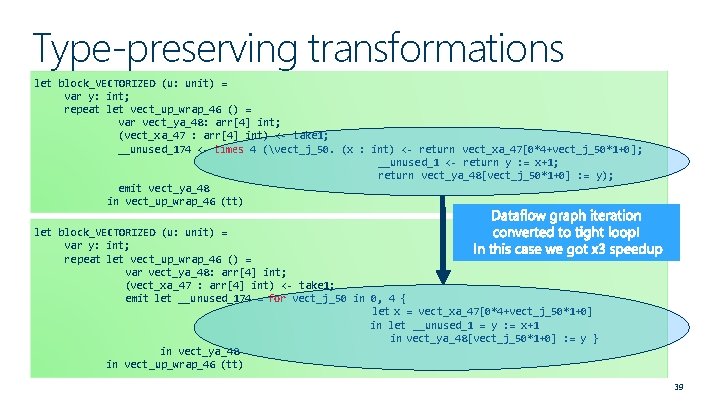
Type-preserving transformations let block_VECTORIZED (u: unit) = var y: int; repeat let vect_up_wrap_46 () = var vect_ya_48: arr[4] int; (vect_xa_47 : arr[4] int) <- take 1; __unused_174 <- times 4 (vect_j_50. (x : int) <- return vect_xa_47[0*4+vect_j_50*1+0]; __unused_1 <- return y : = x+1; return vect_ya_48[vect_j_50*1+0] : = y); emit vect_ya_48 in vect_up_wrap_46 (tt) let block_VECTORIZED (u: unit) = var y: int; repeat let vect_up_wrap_46 () = var vect_ya_48: arr[4] int; (vect_xa_47 : arr[4] int) <- take 1; emit let __unused_174 = for vect_j_50 in 0, 4 { let x = vect_xa_47[0*4+vect_j_50*1+0] in let __unused_1 = y : = x+1 in vect_ya_48[vect_j_50*1+0] : = y } in vect_ya_48 in vect_up_wrap_46 (tt) 39
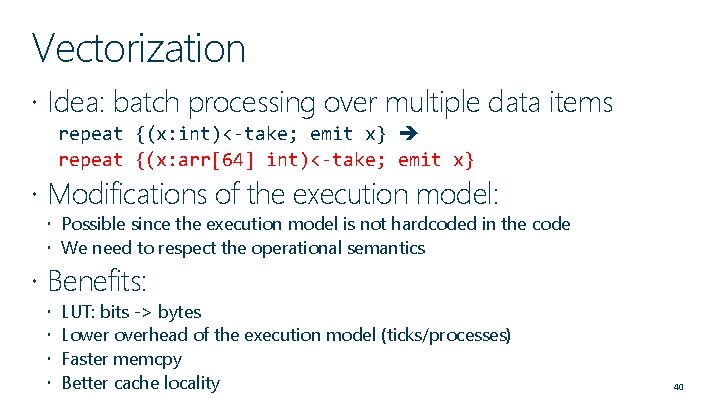
Vectorization Idea: batch processing over multiple data items repeat {(x: int)<-take; emit x} repeat {(x: arr[64] int)<-take; emit x} Modifications of the execution model: Possible since the execution model is not hardcoded in the code We need to respect the operational semantics Benefits: LUT: bits -> bytes Lower overhead of the execution model (ticks/processes) Faster memcpy Better cache locality 40
Vectorization Challenges Len Parse Header (Len, Rate) If rate == 6 Mbps Len CRC scrambler ½ encoder ¾ encoder interleaver BPSK 64 QAM 24 bit 41
LUT Optimizations (by example) let comp scrambler() = var scrmbl_st: arr[7] bit : = {'1, '1, '1, '1}; var tmp, y: bit; repeat { (x: bit) <- take; do { tmp : = (scrmbl_st[3] ^ scrmbl_st[0]); scrmbl_st[0: 5] : = scrmbl_st[1: 6]; scrmbl_st[6] : = tmp; y : = x ^ tmp }; emit (y) } let comp v_scrambler () = var scrmbl_st: arr[7] bit : = {'1, '1, '1, '1}; var tmp, y: bit; var vect_ya_26: arr[8] bit; let auto_map_71(vect_xa_25: arr[8] bit) = LUT for vect_j_28 in 0, 8 { vect_ya_26[vect_j_28] : = tmp : = scrmbl_st[3]^scrmbl_st[0]; scrmbl_st[0: +6] : = scrmbl_st[1: +6]; scrmbl_st[6] : = tmp; y : = vect_xa_25[0*8+vect_j_28]^tmp; return y }; return vect_ya_26 in map auto_map_71 42
Supporting different HW architectures Work in progress… SMP vs FPGA vs ASIC Pipeline and data parallelism SIMD, coprocessors (DSP or ASIC) 43
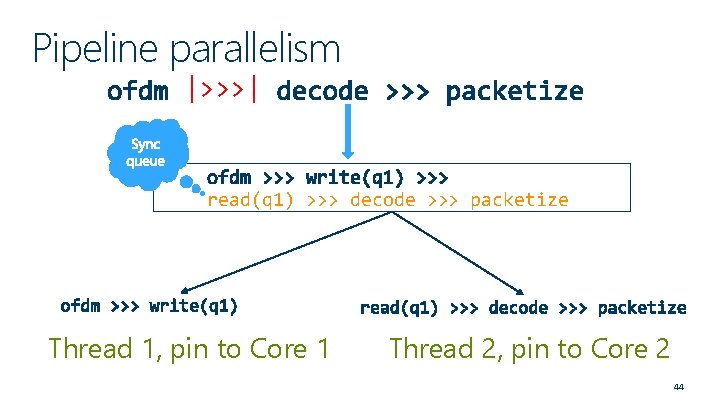
Pipeline parallelism |>>>| read(q 1) >>> decode >>> packetize Thread 1, pin to Core 1 Thread 2, pin to Core 2 44
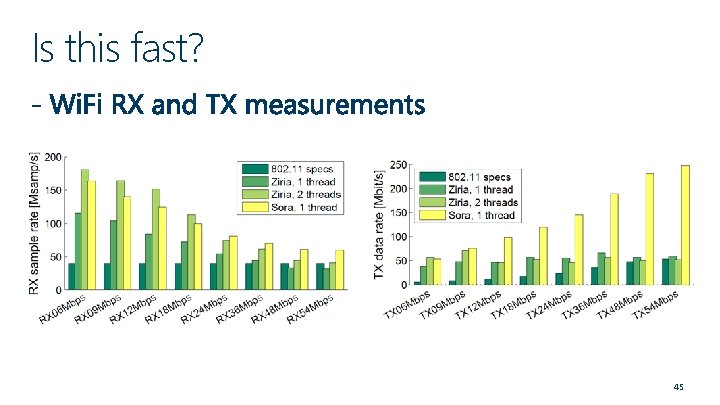
Is this fast? 45
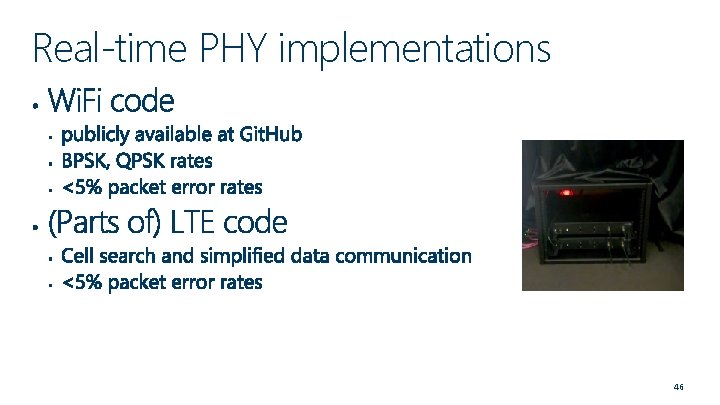
Real-time PHY implementations 46
Status Released to Git. Hub under Apache 2. 0 https: //github. com/dimitriv/Ziria Wi. Fi implementation included in release Currently supports SORA platform Essential dependency on CPU/SIMD Looking into porting to other CPU-based SDRs 47
Conclusions More wireless innovations will happen at intersections of PHY and MAC levels We need prototypes and test-beds to evaluate ideas PHY programming in its infancy Difficult, limited portability and scalability Steep learning curve, difficult to compare and extend previous works Wireless programming is easy and fun – go for it! http: //research. microsoft. com/en-us/projects/ziria/ 48
Thank you! http: //research. microsoft. com/en-us/projects/ziria/ https: //github. com/dimitriv/Ziria