
Zina OLeary 2009 The Essential Guide to Doing

- Slides: 26
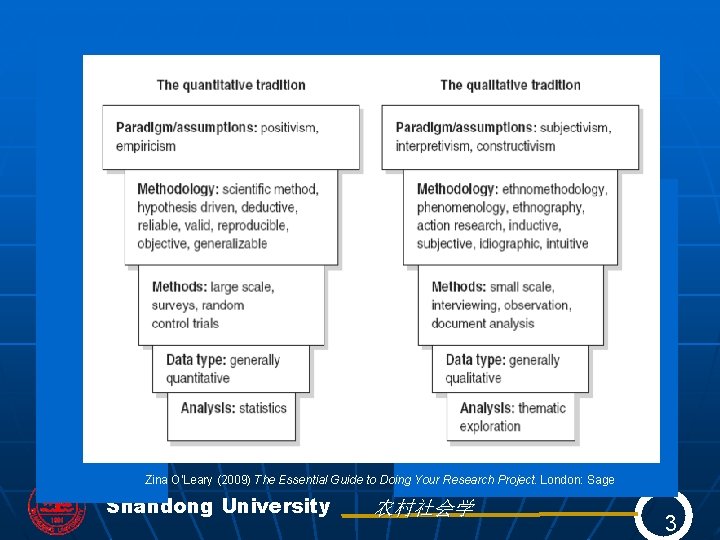
Zina O’Leary (2009) The Essential Guide to Doing Your Research Project. London: Sage Shandong University 农村社会学 3
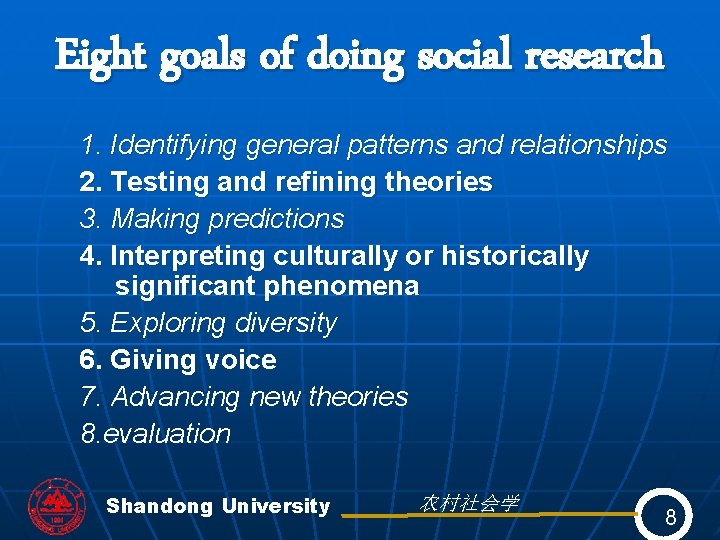
Eight goals of doing social research 1. Identifying general patterns and relationships 2. Testing and refining theories 3. Making predictions 4. Interpreting culturally or historically significant phenomena 5. Exploring diversity 6. Giving voice 7. Advancing new theories 8. evaluation Shandong University 农村社会学 8
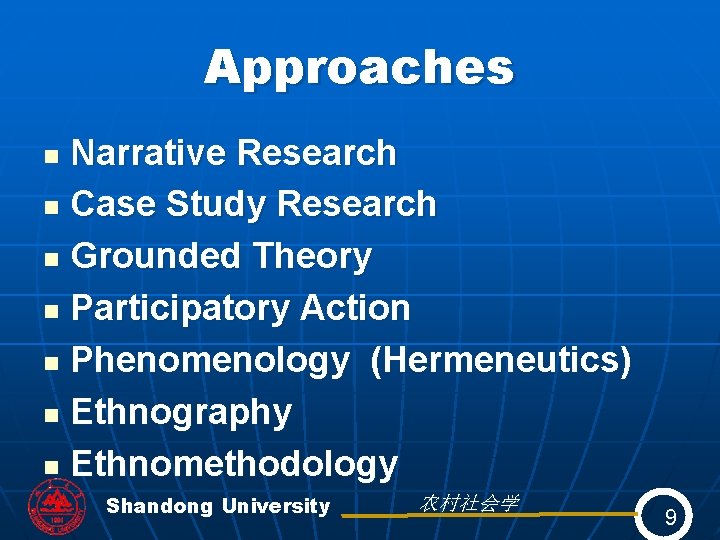
Approaches Narrative Research n Case Study Research n Grounded Theory n Participatory Action n Phenomenology (Hermeneutics) n Ethnography n Ethnomethodology n Shandong University 农村社会学 9
Ethnography n n n Roots are in anthropology Describing of CULTURE Historically, researcher went off to some ‘strange’ culture to observe and write; Participant/observation – immersion into culture over a period of time Contextual, thick description Purpose: To explore or describe certain some social phenomenon as cultural practice Shandong University 农村社会学 10
Grounded Theory n Roots in sociology (symbolic interactionsim) • Names affiliated with GT: Glasser, Strauss, A. , Charmaz, Corbin Explore social processes, actions or interactions in order to understand how they operate n Purpose is to generate a substantive theory or explain a process n Shandong University 农村社会学 11
Phenomenology n n Roots are in philosophy Two basic branches: • Husserl (essence or essential meaning) • Heiddeger (Hermeneutics or interpretive) n n Focus is on describing meaning of lived experience Iterative process (重复逼近法)of moving between the parts and the whole in order to understand Shandong University 农村社会学 12
Narrative Research n n Different definitions and ways of understanding Different roots in humanism, social psychology, linguistics… “narrative is understood as a spoken or written text giving an account of an event/action or series of events/actions, chronologically(按年代 地) connected” (Creswell et al (2007) Purpose is to collect stories to understand • • Biography (one individual) Autobiography (self) Life Histories Personal Experience Stories Shandong University 农村社会学 13
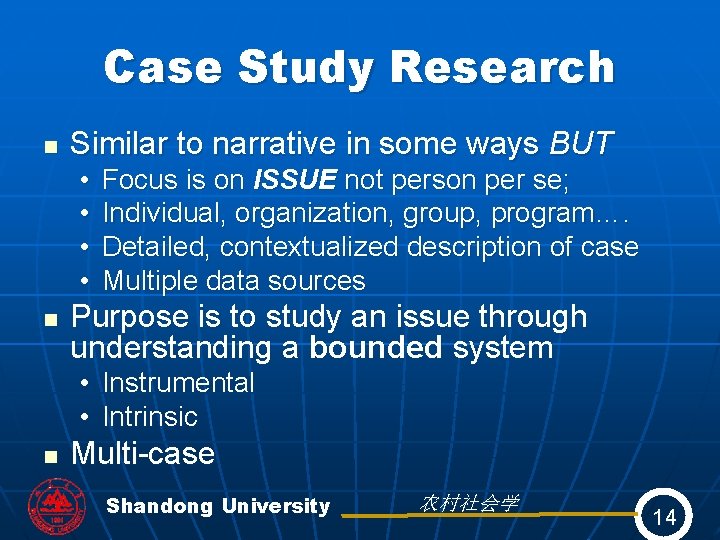
Case Study Research n Similar to narrative in some ways BUT • • n Focus is on ISSUE not person per se; Individual, organization, group, program…. Detailed, contextualized description of case Multiple data sources Purpose is to study an issue through understanding a bounded system • Instrumental • Intrinsic n Multi-case Shandong University 农村社会学 14
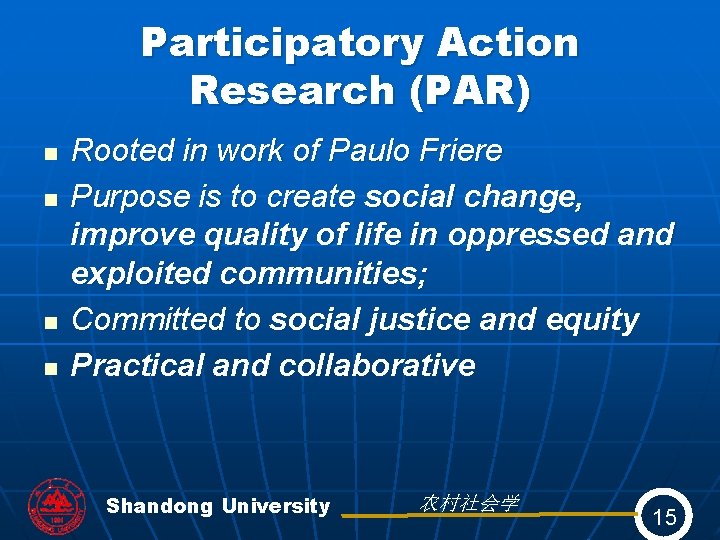
Participatory Action Research (PAR) n n Rooted in work of Paulo Friere Purpose is to create social change, improve quality of life in oppressed and exploited communities; Committed to social justice and equity Practical and collaborative Shandong University 农村社会学 15
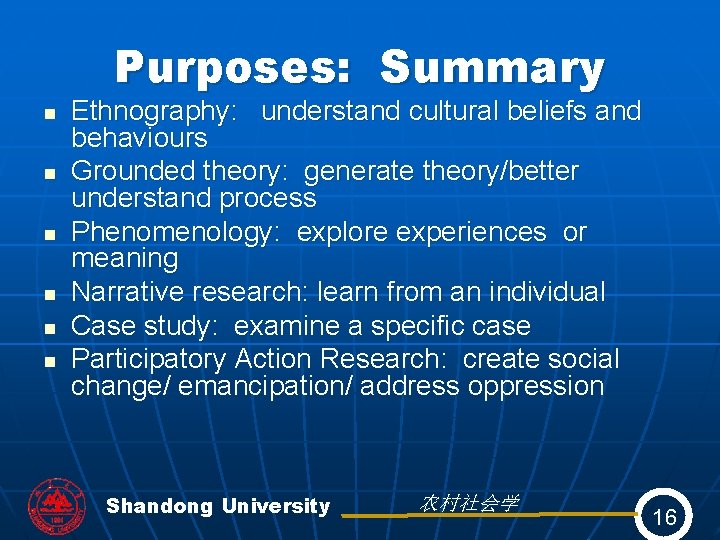
Purposes: Summary n n n Ethnography: understand cultural beliefs and behaviours Grounded theory: generate theory/better understand process Phenomenology: explore experiences or meaning Narrative research: learn from an individual Case study: examine a specific case Participatory Action Research: create social change/ emancipation/ address oppression Shandong University 农村社会学 16
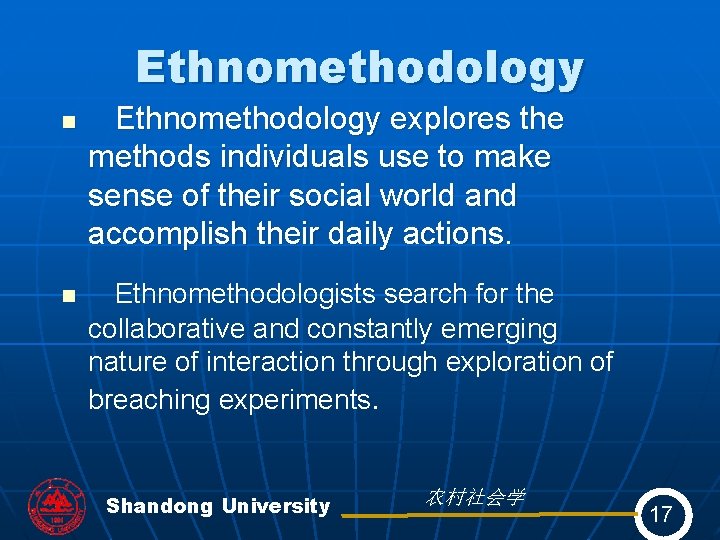
Ethnomethodology n n Ethnomethodology explores the methods individuals use to make sense of their social world and accomplish their daily actions. Ethnomethodologists search for the collaborative and constantly emerging nature of interaction through exploration of breaching experiments. Shandong University 农村社会学 17
Ethnomethodology n • • n Ethnomethodology: recognizes the interpretative work of the individual offers a method for exploring ‘how’ questions allows comparisons of divergent cultural norms and allows exploration of specific forms of interaction. However, it can be critiqued for not addressing ‘significant’ questions, and being too focused on verbal aspects of communication. Shandong University 农村社会学 18
Feminist Approaches n n While not a distinct methodology, feminist research is premised on the belief that traditional ‘rules’ of research are imbued with unacknowledged and unaddressed male bias. Feminist researchers argue that research should be committed to: • • • the empowerment of women overcoming inequity diverse representation of humanity empowerment of marginalized voices lessening the distinction between researcher and researched • searching for multiple, subjective and partial truths. Shandong University 农村社会学 19
Interviewing n n Most common way of generating data in qualitative research; Addresses some of the limitations associated with simply observing including; • Allows structured questioning about observations, emerging understanding; • Access to participant’s perspectives; n n Variety of formats: Individual, Focus group, family… In qualitative research often described as a “conversation with a purpose” Shandong University 农村社会学 20
Core Features of Qualitative Research interviews n n n In-depth, loosely structured; Interactional exchange or dialogue; Relatively informal style; Thematic, topic-centered type of approach; Recognizes that knowledge is situated and it is interviewers job to ensure that the relevant contexts are brought into focus; Relies upon an ‘interview guide’ used flexibly, rather than structured questions. Shandong University 农村社会学 21
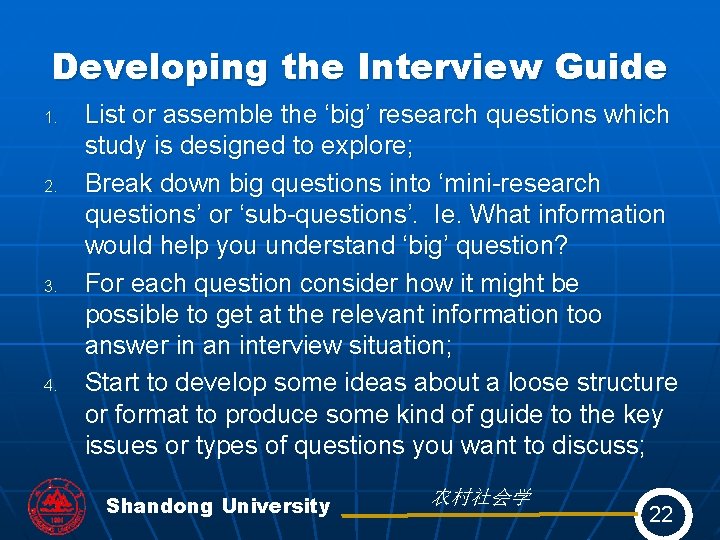
Developing the Interview Guide 1. 2. 3. 4. List or assemble the ‘big’ research questions which study is designed to explore; Break down big questions into ‘mini-research questions’ or ‘sub-questions’. Ie. What information would help you understand ‘big’ question? For each question consider how it might be possible to get at the relevant information too answer in an interview situation; Start to develop some ideas about a loose structure or format to produce some kind of guide to the key issues or types of questions you want to discuss; Shandong University 农村社会学 22
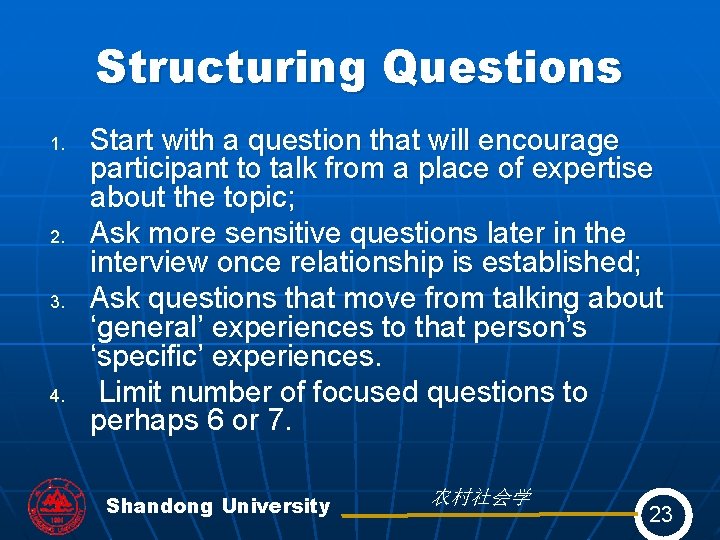
Structuring Questions 1. 2. 3. 4. Start with a question that will encourage participant to talk from a place of expertise about the topic; Ask more sensitive questions later in the interview once relationship is established; Ask questions that move from talking about ‘general’ experiences to that person’s ‘specific’ experiences. Limit number of focused questions to perhaps 6 or 7. Shandong University 农村社会学 23
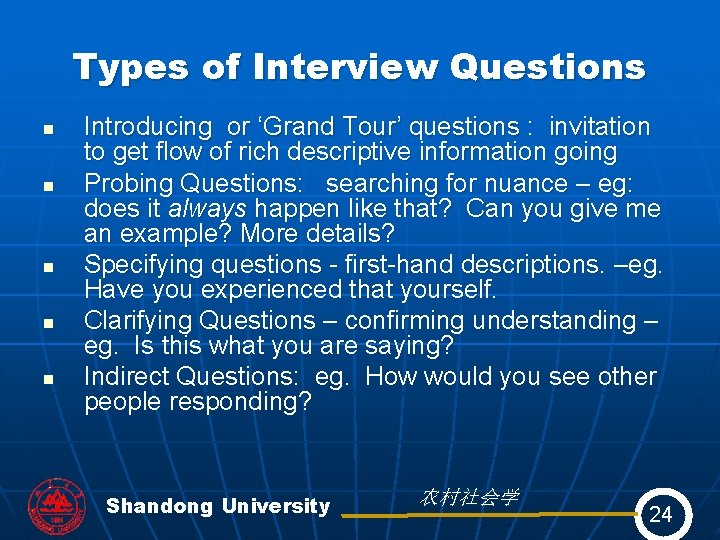
Types of Interview Questions n n n Introducing or ‘Grand Tour’ questions : invitation to get flow of rich descriptive information going Probing Questions: searching for nuance – eg: does it always happen like that? Can you give me an example? More details? Specifying questions - first-hand descriptions. –eg. Have you experienced that yourself. Clarifying Questions – confirming understanding – eg. Is this what you are saying? Indirect Questions: eg. How would you see other people responding? Shandong University 农村社会学 24
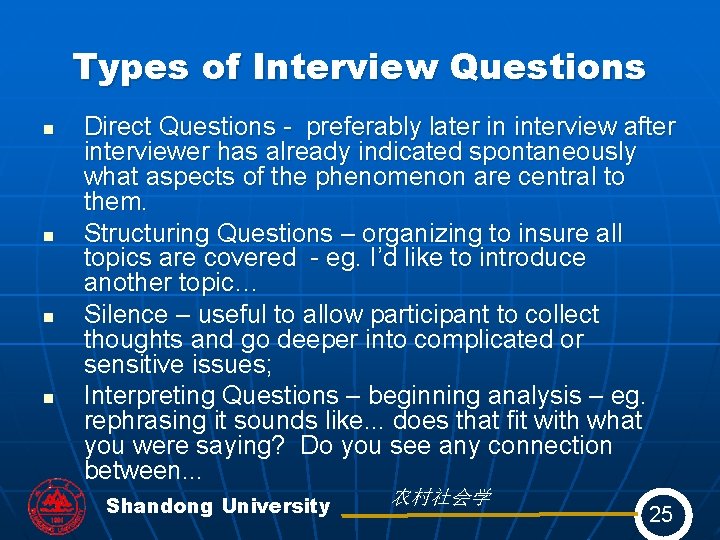
Types of Interview Questions n n Direct Questions - preferably later in interview after interviewer has already indicated spontaneously what aspects of the phenomenon are central to them. Structuring Questions – organizing to insure all topics are covered - eg. I’d like to introduce another topic… Silence – useful to allow participant to collect thoughts and go deeper into complicated or sensitive issues; Interpreting Questions – beginning analysis – eg. rephrasing it sounds like. . . does that fit with what you were saying? Do you see any connection between. . . Shandong University 农村社会学 25