
ZIMBABWE PRESENTATION TO THE FORUM FOR AFRICAN WOMEN
ZIMBABWE PRESENTATION TO THE FORUM FOR AFRICAN WOMEN EDUCATIONALIST (FAWE) CONFERENCE ON GIRLS EDUCATION IN AFRICA AND 10 th GENERAL ASSEMBLY, LUSAKA, ZAMBIA 23 -25 AUGUST 2017 Hon. Dr. L. D. K. Dokora (M. P) Minister of Primary and Secondary Education
Summary 2 Background to provision of education Barriers to Education for girls and young women Legal provisions for addressing gender disparities Some policies and programmes to promoting Quality Education Government expenditure on Education Measures to address Gender Disparities in education Basic education Gender Parity Index Current and ongoing initiatives to promote quality education Conclusion Hon. Dr. L. D. K. Dokora (M. P. )- Zimbabwe 10/3/2020
3 Background Pre-colonial education Colonial Education -Two tier system of education Education for whites compulsory and received 20 times more on budget allocation compared to that of blacks. At attainment of majority rule the Government adopted a socialist principle: ‘Growth with equity’ to redress the inequalities in access to education. Primary Education: 1980, the proportion of female students in primary schools was 47. 6% compared to 52. 4% per cent males by 1999 near parity had been achieved, females in primary at 49. 1% and that of males stood at 50. 9% a move towards parity. Secondary Education: 1980, about 43. 3% of students were females and 56. 7 per cent were males by 1999, the proportion of females had increased to 46. 9% and that of males stood at 53. 1% Hon. Dr. L. D. K. Dokora (M. P. )- Zimbabwe 10/3/2020
4 Background (Ctd) First decade - the number of primary schools increased from 2, 401 in 1979 to 4, 504 in 1989, a 87. 6% increase and primary school enrolment showed a 177. 5% increase from 819, 586 to 2, 274, 178 during the same period. The number of secondary schools increased from 177 in 1979 to 1502 in 1989, an increase of 748. 6% and secondary school enrolment increased from 66, 215 to 695, 882 a 950. 9% increase. The government took steps, such as a rapid increase in public spending on education from 4. 4% of recurrent public expenditures in 1979 -80 to 22. 6% by 1989. The country is a major source of human resources in Southern Africa and today Zimbabwe has thousands of teachers, engineers, doctors, nurses, and other professionals working in neighbouring countries and overseas. Hon. Dr. L. D. K. Dokora (M. P. )- Zimbabwe 10/3/2020
5 Barriers to Education for girls and young women Discriminatory cultural and patriarchal beliefs and practices favouring boys and young men at the expense of girls/young women. Gender stereotyping deterring effective participation of girls and young women in non-traditional scientific, mathematical and technical disciplines in secondary and tertiary levels. Early unplanned pregnancy leads to girls prematurely dropping out of school. According to Zimbabwe Demographic and Health Survey (DHS) 2015 report 7, 24% of girls/ young women began child bearing in their teens (15 -19 years). Whilst in 1999 Go. Z adopted a policy whereby pregnant girls could be readmitted in formal schools after delivery, challenges with stigmatisation and the motherhood responsibilities, affects the re-enrolment of young mothers in formal schools. Hon. Dr. L. D. K. Dokora (M. P. )- Zimbabwe 10/3/2020
Barriers (ctd) 6 Harmful religious and traditional practices forcing early marriages on girls and young women. According to a Demographic and Health Survey 2015 report, 21. 7% of girls/ young women were married during age group 15 -19 years whilst 63. 1% got married during the period 20 -24 age group. Long distances and inadequate learning materials and facilities for secondary education, particularly in rural locations, constitute a major barrier to further education beyond primary level. Transition rate from primary to secondary school 2015 to 2016 now in favour of girls; now at 81. 2% for girls while at 80. 3% for boys. In some areas, some secondary school girls have found/established temporary shelters close to secondary schools in their districts. The temporary shelters further expose the girls to sexual abuse. Poverty is a major barrier to females attaining education. When resources are scarce, girls are the first to be taken out of school, often because they are considered to have an option to get married. Hon. Dr. L. D. K. Dokora (M. P. )- Zimbabwe 10/3/2020
7 Legal provisions for addressing gender disparities Legislation and Policies The Constitution of Zimbabwe (2013) has elaborate provisions on gender equality and women empowerment. National Gender Policy (2004 updated in 2013) Zimbabwe Gender Commission Act (Chapter 10: 31) of 12 February 2016 The Constitutional Court Ruling on ending Child Marriages was made on the 20 th January 2016 -a very significant judgment for children, in particular for girl children. International and Regional q Convention on the Elimination of all forms of Discrimination Against Women (CEDAW) effective adopted by the UN Generally Assembly on 18 December 1979 q Beijing Platform for Action (BPf. A) of 15 September 1995 q African Charter on the Rights of Women of June 1995 q Southern African Development Community Protocol on Gender and Development. (2008) Hon. Dr. L. D. K. Dokora (M. P. )- Zimbabwe 10/3/2020
8 Some policies and programmes to promote Quality Education The National Action Plan for Orphans and Vulnerable Children (NAP for OVC) in which education constitutes the largest component in terms of resource allocation (Phase 1; 2004 -2010 and Phase 2; 2011 -205) (Mo. LSS) The National Strategic Plan for the Education of Girls and other Vulnerable Children, which was formulated to address gender disparity in education including gender based violence in schools, launched in 2006. BEAM as for the education assistance of orphans, the poor and other vulnerable children as mitigation measure following ESAP (under Mo. LSS) The Presidential Schools Computerization Programme which works within the context of the rural electrification programme was introduced to ensure that rural children are computer literate. The Education Amendment Act 2006 which was enacted to regulate the (national) school fees and levy system. Update- current Act under review incorporate the non exclusion of children Hon. Dr. L. D. K. Dokora (M. P. )- Zimbabwe 10/3/2020
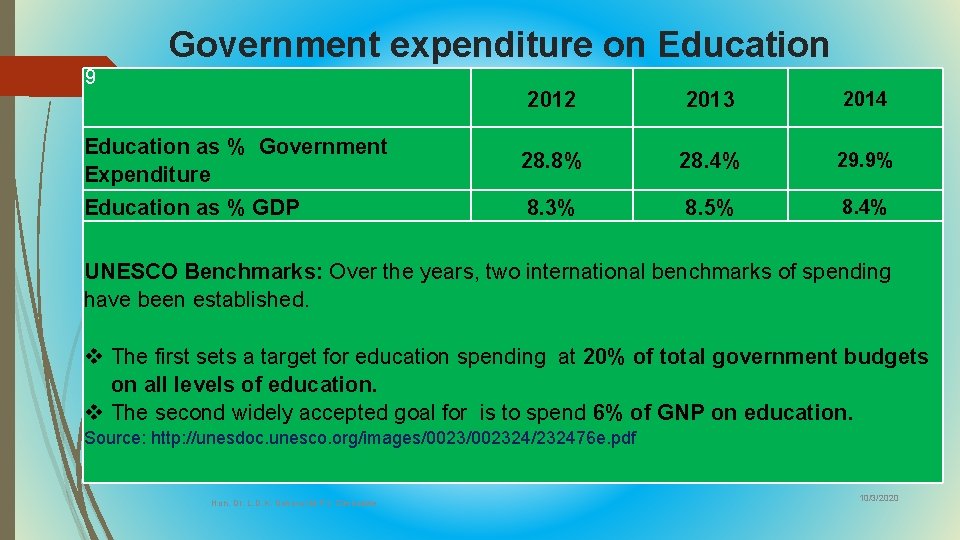
Government expenditure on Education 9 Education as % Government Expenditure Education as % GDP 2012 2013 2014 28. 8% 28. 4% 29. 9% 8. 3% 8. 5% 8. 4% UNESCO Benchmarks: Over the years, two international benchmarks of spending have been established. v The first sets a target for education spending at 20% of total government budgets on all levels of education. v The second widely accepted goal for is to spend 6% of GNP on education. Source: http: //unesdoc. unesco. org/images/002324/232476 e. pdf Hon. Dr. L. D. K. Dokora (M. P. )- Zimbabwe 10/3/2020
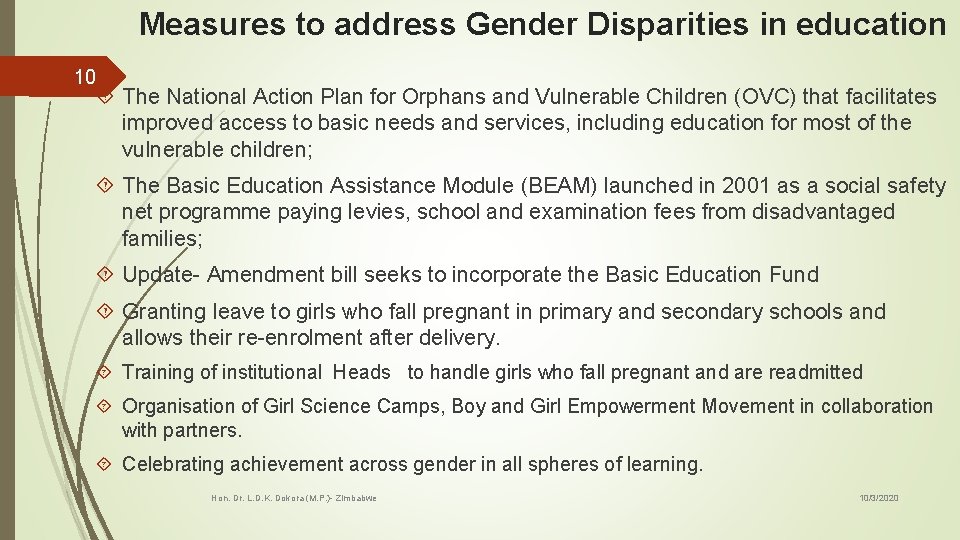
Measures to address Gender Disparities in education 10 The National Action Plan for Orphans and Vulnerable Children (OVC) that facilitates improved access to basic needs and services, including education for most of the vulnerable children; The Basic Education Assistance Module (BEAM) launched in 2001 as a social safety net programme paying levies, school and examination fees from disadvantaged families; Update- Amendment bill seeks to incorporate the Basic Education Fund Granting leave to girls who fall pregnant in primary and secondary schools and allows their re-enrolment after delivery. Training of institutional Heads to handle girls who fall pregnant and are readmitted Organisation of Girl Science Camps, Boy and Girl Empowerment Movement in collaboration with partners. Celebrating achievement across gender in all spheres of learning. Hon. Dr. L. D. K. Dokora (M. P. )- Zimbabwe 10/3/2020
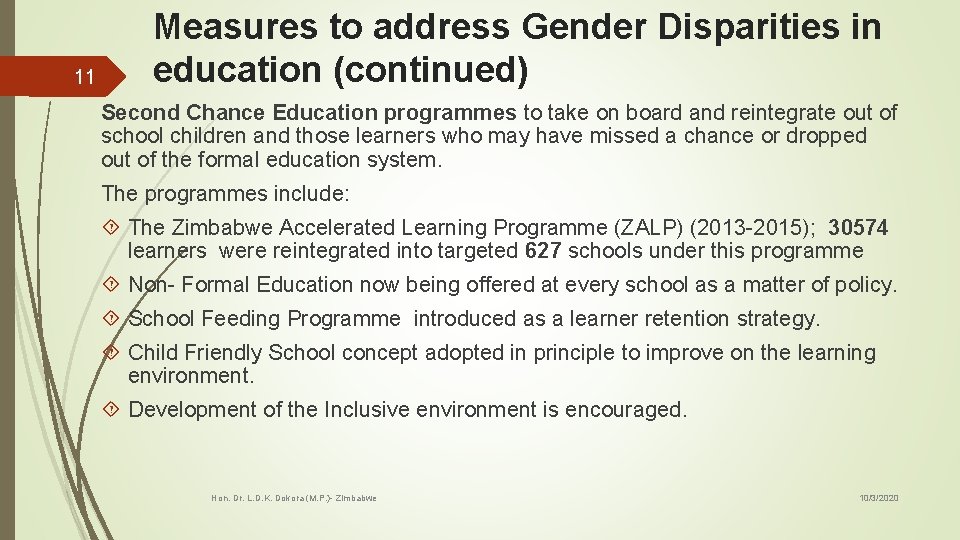
11 Measures to address Gender Disparities in education (continued) Second Chance Education programmes to take on board and reintegrate out of school children and those learners who may have missed a chance or dropped out of the formal education system. The programmes include: The Zimbabwe Accelerated Learning Programme (ZALP) (2013 -2015); 30574 learners were reintegrated into targeted 627 schools under this programme Non- Formal Education now being offered at every school as a matter of policy. School Feeding Programme introduced as a learner retention strategy. Child Friendly School concept adopted in principle to improve on the learning environment. Development of the Inclusive environment is encouraged. Hon. Dr. L. D. K. Dokora (M. P. )- Zimbabwe 10/3/2020
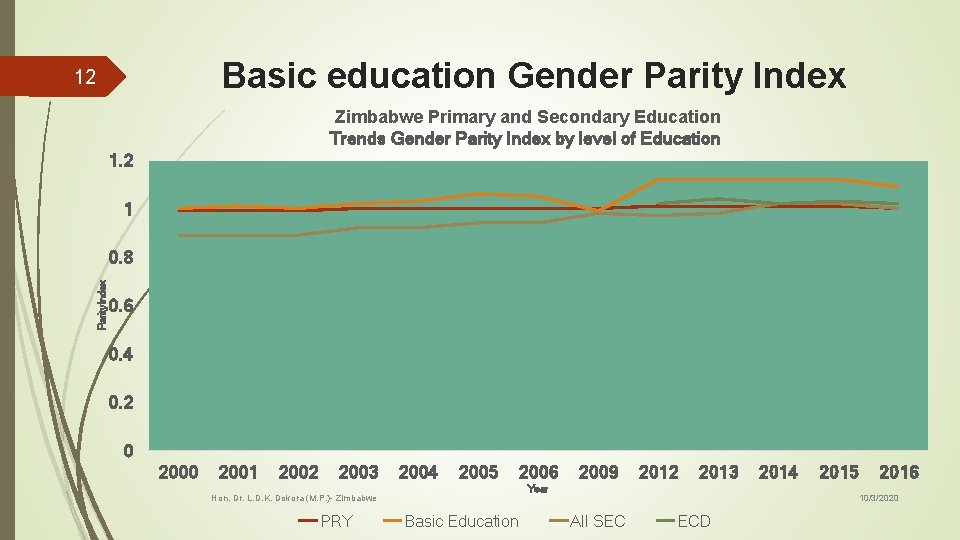
Basic education Gender Parity Index 12 Zimbabwe Primary and Secondary Education Trends Gender Parity Index by level of Education 1. 2 1 Parity. Index 0. 8 0. 6 0. 4 0. 2 0 2001 2002 2003 2004 2005 2009 2012 2013 Year Hon. Dr. L. D. K. Dokora (M. P. )- Zimbabwe PRY 2006 Basic Education 2014 2015 2016 10/3/2020 All SEC ECD
13 Current Education Initiatives New curriculum whose 5 pillars are: The Legal and Regulatory framework; Teacher Capacity Development; Teacher Professional Standards; Infrastructure development, and; The centre for education research, Innovation and Development (CERID). All 5 are inter-related and speak to each other. Hon. Dr. L. D. K. Dokora (M. P. )- Zimbabwe 10/3/2020
14 Current Initiatives Continued The teacher is at the centre of provision of quality education. Teacher Capacity Development anchored on the need to equip teachers with 21 th Century proficiency skills which will lead to quality education. Development of Teacher Professional Standards is a key driver to the new curriculum as the indication is to have skilled, proficient and qualified cadres who have to deliver twenty first century skills to learners. The teaching professional standards will lead to the establishment of a Teaching Professions Council which is to regulate the conduct of teachers. There is need to inculcate the dignity of the teacher through provision of institutionalized housing for teachers. Introduction of indigenous languages in the new curriculum Hon. Dr. L. D. K. Dokora (M. P. )- Zimbabwe 10/3/2020
15 Conclusion The following organisations are acknowledged for their support in initiatives that have been aimed at improving equity and reducing disparities: FAWEZI UNICEF UNESCO UNFPA CAMFED THANK YOU/Asante sana/TWALUMBA LOKO/ TOTELA/ZIKOMO KWAMBILI Hon. Dr. L. D. K. Dokora (M. P. )- Zimbabwe 10/3/2020
- Slides: 15