
ZIKAVIRUS City of Ennis Department of Health Services
- Slides: 12
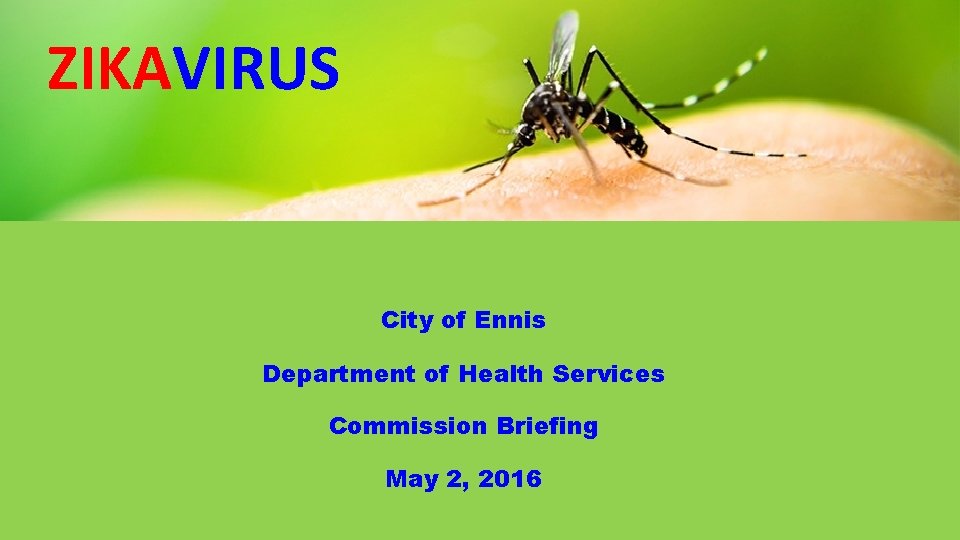
ZIKAVIRUS City of Ennis Department of Health Services Commission Briefing May 2, 2016
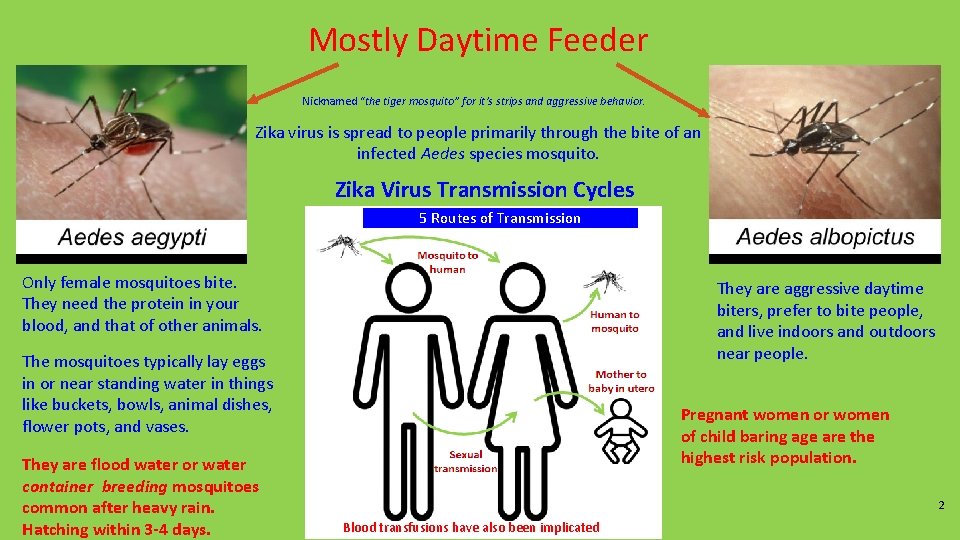
Mostly Daytime Feeder Nicknamed “the tiger mosquito” for it’s strips and aggressive behavior. Zika virus is spread to people primarily through the bite of an infected Aedes species mosquito. Zika Virus Transmission Cycles 5 Routes of Transmission Only female mosquitoes bite. They need the protein in your blood, and that of other animals. They are aggressive daytime biters, prefer to bite people, and live indoors and outdoors near people. The mosquitoes typically lay eggs in or near standing water in things like buckets, bowls, animal dishes, flower pots, and vases. They are flood water or water container breeding mosquitoes common after heavy rain. Hatching within 3 -4 days. Pregnant women or women of child baring age are the highest risk population. 2 Blood transfusions have also been implicated
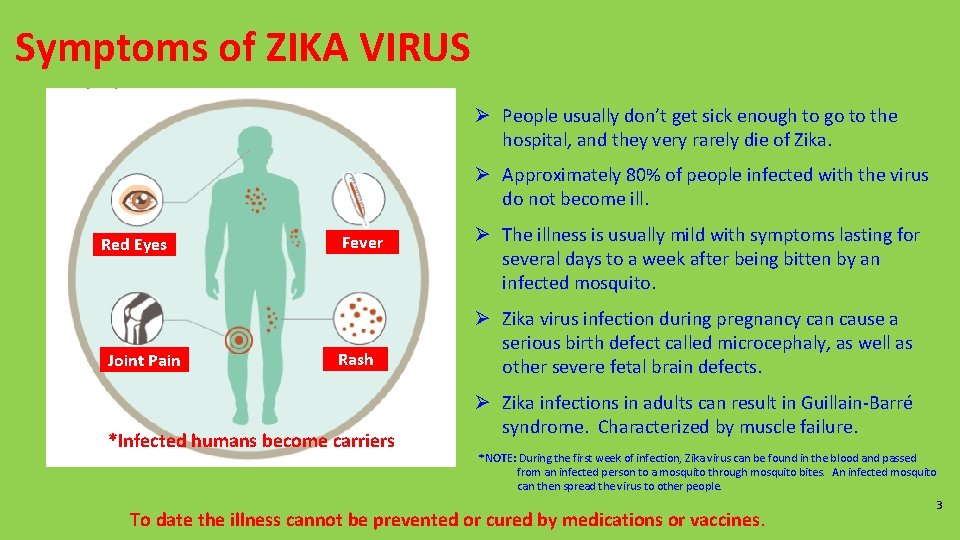
Symptoms of ZIKA VIRUS Ø People usually don’t get sick enough to go to the hospital, and they very rarely die of Zika. Ø Approximately 80% of people infected with the virus do not become ill. Red Eyes Joint Pain Fever Rash *Infected humans become carriers Ø The illness is usually mild with symptoms lasting for several days to a week after being bitten by an infected mosquito. Ø Zika virus infection during pregnancy can cause a serious birth defect called microcephaly, as well as other severe fetal brain defects. Ø Zika infections in adults can result in Guillain-Barré syndrome. Characterized by muscle failure. *NOTE: During the first week of infection, Zika virus can be found in the blood and passed from an infected person to a mosquito through mosquito bites. An infected mosquito can then spread the virus to other people. To date the illness cannot be prevented or cured by medications or vaccines. 3
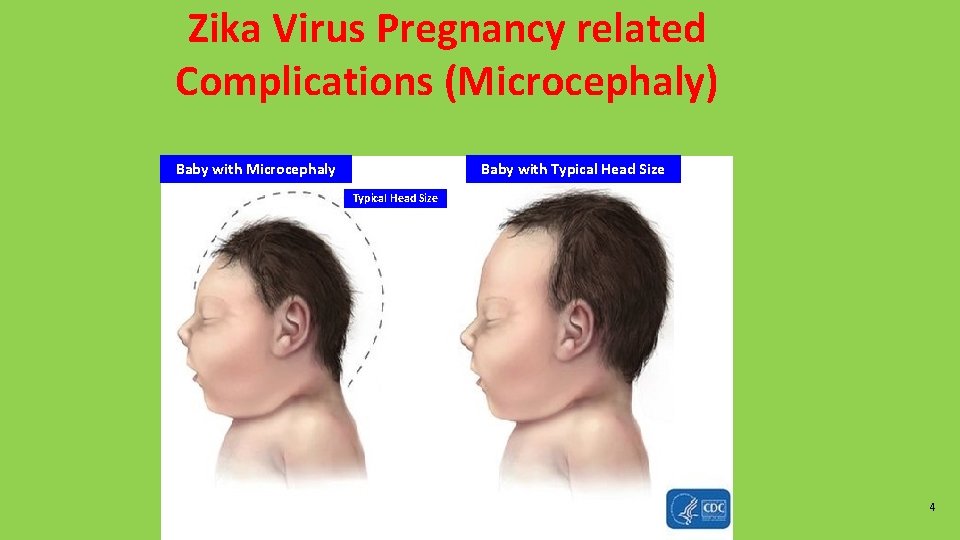
Zika Virus Pregnancy related Complications (Microcephaly) Baby with Typical Head Size Baby with Microcephaly Typical Head Size 4
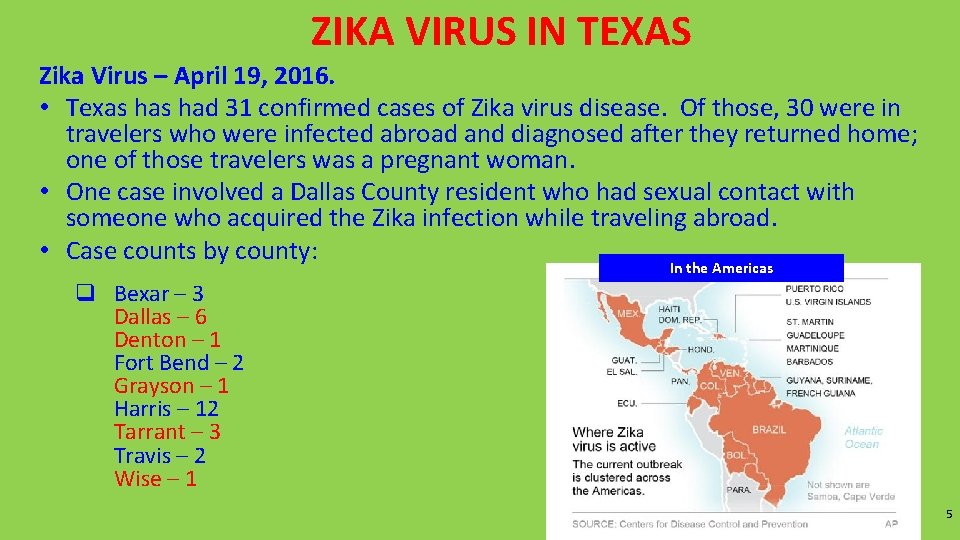
ZIKA VIRUS IN TEXAS Zika Virus – April 19, 2016. • Texas had 31 confirmed cases of Zika virus disease. Of those, 30 were in travelers who were infected abroad and diagnosed after they returned home; one of those travelers was a pregnant woman. • One case involved a Dallas County resident who had sexual contact with someone who acquired the Zika infection while traveling abroad. • Case counts by county: In the Americas q Bexar – 3 Dallas – 6 Denton – 1 Fort Bend – 2 Grayson – 1 Harris – 12 Tarrant – 3 Travis – 2 Wise – 1 5
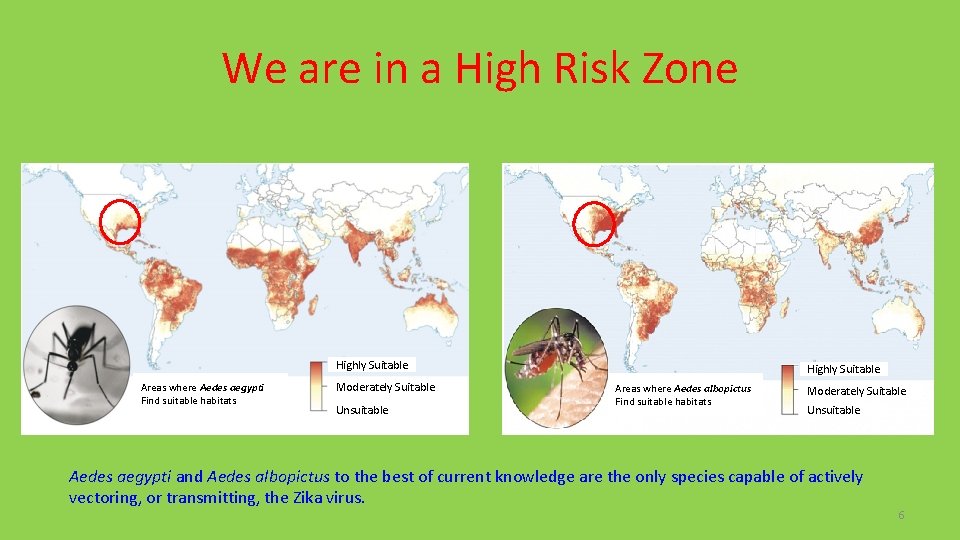
We are in a High Risk Zone Highly Suitable Areas where Aedes aegypti Find suitable habitats Moderately Suitable Unsuitable Highly Suitable Areas where Aedes albopictus Find suitable habitats Moderately Suitable Unsuitable Aedes aegypti and Aedes albopictus to the best of current knowledge are the only species capable of actively vectoring, or transmitting, the Zika virus. 6
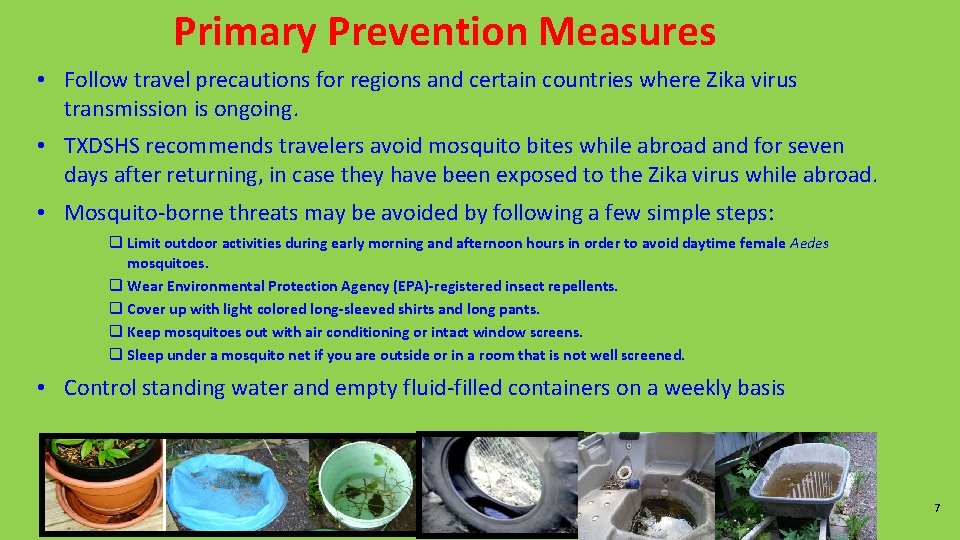
Primary Prevention Measures • Follow travel precautions for regions and certain countries where Zika virus transmission is ongoing. • TXDSHS recommends travelers avoid mosquito bites while abroad and for seven days after returning, in case they have been exposed to the Zika virus while abroad. • Mosquito-borne threats may be avoided by following a few simple steps: q Limit outdoor activities during early morning and afternoon hours in order to avoid daytime female Aedes mosquitoes. q Wear Environmental Protection Agency (EPA)-registered insect repellents. q Cover up with light colored long-sleeved shirts and long pants. q Keep mosquitoes out with air conditioning or intact window screens. q Sleep under a mosquito net if you are outside or in a room that is not well screened. • Control standing water and empty fluid-filled containers on a weekly basis 7
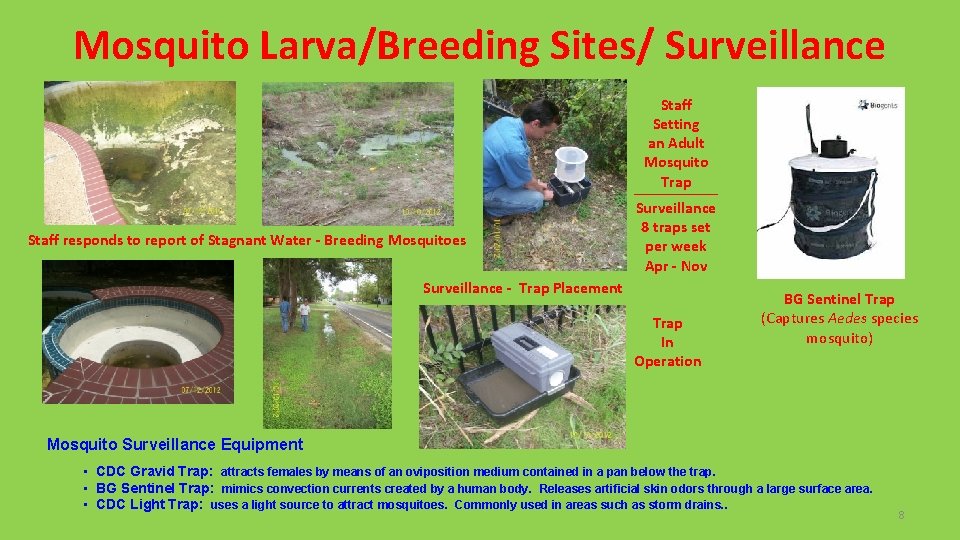
Mosquito Larva/Breeding Sites/ Surveillance Staff Setting an Adult Mosquito Trap Staff responds to report of Stagnant Water - Breeding Mosquitoes Surveillance 8 traps set per week Apr - Nov Surveillance - Trap Placement Trap In Operation BG Sentinel Trap (Captures Aedes species mosquito) Mosquito Surveillance Equipment • CDC Gravid Trap: attracts females by means of an oviposition medium contained in a pan below the trap. • BG Sentinel Trap: mimics convection currents created by a human body. Releases artificial skin odors through a large surface area. • CDC Light Trap: uses a light source to attract mosquitoes. Commonly used in areas such as storm drains. . 8
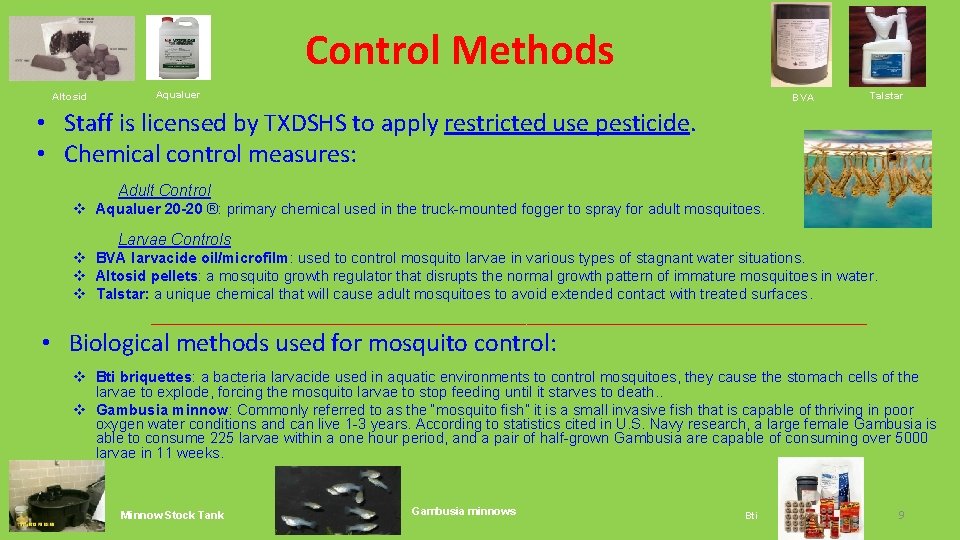
Control Methods Altosid Aqualuer BVA Talstar • Staff is licensed by TXDSHS to apply restricted use pesticide. • Chemical control measures: Adult Control v Aqualuer 20 -20 ®: primary chemical used in the truck-mounted fogger to spray for adult mosquitoes. Larvae Controls v BVA larvacide oil/microfilm: used to control mosquito larvae in various types of stagnant water situations. v Altosid pellets: a mosquito growth regulator that disrupts the normal growth pattern of immature mosquitoes in water. v Talstar: a unique chemical that will cause adult mosquitoes to avoid extended contact with treated surfaces. ________________________________________________________________________ • Biological methods used for mosquito control: v Bti briquettes: a bacteria larvacide used in aquatic environments to control mosquitoes, they cause the stomach cells of the larvae to explode, forcing the mosquito larvae to stop feeding until it starves to death. . v Gambusia minnow: Commonly referred to as the “mosquito fish” it is a small invasive fish that is capable of thriving in poor oxygen water conditions and can live 1 -3 years. According to statistics cited in U. S. Navy research, a large female Gambusia is able to consume 225 larvae within a one hour period, and a pair of half-grown Gambusia are capable of consuming over 5000 larvae in 11 weeks. Minnow Stock Tank Gambusia minnows Bti 9
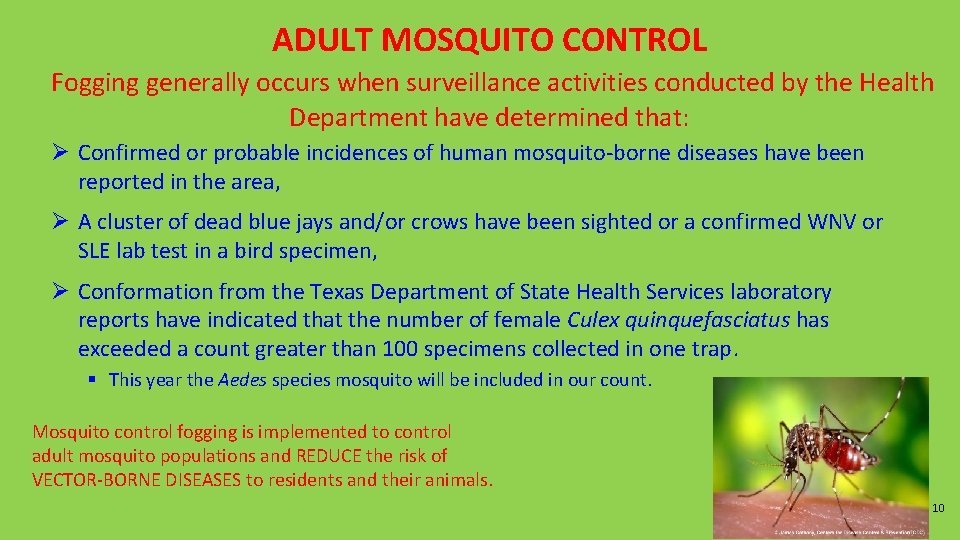
ADULT MOSQUITO CONTROL Fogging generally occurs when surveillance activities conducted by the Health Department have determined that: Ø Confirmed or probable incidences of human mosquito-borne diseases have been reported in the area, Ø A cluster of dead blue jays and/or crows have been sighted or a confirmed WNV or SLE lab test in a bird specimen, Ø Conformation from the Texas Department of State Health Services laboratory reports have indicated that the number of female Culex quinquefasciatus has exceeded a count greater than 100 specimens collected in one trap. § This year the Aedes species mosquito will be included in our count. Mosquito control fogging is implemented to control adult mosquito populations and REDUCE the risk of VECTOR-BORNE DISEASES to residents and their animals. 10
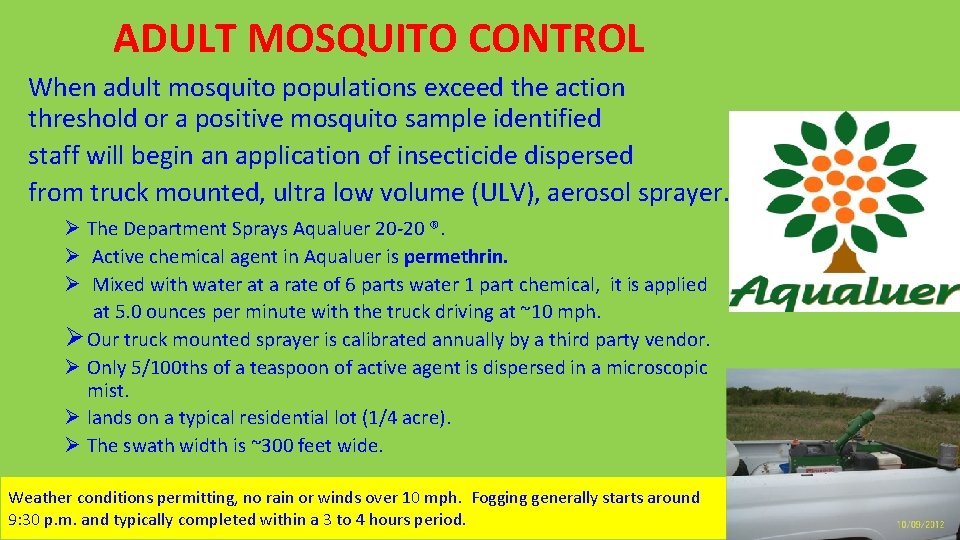
ADULT MOSQUITO CONTROL When adult mosquito populations exceed the action threshold or a positive mosquito sample identified staff will begin an application of insecticide dispersed from truck mounted, ultra low volume (ULV), aerosol sprayer. Ø The Department Sprays Aqualuer 20 -20 ®. Ø Active chemical agent in Aqualuer is permethrin. Ø Mixed with water at a rate of 6 parts water 1 part chemical, it is applied at 5. 0 ounces per minute with the truck driving at ~10 mph. Ø Our truck mounted sprayer is calibrated annually by a third party vendor. Ø Only 5/100 ths of a teaspoon of active agent is dispersed in a microscopic mist. Ø lands on a typical residential lot (1/4 acre). Ø The swath width is ~300 feet wide. Weather conditions permitting, no rain or winds over 10 mph. Fogging generally starts around 9: 30 p. m. and typically completed within a 3 to 4 hours period. 11
MOSQUITO CONTROL A SMALL BUT VITAL PROGRAM • 3 Health Generalist FTE and a 0. 5 FTE Park Department employee are assigned to program. • ~$7, 000 budget for operations. Chauncy Williams , Health Director 12